

The traditional approach to metabolic research often overlooks the intracellular signaling pathways that dictate fat oxidation and energy homeostasis at a foundational level. 5 amino 1mq represents a significant departure from systemic hormonal interventions by targeting the nicotinamide N-methyltransferase (NNMT) enzyme directly. Many researchers find themselves caught between the hyperbolic claims of consumer wellness blogs and the dense, often inaccessible data of peer-reviewed biochemistry. This lack of transparency regarding purity and batch-specific analytical data can compromise the integrity of any laboratory inquiry.
We understand that scientific progress relies on precision and verifiable standards rather than marketing flair. This technical overview provides a comprehensive reference for the molecular mechanism of 5-Amino-1MQ, detailing its role in modulating NAD+ flux and mitochondrial function. You'll gain a clear understanding of the NNMT pathway and the rigorous requirements for batch-verified sourcing that define high-integrity research. We will also examine current applications in cellular ageing and metabolic flux to ensure your laboratory has the objective data necessary for 2026 research standards. This commitment to transparency is essential as we work toward making better, normal through scientific integrity.
Key Takeaways
- Identify the specific role of 5 amino 1mq as a cell-permeable inhibitor of the NNMT enzyme within cytosolic metabolism.
- Analyze how modulating the NAD+ salvage pathway influences mitochondrial biogenesis and oxygen consumption rates in research models.
- Distinguish the intracellular mechanisms of small molecules from the systemic effects of incretin mimetics and triple agonists.
- Understand the analytical documentation required for laboratory inquiry, including the necessity of HPLC and Mass Spectrometry for purity verification.
- Establish rigorous sourcing standards to maintain scientific integrity and ensure consistent results in metabolic and neuroscience research.
Understanding 5-Amino-1MQ and NNMT Inhibition
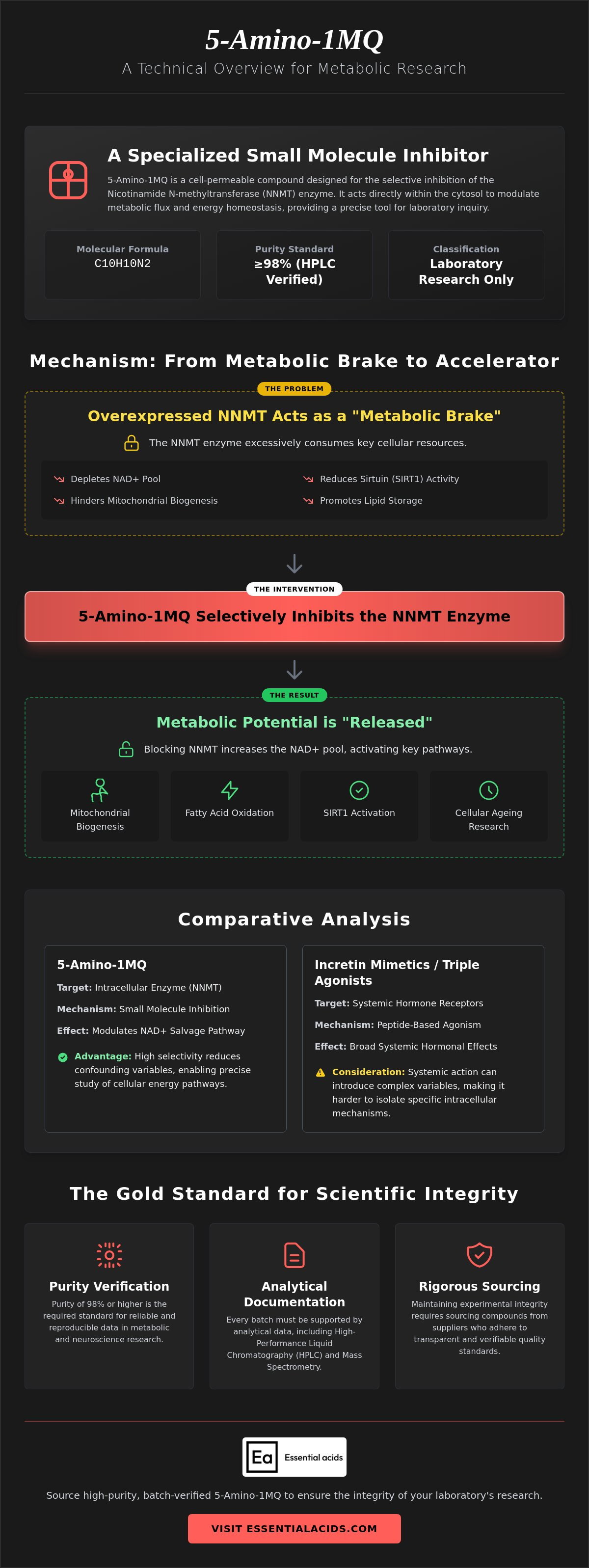
5-Amino-1MQ is a specialized small molecule designed for the selective inhibition of Nicotinamide N-methyltransferase (NNMT). Unlike peptide-based research compounds that consist of long amino acid chains, 5 amino 1mq is a cell-permeable derivative of aminoquinoline. It acts directly within the cytosol to modulate metabolic flux. This compound is strictly classified for laboratory research purposes and isn't intended for human or veterinary consumption. Maintaining this distinction is vital for regulatory compliance and the preservation of scientific integrity within the biochemical community.
The Molecular Structure of 5-Amino-1MQ
The molecular formula C10H10N2 defines the core framework of this compound. It's an aminoquinoline derivative, specifically identified as 1-methylquinolin-5-amine. In laboratory settings, researchers prioritize high-purity batches, typically requiring a purity of 98% or higher as verified by High-Performance Liquid Chromatography (HPLC). Its stability in common solvents like DMSO makes it a reliable candidate for in vitro assays. Researchers must account for its specific solubility profiles when designing experimental protocols to ensure consistent delivery to cellular models. Because it's a small molecule rather than a protein, it bypasses many of the stability issues associated with larger biological agents.
The Significance of NNMT in Metabolic Research
NNMT is a cytosolic enzyme that catalyzes the N-methylation of nicotinamide using S-adenosylmethionine (SAM) as the methyl donor. This process produces 1-methylnicotinamide (MNA) and S-adenosylhomocysteine (SAH). By regulating the SAM-to-SAH ratio, NNMT serves as a metabolic gatekeeper. Overexpression of this enzyme is frequently observed in animal models of metabolic dysfunction and reduced energy expenditure. Inhibiting this pathway allows researchers to investigate the subsequent increase in NAD+ levels and the activation of sirtuins, which are critical for mitochondrial biogenesis and cellular energy homeostasis. It's a high-interest target because it sits at the intersection of epigenetics and energy metabolism.
A primary advantage of 5 amino 1mq is its high selectivity. While other methyltransferase inhibitors may interact with a broad range of biological targets, this compound demonstrates a refined affinity for NNMT. This reduces the risk of confounding variables in complex metabolic signaling studies. It provides a precise tool for exploring cellular ageing and metabolic flux without the systemic interference common in multi-target compounds. All laboratory inquiry involving this molecule should be supported by batch-specific analytical data to confirm molecular weight and chemical integrity.
The Mechanism of Action in Metabolic Research Models
The primary mechanism of 5 amino 1mq involves the systematic preservation of nicotinamide (NAM) by blocking its conversion into 1-methylnicotinamide. When the NNMT enzyme is inhibited, the intracellular pool of NAM increases, providing more substrate for the NAD+ salvage pathway. This process is driven by the enzyme nicotinamide phosphoribosyltransferase (NAMPT), which facilitates the synthesis of NAD+. Elevated NAD+ levels are a critical requirement for the activation of sirtuins, particularly SIRT1. This shift in cellular chemistry directly influences glucose uptake in skeletal muscle research models by promoting GLUT4 translocation to the plasma membrane. It's a fundamental change in how cells process energy substrates at the cytosolic level.
In preclinical research, 5 amino 1mq has demonstrated the ability to regulate adipocyte-specific gene expression. By reducing the metabolic activity of NNMT, researchers observe a downregulation of genes associated with lipid storage and an upregulation of those involved in fatty acid oxidation. This transition is often characterized as "releasing the metabolic brake." It allows for a more detailed laboratory inquiry into how small molecules can influence metabolic flux without the need for systemic hormonal modulation. For researchers focused on these pathways, sourcing high-purity 5-Amino-1MQ is a prerequisite for maintaining experimental integrity and ensuring reproducible data.
Cellular Methylation and Epigenetic Signaling
NNMT is a major consumer of S-adenosylmethionine (SAM), the primary methyl donor in the cell. High levels of NNMT activity lead to SAM depletion and a corresponding increase in S-adenosylhomocysteine (SAH), which can inhibit various methyltransferases. By using this compound to block the pathway, the SAM-to-SAH ratio is stabilized. This stabilization has profound effects on histone methylation and epigenetic signaling, especially in high-fat environments where metabolic flexibility is often compromised. It provides a unique window into the epigenetic regulation of cellular ageing and energy homeostasis.
Mitochondrial Function and Energy Homeostasis
The increase in NAD+ levels triggered by NNMT inhibition leads to the deacetylation and activation of PGC-1α. This transcriptional coactivator is the master regulator of mitochondrial biogenesis. In research settings, this results in increased mitochondrial mass and higher oxygen consumption rates (OCR), indicating enhanced energy expenditure. While mitochondrial signaling peptides like MOTS-c influence these processes via direct mitochondrial genome interaction, this small molecule achieves similar metabolic outcomes through cytosolic enzyme inhibition. This distinction is vital for researchers designing comparative studies on intracellular ATP production and energy homeostasis.
Comparative Analysis: 5-Amino-1MQ vs. Other Metabolic Research Tools
The distinction between enzyme inhibition and receptor agonism is fundamental when evaluating metabolic research tools. Most contemporary metabolic agents operate through ligand-receptor interactions on the cell surface. In contrast, 5 amino 1mq functions as a small molecule inhibitor that penetrates the cell membrane to act directly on cytosolic enzymes. This intracellular approach allows for the modulation of metabolic flux without the systemic hormonal fluctuations typical of peptide-based research. Understanding these divergent pathways is essential for researchers designing multi-arm studies or investigating synergistic effects in complex biological models.
5-Amino-1MQ vs. GLP-1 Agonists
Research tools like Tirzepatide represent the standard for incretin mimetic research, focusing on dual GLP-1 and GIP receptor agonism. These compounds primarily influence metabolic outcomes through central nervous system appetite suppression and delayed gastric emptying. 5-Amino-1MQ offers a non-hormonal alternative by targeting adipocyte metabolism directly. Instead of modifying satiety signals, it addresses the "metabolic brake" within the cell itself. There is significant research interest in the synergistic potential between NNMT inhibitors and triple-agonists like Retatrutide. Combining these different pathways allows for the observation of metabolic homeostasis through both receptor-mediated and enzyme-mediated mechanisms.
Small Molecules vs. Peptides in Laboratory Research
The biochemical properties of 5 amino 1mq provide specific advantages in preclinical laboratory inquiry compared to peptide hormones. As a small molecule, it possesses a different stability profile and pharmacokinetics than longer amino acid chains. Key considerations for researchers include:
- Bioavailability: Small molecules often exhibit higher stability in various research media compared to peptides, which are prone to rapid enzymatic degradation.
- Administration: In animal models, 5-Amino-1MQ is frequently utilized in oral or subcutaneous research protocols, whereas peptides usually require specific delivery systems to maintain integrity.
- Half-Life: The duration of action for enzyme inhibitors differs significantly from receptor ligands, requiring precise dosing schedules to maintain consistent NNMT inhibition.
Scientific integrity demands a clear separation between research-only compounds and therapeutic-grade pharmaceuticals. While clinical agents are optimized for human safety and efficacy, laboratory compounds like 5-Amino-1MQ are refined for analytical precision and molecular transparency. Researchers must prioritize batch-specific HPLC data to ensure the compounds used in their studies meet the rigorous standards required for peer-reviewed inquiry. This disciplined approach to sourcing is a core component of "Making better, normal" within the scientific community. By selecting compounds based on objective analytical documentation rather than market trends, laboratories can ensure their findings are both reliable and reproducible.
Laboratory Standards and Analytical Documentation
Scientific integrity relies on the absolute verification of research materials. For a compound like 5 amino 1mq, analytical precision isn't merely a preference but a prerequisite for valid data collection. Generic Certificates of Analysis (COAs) often fail to provide the batch-specific transparency required to ensure that experimental results aren't skewed by residual solvents or synthesis byproducts. High-Performance Liquid Chromatography (HPLC) remains the essential standard for determining chemical purity. It provides a quantitative assessment, ensuring the compound meets the 98% purity threshold common in high-level metabolic research. Without this data, researchers risk introducing confounding variables into their cellular models.
Mass Spectrometry (MS) serves as the secondary pillar of verification by confirming the molecular weight and identity of the compound. For 5-Amino-1MQ, MS reports must align with the expected mass-to-charge ratio of the C10H10N2 framework. This dual-layered approach prevents the use of misidentified or degraded substances. Maintaining compound stability is equally critical. Lyophilized powders should be stored in a controlled environment, typically at -20°C for long-term preservation, to prevent oxidative degradation. To support these rigorous standards, we provide batch-verified 5-Amino-1MQ accompanied by analytical documentation for every laboratory inquiry.
Verifying Chemical Purity and Integrity
High-purity in analytical research is defined by a minimum 98% threshold of the active molecule. Even minor impurities can interfere with sensitive metabolic signaling pathways, leading to inaccurate readings of oxygen consumption rates or NAD+ flux. Essential Acids ensures batch-specific transparency by linking every vial to its specific HPLC and MS data. This level of detail allows researchers to account for the exact chemical profile of their reagents. It eliminates the ambiguity often found in the marketplace and reinforces the reliability of the resulting data. Integrity in sourcing is the first step toward reproducible science.
Regulatory Compliance and Safety Protocols
The "Research-Use Only" mandate is a strict legal classification. This compound isn't intended for human or veterinary use, and any deviation from this standard carries significant regulatory implications. Laboratory personnel must follow established safe handling procedures for small molecule inhibitors. This includes the use of personal protective equipment and working within a ventilated environment to prevent accidental inhalation or skin contact. Proper disposal of research chemicals must comply with local environmental regulations to prevent contamination. Adhering to these protocols protects both the researcher and the validity of the laboratory's standing. Scientific gatekeeping remains a core value in maintaining these boundaries.
Sourcing High-Purity 5-Amino-1MQ for Scientific Inquiry
The reliability of a laboratory supply chain is often the determining factor in the success of longitudinal metabolic studies. For researchers investigating 5 amino 1mq, consistency across multiple years of inquiry is non-negotiable. Variability in compound purity can introduce unintended signals into metabolic flux data, potentially masking or exaggerating the effects of NNMT inhibition. Essential Acids addresses this need by maintaining a high-integrity procurement model that focuses on research excellence. Our commitment to "Making better, normal" translates into a distribution strategy where the quality of the compound is the primary focus. This ensures that laboratory findings remain reproducible and that the scientific community can rely on the data generated from these specialized small molecules.
The Essential Acids Quality Framework
Our framework is built upon a foundation of scientific integrity and systematic third-party validation. Every batch of 5-Amino-1MQ undergoes a rigorous screening process to confirm its chemical identity and purity before it's released for laboratory use. We focus specifically on compounds that influence metabolic health, cellular response, and neuroscience. By acting as a rigorous scientific gatekeeper, we ensure that only the most precise tools reach the bench. This disciplined approach minimizes the risk of experimental interference and reinforces the validity of research into cellular ageing pathways. Each procurement is handled with a level of caution that reflects the gravity of the research it supports.
Advancing Your Research Agenda
Integrating 5-Amino-1MQ into established protocols requires access to detailed technical support and batch-specific analytical documentation. Researchers often find that combining different mechanisms of action leads to a more comprehensive understanding of cellular energy homeostasis. Our catalog includes a range of high-purity compounds, such as BPC-157, which allows for the exploration of broader biological responses in complex research models. Our technical team is available to assist with specific inquiries regarding molecular stability and batch-specific analytical reports. By maintaining a professional distance and adhering to strict "research-use only" policies, we serve as a reliable partner for high-level scientific inquiry. Accessing this data ensures that your laboratory operates at the peak of analytical precision, maintaining the standards required for 2026 research environments. Consistency in sourcing is the final, essential step in the scientific process.
Advancing Metabolic Inquiry with Analytical Precision
5 amino 1mq represents a refined approach to investigating cellular energy homeostasis by selectively targeting the NNMT enzyme. This intracellular mechanism allows for the observation of metabolic flux and mitochondrial biogenesis without the confounding variables associated with systemic hormonal ligands. As research protocols become increasingly complex, the necessity for verified chemical integrity is paramount. Scientific progress relies on the stability and purity of the reagents used in every assay.
Maintaining high standards in the laboratory requires access to high-purity, analytical-grade compounds backed by transparent documentation. Every inquiry into metabolic signaling or cellular ageing should be supported by batch-specific HPLC and Mass Spec reports to ensure data reproducibility. We remain committed to providing strictly research-only compounds that uphold the gravity of your scientific work. You can View Analytical Standards for 5-Amino-1MQ to verify the chemical profile of your next research batch. Ensuring the integrity of your materials is the most reliable way to advance your laboratory's agenda and contribute to the collective goal of making better, normal through disciplined research.
Frequently Asked Questions
What is the primary role of 5-Amino-1MQ in metabolic research?
The primary role of 5-Amino-1MQ in metabolic research is the selective inhibition of the nicotinamide N-methyltransferase (NNMT) enzyme. By blocking this specific pathway, researchers investigate changes in cellular energy homeostasis and adipocyte metabolism. This compound serves as a precise tool for exploring how intracellular enzyme activity dictates metabolic flux and energy expenditure. It's frequently utilized in studies focusing on cellular ageing and the regulation of mitochondrial biogenesis in preclinical models.
How does 5-Amino-1MQ inhibit the NNMT enzyme?
5-Amino-1MQ inhibits the NNMT enzyme by acting as a cell-permeable competitive inhibitor that prevents the methylation of nicotinamide. It stops the conversion of nicotinamide (NAM) into 1-methylnicotinamide (MNA), which preserves the pool of NAM available for the NAD+ salvage pathway. This enzymatic blockade stabilizes the SAM-to-SAH ratio. Such a mechanism allows for a detailed analysis of intracellular signaling without the systemic interference common in receptor-mediated agents.
Is 5-Amino-1MQ a peptide or a small molecule?
5-Amino-1MQ is strictly classified as a small molecule compound rather than a peptide. It's a derivative of aminoquinoline with the molecular formula C10H10N2. Unlike peptides, which are chains of amino acids prone to rapid enzymatic degradation, this small molecule possesses distinct bioavailability and stability profiles. This classification is vital for understanding its regulatory status and its ability to penetrate cell membranes to interact with cytosolic targets within the laboratory environment.
What are the stability requirements for 5-Amino-1MQ in a lab setting?
Stability requirements for 5-Amino-1MQ in a laboratory setting include storage of the lyophilized powder at -20°C for long-term preservation. Maintaining a dry, temperature-controlled environment is essential to prevent oxidative degradation and ensure chemical integrity. Once reconstituted in solvents like DMSO, the compound's shelf life decreases significantly. Researchers must follow these protocols to prevent the introduction of degraded material into their experimental models, which could compromise the accuracy of the resulting data.
Can 5-Amino-1MQ be used alongside other research peptides?
5-Amino-1MQ can be used alongside other research peptides to explore synergistic effects in complex metabolic models. Researchers often combine this NNMT inhibitor with mitochondrial signaling agents or incretin mimetics to observe how different pathways interact. For example, investigating its role alongside MOTS-c or BPC-157 provides a broader view of cellular response and energy expenditure. All such combinations must be conducted within a strictly controlled laboratory environment to maintain scientific integrity and research excellence.
What documentation should accompany a 5-Amino-1MQ research order?
A 5-Amino-1MQ research order must be accompanied by batch-specific analytical documentation, including High-Performance Liquid Chromatography (HPLC) and Mass Spectrometry (MS) reports. These documents confirm the chemical purity and molecular weight of the specific lot. Generic certificates aren't sufficient for high-level scientific inquiry. Access to this data ensures that the laboratory is working with high-purity compounds, which is a fundamental requirement for the reproducibility of peer-reviewed research and longitudinal studies.
What are the known effects of 5-Amino-1MQ on NAD+ levels in studies?
Studies show that 5 amino 1mq increases intracellular NAD+ levels by diverting nicotinamide back into the salvage pathway. By preventing the consumption of NAM by the NNMT enzyme, the compound facilitates the synthesis of NAD+ via the NAMPT-mediated pathway. Elevated NAD+ levels subsequently activate sirtuins like SIRT1, which are critical for mitochondrial function and energy homeostasis. This effect is a primary area of focus for researchers investigating metabolic flexibility and cellular ageing in various research models.
Why is 5-Amino-1MQ restricted to laboratory research use only?
5-Amino-1MQ is restricted to laboratory research use only because it lacks comprehensive human safety data and hasn't received FDA approval for clinical use. It's intended strictly for in vitro and preclinical animal studies. Human consumption is prohibited, as the compound's long-term effects on human physiology remain unknown. Maintaining this boundary is essential for regulatory compliance and the safety of the research community. It's a fundamental rule that ensures scientific integrity is prioritized over commercial trends.
Legal Disclaimer
All products sold on this website are intended exclusively for laboratory research purposes and not for human or veterinary use, diagnosis, cure, treatment, or prevention of any disease or condition. None of the statements on this site have been reviewed or evaluated by the U.S. Food and Drug Administration (FDA) or comparable regulatory authorities. Purchasing or using these products for any unintended purpose, including human consumption, may violate federal or local laws and poses safety risks.