

The widespread misidentification of GHRH analogues in laboratory settings often compromises the integrity of longitudinal growth hormone studies. Researchers frequently encounter conflicting data regarding half-life and enzymatic resistance, especially when a 577% price variation among vendors suggests inconsistent standards across the market. We recognize that confusing terminology involving cjc 1295 and its variants, such as the distinction between Mod GRF 1-29 and the DAC version, creates significant hurdles for high-level analytical work. Maintaining scientific integrity requires a precise understanding of these compounds before they are introduced into any controlled environment.
This technical reference provides a comprehensive scientific analysis of the molecular structures and pharmacokinetic variations essential for growth hormone research. You'll gain a clear understanding of the biochemical modifications that dictate whether a compound achieves a 30-minute or an 8-day half-life. By detailing the enzymatic resistance of these peptides, we preview the specific mechanisms of action required for your research timelines. Our commitment to "Making better, normal" ensures that your laboratory has access to the rigorous data needed for research-use only applications.
Key Takeaways
- Analyze the molecular structure of cjc 1295 as a 29-amino acid synthetic analogue designed to replicate the signaling of endogenous GHRH.
- Distinguish between DAC and No DAC formulations based on their specific half-lives to ensure alignment with research timeline requirements.
- Detail the intracellular signaling pathways, specifically the roles of cAMP and adenylate cyclase, in mediating growth hormone secretion.
- Explore the complementary mechanisms of GHRH analogues and ghrelin receptor agonists within dual-pathway research models.
- Establish high-purity procurement protocols through HPLC and Mass Spectrometry verification to maintain scientific integrity in laboratory settings.
CJC-1295 Molecular Profile: A Synthetic GHRH Analogue
Scientific research into growth hormone regulation requires high-purity tools that replicate endogenous signaling with enhanced stability. CJC-1295 serves this purpose as a synthetic analogue of Growth Hormone Releasing Hormone (GHRH). It's comprised of a 29-amino acid sequence. This specific chain is derived from the first 29 residues of the naturally occurring 44-amino acid GHRH hormone. While the full-length hormone is biologically active, the truncated 1-29 sequence retains the necessary binding affinity for the GHRH receptor. These modifications aren't random. They're calculated to maximize research utility.
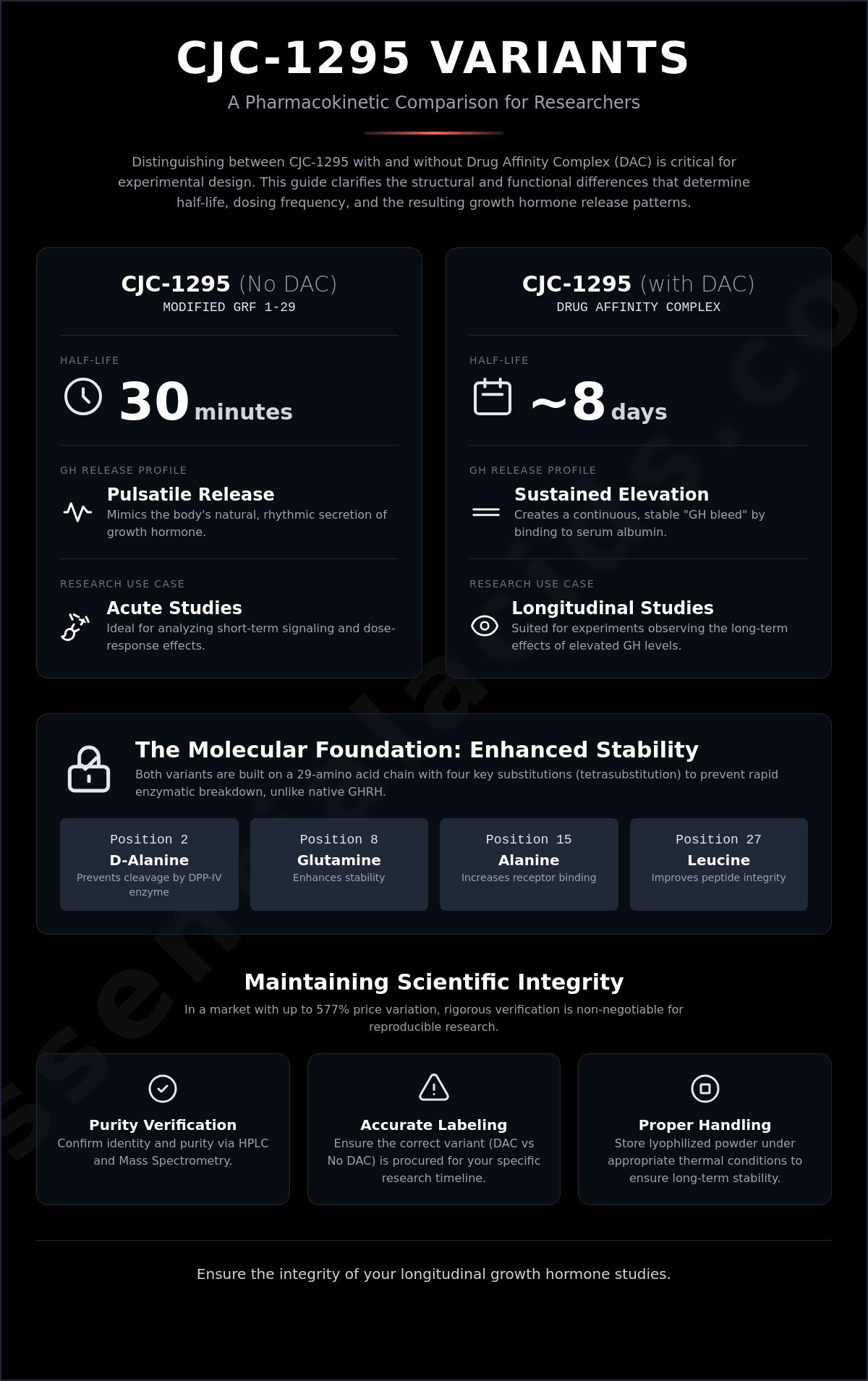
A significant point of confusion in laboratory procurement is the nomenclature surrounding this peptide. Technically, "CJC-1295 No DAC" is more accurately classified as "Modified GRF 1-29" (Growth Hormone Releasing Factor). The original designation for cjc 1295 was intended for the version containing the Drug Affinity Complex (DAC). However, the research community now uses these terms interchangeably to describe the tetrasubstituted peptide without the DAC attachment. Maintaining scientific integrity requires researchers to distinguish between these variants based on their molecular modifications rather than commercial labels.
The structure is defined by four precise amino acid substitutions:
- D-Alanine at position 2
- Glutamine at position 8
- Alanine at position 15
- Leucine at position 27
The Significance of Tetrasubstitution
These four modifications are engineered to overcome the primary limitation of endogenous GHRH: rapid enzymatic degradation. The most critical change occurs at position 2, where the substitution of D-Alanine protects the peptide from dipeptidyl peptidase-IV (DPP-IV). This enzyme usually cleaves the first two residues of the peptide chain, rendering it inactive within minutes. By preventing this cleavage, the tetrasubstituted structure demonstrates significantly higher binding affinity to GHRH receptors compared to native GHRH. This modification ensures that the compound remains stable throughout the duration of a controlled laboratory experiment, allowing for more accurate data collection on growth hormone secretion patterns.
Molecular Weight and Chemical Properties
For analytical verification, researchers must confirm the molecular weight and formula of the compound. The molecular weight for the Modified GRF 1-29 variant is approximately 3367.9 g/mol, with a molecular formula of C152H252N44O42. It's typically provided in a lyophilized powder form, which ensures long-term stability when stored under appropriate thermal conditions. Solubility is achieved through reconstitution with sterile water or BAC water. Verification of these properties through High-Performance Liquid Chromatography (HPLC) and Mass Spectrometry is a requirement for maintaining research-use only standards. These analytical methods confirm the purity and sequence identity of each batch, ensuring that laboratory results aren't skewed by contaminants or incorrect peptide sequences.
DAC vs. No DAC: Understanding Pharmacokinetic Variations
The primary differentiator between variants of cjc 1295 lies in the presence or absence of the Drug Affinity Complex (DAC). This modification isn't a minor adjustment; it fundamentally alters the compound's pharmacokinetic profile and how it interacts with research models. While the base peptide sequence remains a potent GHRH analogue, the addition of the DAC maleimide group determines the duration of action and the physiological pattern of growth hormone release. A clinical study on CJC-1295 effects demonstrates that this modification allows the peptide to maintain elevated plasma levels for significantly longer periods than the unmodified version.
Pharmacokinetic data reveals a stark contrast in half-life. CJC-1295 No DAC, often referred to as Modified GRF 1-29, possesses a half-life of approximately 30 minutes. This necessitates frequent administration to maintain target concentrations. Conversely, the DAC version exhibits a half-life extending up to 8 days. This prolonged presence creates a steady-state elevation of growth hormone levels, whereas the No DAC version is preferred for studies designed to replicate or analyze natural, pulsatile release patterns. Researchers must select the variant that aligns with their specific metabolic or physiological endpoints.
Plasma Protein Binding and the DAC Mechanism
The DAC mechanism relies on a covalent bond between the maleimide group and the Cys34 residue of plasma albumin. This binding is highly specific and efficient. Once the peptide attaches to albumin, it's shielded from rapid enzymatic breakdown and renal clearance. This bioconjugation process effectively turns the albumin into a circulating reservoir for the peptide. In research protocols, this drastically reduces the required frequency of administration. While No DAC protocols often require daily intervention, DAC models allow for weekly intervals while maintaining consistent analytical integrity. For researchers requiring precise control over these variables, sourcing high-purity cjc 1295 is vital for reproducible data.
Choosing the Variant for Research Objectives
Selecting the correct variant depends on the intended research environment. No DAC is the standard choice for acute physiological studies. It allows the pituitary gland to maintain its circadian rhythm, producing growth hormone in distinct pulses. This is critical for studies investigating natural feedback loops. In contrast, the DAC version is utilized in long-term metabolic research where sustained elevation is required. However, researchers must account for the "bleeding" effect associated with DAC. This phenomenon occurs when the constant stimulation of the pituitary causes a continuous, non-pulsatile release of growth hormone. This state can alter receptor sensitivity and IGF-1 production differently than pulsatile models, making it a distinct area of study in cellular ageing and metabolic regulation.
Mechanism of Action: Pituitary GHRH Receptor Interaction
The primary mechanism of CJC-1295 involves its high-affinity binding to the Growth Hormone-Releasing Hormone Receptors (GHRHR) located on the somatotroph cells of the anterior pituitary gland. This interaction is highly selective. Upon binding, the peptide initiates a transmembrane signaling cascade by activating G-protein coupled receptors. This activation specifically triggers the adenylate cyclase pathway, which catalyzes the conversion of adenosine triphosphate (ATP) into cyclic adenosine monophosphate (cAMP). This process is fundamental to maintaining the scientific integrity of growth hormone research.
Elevated intracellular cAMP levels serve as a secondary messenger. It activates protein kinase A (PKA), which subsequently opens calcium channels and facilitates the transcription of growth hormone genes. The result is the dual stimulation of both the synthesis and the regulated secretion of endogenous growth hormone. Crucially, this mechanism preserves the negative feedback loop involving somatostatin. Unlike synthetic growth hormone administration, which can bypass natural regulatory systems, cjc 1295 allows the pituitary to remain responsive to inhibitory signals. This maintains a level of biological balance in research models that seek to observe regulated metabolic adjustments rather than exogenous hormone surges.
The GH/IGF-1 Axis in Research Models
In research environments, the increase in systemic growth hormone leads to the hepatic production of Insulin-like Growth Factor 1 (IGF-1). This axis is a primary focus for studies on cellular repair and protein synthesis. Preclinical models often observe enhanced metabolic activity and adipocyte regulation, as growth hormone promotes lipolysis and inhibits lipid uptake. These downstream effects are critical for understanding how GHRH analogues influence the overall metabolic profile of a subject without overriding natural homeostatic boundaries. Such data is essential for laboratories focusing on the long-term implications of cellular ageing.
Pulsatile vs. Continuous Secretion
The choice between Mod GRF 1-29 and the DAC variant determines the secretory pattern. Mod GRF 1-29 mimics the physiological pulses of endogenous GHRH, whereas the DAC version provides more continuous stimulation. Long-term studies must account for the risk of pituitary desensitization. Continuous exposure to high-dose GHRH analogues may lead to receptor down-regulation, where the somatotrophs become less responsive to the peptide signal. Research findings suggest that while continuous secretion maintains higher IGF-1 levels, pulsatile models may offer better long-term receptor sensitivity. These considerations are vital when designing protocols for research-use only materials to ensure data accuracy over extended durations. Adhering to these rigorous standards is part of our commitment to "Making better, normal" in the field of biochemistry.
Research Synergy: CJC-1295 and Ipamorelin in Dual-Pathway Studies
The combination of a Growth Hormone-Releasing Hormone (GHRH) analogue with a Growth Hormone Secretagogue (GHS) represents a significant advancement in endocrine research models. While cjc 1295 initiates the synthesis and release of endogenous growth hormone by binding to the GHRH receptor, it's often studied alongside a complementary secretagogue like Ipamorelin to achieve a more robust physiological response. In this dual-pathway framework, cjc 1295 effectively provides the "signal" for hormone production, while the secretagogue provides the "amplitude," resulting in a synergistic increase in growth hormone pulse magnitude that exceeds the capabilities of either compound in isolation. Researchers interested in the specific parameters of these combined protocols should consult the CJC-1295 and Ipamorelin synergy guide for a deeper analysis of current laboratory standards.
Observations in controlled environments indicate that this combination doesn't merely result in additive effects. Instead, the simultaneous stimulation of two distinct receptor sets creates a potentiation effect. This is particularly valuable in studies where maintaining the integrity of natural feedback mechanisms is as important as the hormone release itself. By utilizing both pathways, laboratories can observe a more comprehensive metabolic profile that mirrors complex biological interactions. For those conducting high-level analytical work, obtaining verified cjc 1295 No DAC is essential to ensure the reliability of these multi-compound interactions.
GHRH vs. GHS-R1a Receptor Signaling
The biochemical distinction between these two classes of compounds lies in their specific receptor targets. Ipamorelin acts as a selective agonist at the GHS-R1a receptor, effectively mimicking the natural action of ghrelin. This is fundamentally different from the GHRH receptor interaction discussed in previous sections. One of the most critical aspects of this dual-pathway approach is the ability to bypass somatostatin inhibition. Somatostatin is the primary hormone responsible for inhibiting growth hormone release. While GHRH analogues are sensitive to this inhibition, ghrelin mimetics can suppress somatostatin activity at the pituitary level. Detailed comparative data on these mechanisms is available in our Ipamorelin molecular profile, which outlines the technical specifications of GHS-R1a signaling.
Implications for Metabolic and Musculoskeletal Research
Research synergy is defined as the potentiation of growth hormone release through dual-receptor agonism. In animal models, this synergy has demonstrated significant effects on lean tissue mass and the regulation of lipid metabolism. Beyond musculoskeletal data, researchers are increasingly investigating the impact of these compounds on sleep-wave cycles and circadian rhythm research. The pulsatile nature of the release, when using the No DAC variant, appears to influence nocturnal growth hormone surges, providing a unique window into the study of cellular repair during rest phases. These observations are critical for laboratories focusing on the intersection of neuroscience and metabolic health.
Laboratory Standards: Procurement and Handling of High-Purity CJC-1295
Scientific integrity in biochemical research is non-negotiable. Reagent purity directly dictates the validity of data regarding GHRH analogues. To ensure these standards, all research batches of cjc 1295 must undergo rigorous verification via High-Performance Liquid Chromatography (HPLC) and Mass Spectrometry. These analytical techniques confirm that the peptide sequence matches the intended tetrasubstituted structure and that the purity level meets the strict thresholds required for controlled laboratory environments. Without this verification, researchers risk introducing variables that could skew metabolic data or lead to inconsistent results across different study phases.
Lyophilized cjc 1295 demonstrates significant stability when stored correctly. In its powdered form, the peptide is resilient at room temperature for short periods during transit, but long-term storage requires temperatures between 2-8°C. This refrigeration prevents the degradation of the 29-amino acid chain. All compounds provided by Essential Acids are under a strict "research-use only" mandate. This policy is fundamental to our regulatory compliance and ensures that these materials are utilized exclusively within professional laboratory settings. Batch-specific analytical documentation, including a Certificate of Analysis (COA), is provided to verify the chemical identity of every vial, ensuring that the researcher has a verified baseline for their analytical work.
Reconstitution and Stability Protocols
Reconstituting lyophilized peptides requires precision to avoid mechanical degradation of the fragile molecular bonds. Sterile water or BAC water should be introduced slowly along the side of the vial. Vigorous shaking is prohibited; instead, a gentle swirling motion is utilized to achieve full solubility. Once reconstituted, the peptide becomes significantly more sensitive to thermal fluctuations. Stability timelines indicate that reconstituted cjc 1295 should be stored at 2-8°C and used within a specific research window to ensure peak potency. The use of bacteriostatic water is standard in multi-dose research to prevent microbial growth, which could otherwise compromise the analytical results of longitudinal studies.
Verifying Scientific Integrity
Interpreting a Certificate of Analysis (COA) is a critical skill for any researcher. A high-integrity COA will display the HPLC chromatogram, showing a single, sharp peak that represents the primary peptide, alongside mass spectrometry data that confirms the molecular weight matches the theoretical value. These documents are the primary defense against the inconsistent purity often found in the broader market. Essential Acids is committed to "Making better, normal" by providing a high-integrity research supply that prioritizes transparency and accuracy over commercial trends. Researchers can view our high-purity CJC-1295 No DAC for laboratory research to access materials verified to these exact standards.
Advancing Analytical Precision in GHRH Research
Establishing a rigorous research protocol begins with identifying the correct pharmacokinetic variant for your specific metabolic endpoints. Whether a study requires the pulsatile mimicry of Mod GRF 1-29 or the sustained elevation provided by the DAC version, the molecular integrity of the compound is the primary variable. We've detailed how the tetrasubstituted structure of cjc 1295 resists enzymatic degradation, providing a highly stable tool for investigating the GH/IGF-1 axis and dual-pathway receptor synergy.
Maintaining scientific integrity demands access to materials verified by stringent laboratory standards. Every batch provided by Essential Acids includes batch-specific HPLC and Mass Spectrometry reports to guarantee 99%+ purity for analytical research. Our commitment to "Making better, normal" is reflected in our specialized storage and national shipping protocols, ensuring that your laboratory receives compounds in their most stable lyophilized state. We look forward to supporting your continued contributions to the field of biochemistry.
Order High-Purity CJC-1295 for Laboratory Research
Frequently Asked Questions
What is the difference between CJC-1295 No DAC and Mod GRF 1-29?
Technically, these two terms refer to the exact same 29-amino acid peptide sequence. The name "CJC-1295 No DAC" is a misnomer that gained traction in research circles, whereas Modified GRF 1-29 is the correct nomenclature for the tetrasubstituted analogue. Both compounds lack the Drug Affinity Complex and share a half-life of approximately 30 minutes. Researchers must verify the molecular structure via HPLC to ensure the compound matches the tetrasubstituted GHRH 1-29 specifications.
How long does CJC-1295 DAC remain active in research models?
The DAC version remains active for approximately 8 days due to its covalent binding to plasma albumin. This bioconjugation prevents rapid enzymatic breakdown and renal clearance, which are common hurdles for native GHRH. By creating a circulating reservoir, cjc 1295 with DAC provides a steady-state elevation of growth hormone levels. This prolonged activity makes it suitable for long-term metabolic studies where pulsatile release is not the primary focus of the research protocol.
Is CJC-1295 stable at room temperature during shipping?
Stability is maintained at room temperature for short durations when the peptide is in its lyophilized powder form. The vacuum-sealed environment of the vial protects the molecular bonds from degradation during standard shipping timelines. However, long-term storage requires a temperature-controlled environment between 2-8°C to preserve the chemical identity. Once the peptide is reconstituted, it becomes significantly more fragile and must be refrigerated immediately to prevent rapid loss of potency.
What is the recommended reconstitution liquid for CJC-1295 research?
Bacteriostatic water is the standard choice for multi-dose research applications. The inclusion of 0.9% benzyl alcohol acts as a preservative to inhibit microbial growth, which is essential for maintaining the scientific integrity of the compound during longitudinal studies. Sterile water is an acceptable alternative for single-use analytical procedures, but it lacks the antimicrobial properties required for multi-day protocols. Researchers should always follow aseptic techniques during the reconstitution process to avoid contamination.
Can CJC-1295 be used in combination with BPC-157 in research?
Yes, these compounds are frequently utilized together in musculoskeletal and tissue repair research. While cjc 1295 influences systemic growth hormone and hepatic IGF-1 production, BPC-157 operates through localized pathways such as the up-regulation of growth factor receptors. These separate mechanisms allow researchers to observe potential complementary effects on cellular repair. It's vital to note that all such combinations are strictly for research-use only and must be conducted within controlled laboratory environments.
How does CJC-1295 affect insulin sensitivity in metabolic studies?
Observations in metabolic models suggest that elevated growth hormone levels can lead to a decrease in insulin sensitivity. Growth hormone naturally promotes lipolysis and can antagonize the effects of insulin on glucose uptake in peripheral tissues. This glucose-sparing effect is a documented physiological response in GHRH analogue studies. Researchers monitoring glucose metabolism must account for these shifts when analyzing the overall metabolic profile of a research subject over extended durations.
What are the observed side effects of CJC-1295 in preclinical models?
Preclinical data often records transient flushing and localized irritation at the site of administration. In some models, the elevation of growth hormone levels results in minor water retention or peripheral paresthesia. These effects are generally dose-dependent and reflect the pituitary's response to sustained GHRH receptor agonism. Maintaining strict adherence to research-use only protocols ensures that these observations are documented accurately without the variables introduced by non-laboratory environments.
Why is tetrasubstitution important for CJC-1295 integrity?
Tetrasubstitution is the primary modification that enables the peptide to resist rapid enzymatic degradation by dipeptidyl peptidase-IV (DPP-IV). By substituting amino acids at positions 2, 8, 15, and 27, the molecule's structural integrity is significantly enhanced compared to native GHRH. This resistance extends the half-life from a few minutes to roughly 30 minutes for the No DAC version. This window is essential for the peptide to reach and activate pituitary receptors effectively before being cleared.
Legal Disclaimer
All products sold on this website are intended exclusively for laboratory research purposes and not for human or veterinary use, diagnosis, cure, treatment, or prevention of any disease or condition. None of the statements on this site have been reviewed or evaluated by the U.S. Food and Drug Administration (FDA) or comparable regulatory authorities. Purchasing or using these products for any unintended purpose, including human consumption, may violate federal or local laws and poses safety risks.