

The integrity of a biochemical study is only as robust as the molecular purity of its primary reagent. For the professional researcher, a peptide is not merely a sequence of amino acids but a precision instrument that must meet exacting analytical standards to ensure reproducible data. You likely find that the ambiguity between research-grade materials and supplement-grade products creates unnecessary risk in the laboratory environment. Interpreting complex HPLC and mass spectrometry reports often feels like a secondary research project in itself, yet it remains the only way to verify scientific integrity for research-use only compounds.
This guide provides an authoritative reference on peptide structure, synthesis methods, and specific applications within molecular biology. We'll clarify the biochemical distinctions between peptides and proteins while establishing a rigorous framework for laboratory procurement. You'll gain a functional understanding of solid-phase synthesis standards and the protocols required to maintain stability during storage. By prioritizing analytical transparency and batch-specific verification, we aim to support the ethos of making better, normal in the pursuit of high-level scientific discovery.
Key Takeaways
- Distinguish between short-chain amino acid polymers and complex proteins through a precise understanding of molecular architecture and folding.
- Evaluate the technical standards of Solid-Phase Peptide Synthesis (SPPS) to ensure the procurement of high-purity research reagents.
- Identify specialized research models in cellular signaling and metabolism using verified compounds such as BPC-157 and 5-Amino-1MQ.
- Master the stabilization requirements for lyophilized peptide sequences to prevent degradation caused by moisture, UV exposure, and thermal fluctuations.
- Establish a rigorous laboratory procurement framework centered on batch-specific analytical documentation and verified scientific integrity.
Defining the Peptide: Molecular Architecture and Biochemical Significance
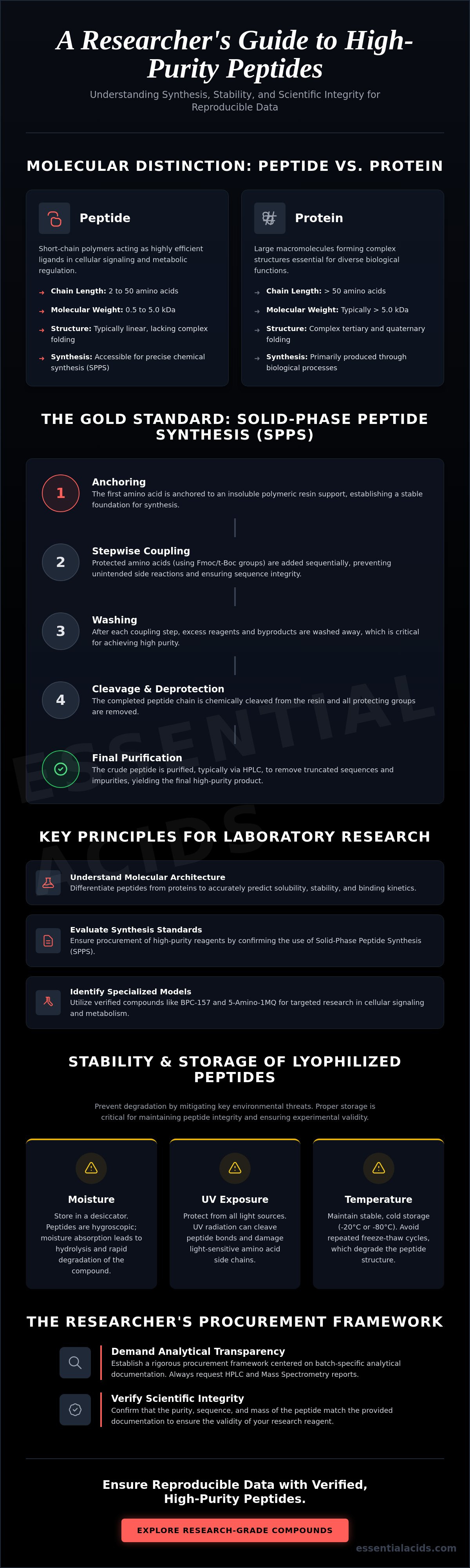
A peptide is characterized as a short-chain polymer of amino acids, organized into specific sequences that dictate biological function. Unlike larger macromolecular structures, these compounds typically maintain a molecular weight between 0.5 and 5.0 kDa. This specific mass range allows them to act as highly efficient ligands within cellular signaling, metabolic regulation, and various endocrine pathways. In a laboratory setting, the precision of these sequences is paramount; even a single amino acid substitution can fundamentally alter receptor affinity and experimental outcomes.
Amino Acid Sequences and Peptide Bonds
The structural integrity of these molecules relies on the formation of covalent amide bonds. This process occurs through dehydration synthesis, where the carboxyl group of one amino acid reacts with the amino group of another, releasing a water molecule. The resulting linkage is rigid and planar, providing a stable backbone for the molecular chain. Sequence specificity is the primary driver of bioactivity. The arrangement of side chains determines how the compound interacts with target receptors, making analytical verification essential for maintaining scientific integrity.
Peptides vs. Proteins: The Threshold of Complexity
While both are composed of amino acids, the distinction between these sequences and a protein is defined by chain length and structural complexity. These molecules generally consist of 2 to 50 amino acids. Once a sequence exceeds this threshold and begins to exhibit complex tertiary or quaternary folding, it is classified as a protein. Because they lack the dense folding of proteins, these shorter chains are more accessible for Chemical peptide synthesis, allowing researchers to modify sequences for targeted receptor activation.
In modern molecular biology, the use of synthesized ligands facilitates the modeling of complex biological systems. Understanding this molecular architecture is the first step in selecting appropriate reagents for metabolic or neurological studies. Researchers must distinguish between these simple chains and their protein counterparts to predict solubility, stability, and binding kinetics accurately. This foundational knowledge ensures that laboratory procurement aligns with the rigorous demands of high-level scientific inquiry, supporting the commitment to making better, normal through precise biological modeling. It's a discipline that demands absolute transparency and objective verification at every stage of the research process.
Chemical Synthesis: Standards for Research-Grade Peptide Production
The chemical synthesis of a peptide sequence requires a disciplined approach to prevent the formation of truncated sequences or racemic mixtures. For researchers, the choice between Solid-Phase Peptide Synthesis (SPPS) and Liquid-Phase Peptide Synthesis (LPPS) is dictated by the required scale and complexity of the target molecule. SPPS remains the gold standard for high-purity research materials due to its efficiency in producing long, complex chains with high yield. Conversely, LPPS is generally reserved for the large-scale production of shorter sequences where cost-efficiency in bulk is prioritized over the speed of sequence assembly.
Preventing unintended side reactions during molecular assembly is achieved through the use of specific protecting groups, most notably Fmoc (9-fluorenylmethyloxycarbonyl) and t-Boc (tert-butyloxycarbonyl). These chemical shields ensure that amino acids only link at the desired carboxyl and amino terminals, preserving the intended sequence. A comprehensive overview of these chemical strategies is available in this Introduction to Peptide Synthesis Methodologies. These methodologies are foundational to maintaining the integrity of the synthetic process and ensuring that the final compound matches the theoretical model.
Solid-Phase Peptide Synthesis (SPPS) Mechanics
The assembly process occurs on an insoluble polymeric resin support, which serves as a stable anchor for the growing chain. Stepwise addition of amino acids allows for precise sequence control, as excess reagents and byproducts are simply washed away after each coupling step. This method significantly reduces the risk of cross-contamination and simplifies final purification protocols. SPPS is the primary method for creating complex synthetic analogs required for advanced biological modeling.
Analytical Verification: HPLC and Mass Spectrometry
Experimental reproducibility is impossible without rigorous purity verification. High-Performance Liquid Chromatography (HPLC) is the analytical standard used to measure the exact percentage of the target peptide within a sample. This process is complemented by Mass Spectrometry (MS), which confirms the molecular weight and identity of the synthesized compound. Scientific integrity relies on batch-specific certificates of analysis (CoA) for every vial to ensure that the material meets the documented specifications. Without these analytical safeguards, laboratory data remains vulnerable to artifacts caused by impurities.
Researchers who prioritize data accuracy often seek out verified research materials that include full analytical documentation. This commitment to transparency ensures that every compound aligns with the rigorous standards of modern biochemistry. Maintaining a professional distance from lower-tier suppliers is necessary to protect the validity of longitudinal research projects. Each step in the synthesis and verification process must be executed with a focus on precision and objective quality assurance.
Primary Research Classifications: Signaling and Metabolic Models
Categorizing research-use only compounds allows for a systematic approach to experimental design. Scientists often classify a synthetic peptide based on its specific metabolic or signaling pathway. For instance, metabolic research frequently utilizes compounds like 5-Amino-1MQ to investigate NNMT (nicotinamide N-methyltransferase) inhibition within muscle research models. These studies focus on how small-molecule inhibitors influence energy homeostasis and cellular aging at the biochemical level. By isolating these pathways, researchers can observe specific cellular responses with a high degree of control.
Endocrine pathway research remains a significant pillar of molecular biology. Somatotropic secretagogues, such as Ipamorelin and CJC-1295, are utilized to model growth hormone secretion and its downstream effects on cellular repair. These sequences allow researchers to observe the pulsatile nature of endocrine signaling without the broader systemic complications of exogenous hormone administration. Similarly, mitochondrial signaling research has expanded with the study of MOTS-c. This mitochondrial-derived sequence is investigated for its role in maintaining metabolic homeostasis and its influence on cellular aging protocols. These compounds serve as precise tools for mapping complex biological interactions within controlled laboratory environments.
Tissue Repair and Regenerative Modeling
This field focuses on the angiogenic and cytoprotective properties of specific sequences. BPC-157 (Body Protection Compound) is extensively studied for its potential to accelerate tissue healing in experimental models. Researchers often consult the molecular profile of BPC-157 to understand its specific structural stability and binding affinity. TB-500, a synthetic version of Thymosin Beta-4, is also frequently included in these studies to investigate its role in actin-sequestering and cellular migration. Additionally, GHK-Cu (Copper Tripeptide) is analyzed for its high affinity in collagen synthesis research, offering insights into extracellular matrix remodeling and tissue regeneration.
Metabolic and Obesity Research Peptides
The investigation of glucose metabolism and lipid regulation relies on dual-agonism models. GLP-1 and GIP receptor agonists, such as Tirzepatide, are central to these inquiries. Analyzing the tirzepatide structure provides critical data on how dual-receptor activation influences metabolic signaling. AOD-9604 is also frequently employed as a lipolytic fragment in lipid metabolism studies to observe its effects on adipose tissue without affecting systemic insulin sensitivity. These classifications ensure that laboratory procurement remains aligned with the specific objectives of the research protocol, maintaining the scientific integrity of the project.
Stability, Storage, and Degradation of Lyophilized Peptides
Lyophilization, or freeze-drying, is the standard protocol for stabilizing a synthetic peptide for transit and long-term storage. This process involves removing moisture through sublimation, which effectively "locks" the molecular structure in a state of suspended animation. Despite this stabilization, the compound remains vulnerable to environmental stressors that can catalyze hydrolysis or oxidation. Temperature fluctuations, UV exposure, and moisture ingress are the primary drivers of chemical degradation. A peptide's shelf-life is drastically different depending on its physical state; lyophilized powders are significantly more robust than their reconstituted liquid counterparts, which can begin to degrade within days if not handled with extreme caution.
Optimal Storage Conditions for Research Materials
Lyophilized vials should ideally be maintained at -20°C for long-term stability. Under these controlled conditions, most research compounds remain viable for up to 24 months. Short-term storage at 4°C is acceptable for materials scheduled for immediate laboratory use within a 1-4 week window. Light protection is essential for specific sequences, such as Melanotan II, to prevent photodegradation of the peptide chain. Researchers must ensure that storage environments are monitored to prevent accidental thawing, as even brief exposure to room temperature can initiate the degradation of sensitive sequences. The use of desiccants within storage containers is also recommended to mitigate the risks posed by moisture ingress.
Reconstitution and Handling Best Practices
Reconstitution must be handled with care to protect the delicate secondary structure of the chain. Vigorous shaking should be replaced with gentle swirling to prevent mechanical denaturation or the formation of aggregates. Using bacteriostatic water is the preferred method for multi-use research vials, as the inclusion of 0.9% benzyl alcohol inhibits microbial growth over time. While sterile saline is an alternative, it lacks this antimicrobial protection, making it less suitable for longitudinal studies involving multiple withdrawals from a single vial. Once the compound is in a liquid state, it's far more sensitive to thermal stress and enzymatic cleavage. Repeated freeze-thaw cycles must be avoided, as they introduce structural artifacts that compromise research-grade purity and experimental reproducibility.
Maintaining these rigorous standards is necessary for any high-integrity laboratory. Researchers who require reliable research compounds often implement strict logging of storage temperatures and reconstitution dates. This level of oversight ensures that the analytical integrity of the study is never compromised by preventable environmental degradation. It's this commitment to precision that separates high-level research from more casual applications.
Standards for Laboratory Procurement: Ensuring Scientific Integrity
Procurement in a controlled laboratory environment requires a level of scrutiny that transcends standard commercial transactions. For the professional researcher, the distinction between 'research-grade' and 'pharmaceutical-grade' materials is a matter of regulatory and analytical alignment. Research-grade compounds are synthesized specifically for in vitro and in vivo modeling, where the primary objective is molecular precision and sequence accuracy. While pharmaceutical-grade materials focus on human safety and clinical delivery, research-use only (RUO) designations prioritize the purity profiles necessary for high-fidelity data. Adhering to these designations is a non-negotiable aspect of maintaining scientific integrity within a professional institution.
Every peptide sequence introduced into a study must be accompanied by batch-specific analytical documentation. This documentation acts as a biological fingerprint, confirming that the material in the vial matches the theoretical sequence required for the experiment. Without these records, a researcher cannot account for impurities that might interfere with receptor binding or metabolic signaling. High-purity reagents are the only way to ensure that experimental results are a reflection of the compound's activity rather than a byproduct of synthesis artifacts. Maintaining a disciplined approach to procurement protects the validity of the research and the reputation of the laboratory.
Verifying Vendor Quality and Transparency
Identifying a reliable supplier involves more than reviewing a product catalog; it requires a deep dive into their quality control protocols. Third-party testing remains the gold standard for verifying the claims of any synthesis laboratory. Transparent HPLC and Mass Spectrometry reporting should be readily available for every batch to confirm both purity levels and molecular weight. Avoiding 'grey market' suppliers is essential, as these entities often lack the analytical infrastructure to verify their products. Researchers looking to order peptides online must prioritize vendors that demonstrate a commitment to transparency and regulatory compliance over those offering aggressive marketing or unsubstantiated claims.
The Role of Essential Acids in Modern Research
Essential Acids serves as a rigorous scientific gatekeeper, providing an extensive catalog of high-purity compounds tailored for neuroscience and metabolic studies. Every compound in the inventory is intended strictly for controlled research environments, reinforcing a stable boundary between laboratory inquiry and human use. This commitment to regulatory compliance is central to the brand's identity. By focusing on batch-specific verification and analytical integrity, the brand supports the pursuit of high-level discovery. The philosophical signature, 'Making better, normal,' is achieved through the provision of reliable tools that allow researchers to map biological processes with absolute precision. This professional distance ensures that the quality of the compounds remains the primary focus of the partnership.
Advancing Scientific Discovery Through Analytical Precision
The transition from molecular theory to reproducible experimental data depends entirely on the quality of the primary reagent. A synthesized peptide must be treated as a precision instrument, requiring rigorous verification through batch-specific HPLC and Mass Spectrometry reports to ensure scientific integrity. Maintaining these standards ensures that metabolic and cellular signaling models remain free from artifacts caused by sequence degradation or synthesis impurities. By adhering to strict storage protocols and "research-use only" designations, you protect the validity of your longitudinal studies and the reputation of your laboratory.
Essential Acids remains a dedicated partner in this pursuit, providing high-purity compounds specifically for controlled laboratory environments. Our specialized focus on metabolic and cellular signaling ensures that every sequence meets the exacting demands of modern biochemistry. We invite you to view our catalog of high-purity research peptides to find the specialized tools necessary for your next phase of inquiry. Your commitment to objective quality assurance is the foundation of meaningful discovery as we work toward making better, normal through rigorous science.
Frequently Asked Questions
What is the difference between a peptide and a protein?
The primary distinction between these molecular structures is defined by the length of the amino acid chain and the complexity of its folding. A peptide typically consists of a sequence of 2 to 50 amino acids and lacks the dense tertiary or quaternary structures found in larger macromolecules. Once a chain exceeds this length and exhibits complex three-dimensional folding, it is classified as a protein. This structural simplicity makes shorter sequences more suitable for targeted receptor modeling in laboratory environments.
How are research peptides synthesized in a laboratory?
Most high-purity sequences are produced through Solid-Phase Peptide Synthesis (SPPS), a method involving the stepwise assembly of amino acids on an insoluble resin support. Protecting groups such as Fmoc are utilized to ensure that linkages occur only at the intended carboxyl and amino terminals. This stepwise approach allows for the precise control of the sequence and the efficient removal of reagents through washing cycles. The final product is then cleaved from the resin and purified using chromatographic techniques.
What does the 'Research Use Only' (RUO) designation mean for peptides?
The RUO designation is a regulatory classification indicating that the compound is intended strictly for laboratory research and experimental modeling. These materials are not approved for human therapeutic use, medical diagnostics, or clinical applications. Adherence to this policy is a core component of scientific integrity and ensures that the compounds are utilized only in controlled environments by qualified professionals. This classification maintains a clear boundary between experimental inquiry and established medical practice.
How should lyophilized peptides be stored to prevent degradation?
Long-term stability is best maintained by storing lyophilized vials at -20°C in a desiccated environment to prevent moisture ingress. While short-term storage at 4°C is acceptable for immediate use, sub-zero temperatures are necessary to inhibit hydrolysis and oxidative pathways. Vials should also be protected from UV light exposure, as certain sequences are highly sensitive to photodegradation. Proper storage protocols are essential for ensuring that the analytical profile of the compound remains stable throughout the duration of the study.
What is HPLC and why is it important for peptide purity?
High-Performance Liquid Chromatography (HPLC) is the analytical standard used to separate and quantify the target peptide from synthesis byproducts. This process measures the percentage of the intended sequence within a sample, providing a clear metric for its chemical purity. It's important because even minor impurities or truncated sequences can interfere with receptor binding and compromise the validity of research data. A batch-specific HPLC report serves as a verified confirmation that the material meets the required laboratory standards.
Can peptides be stored at room temperature during shipping?
Lyophilized powders are generally stable at room temperature for the brief duration required for transit and logistics. The freeze-drying process removes the moisture necessary for most degradation reactions, allowing the compound to withstand ambient temperatures for several days. However, the material must be moved to a controlled cold storage environment at -20°C immediately upon arrival at the laboratory. Maintaining this cold chain after receipt is necessary to preserve the molecular integrity of the sequence for long-term use.
What is the role of bacteriostatic water in peptide research?
Bacteriostatic water serves as a sterile diluent containing 0.9% benzyl alcohol, which acts as a preservative to inhibit the growth of bacteria. This is particularly important for multi-withdrawal research vials where the seal is punctured multiple times over a period of days or weeks. The inclusion of an antimicrobial agent helps maintain the purity of the reconstituted liquid throughout the experimental window. Without this protection, the solution would be highly susceptible to microbial contamination, which could introduce artifacts into the research model.
How do researchers determine the correct concentration for peptide modeling?
The concentration is determined by calculating the mass of the lyophilized powder against the volume of the diluent added to the vial. Researchers refer to the molecular weight provided in the analytical report to ensure accurate molarity for their specific biological models. Precise calculations are necessary to maintain the consistency of the experimental variables and ensure that the results are reproducible. Most protocols involve a stepwise reconstitution process to ensure the compound is fully dissolved before the concentration is finalized for use.
Legal Disclaimer
All products sold on this website are intended exclusively for laboratory research purposes and not for human or veterinary use, diagnosis, cure, treatment, or prevention of any disease or condition. None of the statements on this site have been reviewed or evaluated by the U.S. Food and Drug Administration (FDA) or comparable regulatory authorities. Purchasing or using these products for any unintended purpose, including human consumption, may violate federal or local laws and poses safety risks.