

In high-stakes laboratory research, a peptide without a batch-specific HPLC report isn't a reagent; it's an uncontrolled variable that can compromise years of metabolic data. You understand that the validity of your findings depends entirely on the chemical precision of your compounds. However, the search for peptides for sale often leads to batch-to-batch inconsistency and a lack of transparent analytical documentation that fails to meet the rigorous standards of an Australian laboratory environment.
This guide provides a clinical evaluation of procurement standards for 2026, focusing on how to secure high-purity, lyophilized compounds with verified analytical transparency. We'll examine the necessity of HPLC and MS verification to confirm molecular identity, the impact of national transit on peptide integrity, and the regulatory framework governing research-use only materials. By prioritizing scientific integrity over commercial convenience, you can ensure that your laboratory access remains stable and your data remains beyond reproach. We'll outline the specific protocols required to maintain the precision of your cellular ageing and biochemical research in the evolving Australian landscape.
Key Takeaways
- Establish the necessity of batch-specific HPLC and Mass Spectrometry reports to verify the chemical identity and high-purity of research compounds.
- Navigate the 2026 procurement landscape by identifying reputable sources for peptides for sale that maintain strict adherence to research-use only protocols.
- Examine the laboratory applications of core metabolic and regenerative compounds, including 5-Amino-1MQ and BPC-157, within tissue modeling frameworks.
- Understand the critical role of lyophilization in preserving peptide bond integrity against temperature fluctuations during national shipping within Australia.
- Implement a procurement strategy that prioritizes analytical transparency and scientific integrity to ensure the replicability of laboratory data.
Navigating the 2026 Landscape of Research Peptides for Sale
The Australian peptide therapeutics market generated a revenue of USD $1,906.3 million in 2025. This significant valuation reflects the intensifying focus on metabolic and cellular response modeling within domestic laboratories. Procurement of research materials requires a sophisticated understanding of chemical classifications and regulatory boundaries. What are peptides? At their core, these amino acid chains serve as critical signaling molecules in biochemical assays. When sourcing peptides for sale, researchers must distinguish between clinical-grade pharmaceuticals and the high-purity compounds required for analytical verification.
The distinction is not merely semantic; it's a matter of scientific integrity. Human-grade pharmaceuticals are manufactured for therapeutic intervention, whereas research-grade compounds are synthesized for the precise measurement of metabolic pathways. Essential Acids maintains a strict "research-use only" policy. This ensures that the compounds provided remain within the legal and ethical boundaries of laboratory inquiry. The surge in metabolic disorder research, currently the fastest-growing segment in the Australian market, demands chemicals that are free from the fillers or stabilizers found in medical prescriptions. Using high-purity peptides allows for the isolation of specific biological reactions without the interference of exogenous agents.
Defining Research-Grade Integrity
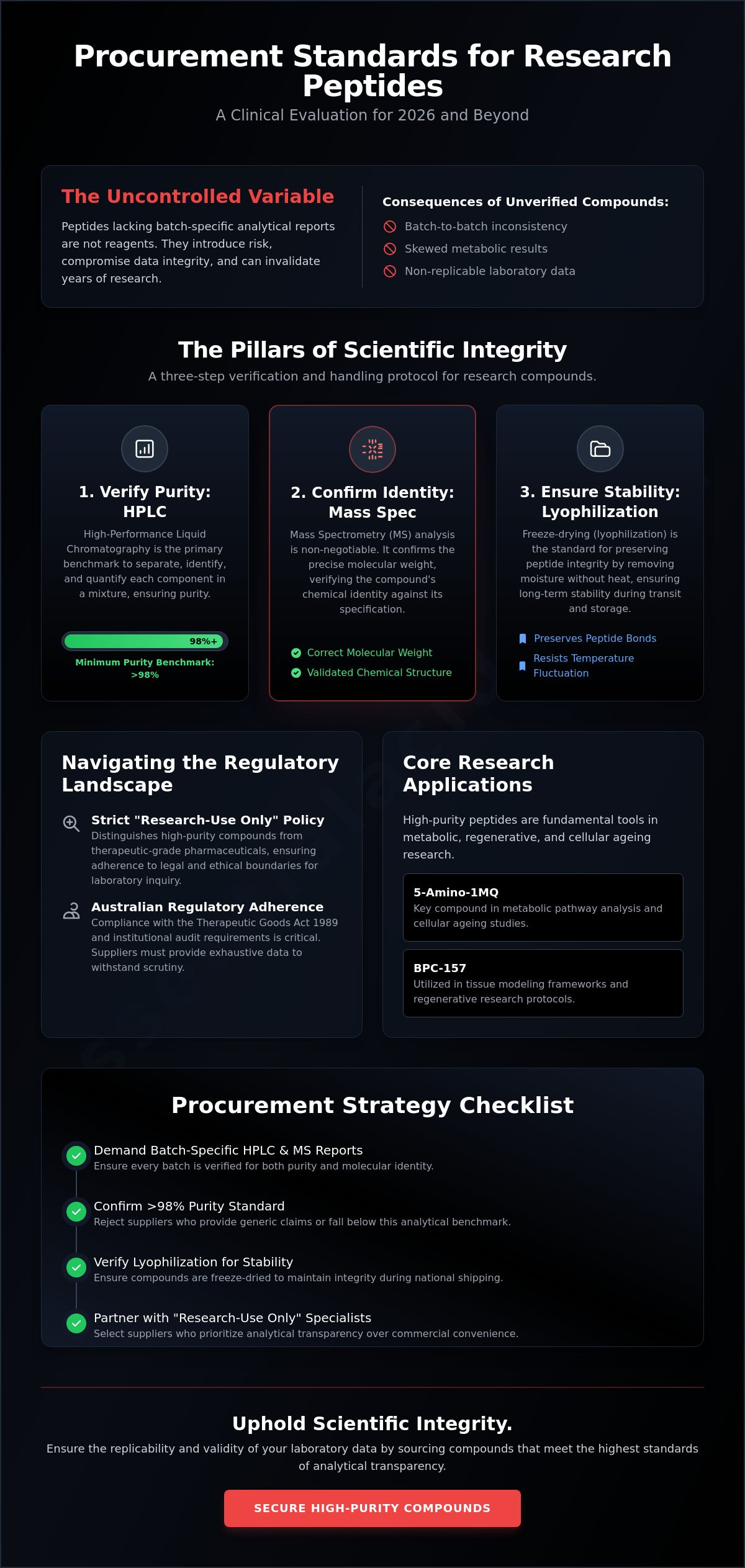
In analytical chemistry, the structural requirements for synthetic peptides are uncompromising. High-purity synthesis involves a rigorous purification process where impurities are removed until a specific threshold, typically exceeding 98 percent, is achieved. Lyophilization, or freeze-drying, is the standard for ensuring long-term molecular stability. This process removes moisture without compromising the peptide bond, allowing the compound to remain stable during transit and storage. Unlike generic chemical distribution, high-purity research compounds must be accompanied by batch-specific documentation to verify their chemical identity and purity levels. Stability is a primary concern for researchers who require consistent results across multiple testing cycles.
Regulatory Compliance in Australian Research
The Australian regulatory landscape is governed by the Therapeutic Goods Act 1989. While the TGA regulates therapeutic goods for human use, research laboratories must adhere to institutional audit requirements and the 2026 WADA Prohibited List. Procuring peptides for sale within this framework requires a supplier that prioritizes transparency over marketing. Professional researchers often select partners based on a "quiet authority" profile. This means the supplier provides exhaustive analytical data and maintains a formal, detached perspective on the research process. Adherence to these protocols is essential for maintaining the integrity of cellular response models and ensuring compliance with national safety standards. Documentation must be maintained with precision to survive the scrutiny of institutional oversight and regulatory audits.
Evaluating Analytical Integrity: HPLC and Mass Spectrometry
Analytical verification is the bridge between a raw chemical and a valid research reagent. In the procurement of peptides for sale, the absence of batch-specific data isn't just a clerical oversight; it's a fundamental failure in scientific integrity. For Australian laboratories, where institutional oversight is rigorous, relying on generic purity claims is insufficient for maintaining reproducible data. Credible research requires two distinct but complementary analytical methods to confirm that a compound is both pure and correctly identified.
The TGA safety alert on illegal peptides highlights the persistent risks of unverified compounds entering the research supply chain. Without rigorous testing, laboratories may inadvertently introduce contaminants or degraded analogs into their cellular models. This leads to skewed metabolic results and potentially compromises the safety of the laboratory environment. Verification protocols must be standard practice for every procurement cycle.
The HPLC Purity Benchmark
High-Performance Liquid Chromatography (HPLC) remains the primary benchmark for assessing the purity of research compounds. HPLC is a chromatographic technique used to separate, identify, and quantify each component in a mixture. For legitimate laboratory applications, a minimum purity threshold of 98 percent is required. Anything less introduces an unacceptable level of unknown variables into the experimental design. When reviewing an HPLC report, researchers should focus on the peak area percentages. A single, sharp peak with minimal "noise" on the baseline indicates a high-purity synthesis. Conversely, secondary peaks or broad retention times suggest the presence of truncated sequences or residual solvents from the manufacturing process.
Mass Spectrometry Verification
While HPLC confirms the quantity of the primary component, Mass Spectrometry (MS) confirms its identity. MS measures the mass-to-charge ratio of ions to determine the precise molecular weight of the peptide. This ensures that the compound synthesized is exactly what was ordered. Theoretical molecular mass must align with the analytical results within a narrow margin of error. This is particularly vital for verifying the tirzepatide structure, where sequence accuracy is paramount for receptor binding studies. MS also detects the presence of counter-ions, such as Trifluoroacetic acid (TFA) salts, and residual moisture levels. High salt content can significantly alter the actual peptide concentration in a lyophilized vial, which directly impacts the accuracy of concentration-dependent assays. Researchers can verify these critical metrics by reviewing our batch-specific analytical reports before beginning any new study phase.
A Certificate of Analysis (COA) should be viewed as a living document tied to a specific lot number. It's not enough for a supplier to provide a "typical" report. Each batch must be independently verified to account for the inherent volatility of peptide synthesis. By demanding these standards, laboratories protect their data from the variables of chemical degradation and synthesis errors.
Core Research Peptides for Metabolic and Tissue Modeling
The selection of specific analogs for laboratory inquiry depends on the target biological pathway and the required signaling precision. As metabolic disorders represent the largest revenue-generating application in the Australian peptide market, the demand for verified research compounds has increased. Current initiatives in Australian peptide and protein science research emphasize the importance of using high-purity sequences to model complex cellular responses. When evaluating peptides for sale for metabolic or regenerative studies, researchers must prioritize compounds that offer predictable interactions with receptor sites.
Metabolic and Energy Research
Metabolic homeostasis research has been significantly advanced by the introduction of triple hormone receptor agonists. Retatrutide represents a novel frontier in this field, acting as a potent agonist for the glucagon-like peptide-1 (GLP-1), glucose-dependent insulinotropic polypeptide (GIP), and glucagon receptors. This triple-action profile allows for more comprehensive modeling of energy expenditure and glucose regulation than single-receptor analogs. In obesity and metabolic syndrome studies, the synergy between these three pathways provides a nuanced view of metabolic flux.
5-Amino-1MQ serves a different but complementary role in cellular aging research. It functions as a small molecule inhibitor of nicotinamide N-methyltransferase (NNMT), an enzyme that plays a critical role in metabolic regulation. By inhibiting NNMT, researchers can analyze changes in intracellular NAD+ levels and their subsequent impact on metabolic efficiency. This compound is frequently utilized in assays designed to study the slowing of cellular ageing and the enhancement of mitochondrial function. The stability of these compounds in a laboratory setting is essential for maintaining the accuracy of long-term metabolic data.
Regenerative and Tissue Signaling
Regenerative signaling research often focuses on the modulation of the extracellular matrix (ECM) and the acceleration of angiogenesis. The compound bpc 157 5mg is a primary tool for musculoskeletal modeling due to its documented role in upregulating growth factors. It's particularly effective in studies involving tendon-to-bone healing and gastrointestinal mucosal repair. The molecular integrity of BPC-157 must be verified through the HPLC protocols discussed in previous sections to ensure that regenerative signaling isn't obscured by synthesis by-products.
TB-500, a synthetic version of the naturally occurring peptide Thymosin Beta-4, is another essential reagent for tissue modeling. Its primary mechanism involves the sequestering of G-actin, which facilitates cellular migration and tissue repair. In laboratory models, TB-500 is used to study the formation of new blood vessels and the reduction of inflammatory markers in connective tissues. These peptides for sale are intended strictly for research-use only, providing the necessary chemical scaffolding for advancing our understanding of tissue signaling. Maintaining a stable supply of these high-purity compounds is a fundamental requirement for the continuity of Australian musculoskeletal research.
Logistics and Stability in National Peptide Distribution
The stability of a peptide bond is highly susceptible to environmental stressors, particularly during transit across Australia's varied climate zones. Thermal instability can lead to the unfolding of the peptide's secondary structure, rendering the compound inactive or introducing degradation products that interfere with analytical results. When procuring peptides for sale, the logistical framework must be as rigorous as the initial synthesis. National distribution requires a supply chain that prioritizes molecular integrity over standard shipping speed.
Heat exposure and UV light are the primary catalysts for chemical degradation. These factors accelerate deamidation and oxidation, which alter the chemical profile of the compound. Mechanical agitation, such as excessive vibration during transit, can also induce aggregation in sensitive sequences. To mitigate these risks, high-purity compounds are distributed in a lyophilized state. Lyophilization removes water through sublimation, preserving the peptide’s secondary structure. This process ensures that the compound remains stable at room temperature for short periods, although thermal packaging is still utilized for specific neuropeptide analogs to prevent even minor thermal excursions.
Maintaining the Cold Chain
Sensitive neuropeptides require specific thermal packaging to maintain a consistent environment. The physics of degradation involve a complex interplay of heat, light, and mechanical agitation, all of which can compromise the peptide's efficacy. Standard protocols for national laboratory supply chains in Australia involve the use of validated insulated containers and phase-change materials. These measures ensure that the internal temperature of the package remains within the required parameters regardless of external conditions. Monitoring these variables is essential for researchers who require absolute consistency in their cellular models.
Laboratory Storage Standards
Optimal laboratory storage is essential for maintaining the shelf life of research reagents once they arrive at the facility. For long-term preservation, lyophilized vials should be stored in a temperature-controlled environment between -20°C and -80°C. Frequent temperature fluctuations, often caused by the opening of freezer doors, can cause cumulative damage to the lyophilized cake. Once a compound is needed for an assay, it must be handled with precise reconstitution protocols to avoid degradation. Reconstitution should be performed using bacteriostatic water to inhibit microbial growth, particularly if the vial will be accessed multiple times over several days.
The integrity of the solution is maintained by avoiding vigorous shaking; instead, gentle swirling is recommended to ensure complete dissolution. These storage standards are vital when integrating tesamorelin research applications into existing laboratory storage protocols. Proper management of these variables ensures that the data derived from metabolic or tissue modeling remains consistent with the batch-specific HPLC verification discussed in previous sections. You can verify our national distribution standards and compound availability to secure stable reagents for your next study.
Essential Acids: Upholding Scientific Integrity
A high-level supplier does not merely distribute materials; they act as a safeguard for the scientific method. The procurement of peptides for sale within the Australian research sector requires a partner that understands the gravity of laboratory inquiry. At Essential Acids, we maintain a clinical, high-integrity professionalism that prioritizes scientific accuracy over traditional marketing flair. We recognize that the quality of our compounds must speak for itself, rooted in the disciplined emotional weight of the research they facilitate. Our commitment to the philosophical signature, "Making better, normal," reflects an aspirational outlook on human potential, yet our operational atmosphere remains strictly objective and cautious.
The Essential Acids Procurement Process
Our digital storefront is designed to provide a streamlined experience for researchers while maintaining the protective language of our research-only policy. Secure online fulfillment for physical laboratory materials is backed by batch-specific HPLC verification, ensuring that every vial meets the analytical benchmarks discussed in previous sections. We provide the necessary documentation for every order, allowing institutions to maintain the rigorous records required for national audits. By supporting national research initiatives with reliable chemical supplies, we ensure that the transition from procurement to data collection is seamless and verified. The structural contrast between our ease of use and our rigorous safety protocols reinforces our stability as a well-regulated operation.
Scientific Integrity as a Core Value
The repetitive refrain of "research-use only" isn't a legal formality; it's a boundary that protects the integrity of the biochemical community. We prioritize objective data and specialized vocabulary from the fields of biochemistry and neuroscience over the hyperbolic adjectives found in consumer-facing markets. This personality defines Essential Acids as a rigorous, no-nonsense scientific gatekeeper. We don't engage in aggressive sales tactics or emotional appeals. Instead, we maintain a professional distance that respects the user's time and professional focus. Our role is to ensure that every compound, from metabolic inhibitors to tissue signaling analogs, meets the highest standards of purity and identity.
By adhering to these rules, we present ourselves as a highly reliable and ethical partner for Australian researchers. Scientific integrity is not just a value; it's the foundation of every interaction. Whether you are analyzing NNMT inhibition or modeling extracellular matrix modulation, our role is to provide the high-purity reagents necessary for replicable findings. You can access our current catalog of peptides for sale and review the batch-specific analytical data required for your next study phase. We remain more interested in the precision of the laboratory than the trends of the marketplace, projecting an image of a trustworthy, high-level supplier.
Standardizing Analytical Verification in Australian Research
Replicable data in metabolic and tissue modeling requires an unwavering commitment to chemical purity. It's been established that batch-specific HPLC and Mass Spectrometry reports serve as the only valid verification for high-purity compounds. Ensuring the stability of these sequences during national transit is equally critical to prevent degradation before the research phase begins. When evaluating peptides for sale, the focus must remain on the analytical transparency that supports institutional compliance and scientific integrity.
Essential Acids serves as a disciplined gatekeeper in the biochemical community, providing strictly clinical, research-only standards. Our national distribution network is designed to protect the secondary structure of every compound through validated thermal protocols. By prioritizing objective data over marketplace trends, we ensure your laboratory has access to the precise reagents required for advanced metabolic studies. This approach maintains the "quiet authority" necessary for high-level scientific partnership.
Explore the Essential Acids Research Catalog to access verified compounds backed by comprehensive analytical documentation. We remain committed to facilitating the precision required for your institutional objectives.
Frequently Asked Questions
Are these peptides for sale intended for human use or clinical trials?
No, the peptides for sale are strictly intended for laboratory research applications and are not for human use, clinical trials, or therapeutic intervention. Every compound is synthesized exclusively for in vitro and in vivo modeling within a controlled scientific environment. Adherence to this "research-use only" mandate is a non-negotiable pillar of our operational policy and institutional compliance.
How do I verify the purity of a specific batch from Essential Acids?
Verification is achieved by reviewing the batch-specific Certificate of Analysis (COA) that accompanies every shipment. Each report includes High-Performance Liquid Chromatography (HPLC) data to confirm purity levels and Mass Spectrometry (MS) data to verify the molecular identity of the compound. These documents are tied to specific lot numbers to ensure the data aligns with the physical material in the laboratory.
What is the standard shipping timeframe for national laboratory orders in Australia?
National laboratory orders for peptides for sale within Australia are generally fulfilled within one to three business days through our validated distribution network. Shipping times may vary slightly based on the laboratory's distance from our central fulfillment center; however, all orders utilize thermal packaging to maintain molecular integrity during transit. We prioritize a stable supply chain to prevent any disruption in ongoing research cycles.
Do you provide HPLC and Mass Spectrometry reports for all research compounds?
Yes, independent analytical verification is provided for every research compound in our inventory. We don't rely on "typical" reports; instead, each synthesis batch undergoes rigorous HPLC and MS testing to confirm it meets our high-purity benchmarks. This documentation is essential for researchers who must maintain high-integrity data for institutional audits and peer-reviewed publications.
What are the recommended storage conditions for lyophilized peptides upon arrival?
Lyophilized peptides should be stored in a temperature-controlled freezer at -20°C for short-term use or -80°C for long-term preservation. Vials must be kept away from light and moisture to prevent chemical degradation. It's recommended to allow the vial to reach room temperature before opening to prevent condensation from forming on the lyophilized cake, which can compromise the peptide bond.
Can I purchase bacteriostatic water for laboratory reconstitution through your site?
Yes, BAC Water is available through our digital storefront for laboratory reconstitution purposes. This reagent is necessary for maintaining the stability of the solution after the initial seal is broken, especially if the compound will be used across multiple assays. Proper reconstitution protocols are vital for ensuring the consistency of cellular response modeling and metabolic research data.
Why is lyophilization preferred over liquid peptide formats for research?
Lyophilization is preferred because it significantly enhances the chemical stability of the peptide by removing moisture through sublimation. Liquid formats are highly susceptible to heat, light, and enzymatic degradation, making them unsuitable for national distribution or long-term laboratory storage. The freeze-dried state preserves the secondary structure of the compound, ensuring that the analytical profile remains consistent from the point of synthesis to the final assay.
What is the policy regarding the return of research materials if purity is questioned?
Our policy requires a formal analytical review if the purity of a research compound is questioned by the procuring laboratory. Should a researcher's independent HPLC or MS verification reveal a discrepancy from our provided batch-specific documentation, we require the raw data for internal review. Our commitment to scientific integrity ensures that any material failing to meet our verified purity benchmarks is handled with professional distance and technical precision.
Legal Disclaimer
All products sold on this website are intended exclusively for laboratory research purposes and not for human or veterinary use, diagnosis, cure, treatment, or prevention of any disease or condition. None of the statements on this site have been reviewed or evaluated by the U.S. Food and Drug Administration (FDA) or comparable regulatory authorities. Purchasing or using these products for any unintended purpose, including human consumption, may violate federal or local laws and poses safety risks.