

While traditional research into sexual dysfunction focuses almost exclusively on peripheral vascular pathways, pt 141 represents a fundamental shift toward central nervous system signaling. This synthetic heptapeptide bypasses the limitations of nitric oxide-mediated responses by targeting the hypothalamic melanocortin system directly. You likely find it difficult to reconcile the conflicting data found on consumer-facing blogs with the rigorous requirements of a controlled laboratory environment. Identifying high-purity, batch-verified compounds remains a primary challenge for researchers dedicated to scientific integrity.
This technical overview provides a comprehensive breakdown of the bremelanotide molecular structure and its specific affinity for the MC3R and MC4R receptors. We will establish clear, evidence-based protocols for laboratory reconstitution and analyze the stability profile of the lyophilized peptide under various storage conditions. By the end of this profile, you'll have the precise data required to maintain the integrity of your research while exploring the unique signaling mechanisms of the melanocortin system. We focus on the precision of the laboratory to assist in making better, normal.
Key Takeaways
- Define the biochemical profile of Bremelanotide as a synthetic heptapeptide analogue of alpha-MSH with a molecular weight of approximately 1025.2 Da.
- Distinguish the central nervous system signaling of pt 141 from peripheral vascular mechanisms by analyzing its affinity for MC3R and MC4R receptors.
- Review the primary research applications for melanocortin agonists in investigating the neurological etiologies of HSDD and FSIAD.
- Implement standardized laboratory protocols for the reconstitution of lyophilized peptides using bacteriostatic agents to ensure compound stability.
- Establish rigorous criteria for procurement by prioritizing batch-specific documentation and high-purity analytical profiles to maintain scientific integrity.
What is PT-141? The Molecular Structure of Bremelanotide
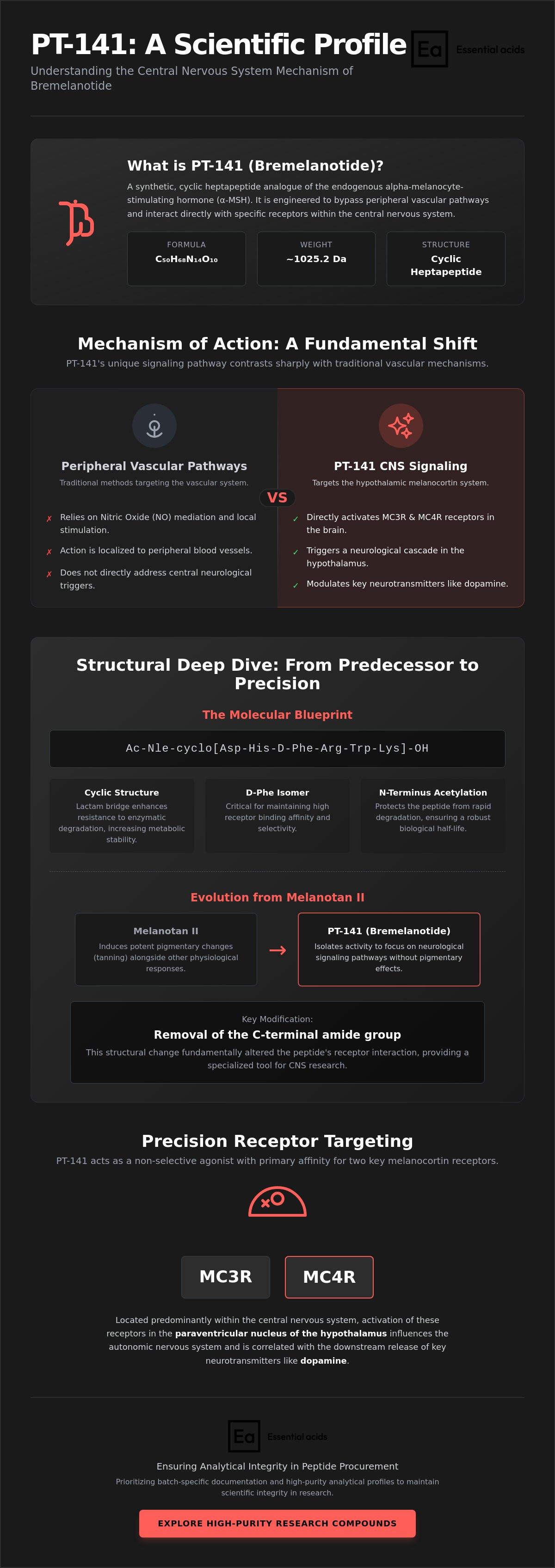
Bremelanotide (PT-141) is a synthetic peptide analogue of the endogenous alpha-melanocyte-stimulating hormone (α-MSH). It is classified as a cyclic heptapeptide, a structural configuration that provides enhanced metabolic stability compared to linear peptide chains. The compound is defined by the molecular formula C50H68N14O10 and possesses a molecular weight of approximately 1025.2 Da. Unlike traditional pharmacological agents that target the vascular system, pt 141 is engineered to interact with specific receptors within the central nervous system, establishing a distinct research profile for investigating melanocortin pathways.
The transition from endogenous hormones to synthetic research compounds requires precise molecular alterations to ensure biochemical integrity. The cyclic structure of this peptide is not merely a geometric feature; it's a functional modification that protects the molecule from rapid degradation. Researchers prioritize high-purity variants to ensure that the analytical data collected reflects the true biological potential of the compound without the interference of truncated sequences or contaminants.
Chemical Sequence and Structural Integrity
The primary chemical sequence of the peptide is Ac-Nle-cyclo[Asp-His-D-Phe-Arg-Trp-Lys]-OH. This specific arrangement includes an acetylation at the N-terminus and a cyclisation between the Asp (aspartic acid) and Lys (lysine) residues. This lactam bridge formation is critical because it restricts the conformational flexibility of the peptide, which enhances its resistance to enzymatic proteolysis in laboratory models. The presence of the D-Phe isomer at the fourth position is essential for maintaining high receptor binding affinity and selectivity within the melanocortin system. This structural rigidity ensures that the peptide remains stable long enough to facilitate meaningful observations in cellular assays.
Evolution from Melanotan II
The development of pt 141 originated from research into Melanotan II, a synthetic tanning peptide. While Melanotan II demonstrated potent effects on melanogenesis, it also induced significant non-pigmentary physiological responses. Scientists sought to isolate these secondary effects by modifying the molecular structure to eliminate the tanning response. The primary modification involved the removal of the C-terminal amide, a change that fundamentally altered the peptide's interaction with the melanocortin receptors.
This structural evolution resulted in a compound that maintains a robust biological half-life while focusing its activity on the MC3R and MC4R receptors. Laboratory observations distinguish the two peptides by their primary outcomes; where the predecessor induces pigmentary changes, the isolated bremelanotide molecule remains focused on neurological signaling pathways. This specificity allows for more targeted research into metabolic and behavioral processes without the confounding variables associated with systemic melanin production. The removal of the C-terminal amide is the defining factor in this shift, providing a specialized tool for researchers exploring central nervous system activation.
Mechanism of Action: Central Nervous System vs. Peripheral Pathways
The biological activity of pt 141 is defined by its function as a non-selective agonist of melanocortin receptors. Its primary affinity is directed toward the MC3R and MC4R subtypes, which are located predominantly within the central nervous system. This signaling pathway triggers a cascade of biological responses that originate in the brain rather than the periphery. Specifically, the peptide activates hypothalamic neurons within the paraventricular nucleus. This site acts as a regulatory hub for autonomic and behavioral responses. According to Bremelanotide chemical data, the compound's structural specificity allows it to interact with these central pathways effectively without relying on local vascular stimulation.
The Role of MC4R Signaling
MC4R activation influences the autonomic nervous system through complex signaling pathways. When pt 141 binds to these receptors, it correlates with the downstream release of neurotransmitters such as dopamine. These chemical messengers are essential for modulating behavioral interest in research models. Receptor selectivity remains a priority in analytical research to reduce off-target metabolic effects. While MC3R is associated with energy homeostasis, MC4R is more directly linked to the initiation of central behavioral responses. Researchers must account for these dual affinities to ensure scientific integrity during data collection.
Comparison with Phosphodiesterase Type 5 (PDE5) Inhibitors
A technical contrast exists between CNS-mediated responses and peripheral vascular relaxation. Phosphodiesterase type 5 (PDE5) inhibitors function by increasing nitric oxide levels in local tissues to induce vasodilation. Conversely, pt 141 doesn't rely on the vascular system to initiate its primary effect. This distinction is critical for researchers studying subjects who don't respond to traditional vascular compounds. If the underlying etiology is neurological rather than circulatory, peripheral treatments often prove ineffective.
The pharmacodynamic windows also differ. PDE5 inhibitors typically have a rapid onset centered on local blood flow. Melanocortin agonists exhibit a delayed onset, reflecting the time required for central nervous system signaling. For those requiring high-purity compounds for comparative studies, the analytical grade peptides available for research use provide the necessary consistency for reproducible results. This ensures that the observed data points remain strictly objective and free from the variables introduced by lower-quality compounds.
Primary Research Applications: Investigating Melanocortin Pathways
Research into pt 141 centers on the complex interplay within the melanocortin system. While much of the existing literature focuses on its approved clinical analogues, laboratory investigation explores broader applications. This includes the study of Female Sexual Interest/Arousal Disorder (FSIAD) and Hypoactive Sexual Desire Disorder (HSDD). By targeting central pathways, researchers observe how the peptide modulates interest at a neurological level. This distinguishes the compound from agents that only address peripheral physiological symptoms without influencing the underlying drive.
Studies also extend to male erectile dysfunction (ED), specifically focusing on cases where traditional vascular treatments fail. This is particularly relevant for research models involving psychological or neurological etiologies. Beyond these primary areas, emerging data suggests that melanocortin agonists possess significant anti-inflammatory properties. Laboratory models of haemorrhagic shock and ischaemia-reperfusion injury utilize these compounds to investigate their ability to modulate systemic inflammatory responses and autonomic stability during acute physiological stress. These applications suggest a versatile role for the peptide in critical care and inflammatory research.
Neuropsychological Research Models
Behavioral observations in animal models provide a foundation for understanding the biological basis of motivation. When pt 141 is administered in a controlled setting, it facilitates the study of how melanocortin signaling interacts with the brain's reward systems. Specifically, research focuses on the correlation between MC4R activation and the subsequent release of dopamine in the mesolimbic pathway. These observations help define the chemical triggers of desire. This research moves beyond simple mechanical responses to a more holistic understanding of central nervous system behavior and its impact on physiological outcomes.
Metabolic and Inflammatory Studies
The influence of MC3R and MC4R agonism extends into energy homeostasis and systemic inflammation. Agonists within this class are being examined for their potential to mitigate cellular stress in various experimental environments. Recent findings indicate that these peptides may exert protective effects in models of ischaemic damage. This line of inquiry often overlaps with other areas of cellular longevity and integrity research. For example, the investigation of metabolic stability and systemic protection aligns with Epithalon research regarding telomerase activation and the mitigation of molecular aging. Such cross-disciplinary studies are vital for defining the role of high-purity peptides in cellular protection and systemic regulation. Maintaining scientific integrity requires that all such observations be conducted using batch-verified compounds to ensure that metabolic data remains accurate and reproducible.
Laboratory Standards: Stability, Reconstitution, and Storage
Maintaining the analytical integrity of pt 141 requires strict adherence to standardized laboratory handling protocols. The peptide is typically synthesized and distributed as a lyophilized (freeze-dried) powder to ensure maximum stability. This state minimizes chemical degradation and prevents the premature initiation of enzymatic proteolysis. Once the vacuum seal of the vial is compromised, the molecule becomes increasingly susceptible to environmental factors. Researchers must prioritize high-purity compounds to ensure that stability data remains consistent across different batches.
Reconstitution is a critical phase where the peptide's primary structure is most vulnerable. It's essential to use an antimicrobial agent, such as bacteriostatic water, to prevent microbial growth during the study period. Using sterile water without a preservative agent is generally discouraged for any research extending beyond 24 hours. Proper handling during this stage involves avoiding any form of vigorous agitation; shaking the vial can lead to peptide denaturation and the loss of biological activity.
Reconstitution Protocols for Research
The reconstitution process should be performed with precision to minimize shear stress on the molecule. Laboratory technicians should follow these steps:
- Clean the vial septum with a 70% isopropyl alcohol swab.
- Introduce the bacteriostatic water slowly, allowing the solvent to drip down the interior side of the glass vial.
- Avoid direct impact of the liquid onto the lyophilized cake.
- Allow the vial to sit undisturbed until the powder dissolves completely; a gentle swirling motion may be used if necessary.
Standard laboratory concentrations often utilize a ratio of 10mg of peptide per 1ml of solvent. For more on handling standards for various compounds, see our guide on BPC-157 5mg molecular profiles. Following these established protocols ensures that the experimental results aren't confounded by degraded materials.
Temperature and Environment Requirements
Storage conditions serve as the primary determinant of the peptide's shelf life. In its lyophilized form, the compound is stable at room temperature for short periods, typically during transit. However, -20°C is recommended for long-term preservation to maintain the integrity of the cyclic structure for several years. Once reconstituted, the solution must be kept in a refrigerated environment between 2°C and 8°C. Under these conditions, the peptide generally remains viable for a timeframe of 28 to 30 days.
Environmental variables such as light exposure and temperature fluctuations can rapidly degrade the peptide. UV light, in particular, can catalyze the breakdown of the disulfide bonds or other structural linkages. It's vital to store vials in a dark environment or opaque containers. To maintain the highest level of scientific integrity in your study, you should source batch-verified research compounds that come with confirmed stability profiles. This level of caution reflects the gravity of laboratory research and the need for objective, reproducible data.
Ensuring Analytical Integrity in Peptide Procurement
The validity of observations within the melanocortin system is fundamentally dependent on the initial purity of the research materials. When investigating pt 141, the presence of truncated peptide sequences or residual solvents can compromise the analytical integrity of a study. Scientific integrity relies on the use of high-purity compounds with verified molecular profiles. Researchers must demand batch-specific documentation to ensure the absence of contaminants that could otherwise skew data related to receptor affinity or metabolic signaling. Essential Acids prioritizes transparency through rigorous testing and analytical reporting, providing the necessary clarity for complex laboratory environments.
A disciplined approach to procurement acts as a linguistic and procedural filter. It ensures that the compounds utilized in a study meet the stringent requirements of modern biochemistry. The reliance on precise nouns and verbs in our reporting emphasizes quality assurance over marketing flair. This commitment to transparency is designed to support researchers who require stable, verified compounds for reproducible results. Without a foundation of high-purity materials, the precision of the laboratory is lost to the variables of inconsistent manufacturing.
The Importance of HPLC and MS Testing
Verifying the chemical composition of a peptide requires specialized analytical techniques that go beyond surface-level descriptions. High-Performance Liquid Chromatography (HPLC) is utilized to determine the chemical purity percentage of the compound. This process separates the primary peptide from any impurities, ensuring that the researcher is working with a verified substance. Mass Spectrometry (MS) serves as a secondary layer of validation by confirming the identity of the peptide. It verifies the molecular mass against the theoretical weight of the sequence, ensuring the heptapeptide structure is correct. Learn more in our Researcher’s Guide to Analytical Integrity. Without these dual verification steps, the risk of utilizing misidentified or degraded compounds increases, which can lead to irreproducible results.
Regulatory Compliance and Ethical Sourcing
The philosophical signature "Making better, normal" is a commitment to providing the high-purity research materials required to advance scientific understanding. There's a clear distinction between research-grade peptides and human-grade pharmaceuticals. Essential Acids maintains a professional distance by strictly adhering to "Research Use Only" policies. This boundary ensures regulatory compliance and maintains a professional focus on the gravity of laboratory investigation. The use of pt 141 in a research setting is governed by these rules to ensure safety and boundary-setting remain priorities.
Responsible procurement involves maintaining a controlled research environment. This is achieved by sourcing compounds from entities that prioritize analytical precision over market trends. By ensuring that every vial is accompanied by verifiable data, the integrity of the scientific process is preserved. This disciplined approach to sourcing ensures that the focus remains on the precision of the laboratory. It reflects a deep commitment to regulatory transparency, distinguishing the brand from more commercialized health and wellness entities.
Advancing Melanocortin Research Through Analytical Precision
The investigation of pt 141 represents a sophisticated pivot from vascular-centric models to central nervous system signaling. By prioritizing the cyclic heptapeptide structure and its specific affinity for MC3R and MC4R, researchers can explore complex biological responses with greater precision. It's essential to maintain the structural integrity of these molecules through strict adherence to the storage and reconstitution protocols outlined in this profile. This ensures that every analytical observation remains objective and reproducible.
Reliable data is built on the foundation of high-purity compounds. Essential Acids provides the transparency necessary for rigorous laboratory work by offering batch-specific HPLC and Mass Spectrometry reports for all research materials. These high-purity peptides are manufactured to meet the demands of modern science. Secure national shipping across Australia ensures that your materials arrive under optimal conditions to preserve their stability. We invite you to continue your exploration of the melanocortin system with the confidence that your materials meet the highest analytical standards.
View PT-141 Analytical Data and Research Vials
Frequently Asked Questions
What is the primary difference between PT-141 and sildenafil?
The primary difference lies in the mechanism of action and the site of physiological activity. Sildenafil functions as a phosphodiesterase type 5 (PDE5) inhibitor that targets peripheral vascular relaxation by increasing nitric oxide levels in local tissues. In contrast, pt 141 is a melanocortin agonist that bypasses the vascular system to activate signaling pathways within the central nervous system. This distinction makes it a primary focus for research models involving neurological or psychological etiologies rather than purely circulatory issues.
Is PT-141 stable at room temperature during shipping?
PT-141 is stable at room temperature during shipping when it is maintained in its lyophilized (freeze-dried) state. This vacuum-sealed powder form is engineered to resist thermal degradation during standard transit timeframes. However, long-term stability requires more stringent temperature controls once the material reaches the laboratory. It should be transferred to a freezer at -20°C for long-term preservation to ensure the integrity of the molecular sequence remains intact for the duration of the study.
Which melanocortin receptors does PT-141 target most effectively?
This peptide functions as a non-selective agonist with its most effective affinity directed toward the MC3R and MC4R receptors. These receptors are predominantly located in the hypothalamus and are responsible for regulating autonomic and behavioral responses. While it also interacts with MC1R and MC5R, the primary research interest centers on the activation of the MC4R pathway. This specific interaction is what triggers the downstream release of neurotransmitters such as dopamine in CNS research models.
Can PT-141 be reconstituted with sterile water instead of bacteriostatic water?
PT-141 can be reconstituted with sterile water, but this is only recommended for single-use laboratory applications where the solution is utilized immediately. Sterile water lacks an antimicrobial agent, meaning the reconstituted peptide is highly susceptible to microbial growth. For any research protocol requiring multi-dose withdrawal or storage beyond 24 hours, bacteriostatic water is the required solvent. Using a preservative agent ensures the analytical integrity of the compound is not compromised by bacterial contamination during the study.
What are the common observations in research models regarding PT-141 side effects?
The most frequently observed side effect in clinical research models is nausea, which was reported in approximately 40% of participants during controlled trials. Other documented observations include facial flushing, headache, and a transient increase in blood pressure immediately following administration. These physiological responses are typically considered dose-dependent and are linked to the peptide's interaction with the broader melanocortin system. Researchers must monitor these variables closely to ensure the accuracy of their behavioral data.
How is the purity of PT-141 verified in a laboratory setting?
Verification of purity is achieved through High-Performance Liquid Chromatography (HPLC) and Mass Spectrometry (MS). HPLC is used to measure the purity percentage by separating the primary peptide from any residual solvents or truncated sequences. Mass Spectrometry confirms the identity of the molecule by verifying its molecular mass against the theoretical weight of 1025.2 Da. These analytical reports are essential for maintaining scientific integrity and ensuring that the laboratory results are not skewed by contaminants or incorrect peptide sequences.
What is the half-life of PT-141 in analytical research?
The terminal half-life of pt 141 in analytical research models is approximately 2.7 hours. While the peptide is cleared relatively quickly from the systemic circulation, the biological effects resulting from central nervous system signaling often persist significantly longer. This discrepancy between plasma concentration and physiological response is a key area of study for researchers. It suggests that the activation of the hypothalamic pathways triggers a cascade of downstream events that outlast the presence of the peptide itself.
Why is PT-141 restricted to research use only?
PT-141 is restricted to research use only to ensure it is handled within controlled laboratory environments by qualified professionals. This classification is a critical regulatory boundary that distinguishes high-purity research compounds from finished pharmaceutical products. Maintaining this status allows for the rigorous testing and batch-specific verification required for scientific integrity. It also serves as a necessary safety protocol, emphasizing that these materials are intended for in-vitro or animal research models and not for human consumption.
Legal Disclaimer
All products sold on this website are intended exclusively for laboratory research purposes and not for human or veterinary use, diagnosis, cure, treatment, or prevention of any disease or condition. None of the statements on this site have been reviewed or evaluated by the U.S. Food and Drug Administration (FDA) or comparable regulatory authorities. Purchasing or using these products for any unintended purpose, including human consumption, may violate federal or local laws and poses safety risks.