

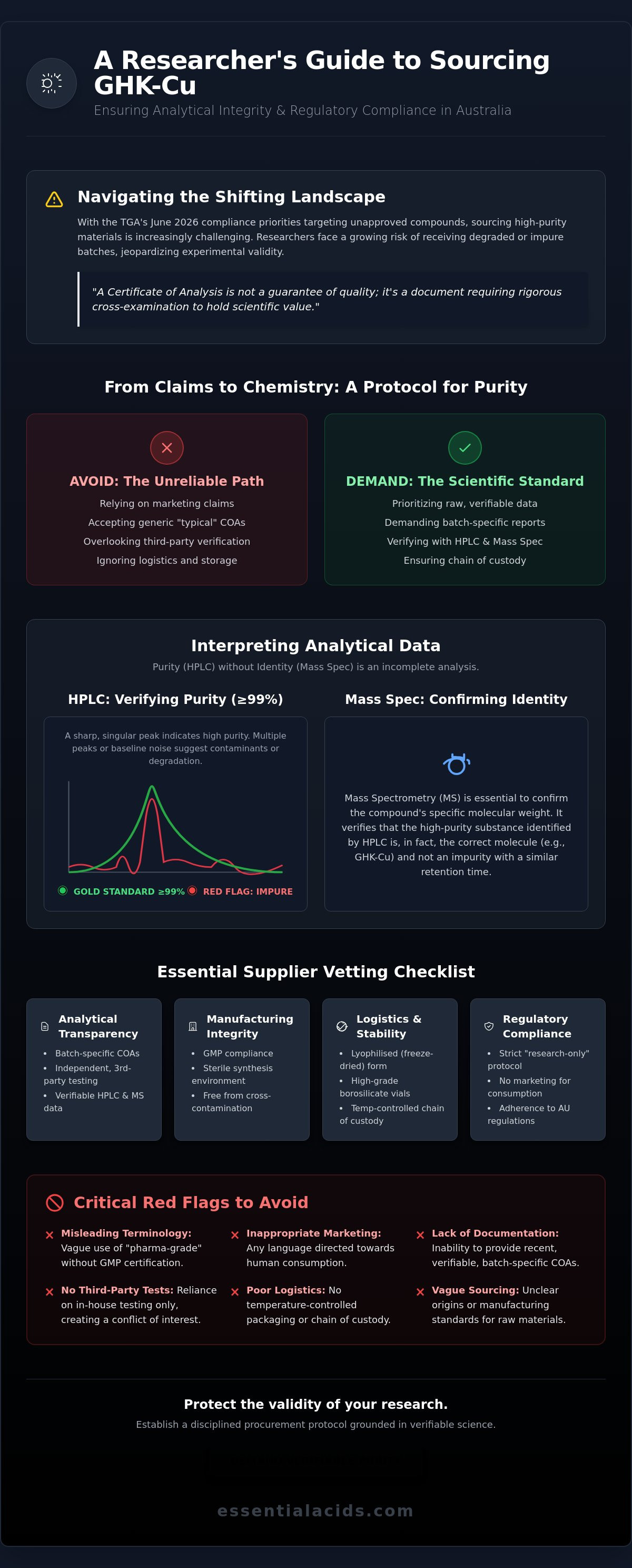
A Certificate of Analysis is not a guarantee of quality; it's merely a document that requires rigorous cross-examination to hold any scientific value. You likely understand that the Australian research landscape is currently under intense scrutiny, especially with the TGA’s June 2026 compliance priorities targeting unapproved compounds. Sourcing consistent materials is becoming increasingly difficult as regulatory boundaries tighten and the risk of receiving degraded or impure batches rises. This guide provides an objective framework to help you navigate these complexities and buy ghk-cu with confidence in its analytical integrity.
We prioritize raw data over marketing claims to ensure your laboratory work remains grounded in verifiable science rather than the trends of a volatile marketplace. We'll examine how to interpret batch-specific HPLC and mass spectrometry reports, verify ≥99% purity levels, and ensure the stability of lyophilised vials during transit within the Australian market. By establishing a disciplined procurement protocol, you can protect the validity of your research and maintain the high standards required for cellular ageing and metabolic studies. Our focus remains on the precision of the laboratory to help you achieve the goal of making better, normal.
Key Takeaways
- Learn to verify scientific integrity by demanding batch-specific HPLC and Mass Spectrometry reports rather than relying on generic documentation.
- Identify the specific criteria required to buy ghk-cu safely within the Australian regulatory landscape, focusing on suppliers that adhere to strict research-only protocols.
- Recognize common industry red flags, such as the misuse of "pharma-grade" terminology or marketing directed toward human consumption, which signal a lack of regulatory compliance.
- Understand the importance of domestic chain of custody and temperature-controlled packaging to prevent the degradation of sensitive lyophilised materials during transit.
- Evaluate manufacturing standards like Good Manufacturing Practice (GMP) to ensure that every compound meets the high-purity requirements of professional laboratory research.
Criteria for Selecting a Research Peptide Supplier in Australia
Procuring research materials within the Australian regulatory framework requires a transition from consumer-based logic to analytical verification. The selection of a supplier is a clinical decision that directly impacts the reproducibility of laboratory data. With the TGA increasing its scrutiny of unapproved peptides as of June 2026, researchers must prioritize suppliers that operate with absolute transparency and a strict adherence to research-only protocols. Scientific integrity is not a marketing claim; it's a measurable outcome of rigorous synthesis and independent verification. When you intend to buy ghk-cu for metabolic or cellular ageing studies, the supplier's expertise in biochemistry and their commitment to "Making better, normal" through high-purity compounds should be the primary metrics for evaluation.
Analytical Transparency and Certificates of Analysis
A Certificate of Analysis (COA) is the only valid proof of a peptide's purity and identity. To maintain scientific standards, this document must be batch-specific rather than a generic "typical" report used for multiple production runs. Each COA should clearly display the results of High-Performance Liquid Chromatography (HPLC) to verify purity and Mass Spectrometry (MS) to confirm the specific molecular weight of the Copper peptide GHK-Cu. Independent, third-party testing is essential to eliminate the conflict of interest inherent in self-reporting. Researchers are encouraged to verify the authenticity of these documents by cross-referencing the batch number directly with the testing facility. Any supplier unable to provide recent, verifiable, and batch-specific data fails the basic requirement of analytical integrity.
Manufacturing Integrity and Storage Standards
The biological activity of a peptide depends heavily on the precision of its synthesis and the stability of its final form. Adherence to manufacturing standards, such as Good Manufacturing Practice (GMP) compliance, ensures that the synthesis occurs in a sterile environment free from cross-contamination. Lyophilisation, the process of freeze-drying the peptide, is critical for long-term stability. This state prevents the rapid degradation that occurs in aqueous solutions. However, the quality of the primary packaging is often overlooked. Suppliers must use high-grade borosilicate glass vials and medical-grade stoppers to prevent oxidation and moisture ingress. In Australia's varied climate, maintaining a temperature-controlled chain of custody is non-negotiable. Sensitive research materials must be stored in climate-controlled environments to ensure that the molecular structure remains intact from the point of synthesis to the moment of laboratory arrival. When you buy ghk-cu, you are investing in the stability of the compound as much as the compound itself.
Interpreting Analytical Documentation: HPLC and Mass Spectrometry
Procuring research compounds without comprehensive analytical data is a risk to laboratory validity. High-Performance Liquid Chromatography (HPLC) serves as the primary standard for purity verification, but it is insufficient when used in isolation. A complete molecular profile requires the integration of Mass Spectrometry (MS) to ensure the compound synthesized is indeed the target sequence. Relying on a single report creates a blind spot where purity is confirmed, but identity remains unverified. For researchers in Australia, maintaining this level of scrutiny is a professional necessity to ensure that data remains reproducible and scientifically sound.
Reading an HPLC Chromatogram
HPLC is a technique used to separate, identify, and quantify each component in a mixture. When reviewing an HPLC chromatogram, the researcher must identify the primary peak and calculate the area under the curve (AUC). This calculation determines the purity percentage relative to other detectable signals. A sharp, narrow peak indicates high-purity material, ideally reaching ≥99%. Conversely, baseline instability or the presence of multiple major peaks are red flags that suggest the presence of synthesis byproducts or degradation. This "noise" on the graph signifies that the material does not meet the standards required for precise cellular signalling research.
The distinction between purity and concentration is often misunderstood. Purity measures the absence of contaminants within the peptide fraction itself. Concentration defines the actual mass of the peptide present in the lyophilised vial. It is possible to have a 99% pure peptide that is under-filled, leading to inaccurate dosing in a laboratory setting. Researchers must verify that the supplier's manufacturing processes ensure consistency in both purity and the total mass of the compound.
Verifying Molecular Weight via Mass Spectrometry
Mass Spectrometry provides the necessary verification of molecular weight by measuring the mass-to-charge ratio of ions. By matching the observed molecular weight to the theoretical weight of the peptide sequence, researchers can confirm the identity of the compound. MS ensures that the correct sequence is present, preventing the use of pure but incorrect substances in a study. Comparing MS data with established profiles, such as the tirzepatide structure, allows for the confirmation of complex molecular signatures through rigorous comparison.
Given the TGA compliance focus on unapproved peptides, maintaining this level of documentation is a prerequisite for professional laboratory work in Australia. When you buy ghk-cu, demanding a dual-report profile is the only way to satisfy the requirements of scientific integrity. To maintain these standards in your own facility, consider the verified research materials provided by Essential Acids, where analytical transparency is the baseline for every batch.
Research Grade vs. Commercial Grade: Identifying Red Flags
"Pharma-grade" is a marketing misnomer frequently employed to suggest a level of quality that is often unverified by batch-specific data. In a professional laboratory environment, the only relevant metric is analytical purity as confirmed by the HPLC and MS reports discussed previously. A primary red flag is any supplier offering peptides for human or veterinary consumption, or for use in medical diagnosis. Such claims are incompatible with the "research-use only" status required for regulatory compliance in Australia. When you buy ghk-cu, the documentation must reflect a clinical focus on biochemistry rather than consumer desires.
Suppliers who fail to include prominent disclaimers on all documentation and digital storefronts present a significant risk to the researcher’s chain of custody. Scientific integrity demands a detached, objective presentation of data. If the pricing structure appears significantly lower than the standard costs of high-purity synthesis, the material likely contains impurities or commercial additives. These additives, while common in consumer-grade products, can interfere with cellular signalling pathways and invalidate research outcomes. When you buy ghk-cu, the purity must be absolute, without the interference of stabilizing agents found in commercial formulations.
The Risk of Non-Lyophilised or Reconstituted Peptides
High-purity research peptides should be obtained exclusively in lyophilised powder form. Reconstitution in bacteriostatic water or saline initiates a countdown toward molecular degradation. Peptides in aqueous solution are highly susceptible to deamidation and irreversible oxidation, particularly when exposed to the thermal fluctuations common during transit across Australia. Lyophilisation provides a stable, "frozen" state that preserves the amino acid sequence until the moment of laboratory preparation. Receiving peptides in a pre-liquid state is a definitive sign of improper handling and compromised scientific utility.
Vetting the Supplier’s Scientific Authority
Evaluating a supplier requires an assessment of their technical expertise and the clinical accuracy of their communication. A legitimate partner for laboratory procurement will provide comprehensive technical data sheets and detailed molecular profiles. Marketing hype should be absent, replaced by specialized vocabulary from biochemistry and neuroscience. For instance, sourcing from suppliers that adhere to bpc 157 5mg standards ensures that the laboratory receives materials synthesized under rigorous protocols. A supplier’s authority is established through their adherence to these rules and their ability to provide the "quiet authority" of verified data. This disciplined approach ensures that your research remains focused on making better, normal through reliable compounds.
Logistics and Compliance for Australian Laboratory Procurement
Domestic fulfilment in Australia provides a critical advantage in maintaining a secure chain of custody for sensitive compounds. International transit often involves prolonged exposure to uncontrolled environments and customs related delays that can exceed three weeks. These variables introduce significant risks to the molecular integrity of the peptide. By sourcing locally, researchers ensure that materials are handled under Australian regulatory standards from the point of storage to final delivery. When you buy ghk-cu from a domestic supplier, the reduced transit time minimizes the window for environmental degradation and ensures the compound arrives in its intended analytical state.
Understanding the legal framework is essential for institutional compliance. In Australia, these peptides are classified strictly as laboratory research chemicals, which necessitates a specific type of documentation. Professional invoicing must reflect this classification to satisfy internal audits and regulatory requirements. High integrity suppliers avoid the casual language of e-commerce, instead providing the technical data and legal disclaimers required for professional procurement. This transparency ensures that the laboratory remains focused on metabolic and cellular ageing research without the administrative ambiguity that often accompanies international sourcing.
Cold Chain and Stability During Transit
The stability of lyophilised peptides is notably higher than their reconstituted counterparts, yet they remain vulnerable to the extreme thermal conditions of the Australian summer. Thermal insulated packaging is a non negotiable requirement for protecting the peptide's primary structure during transit. Expedited domestic shipping routes are utilized to further limit thermal exposure and maintain a consistent environment. Upon arrival at the facility, laboratory safety protocols should require immediate transfer to -20°C storage for long term stability. This disciplined approach to storage ensures that the compound's analytical profile remains unchanged until it is required for synthesis or analysis.
Institutional and Analytical Procurement Standards
Essential Acids functions as a rigorous gatekeeper for the scientific community, ensuring that all materials meet the highest standards of manufacturing integrity. We understand that the validity of your research depends on the reliability of your supply chain. By adhering to strict laboratory safety and handling protocols, we provide a stable foundation for neuroscience and biochemistry studies across Australia. This commitment to scientific integrity helps researchers achieve the goal of making better, normal through precise data. To maintain these standards in your facility, you can buy ghk-cu and other research materials through our secure, domestic portal.
Essential Acids: A Commitment to Scientific Integrity
Essential Acids operates with a disciplined commitment to scientific integrity, prioritizing the requirements of the laboratory over the trends of the commercial market. Our core philosophy, "Making better, normal," reflects a visionary outlook on human potential that is grounded in strictly objective and cautious research practices. Every compound in our catalog is positioned as a research-use only material, ensuring complete transparency with regulatory standards in Australia. By providing verified compounds for advanced modelling, we act as a reliable partner for researchers who demand high-purity materials for metabolic and cellular ageing studies. When you buy ghk-cu from our facility, you're engaging with a supplier that values the precision of the laboratory above all else.
Analytical rigor is maintained through the provision of batch-specific HPLC and Mass Spectrometry documentation for every vial. This ensures that the identity and purity of each compound are verified before they enter your laboratory environment. We maintain a professional distance that avoids the aggressive sales tactics common in modern e-commerce, allowing the quality of our compounds to speak for itself. This "quiet authority" is essential for maintaining the stability of research data and ensuring that every experiment is conducted with materials of the highest integrity. Our focus remains on the synthesis of compounds that meet the specific rigours of the scientific process.
Specialized Metabolic and Cellular Compounds
Our selection includes specialized metabolic inhibitors such as 5-Amino-1MQ, which is utilized in research models focusing on NNMT inhibition and muscle metabolism. While many suppliers focus on broad-market wellness, we provide the technical data necessary for precise tissue modelling applications. This includes high-purity GHK-Cu, BPC-157, and TB-500, each accompanied by batch-specific documentation to confirm sequence identity. For those investigating complex endocrine pathways, we offer innovative compounds like Retatrutide for triple hormone receptor agonism studies. When you buy ghk-cu for tissue modelling, you're accessing a material synthesized for absolute molecular accuracy.
Securing Your Research Materials
Accessing batch-specific analytical documentation is a standard part of our procurement process. We encourage researchers to review these technical profiles prior to procurement to ensure alignment with their specific modelling requirements. Our communication remains clinical and accurate, providing the specialized data needed for biochemistry and neuroscience research without unnecessary marketing flair. This adherence to rules and professional distance establishes Essential Acids as a highly reliable and ethical partner for the Australian research community. To maintain the validity of your laboratory work, you may review our catalog of high-purity research peptides and access the verified materials required for your next study.
Advancing Research Through Analytical Precision
The procurement of research materials in Australia requires a transition from speculative trust to empirical verification. You've seen that the validity of laboratory outcomes depends on the integration of batch-specific HPLC and Mass Spectrometry reports to confirm both purity and molecular identity. By prioritizing suppliers that adhere to strict research-only compliance standards, you protect your work from the risks of degradation and regulatory ambiguity. Maintaining this level of scrutiny is essential for ensuring that your data remains reproducible and scientifically sound within the evolving Australian landscape.
Whether you need to buy ghk-cu for cellular ageing models or specialized NNMT inhibitors like 5-Amino-1MQ for metabolic studies, the standard remains the same: transparency is non-negotiable. Essential Acids remains dedicated to this disciplined approach, ensuring that every compound provided meets the rigorous requirements of the scientific community. We invite you to procure high-purity research peptides with analytical transparency to secure the future of your modelling efforts. Establishing a reliable supply chain isn't just a logistical task; it's a fundamental requirement for achieving your objective of making better, normal.
Frequently Asked Questions
Is it legal to buy peptides in Australia for research purposes?
Peptides are legal in Australia when intended strictly for laboratory research use. The Therapeutic Goods Administration (TGA) maintains oversight of unapproved peptides, particularly those synthesized for clinical modelling. It's critical that procurement is handled through professional channels that provide clear "research use only" documentation to satisfy institutional compliance and Australian law.
How can I verify the purity of a peptide before ordering?
Purity is verified by examining batch-specific High-Performance Liquid Chromatography (HPLC) and Mass Spectrometry (MS) data. The HPLC chromatogram should show a single primary peak with an area under the curve (AUC) representing ≥99% purity. MS confirms that the molecular weight of the substance matches the specific peptide sequence, ensuring the compound is correctly identified.
What is the difference between research-grade and pharmaceutical-grade peptides?
Research-grade peptides are synthesized specifically for analytical modelling and laboratory experimentation. Pharmaceutical-grade refers to compounds manufactured under different regulatory pathways for human clinical use. In the research sector, "pharma-grade" is frequently used as a marketing term rather than a technical classification, making analytical verification the only reliable metric for quality.
Can research peptides be purchased for human consumption?
No, research peptides are never for human or veterinary consumption. These compounds are synthesized strictly for in vitro or in vivo laboratory research. Any supplier marketing these materials for human use or diagnosis is operating outside of established scientific and regulatory boundaries, posing a significant risk to the researcher's professional standing.
How should lyophilised peptides be stored upon delivery to the lab?
Lyophilised vials should be stored at -20°C immediately upon arrival at the laboratory. While the freeze-dried powder remains stable at room temperature for brief periods, sub-zero temperatures are necessary to prevent long-term degradation. Avoid frequent freeze-thaw cycles by only reconstituting the material when it's required for immediate experimental use.
What documents should a reputable peptide supplier provide?
Reputable suppliers provide batch-specific Certificates of Analysis (COA) that include both HPLC and Mass Spectrometry reports. You should also receive technical data sheets detailing the molecular profile and professional invoices that correctly classify the materials as research chemicals. These documents are necessary for maintaining a transparent and compliant laboratory chain of custody.
Why is batch-specific testing more important than a general COA?
Batch-specific testing is the only way to account for synthesis-to-synthesis variations in purity and identity. General or "typical" COAs are often outdated and don't reflect the specific vial you receive. Demanding data for every unique batch ensures that your research is conducted with materials that meet the exact 99% purity standards required for data reproducibility.
How does Essential Acids ensure the stability of peptides during domestic shipping?
We use thermal-insulated packaging and expedited domestic routes to minimize thermal stress during transit. This protective protocol ensures that when you buy ghk-cu or other sensitive metabolic compounds, the molecular integrity remains intact. Our logistics are designed to respect the gravity of laboratory research by maintaining a stable environment from our facility to yours.
Legal Disclaimer
All products sold on this website are intended exclusively for laboratory research purposes and not for human or veterinary use, diagnosis, cure, treatment, or prevention of any disease or condition. None of the statements on this site have been reviewed or evaluated by the U.S. Food and Drug Administration (FDA) or comparable regulatory authorities. Purchasing or using these products for any unintended purpose, including human consumption, may violate federal or local laws and poses safety risks.