

A 5-amino-1mq certificate of analysis isn't merely a supplementary document; it's the primary safeguard for the integrity of your laboratory data. In the rigorous field of NNMT inhibition research, assuming a compound's purity based on a label alone is a risk that few serious investigators can afford. You've likely encountered the frustration of deciphering dense HPLC reports or questioning if a specific batch aligns with its documented molecular mass of 159.21 g/mol. We agree that transparency in chemical procurement is non-negotiable for reproducible science.
This technical guide provides a clear framework for interpreting analytical documentation to confirm that your 5-Amino-1MQ meets the 99% purity threshold required for metabolic studies. We'll break down the complexities of mass spectrometry and batch-specific data, ensuring you can verify the identity and quality of your research materials with absolute precision. This overview covers how to evaluate chromatograms and verify molecular integrity, providing the clarity needed for reliable procurement in a research-only context.
Key Takeaways
- Identify the essential components of a 5-amino-1mq certificate of analysis to ensure every batch of NNMT inhibitors meets rigorous scientific validation standards.
- Master the interpretation of HPLC and Mass Spectrometry reports to confirm both the purity levels and the precise molecular identity of your laboratory samples.
- Evaluate the necessity of the ≥99% purity benchmark for metabolic research and understand how sub-standard compounds can compromise the integrity of sensitive cellular assays.
- Apply analytical data to optimize laboratory handling and desiccated storage conditions, maintaining the long-term stability of 5-Amino-1MQ across various experimental timelines.
- Implement a protocol for third-party verification to guarantee batch-to-batch transparency and safeguard the reproducibility of your research findings.
The Role of a Certificate of Analysis in 5-Amino-1MQ Research
A Certificate of Analysis (COA) serves as the definitive analytical record for a specific production lot of a chemical compound. For investigators studying 5-Amino-1MQ, this document is the primary evidence that the material received matches the chemical properties required for valid experimental outcomes. 5-Amino-1MQ functions as a potent, small molecule inhibitor of nicotinamide N-methyltransferase (NNMT), an enzyme central to cellular energy metabolism. Because metabolic pathways are highly sensitive to exogenous contaminants, rigorous validation through a 5-amino-1mq certificate of analysis is essential to prevent confounding variables. In laboratory settings, experimental reproducibility relies on the precise quantification of purity, usually determined through High-Performance Liquid Chromatography (HPLC).
The relationship between analytical transparency and data integrity cannot be overstated. Without a batch-specific report, a researcher is essentially operating in the dark, relying on generalized data that may not reflect the actual composition of the sample. In Australia, laboratory standards for research-grade compounds require strict adherence to documentation that proves identity and purity. This ensures that any biological effect observed during an assay is attributable to the compound itself rather than an unintended impurity or byproduct of synthesis.
Scientific Integrity and Batch-Specific Data
Generic specification sheets often outline what a product should be, but they don't reflect what a specific vial actually contains. Scientific integrity requires batch-specific results that provide a real-time snapshot of a compound's purity and identity. Timestamped analytical reports allow investigators to log precise data into their laboratory management systems, ensuring that every assay is backed by verified metrics. It's critical to confirm that the compound matches the IUPAC designation of 5-Amino-1-methylquinolin-1-ium. Discrepancies in molecular identity can lead to unintended biological interactions, particularly in sensitive cellular ageing models. A 5-amino-1mq certificate of analysis provides this necessary layer of confirmation, distinguishing high-purity research materials from unverified alternatives.
Regulatory Compliance for Research Use
The documentation accompanying 5-Amino-1MQ must clearly define its status as a "Research Use Only" compound. This isn't just a label; it's a regulatory boundary that dictates how the material is handled, stored, and disposed of within institutional frameworks. COAs support institutional safety protocols and ethics committee requirements by providing the necessary chemical identifiers. Key components for compliance include:
- The CAS Number: Utilizing 1190315-88-7 for precise material identification in safety data logs.
- Purity Thresholds: Confirming the sample meets the minimum requirements for the specific research application.
- Traceability: Linking the physical sample to its synthesis records through a unique lot number.
Maintaining this level of transparency is vital for adhering to strict laboratory standards. By providing a 5-amino-1mq certificate of analysis with every lot, suppliers ensure that researchers remain compliant with both local regulations and the internal requirements of their respective research institutions. This disciplined approach to documentation reflects a commitment to the gravity of scientific inquiry.
Key Analytical Components: HPLC and Mass Spectrometry
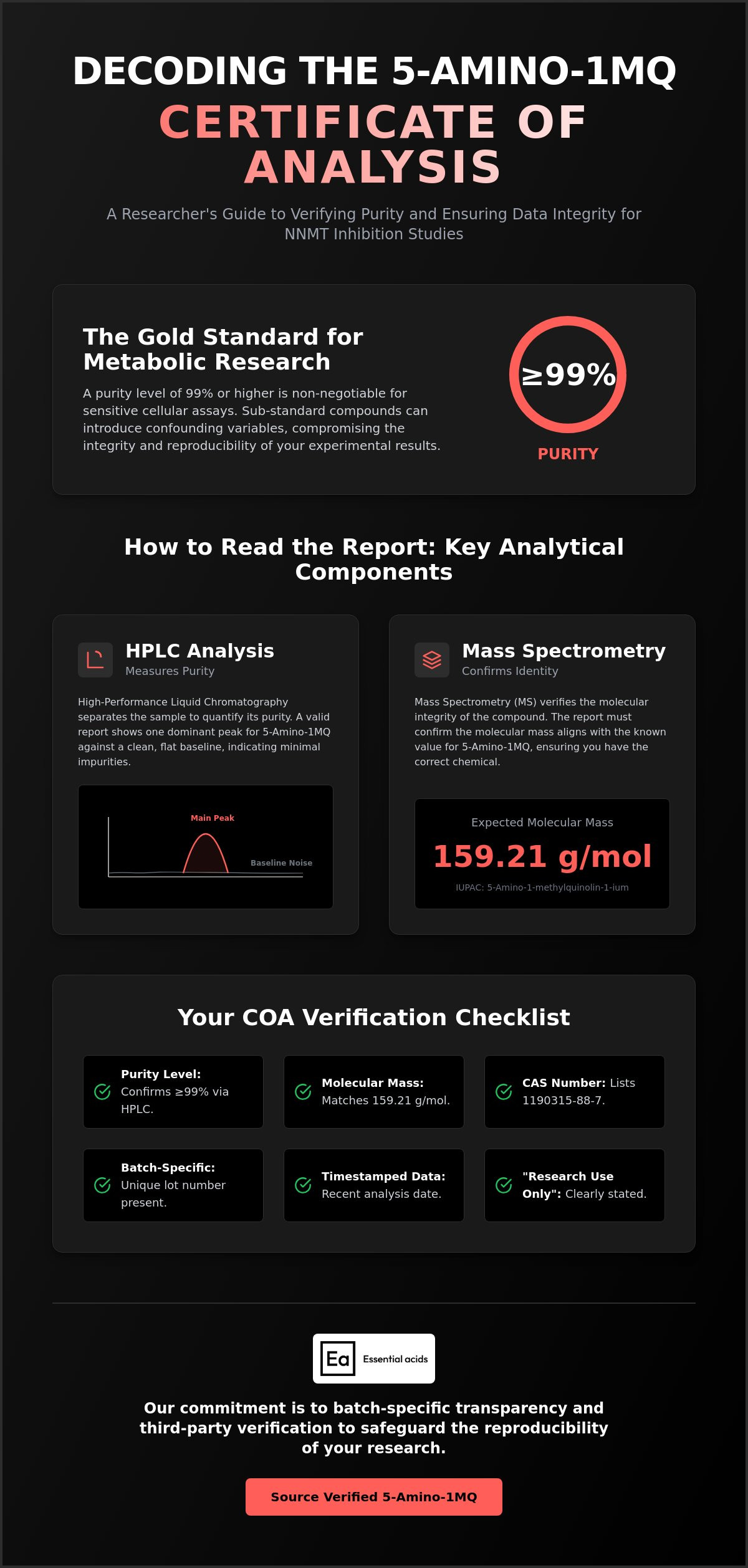
The analytical verification of 5-Amino-1MQ relies on two primary pillars: High-Performance Liquid Chromatography (HPLC) and Mass Spectrometry (MS). HPLC serves as the gold standard for determining chemical purity by separating the sample into its constituent parts. This process involves passing the compound through a stationary phase (the column) using a liquid mobile phase (the solvent). A high-integrity 5-amino-1mq certificate of analysis must detail these specific parameters, as variations in the column type or solvent gradient can significantly shift results. These methods should align with the principles found in FDA guidance on methods validation to ensure the data is both reliable and reproducible.
When reviewing a report, investigators must distinguish between the primary peak and baseline noise. The baseline represents the electronic and chemical background of the system. A sharp, narrow peak with minimal "tailing" indicates a stable and well-resolved sample. Conversely, wide peaks or significant baseline drift can suggest degradation or poor chromatographic conditions. Researchers seeking verified compounds can review the batch data for 5-Amino-1MQ to ensure alignment with their specific protocol requirements.
Decoding the HPLC Chromatogram
The retention time (Rt) is the specific duration it takes for 5-Amino-1MQ to travel through the column. This value is a fingerprint for the compound under a given set of conditions. Purity is calculated using the Area Under the Curve (AUC) method, which measures the area of the target peak relative to the total area of all detected peaks. A report showing 99% purity means that 99% of the total detector response is attributed to the 5-Amino-1MQ molecule. Any secondary peaks, no matter how small, indicate impurities that could potentially interfere with sensitive NNMT inhibition assays. Identifying these trace contaminants is vital for maintaining the objectivity of your research outcomes.
Mass Spectrometry and Molecular Identity
While HPLC quantifies purity, Mass Spectrometry (MS) confirms the molecular identity of the compound. It measures the mass-to-charge (m/z) ratio of ions to determine the exact molecular weight. For 5-Amino-1MQ, the MS spectrum must show a dominant peak at 159.21 g/mol. This data confirms that the synthesis has yielded the correct quinoline derivative rather than a structural isomer or a precursor. MS is also highly effective at detecting residual solvents or heavy metal by-products that might not be visible on an HPLC chromatogram. A clean, batch-specific MS report ensures the molecular integrity of the sample, providing a secure foundation for metabolic and cellular research.
Interpreting Purity Thresholds for Research Compounds
In metabolic research, the difference between 98% and 99% purity isn't just a marginal statistic; it represents a tenfold decrease in potential contaminants. For a compound like 5-Amino-1MQ, which specifically targets the NNMT enzyme, the presence of even 1% unknown material can introduce significant experimental noise. A 5-amino-1mq certificate of analysis provides the quantitative proof that a batch meets the high-integrity standards required for cellular assays. Utilizing compounds with sub-98% purity introduces the risk of including residual synthesis catalysts or structural isomers that can competitively inhibit the target enzyme or cause unintended cytotoxic effects.
Comparing 5-Amino-1MQ purity across different manufacturing batches reveals the stability of the synthesis process. Documented examples show verified purities of 99.1% for specific lots (such as Lot #YPB.242) and 99.2% for others (Lot #YPB.247). These minor fluctuations are recorded within the analytical report to allow researchers to adjust their protocols if necessary. Maintaining this level of batch-specific transparency is essential for investigators who require precise control over their experimental variables and want to ensure that observed biological effects are strictly attributable to the target molecule.
Defining High-Purity in a Research Context
Technical grade chemicals are often suitable for industrial applications but lack the rigorous validation needed for biochemistry. Analytical research grade requires a specific quantitative percentage backed by a 5-amino-1mq certificate of analysis. This distinction ensures that the compound's "High-Purity" claim is a verified fact rather than a marketing descriptor. For NNMT inhibition studies, a minimum purity threshold of 99% is required to ensure that observed metabolic shifts are not the result of exogenous contaminants.
Detecting and Quantifying Impurities
Quinoline synthesis often results in specific by-products that must be identified and quantified. Researchers should examine the chromatogram for any secondary peaks that rise above the baseline noise. Determining if an impurity peak is statistically significant depends on the signal-to-noise ratio; a peak is typically considered significant if its height is at least three times the level of the baseline noise. The baseline itself should be stable and flat, indicating that the column was properly equilibrated and the mobile phase was free of contaminants. If the signal-to-noise ratio is low, the reported purity may be less reliable, potentially compromising the integrity of sensitive metabolic data. This level of scrutiny is what separates reliable laboratory research from unverified experimentation.
Laboratory Standards: Sourcing and Handling Research Materials
The 5-amino-1mq certificate of analysis serves as a critical reference point for establishing laboratory storage and handling protocols. Because 5-Amino-1MQ is a small molecule inhibitor of NNMT, its stability is contingent on maintaining specific environmental conditions. Most high-purity batches require storage in a desiccated environment at temperatures between -20°C and 4°C to prevent degradation over extended periods. Moisture ingress is a primary concern for quinoline derivatives, as it can compromise the molecular integrity verified during the initial HPLC analysis. Failure to maintain these conditions can lead to the formation of degradation products that interfere with cellular metabolic assays.
Physical verification is a mandatory step upon receiving any research-grade compound. The COA typically describes the material as an off-white to yellow powder. If the physical sample shows signs of clumping or significant color shifts not documented in the report, the batch's purity should be questioned. This visual assessment complements the quantitative data provided in the analytical reports, ensuring the compound hasn't been compromised during transit. It's a fundamental aspect of quality control that precedes any solvent reconstitution or experimental application.
Procurement and Quality Assurance
Integrating COA verification into the buy research peptides australia workflow allows institutions to maintain high standards of scientific integrity. A robust procurement strategy involves auditing suppliers to ensure they provide batch-specific documentation rather than generic specification sheets. Digital archives of every 5-amino-1mq certificate of analysis should be maintained to facilitate long-term study validation and to provide a clear audit trail for ethics committees and regulatory bodies. This disciplined approach to documentation ensures that if experimental anomalies occur, the researcher can quickly rule out material impurity as a cause.
Stability and Handling Protocols
Molecular stability varies significantly across different classes of research chemicals. While peptides have unique folding requirements, researchers may find it useful to review the tirzepatide structure guide to understand how molecular profiling informs stability analysis in a laboratory setting. For 5-Amino-1MQ, the specific batch data often dictates solubility thresholds in common laboratory solvents like DMSO or ethanol. All handling procedures must strictly follow the Material Safety Data Sheet (MSDS) markers to mitigate risks associated with chemical exposure. Researchers can procure 5-Amino-1MQ with verified analytical data to ensure their laboratory protocols are based on accurate, batch-specific information.
Batch-Specific Transparency: The Essential Acids Quality Protocol
Essential Acids operates with a disciplined focus on scientific integrity. We understand that laboratory research requires more than just high-purity chemicals; it requires the verifiable data to prove it. Every lot of 5-Amino-1MQ we provide is accompanied by a batch-specific 5-amino-1mq certificate of analysis. This protocol ensures that the "Making better, normal" philosophy is grounded in objective, technical reality. We prioritize transparency over marketing flair, allowing the analytical results to speak for the quality of the compound. This approach serves as a linguistic and structural filter, ensuring that our materials are utilized by researchers who value precision and regulatory compliance.
Our commitment to transparency extends to the verification of every vial. We don't rely on outdated or generic specification sheets that fail to account for batch-to-batch variation. Instead, we provide the exact chromatograms and mass spectrometry data that correspond to the specific material in your laboratory. This level of detail is necessary for investigators who must account for every variable in their NNMT inhibition models. By maintaining this rigorous standard, we establish ourselves as a reliable partner for institutions that prioritize data accuracy over commercial convenience.
Our Analytical Verification Process
The journey of a compound from synthesis to your laboratory involves multiple rigorous checkpoints. Once 5-Amino-1MQ is synthesized, it undergoes internal testing before being sent to independent third-party laboratories for final validation. These external partners perform HPLC and MS analysis to confirm that the material meets our ≥99% purity threshold. For example, specific lots like Lot #YPB.247 are verified to 99.2% purity, ensuring that the molecular footprint of 159.21 g/mol is consistent across the sample. This process eliminates the bias often found in self-reported data and ensures that every vial maintains the molecular integrity required for metabolic research. It's a standard that reflects our commitment to the gravity of scientific inquiry.
Direct Access to Research Documentation
We facilitate seamless access to all technical data for our research community. Investigators can use the unique batch numbers found on their vials to retrieve the corresponding 5-amino-1mq certificate of analysis from our digital archive. This system allows for precise laboratory logging and supports institutional ethics committee requirements for material validation. If you have technical inquiries regarding specific peak resolutions or m/z ratios, our professional team is available to provide the necessary clarification. We are dedicated to supporting the Australian scientific community by providing the verified research materials required for reproducible, high-level science. This direct access ensures that your focus remains on the laboratory results rather than the uncertainty of chemical quality.
Advancing Scientific Integrity in Metabolic Research
Ensuring the reproducibility of NNMT inhibition studies requires a disciplined approach to material validation. A 5-amino-1mq certificate of analysis isn't just a regulatory requirement; it's the technical foundation for every assay conducted in your laboratory. By verifying that your compounds meet the 99% purity threshold and align with the correct molecular mass via mass spectrometry, you eliminate the variables that compromise experimental data. Precise storage and handling, informed by batch-specific results, further safeguard the long-term stability of your research materials.
Essential Acids maintains a firm commitment to transparency and scientific accuracy. Every lot we provide undergoes rigorous third-party testing to ensure it meets our exacting standards for laboratory research use only. We invite you to Procure 5-Amino-1MQ with Batch-Specific Analytical Documentation to secure the integrity of your next study. With verified analytical reports and a focus on high-purity compounds, your laboratory can move forward with total confidence in its metabolic discoveries.
Frequently Asked Questions
How do I read a 5-Amino-1MQ HPLC report?
Reading an HPLC report requires identifying the primary peak and calculating the area under the curve (AUC). You must locate the retention time (Rt) that corresponds to the 5-Amino-1MQ molecule under the specified chromatographic conditions. Any secondary peaks represent impurities that should be quantified relative to the total detector response. A stable baseline and sharp peak resolution are indicators of a well-executed 5-amino-1mq certificate of analysis that confirms material quality.
What is the significance of the 159.21 g/mol molecular weight in the COA?
The molecular weight of 159.21 g/mol serves as the definitive identifier for the 5-Amino-1-methylquinolin-1-ium cation. This value is verified through mass spectrometry to ensure the synthesis has produced the correct quinoline derivative. Discrepancies in this molecular mass suggest the presence of structural isomers or incomplete chemical reactions. It is a fundamental metric for confirming that the compound in the vial matches the intended research material exactly.
Why is 99% purity critical for laboratory research involving 5-Amino-1MQ?
High-purity thresholds of 99% or greater are necessary to prevent exogenous contaminants from interfering with sensitive enzymatic assays. Because 5-Amino-1MQ is a potent NNMT inhibitor, even trace amounts of residual catalysts can alter cellular energy metabolism results. Sub-standard purity levels introduce experimental noise that compromises the reproducibility of your data. Maintaining this benchmark ensures that observed biological effects are strictly attributable to the target molecule in your study.
Does every batch of 5-Amino-1MQ come with a unique Certificate of Analysis?
Yes, Essential Acids provides a unique 5-amino-1mq certificate of analysis for every individual production lot. We don't utilize generic specification sheets because analytical results can vary slightly between synthesis cycles. Providing batch-specific data allows researchers to log precise purity levels into their laboratory management systems. This practice is essential for maintaining a rigorous audit trail and ensuring institutional compliance during long-term metabolic studies.
What is the difference between an HPLC report and a Mass Spectrometry report?
HPLC measures the purity of a sample by separating its components, while Mass Spectrometry (MS) confirms the molecular identity by measuring the mass-to-charge ratio. HPLC tells you how much of the target compound is present relative to impurities. MS provides the molecular footprint to prove that the compound is indeed 5-Amino-1MQ. Both analytical techniques are required to provide a comprehensive profile of a research-grade chemical before laboratory application.
How can I verify the authenticity of an Essential Acids COA?
You can verify the authenticity of our documentation by cross-referencing the batch number on your vial with our digital archive. Each report is timestamped and linked to a specific production lot that has undergone third-party validation. If the batch number on your physical sample doesn't match the documentation provided, it's a sign that the material's integrity cannot be guaranteed. This system ensures transparency and protects the quality of your research data.
Does 5-Amino-1MQ require a Material Safety Data Sheet (MSDS) for laboratory use?
Every research compound requires a Material Safety Data Sheet (MSDS) to comply with institutional safety and ethics protocols. The MSDS provides critical information on solubility, toxicity, and proper disposal methods for 5-Amino-1MQ. While the COA focuses on analytical purity, the MSDS ensures that laboratory personnel can handle the material safely. Both documents are necessary for maintaining a well-regulated and secure laboratory environment during all experimental phases.
What should I do if the COA results do not match my independent laboratory test?
If your independent results don't align with our COA, you should first verify that your laboratory used the same chromatographic parameters. Variations in the mobile phase, column type, or detector wavelength can lead to different retention times and purity calculations. We encourage researchers to contact our technical support team to compare methodologies and resolve discrepancies. Our goal is to ensure scientific integrity through transparent communication and rigorous data verification.
Legal Disclaimer
All products sold on this website are intended exclusively for laboratory research purposes and not for human or veterinary use, diagnosis, cure, treatment, or prevention of any disease or condition. None of the statements on this site have been reviewed or evaluated by the U.S. Food and Drug Administration (FDA) or comparable regulatory authorities. Purchasing or using these products for any unintended purpose, including human consumption, may violate federal or local laws and poses safety risks.