

Accrediting analytical research laboratory procedures is not a bureaucratic formality. It is the mechanism by which a laboratory proves, to an independent third party, that its methods produce reliable, traceable, and scientifically defensible results. The formal industry term for this process is laboratory accreditation, governed primarily by standards such as ISO/IEC 17025. Without it, your data is vulnerable to regulatory challenge, client rejection, and the kind of reputational damage that takes years to recover from. This guide walks quality assurance professionals through every phase of accreditation, from initial prerequisites through to maintaining compliance across surveillance cycles.
Table of Contents
- Key takeaways
- Accrediting analytical research laboratory procedures: prerequisites first
- Steps for implementing accreditation of analytical procedures
- Common accreditation challenges and how to address them
- Maintaining accreditation: ongoing quality assurance
- My perspective on accreditation in practice
- Support your accredited research with quality compounds
- FAQ
Key takeaways
| Point | Details |
|---|---|
| Accreditation is ongoing | Treat laboratory accreditation as a continuous quality cycle, not a one-time approval event. |
| Scope precision is non-negotiable | Each analyte, method, and matrix combination must be individually accredited with no assumed equivalence. |
| Method validation drives compliance | Thorough validation of analytical procedures before assessment prevents costly delays and nonconformities. |
| Documentation trails matter | Every record from sample receipt to final report must demonstrate traceability and competence. |
| Proficiency testing is a live check | Systematic participation in proficiency testing is mandatory and a frequent failure point at reassessment. |
Accrediting analytical research laboratory procedures: prerequisites first
Before submitting an application to an accreditation body, your laboratory must have several foundational elements firmly in place. Attempting to pursue accreditation without these is the single most common reason labs stall during the process.
The two most relevant frameworks for analytical research laboratories in 2026 are ISO/IEC 17025 and the FDA’s LAAF programme, which requires accredited laboratories for specific food testing activities. Understanding which standard governs your scope of work determines your entire preparation strategy.
Core requirements at a glance
| Requirement | What assessors look for |
|---|---|
| Management system | Documented quality manual, policies, and objectives aligned to the standard |
| Personnel competence | Training records, qualifications, and demonstrated analytical proficiency |
| Method documentation | SOPs, work instructions, and validated or verified method records |
| Equipment calibration | Current calibration certificates with traceability to national standards |
| Scope definition | Exact analyte, method, and matrix combinations listed for accreditation |
| Internal audit records | Evidence of completed audits with findings and corrective actions closed |
Scope definition deserves particular attention. Exact scope matching for analyte, method, and matrix is critical, with no automatic reciprocity even for seemingly equivalent methods. A laboratory accredited to measure lead in drinking water by ICP-MS cannot assume that accreditation extends to lead in soil or lead by atomic absorption spectroscopy. Each combination is assessed independently.
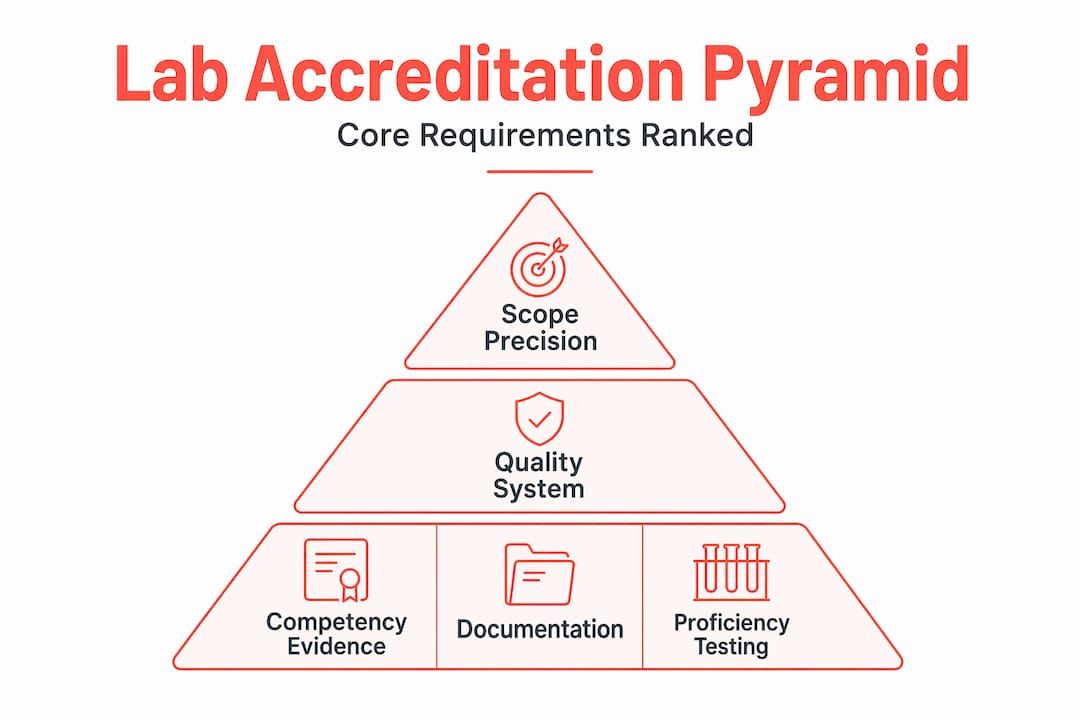
Your quality management system must be genuinely operational before assessment, not assembled in the weeks prior. Assessors distinguish quickly between a system that is lived in and one that was printed for the occasion.
Steps for implementing accreditation of analytical procedures
The accreditation process follows a structured sequence. Rushing any phase creates compounding problems downstream.
-
Conduct a gap analysis. Compare your current quality system, documentation, and method records against the requirements of your target standard. Be honest. Identify missing SOPs, expired calibrations, and personnel training gaps before an assessor does.
-
Develop and revise your quality manual and SOPs. Your quality manual sets the framework. SOPs must describe each analytical procedure in enough detail that a competent analyst can reproduce results consistently. Work instructions handle equipment-specific steps.
-
Perform method validation or verification. This is where many laboratories underestimate the effort required. Validation elements include specificity, linearity, accuracy, precision, range, limit of detection, and limit of quantitation. Standard methods require verification under your laboratory’s conditions. Lab-developed methods require comprehensive validation from the ground up.
-
Train staff and assess competence. Training records alone are insufficient. You need documented evidence that analysts have demonstrated competency on each method. Witnessed analyses, proficiency test results, and supervisor sign-offs all contribute to this record.
-
Run internal audits and management reviews. The typical accreditation timeline spans documentation development in months two through five, implementation and training in months four through eight, method validation in months three through ten, and onsite assessment in months eleven through fourteen. Internal audits during this period are not optional rehearsals. They are your primary quality check.
-
Submit your application and prepare for onsite assessment. Assessment teams include a lead assessor who evaluates your quality management system and technical assessors who observe analytical procedures, interview staff, and inspect records. Prepare your team for both.
Pro Tip: Run a mock assessment at least six weeks before your scheduled onsite visit. Have someone unfamiliar with your day-to-day operations ask the questions an assessor would ask. The gaps that surface will surprise you.
Common accreditation challenges and how to address them
Even well-prepared laboratories encounter obstacles. Knowing where others have struggled lets you get ahead of the problems.
Proficiency testing failures. Labs must typically participate in proficiency testing one to two times per year per test method. The failure is rarely in participation itself. It is in treating PT as a paperwork exercise rather than a genuine competence check. When a PT result falls outside acceptable limits, the corrective action must be thorough, documented, and closed before reassessment.
Measurement uncertainty estimation. Many laboratories either skip this entirely or produce estimates that are not fit for purpose. Uncertainty must be estimated for each method and reported with results. If your analysts cannot explain how the uncertainty budget was constructed, assessors will notice.

Scope precision errors. As noted above, the analyte-method-matrix combination must be exact. Laboratories frequently list scope items in ways that are broader than what they have actually validated. Assessors will test the boundaries of your stated scope.
Documentation gaps. The most common gaps include missing competency evidence for specific methods, corrective actions that were opened but never formally closed, and equipment records that cannot demonstrate continuous calibration traceability. The evidence chain from sample receipt through reporting must be complete and legible.
Assessor interviews. Analysts who cannot explain why a procedure is performed a certain way, or who give answers inconsistent with the SOP, raise immediate concerns. Prepare your team not just to follow procedures but to articulate the reasoning behind them.
Pro Tip: Create a single-page competency matrix for each analyst showing which methods they are authorised to perform and when that authorisation was last verified. Assessors ask for this information repeatedly and having it immediately accessible signals a well-managed system.
Maintaining accreditation: ongoing quality assurance
Accreditation is an ongoing quality cycle involving assessments, corrective actions, and continual improvement. The work does not stop when the certificate arrives.
-
Prepare for annual surveillance assessments. Surveillance visits are not lighter versions of initial assessment. Assessors check whether your system has been maintained and whether previous findings have been genuinely resolved.
-
Maintain systematic proficiency testing. Maintaining scope precision and systematic proficiency testing programmes is critical to reducing surprises at reassessment. Schedule PT participation well in advance and review results formally through your corrective action system when they fall outside limits.
-
Complete management reviews and internal audit cycles. These must occur at defined intervals and produce documented outputs. A management review that generates no actions is a red flag for assessors.
-
Notify your accreditation body of scope changes. Adding new methods, matrices, or analytes requires formal notification and often a supplementary assessment. Regulatory amendments, such as updated procedural guidance from accreditation bodies in 2026, emphasise continuous improvement and interlaboratory comparisons as ongoing obligations.
-
Respond to nonconformities within required timeframes. Major nonconformities found during surveillance require documented corrective actions and evidence submitted within defined timeframes. Failure to respond adequately risks suspension of accreditation status.
The following table summarises the key ongoing obligations and their typical frequencies.
| Activity | Typical frequency |
|---|---|
| Proficiency testing participation | 1 to 2 times per year per method |
| Internal audits | At least annually, covering all scope areas |
| Management review | At least annually |
| Equipment calibration checks | Per calibration schedule and method requirements |
| Surveillance assessment | Annually or per accreditation body schedule |
| Scope change notifications | As required when adding or modifying methods |
My perspective on accreditation in practice
I’ve worked alongside quality assurance teams at various stages of accreditation, and the pattern I see most often is this: laboratories that struggle treat accreditation as a compliance exercise. Laboratories that succeed treat it as a quality culture.
The distinction sounds philosophical, but it has practical consequences. A compliance-focused lab builds its quality system to satisfy assessors. A quality-focused lab builds it to catch its own errors first. The second type finds accreditation far less stressful because the system is already doing what it is supposed to do.
The misconception I encounter most frequently is that thorough method validation is optional for standard methods. It is not. Verification under your specific laboratory conditions is still required, and the depth of that verification must be proportionate to the risk of the testing. I’ve seen laboratories lose months to rework because they assumed a published method needed no further scrutiny.
My practical advice: invest heavily in method validation early. The time spent generating solid validation data before assessment pays back in reduced nonconformities, faster assessor review, and genuine confidence in your results. The laboratories that cut corners here spend far more time and money fixing problems than they saved by skipping the work.
— Michael
Support your accredited research with quality compounds
When you are developing and validating analytical procedures in an accredited or pre-accreditation environment, the quality of your reference materials and research compounds directly affects the reliability of your validation data. Essentialacids supplies high-purity research peptides with batch-specific Certificates of Analysis, giving your laboratory the traceability documentation that accreditation bodies expect to see.
Whether you are establishing method specificity, running linearity studies, or building your QC programme, compounds with documented purity and known composition reduce one significant source of variability. Explore Essentialacids’ research-grade peptides for laboratory use, including options such as BPC-157 for advanced analytical method development. All products are supplied strictly for research purposes, with full documentation to support your compliance requirements. Contact Essentialacids directly for bulk or specialised research orders.
FAQ
What is the main standard for laboratory accreditation?
ISO/IEC 17025 is the primary international standard for testing and calibration laboratories. It covers both technical competence and management system requirements, and most national accreditation bodies use it as the basis for their programmes.
How long does the accreditation process typically take?
The timeline typically spans twelve to fourteen months from documentation development through to onsite assessment, though this varies depending on the complexity of the laboratory’s scope and the readiness of its quality system.
What is the difference between method validation and verification?
Validation is a comprehensive demonstration that a method is fit for purpose, required for lab-developed methods. Verification confirms that a laboratory can successfully apply a standard method under its own conditions, with a scope of testing proportionate to the method’s risk profile.
How often must proficiency testing be completed?
Most accreditation requirements specify participation in proficiency testing one to two times per year for each test method within the laboratory’s accredited scope. Failure to participate, or to address poor PT results through corrective action, is a common cause of nonconformities at surveillance.
What happens if a major nonconformity is found during surveillance?
The laboratory must submit documented corrective actions and supporting evidence within the timeframe set by the accreditation body. If the response is inadequate or late, the accreditation body may suspend or withdraw accreditation for the affected scope.