

Technical verification, not anecdotal sentiment, is the only valid metric for evaluating laboratory research chemical suppliers in 2026. As the TGA intensifies its regulatory focus on unapproved therapeutic goods following the June 2026 compliance update, the search for an amino club australia review often leads researchers to prioritize convenience over analytical certainty. You likely recognize that the surge in online peptide promotion has made it increasingly difficult to distinguish between high-integrity laboratories and entities that mask inconsistent batch purity with marketing.
This analysis provides a clinical framework for evaluating peptide procurement based on rigorous laboratory standards and verified Certificates of Analysis (COAs). We'll examine the critical necessity of batch-specific testing for compounds like 5-Amino-1MQ and BPC-157 to ensure your scientific study isn't compromised by degraded materials. By the end of this review, you'll possess a protocol for verifying supplier integrity that prioritizes metabolic precision and regulatory transparency over marketplace trends. Establishing these rigorous standards is essential for scientific integrity, ensuring we're making better, normal.
Key Takeaways
- Identify the shifting 2026 regulatory environment and its implications for the importation of unapproved research peptides.
- Learn how to verify batch-specific HPLC and MS reports to confirm the purity of compounds like 5-Amino-1MQ and BPC-157.
- Determine if an amino club australia review provides sufficient analytical data or relies on subjective anecdotal evidence.
- Mitigate procurement risks by establishing a laboratory protocol that prioritizes chemical stability and physical analytical oversight.
- Implement the "Making better, normal" standard by selecting suppliers that provide transparent, unit-level verification for every research material.
The Landscape of Peptide Procurement in Australia for 2026
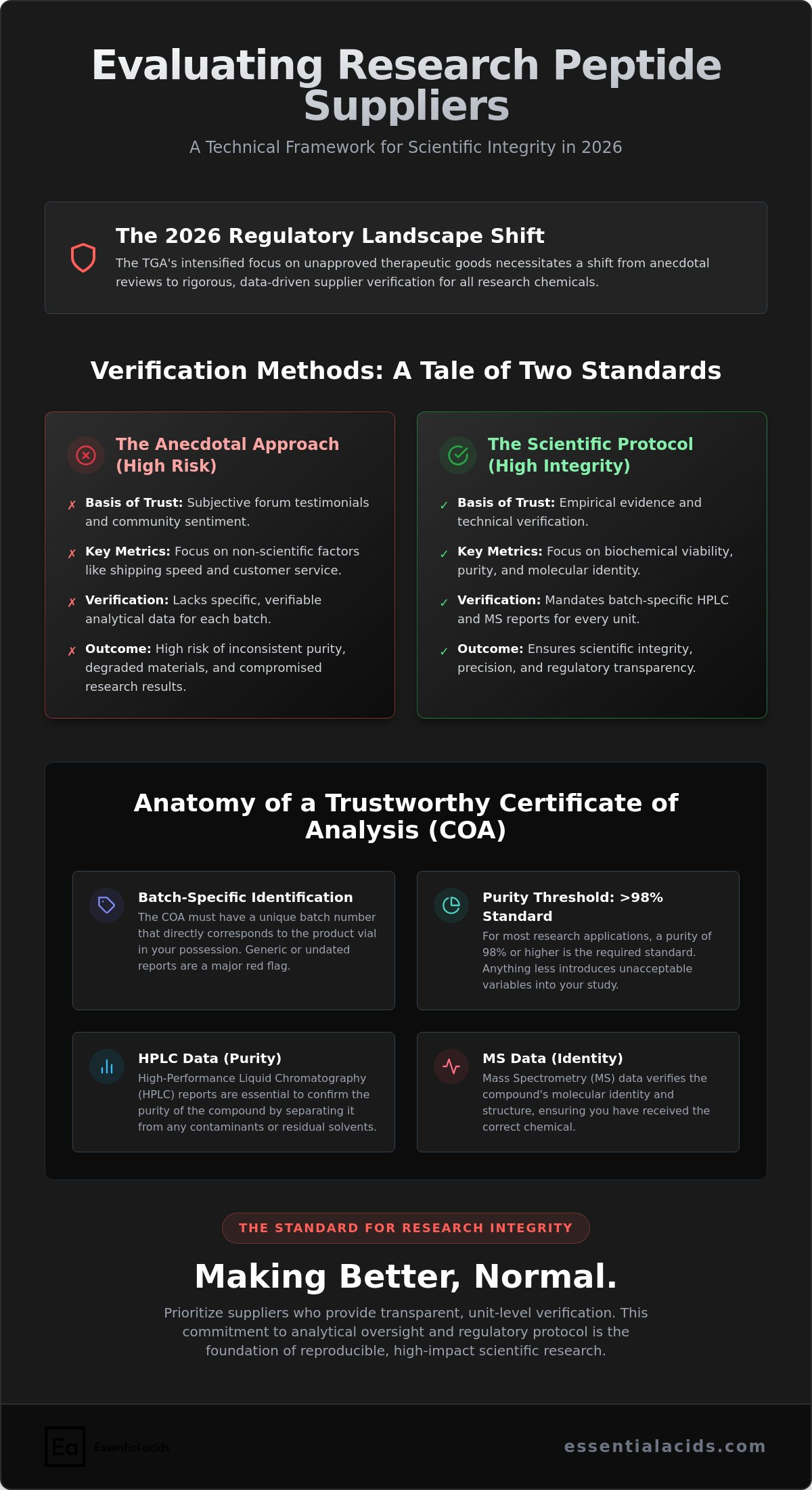
The Australian research chemical market underwent a structural transition in early 2026. This shift followed the Therapeutic Goods Administration (TGA) announcement in June 2026, which established unapproved peptide products as a primary compliance priority. For researchers, this regulatory environment demands a departure from the informal procurement methods of previous years. The reliance on community forums and subjective testimonials has been replaced by a necessity for technical verification. Scientific integrity is now defined by the ability to provide empirical evidence of compound identity and purity.
Search queries for an amino club australia review frequently yield results centered on logistical metrics, such as shipping duration or customer service responsiveness. While these factors affect the procurement experience, they offer zero insight into the biochemical viability of the materials. Anecdotal feedback is inherently unscientific. It cannot account for batch-to-batch variability or the presence of residual solvents. Laboratory-focused entities prioritize analytical data over consumer sentiment, recognizing that the success of a study depends entirely on the precision of the peptide synthesis and subsequent purification processes.
The Shift Toward Analytical Transparency
Researchers are increasingly abandoning forum-based recommendations in favor of third-party verification. In 2026, trust isn't granted based on brand longevity but is earned through the publication of batch-specific High-Performance Liquid Chromatography (HPLC) reports. Scientific integrity requires that every unit of a compound, whether it's BPC-157 or 5-Amino-1MQ, is accompanied by documentation that confirms its molecular mass and purity levels. This transparency ensures that the researcher isn't introducing unknown variables into their cellular or metabolic models.
Regulatory Boundaries for Research Compounds
Compliance in the Australian market is governed by strict adherence to "research-use only" protocols. It's essential to understand that the "research chemical" designation isn't a legal loophole but a rigorous classification that excludes human consumption. Australian laboratories maintaining high standards of integrity utilize professional-grade documentation to track the acquisition and storage of these compounds. This disciplined approach reflects the gravity of laboratory research. By maintaining a detached, formal perspective on compound distribution, suppliers ensure that the focus remains on the biological data rather than commercial trends. This commitment to protocol is fundamental to the Essential Acids mission of making better, normal through the provision of verified, high-purity research materials.
Criteria for Evaluating Technical Reviews and Supplier Integrity
Standard procurement reviews often emphasize shipping speed or customer service responsiveness. These metrics are irrelevant to the success of a laboratory study. A technically sound amino club australia review must instead focus on the analytical verification of the compounds provided. Scientific integrity requires a shift from subjective experience to empirical data. High-purity research materials are only as reliable as the documentation supporting them.
Evaluating a supplier involves scrutinizing two primary analytical tools: High-Performance Liquid Chromatography (HPLC) and Mass Spectrometry (MS). HPLC reports are used to determine the purity of a substance by separating its components. MS data is used to confirm the molecular identity, ensuring the researcher is working with the correct chemical structure. Without these specific reports, the risk of receiving degraded or incorrectly identified materials increases significantly. This technical oversight is what distinguishes a professional laboratory from a mere reseller.
Reading a Certificate of Analysis (COA)
A Certificate of Analysis is more than a summary of purity. It's a legal and technical record of a specific batch. Authentic COAs must include a batch number that corresponds directly to the unit in your laboratory. Generic reports that lack specific dates or batch identifiers are significant red flags. For most research applications, a purity threshold of 98% or higher is the standard. Any report showing lower purity levels or containing ambiguous "proprietary" markers should be viewed with caution. Researchers should also look for the presence of residual solvents or moisture content, which can affect the stability of compounds like BPC-157 or other high-purity peptides.
The Role of Third-Party Verification
Independent laboratory testing is the gold standard for procurement in 2026. Internal testing is a starting point, but it lacks the objective oversight necessary for scientific integrity. Third-party verification involves sending a sample from a specific batch to an external, accredited facility for analysis. It's not enough for a supplier to provide a report; researchers must cross-reference these reports with the testing facility to ensure they haven't been altered. There's a critical difference between "initial testing," which might be performed on a master batch, and "batch-specific verification," which tests the actual units being distributed. High-integrity suppliers maintain a transparent chain of custody and provide access to these external reports for every unit sold. This rigorous approach ensures that your laboratory work remains focused on cellular and metabolic outcomes rather than troubleshooting contaminated materials.
Technical Comparison: Purity, Verification, and Analytical Standards
The landscape of an amino club australia review often overlooks the granular data required for sensitive scientific assays. While many suppliers provide general purity claims, the distinction between "industrial grade" and "laboratory grade" lies in the precision of the analytical benchmarks. For researchers, the primary concern isn't just the presence of the target compound, but the specific profile of the remaining 1% of the material. Inconsistent batch purity can introduce uncontrolled variables into metabolic models, rendering the resulting data unreliable.
Molecular weight verification is a critical component of this process. It serves as a secondary check to ensure the chemical identity of the peptide matches the theoretical mass. For complex molecules like Retatrutide or BPC-157, even slight deviations in the peptide sequence can alter the biological activity. A comprehensive amino club australia review should therefore prioritize suppliers that offer both High-Performance Liquid Chromatography (HPLC) and Mass Spectrometry (MS) for every batch. This dual-verification method is the only way to confirm that the research material is both pure and correctly identified.
Analytical Benchmarks for 5-Amino-1MQ
5-Amino-1MQ is frequently utilized in metabolic research due to its role as a small molecule NNMT inhibitor. This specific application requires a rigorous molecular profile, as residual reagents or solvents from the synthesis process can interfere with enzyme kinetics. Impurity thresholds must be strictly monitored; even trace amounts of contaminants can skew analytical outcomes in cellular ageing studies. High-integrity laboratories focus on achieving a clean baseline in HPLC chromatograms to prevent these interactions. In 2026, 5-Amino-1MQ research requires a minimum purity threshold of 99% verified by batch-specific HPLC to ensure accurate metabolic inhibition data.
Laboratory Procurement Standards
Integrating professional standards into institutional protocols is essential for maintaining scientific integrity. Researchers should follow a structured approach when they buy research peptides australia, ensuring that the procurement process includes a review of the supplier's physical analytical oversight. For instance, evaluating bpc 157 5mg units involves more than checking the purity percentage; it requires assessing the lyophilization quality and the stability of the cake. Poorly lyophilized peptides are prone to rapid degradation when exposed to moisture or temperature fluctuations.
Stability testing is further complicated by the choice of reconstitution media. The use of high-quality bacteriostatic water is the standard for maintaining research longevity, as it inhibits bacterial growth that could otherwise compromise the peptide's integrity over time. Additionally, the necessity of cold-chain logistics cannot be ignored for sensitive compounds. Peptides like Retatrutide or MOTS-c require strict temperature controls during transit to prevent denaturing. At Essential Acids, we maintain these rigorous standards to ensure that the materials provided are fit for high-level scientific study. We believe that by providing verified, stable compounds, we're making better, normal for the research community.
Navigating Procurement Risks in the Australian Research Market
Procurement in the Australian research market requires a defensive strategy against "paper-only" entities. These organizations operate as digital intermediaries without maintaining physical oversight or laboratory infrastructure. A comprehensive amino club australia review should examine whether a supplier actually possesses the analytical equipment necessary to verify their inventory. Brokers who ship directly from overseas manufacturers without local batch-testing introduce unacceptable levels of risk regarding chemical identity and stability. Scientific integrity is compromised when the chain of custody is broken by entities that never physically inspect the materials they distribute.
Avoiding "grey market" vendors is a matter of scientific survival. These entities often lack the biochemistry expertise required to handle sensitive compounds like Retatrutide or IGF-1LR3. They prioritize volume over the disciplined emotional weight of laboratory research. Ensuring compliant fulfillment means selecting partners who understand the gravity of the 2026 TGA regulatory landscape and maintain a professional distance from consumer-focused marketing. High-integrity laboratories focus on the precision of the compound rather than the trends of the marketplace. This stable approach is fundamental to making better, normal for the scientific community.
Identifying Counterfeit or Substandard Materials
Lyophilized powders should present as a solid, uniform "cake" rather than loose, granular dust. This structure indicates a successful freeze-drying process, which is vital for long-term stability. Vacuum-sealed vials are non-negotiable; they provide the necessary atmospheric protection against oxidation and moisture ingress. While low prices are attractive, they often indicate a lack of third-party verification. In the laboratory, the cost of a failed experiment far outweighs the savings from substandard materials. Researchers should prioritize visual indicators of structural integrity as the first line of defense against degraded research materials.
Mitigating Logistics and Degradation Risks
The Australian climate presents a unique challenge to peptide stability during transit. High ambient temperatures can cause rapid denaturing of fragile amino acid chains, especially during the summer months. Suppliers must utilize robust, protective packaging to mitigate these thermal risks. Additionally, the quality of auxiliary materials like BAC Water is frequently overlooked. Using impure water for research reconstitution can introduce bacterial contamination, compromising the integrity of the entire study. Researchers seeking to eliminate these variables should secure high-purity compounds from Essential Acids, where every batch is subjected to rigorous physical oversight and protective fulfillment protocols.
Essential Acids: Setting the Benchmark for Research Integrity
Essential Acids operates with a commitment to scientific integrity that transcends standard marketplace trends. While a typical amino club australia review might focus on the logistics of acquisition or shipping speed, our protocol centers on the analytical verification of the compounds themselves. Every unit provided is accompanied by batch-specific High-Performance Liquid Chromatography (HPLC) and Mass Spectrometry (MS) reports. This ensures that researchers aren't just receiving a product, but a verified chemical identity suitable for rigorous laboratory study. The quality of the compounds is expected to speak for itself, reflecting our quiet authority in the field of biochemistry.
The focus remains strictly on research-use only compounds such as 5-Amino-1MQ. By maintaining direct e-commerce fulfillment with institutional-grade transparency, the risks associated with "paper-only" brokers are eliminated. Our role is that of a scientific gatekeeper. We ensure that the materials entering your laboratory meet the highest purity thresholds. This disciplined approach reflects the gravity of metabolic and cellular ageing research, where even minor impurities can compromise peer-reviewed outcomes. The structural contrast between the ease of our digital storefront and the protective language of our research-only policies reinforces our commitment to regulatory compliance.
The Essential Acids Difference
We provide detailed molecular profiles for complex compounds, including Semax. Our rigorous verification of Ipamorelin and other growth-related research materials follows the same uncompromising standard. Documentation is provided to support the precise requirements of scientific study. This allows researchers to focus on biological data rather than supplier reliability. By removing the ambiguity of chemical purity, we provide the foundation for consistent analytical results. Every unit is treated with the level of caution required for high-purity research materials, ensuring that the integrity of the laboratory environment is never compromised.
Securing Your Research Future
Transitioning from anecdotal suppliers to verified analytical partners is a critical step for institutional researchers. An amino club australia review might highlight the convenience of a storefront, but it rarely addresses the necessity of unit-level verification. Accessing batch-specific documentation on our platform is straightforward. This provides the transparency required for metabolic assays and cellular models. Our technical journal offers molecular mechanism overviews to assist in the design of experimental protocols. We remain dedicated to the precision of the laboratory, ensuring we're making better, normal for the scientific community through stable and well-regulated operations.
Advancing Laboratory Standards in 2026
The transition from anecdotal procurement to rigorous analytical verification is no longer optional for the Australian research community. As the regulatory landscape continues to evolve, scientific integrity depends on the ability to verify chemical identity and purity at the unit level. While an amino club australia review might provide insight into delivery timelines, it doesn't replace the necessity of physical analytical oversight and batch-specific documentation. Researchers must demand transparent data to ensure that metabolic and cellular models remain untainted by inconsistent materials.
Essential Acids maintains a disciplined focus on quality assurance by providing comprehensive HPLC and Mass Spectrometry reports for every batch. This commitment to making better, normal ensures that your laboratory study is supported by high-purity compounds that meet strict research-only standards. By choosing a partner that prioritizes technical precision over marketing trends, you secure the accuracy of your scientific outcomes. View our batch-verified research compounds at Essential Acids and establish a new benchmark for your institutional protocols. We look forward to supporting your next breakthrough with verified integrity.
Frequently Asked Questions
Is Amino Club Australia a legitimate supplier for laboratory research?
Legitimacy in the research sector is defined by the provision of verifiable analytical documentation rather than commercial longevity. Amino Club is a US-based entity, so researchers in Australia must evaluate their specific importation protocols against 2026 TGA compliance standards. A thorough amino club australia review should prioritize the presence of batch-specific data over marketing claims to ensure the materials are suitable for high-integrity scientific study.
How can I verify the purity of peptides purchased in Australia?
Purity verification requires a cross-reference between the supplier's provided documentation and independent third-party laboratory results. Researchers should request High-Performance Liquid Chromatography (HPLC) reports that show a clear baseline and minimal impurity peaks. It's also advisable to contact the testing facility directly to confirm the report's authenticity. This process ensures that the compound's chemical identity hasn't been compromised during the synthesis or distribution phases.
What is the significance of HPLC and Mass Spectrometry in peptide reviews?
HPLC and Mass Spectrometry are the primary analytical tools used to confirm chemical purity and molecular identity. HPLC separates the components of a sample to quantify the percentage of the target compound, while Mass Spectrometry verifies the molecular weight to ensure the substance is correctly identified. In 2026, a technical amino club australia review isn't valid without these specific data points. They provide the empirical evidence necessary to maintain scientific integrity.
Are research peptides like 5-Amino-1MQ legal for laboratory use in Australia?
Peptides like 5-Amino-1MQ are legal for laboratory research purposes provided they aren't intended for human consumption or therapeutic use. These compounds are classified as research chemicals and must be handled within a controlled environment that follows strict safety protocols. Compliance depends on the researcher's adherence to the "research-use only" designation. It's essential to maintain professional documentation that reflects the scientific intent of the procurement to satisfy regulatory requirements.
What should I look for in a Certificate of Analysis (COA) for 2026?
A 2026 COA must include a batch number that matches the physical unit, the date of analysis, and the specific purity percentage. It should clearly display the HPLC chromatogram and Mass Spectrometry data for the individual batch. Generic or outdated reports that lack these identifiers are insufficient for modern laboratory standards. High-integrity suppliers provide these documents to ensure transparency and to facilitate peer-reviewed replication of scientific studies.
Can I use anecdotal reviews to determine the quality of a research chemical?
Anecdotal reviews are unscientific and shouldn't be used to determine the quality of a research chemical. Subjective testimonials regarding shipping speed or perceived effects offer no insight into the actual purity or molecular stability of the compound. Laboratory materials require empirical verification through analytical testing. Relying on forum-based feedback introduces uncontrolled variables into your research, which can lead to inaccurate data and compromised metabolic models.
Why is batch-specific testing superior to periodic supplier audits?
Batch-specific testing is superior because it accounts for the inherent variability in the peptide synthesis process. Periodic audits only provide a snapshot of a supplier's historical performance, which doesn't guarantee the quality of the current inventory. Every individual batch can contain different impurity profiles or degradation levels. Testing every unit ensures that the specific material used in your study meets the required purity threshold, upholding the core value of scientific integrity.
How does Essential Acids ensure the stability of compounds during Australian transit?
Essential Acids utilizes robust protective packaging and climate-controlled logistics to mitigate the risks of thermal degradation. Lyophilized powders are vacuum-sealed in vials to prevent oxidation and moisture ingress during the transit process. This physical oversight is critical for maintaining the structural integrity of fragile amino acid chains in the Australian environment. Every shipment is handled with the caution required for high-purity research materials, ensuring they arrive in a stable condition.
Legal Disclaimer
All products sold on this website are intended exclusively for laboratory research purposes and not for human or veterinary use, diagnosis, cure, treatment, or prevention of any disease or condition. None of the statements on this site have been reviewed or evaluated by the U.S. Food and Drug Administration (FDA) or comparable regulatory authorities. Purchasing or using these products for any unintended purpose, including human consumption, may violate federal or local laws and poses safety risks.