

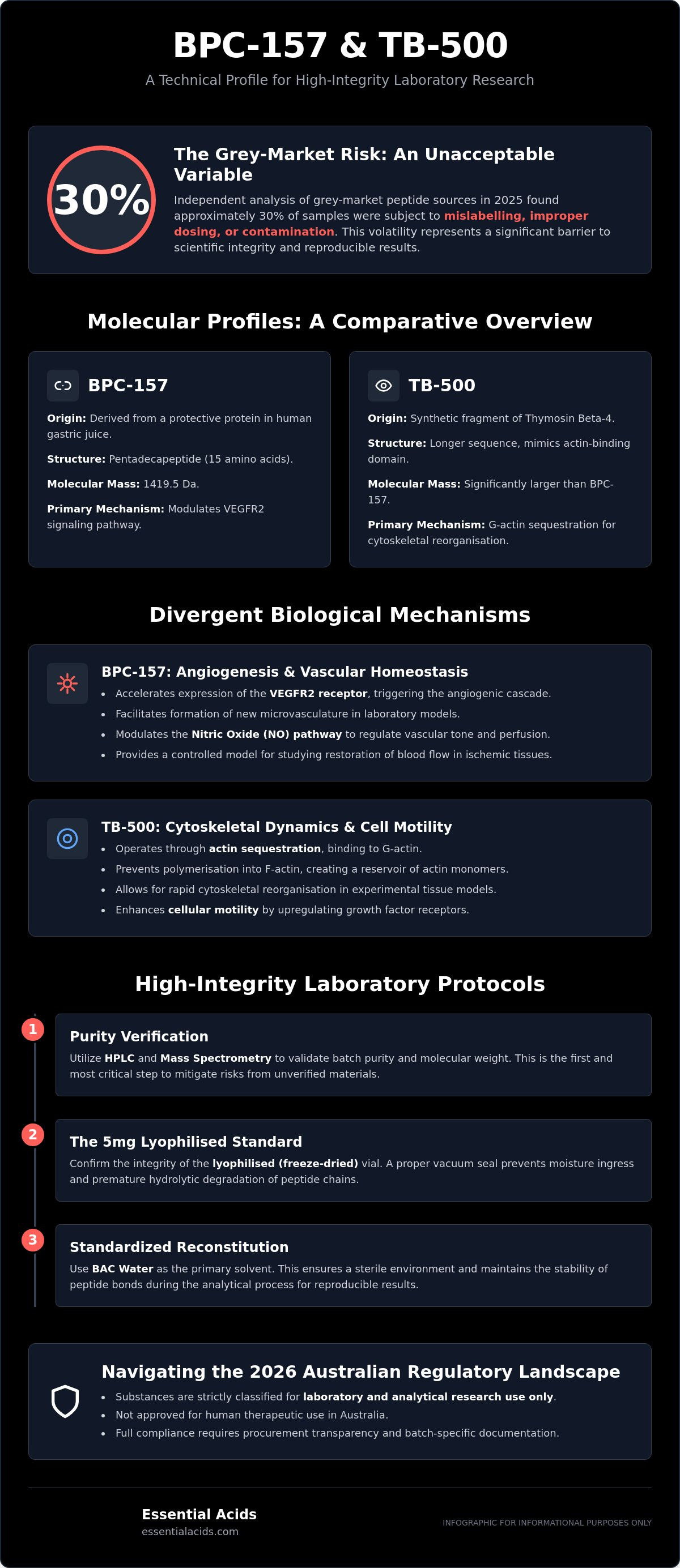
Independent analysis of grey-market peptide sources in 2025 identified mislabelling, improper dosing, or contamination in approximately 30% of samples. For Australian researchers, this volatility represents a significant barrier to maintaining scientific integrity and reproducible results. You likely recognize that the absence of batch-specific HPLC/MS documentation creates unacceptable risks in a laboratory setting, especially when investigating complex biological pathways.
This technical profile offers a disciplined examination of bpc-157 and tb-500 research, providing the analytical clarity required to navigate the current regulatory and biochemical landscape. We promise a rigorous breakdown of molecular mechanisms and the exact purity verification standards necessary for high-level study in 2026. We will explore the VEGFR2 and Actin sequestration pathways, alongside standardized protocols for the reconstitution and stability of these compounds, ensuring your focus remains on precise data collection rather than material uncertainty.
Key Takeaways
- Understand the distinct molecular profiles of BPC-157 and TB-500, focusing on their respective roles in VEGFR2 signaling and G-actin sequestration.
- Establish high-integrity verification standards for bpc-157 and tb-500 research using HPLC and Mass Spectrometry to validate batch purity and molecular weight.
- Apply standardized laboratory protocols for the reconstitution of 5mg vials, ensuring maximum stability against thermal fluctuations and peptide chain degradation.
- Navigate the specific 2026 Australian regulatory environment for research-use substances to ensure full compliance and procurement transparency.
- Identify the technical documentation required to mitigate risks associated with unverified analytical materials in a disciplined laboratory setting.
Molecular Profiles: BPC-157 and TB-500 in Research Context
The integrity of bpc-157 and tb-500 research depends on a precise understanding of their molecular structures and biochemical origins. These compounds aren't interchangeable; they represent distinct classes of regenerative peptides with unique amino acid sequences. BPC-157 is a pentadecapeptide composed of 15 amino acids. It's derived from a protective protein found in human gastric juice, making it inherently stable in acidic environments. In contrast, TB-500 is a synthetic fragment of Thymosin Beta-4, a naturally occurring protein present in almost all mammalian cells. Both materials are strictly classified for laboratory and analytical research applications only. They aren't approved for human therapeutic use in Australia and must be handled with the discipline required for experimental substances.
Chemical Properties and Molecular Weight
The molecular sequence of BPC-157 (Gly-Pro-Leu-Ser-Cys-Ala-Pro) yields a molecular mass of 1419.5 Da. This specific arrangement allows for high biological activity even at low concentrations. TB-500 features a significantly longer sequence: Ac-Ser-Asp-Lys-Pro-Asp-Met-Ala-Glu-Ile-Glu-Lys-Phe-Asp-Lys-Ser-Lys-Leu-Lys-Lys-Thr-Glu-Thr-Gln-Glu-Lys-Asn-Pro-Leu-Pro-Ser-Lys-Glu-Thr-Ile-Glu-Gln-Glu-Lys-Gln-Ala-Gly-Glu-Ser. This structure is designed to mimic the actin-binding domain of the parent protein. Both peptides exhibit high solubility in aqueous environments. For standardised laboratory titration, researchers typically utilise BAC Water as the primary solvent. This ensures a sterile environment and maintains the stability of the peptide bonds during the analytical process.
The 5mg Lyophilised Standard
Research chemicals are often supplied in 5mg vials because this concentration facilitates controlled scientific trials. This amount is sufficient for multiple assays while minimising the risk of degradation that occurs with larger volumes. Lyophilisation, or freeze-drying, is the critical process used to preserve these molecular structures. By removing water under vacuum, the peptide's primary structure remains intact during transport and storage. When investigating bpc-157 and tb-500 research, verifying the vial's vacuum integrity is a fundamental protocol. A proper seal prevents atmospheric moisture from entering the vial, which could otherwise lead to premature hydrolytic cleavage of the peptide chains. Scientific integrity starts with the physical state of the material upon receipt. The 5mg standard allows for reproducible dosage calculations across different laboratory settings, ensuring that data remains consistent and comparable.
Biological Mechanisms: VEGFR2 Pathways and Actin Sequestration
The biochemical utility of bpc-157 and tb-500 research lies in their divergent but complementary molecular pathways. BPC-157 primarily functions through the modulation of the Vascular Endothelial Growth Factor (VEGF) system. It accelerates the expression of the VEGFR2 receptor, a critical signaling protein that triggers the angiogenic cascade. By upregulating this receptor, the peptide facilitates the formation of new microvasculature in laboratory models. This mechanism is distinct from TB-500, which targets the cellular cytoskeleton. TB-500 operates through actin sequestration, specifically binding to G-actin to prevent its polymerisation into F-actin. This creates a reservoir of actin monomers, allowing for rapid cytoskeletal reorganisation and enhanced cellular motility in experimental tissue models.
Angiogenesis and Nitric Oxide Modulation
BPC-157 exerts a significant influence on the nitric oxide (NO) pathway, which is fundamental to vascular homeostasis. It interacts with the endothelial nitric oxide synthase (eNOS) system to regulate vascular tone and perfusion. In in-vitro environments, this modulation allows researchers to observe how endothelial cells respond to oxidative stress and vascular injury. Scientific literature, such as the review on Therapeutic Peptides in Orthopaedics, suggests that this NO-dependent pathway is a primary driver behind the peptide's observed influence on microvascular density. By stabilizing the vascular response, BPC-157 provides a controlled model for studying the restoration of blood flow in ischemic tissues.
Cytoskeletal Dynamics and Growth Factor Expression
TB-500 facilitates cell migration by upregulating specific growth factor receptors and modulating the availability of intracellular actin. This process is essential for studying the migration of fibroblasts and keratinocytes during wound healing simulations. When comparing growth factor signaling, the mechanism of TB-500 is fundamentally different from that of Ipamorelin, which targets the ghrelin receptor to influence growth hormone secretion. While Ipamorelin research focuses on systemic metabolic pathways, TB-500 research is localized to the structural integrity and movement of individual cells. This makes TB-500 a more appropriate candidate for protocols focused on cytoskeletal dynamics and structural protein expression.
Dual-peptide models often investigate the synergistic potential of combining these two mechanisms. When BPC-157 and TB-500 are studied together, researchers can observe the simultaneous influence of VEGFR2-driven angiogenesis and actin-mediated cell migration. This combination is particularly valuable in microvascular density studies and experiments involving collagen expression in fibroblast models. To ensure the integrity of such complex assays, researchers must use compounds that meet strict analytical standards. You can source high-purity analytical materials to maintain the precision of your laboratory data. These biological mechanisms provide the technical framework necessary for understanding how these peptides interact with the cellular environment in a disciplined research context.
Verifying Peptide Purity: HPLC and Mass Spectrometry Analysis
Scientific validity in bpc-157 and tb-500 research requires more than just a label of intent. It demands rigorous analytical verification of every batch. Independent data from 2025 indicates that approximately 30% of grey-market peptides suffer from mislabelling, improper dosing, or contamination. This statistic highlights the necessity of batch-specific Certificates of Analysis (COA). A COA isn't a marketing document; it's a technical record that must include both High-Performance Liquid Chromatography (HPLC) and Mass Spectrometry (MS) data. Without these, the molecular identity and purity of the compound remain unverified, compromising the integrity of any downstream assay.
Interpreting HPLC Chromatograms
High-Performance Liquid Chromatography is the gold standard for peptide quantification in analytical research. The process involves passing the peptide through a stationary phase under high pressure to separate the target molecule from impurities. When reviewing a chromatogram, the primary focus is the main peak. The purity percentage is determined by calculating the area under the curve (AUC) for this peak relative to the total area of all detected peaks. In 2026, the accepted laboratory standard for high-integrity research is a purity rating of 98% or higher. Any secondary peaks, no matter how small, indicate the presence of residual solvents, truncated sequences, or degradation products like trifluoroacetic acid (TFA). These contaminants can interfere with cellular signaling, potentially skewing results in a Review of BPC-157 for Musculoskeletal Healing or similar microvascular studies.
Sequence Validation via Mass Spectrometry
While HPLC confirms how much of a substance is present, Mass Spectrometry validates exactly what that substance is. MS measures the mass-to-charge ratio of ions to determine the precise molecular weight of the peptide batch. For BPC-157, the observed mass peak should align closely with the theoretical weight of 1419.5 Da discussed in previous sections. TB-500 requires similar validation against its significantly larger molecular structure. A clean MS report will show a single, prominent peak. Multiple peaks suggest the presence of truncated sequences, where the peptide chain failed to complete during synthesis. Maintaining scientific integrity through transparent analytical documentation is non-negotiable for professional researchers. This transparency ensures that bpc-157 and tb-500 research is based on verified molecular identities, preventing the "research-chemical" loophole from undermining laboratory standards.
Laboratory Handling: Reconstitution and Stability Protocols
Standardised handling protocols are the foundation of reproducible bpc-157 and tb-500 research. Even the highest purity materials will fail to yield accurate data if the molecular structure is compromised during preparation. Peptides are inherently fragile sequences of amino acids held together by peptide bonds. These bonds are susceptible to degradation from mechanical stress, thermal fluctuations, and microbial contamination. Researchers must adhere to a strict "swirl, do not shake" rule. Vigorous agitation can cause the denaturation of the peptide chains, leading to a loss of biological activity and skewed assay results. Maintaining structural integrity requires a disciplined approach to every step of the laboratory workflow.
Reconstitution Best Practices
Reconstitution involves the transition of the lyophilised powder back into a liquid state for laboratory application. To achieve a precise concentration of 2.5mg/ml, 2ml of a diluent is typically added to a 5mg vial. Using a bacteriostatic agent is essential for longitudinal studies. This prevents microbial growth that could otherwise degrade the peptide or introduce confounding variables into the research model. When adding the diluent, the liquid should be aimed at the side of the glass vial rather than directly onto the powder cake. This ensures a gentle dissolution process. It's vital to maintain a sterile environment during vial access, utilising aseptic techniques to prevent cross-contamination of the aliquot preparation.
Environmental Control and Storage
Thermal stability is a primary concern for any laboratory investigating peptide mechanisms. In their lyophilised state, these compounds are relatively stable, but cold storage is still recommended. Optimal storage for long-term archival is -20°C, while 2-8°C is sufficient for short-term use. Once reconstituted, the stability window narrows significantly. Most reconstituted materials should be used within 14 to 28 days if stored at 2-8°C. Exposure to UV light must be strictly avoided; photo-degradation can cause rapid cleavage of the peptide sequence, rendering the batch useless for analytical purposes. Monitoring vial clarity is a simple but effective stability marker. Any cloudiness or precipitation suggests that the peptide has fallen out of solution or has been compromised by bacterial growth. To ensure your laboratory is equipped with the necessary materials for these protocols, you can buy high-purity research components directly from verified suppliers.
Procurement Standards for Australian Research in 2026
The regulatory environment for bpc-157 and tb-500 research in Australia underwent a significant shift on June 20, 2026. A joint statement from the Therapeutic Goods Administration (TGA) and the Chief Medical Officer highlighted the risks associated with unapproved peptide products. This warning has placed a renewed emphasis on the burden of proof for institutional researchers. Procurement must be strictly limited to laboratory-grade materials that carry explicit "Research Use Only" labeling. These compounds are classified as Schedule 4 (S4) substances under Australian law. They are not approved for human therapeutic use and remain prohibited by WADA for athletes at all times. For the analytical scientist, compliance isn't a secondary concern; it's a prerequisite for the validity of the study.
Compliance and Ethical Procurement
Acquiring non-therapeutic compounds in Australia requires a disciplined adherence to laboratory safety and procurement policies. Researchers must vet suppliers based on their commitment to technical transparency. This involves verifying that every batch is accompanied by the HPLC and MS documentation discussed in previous sections. Ethical procurement also means respecting the boundaries of the "Research Use Only" designation. This isn't a legal loophole. It is a strict classification that ensures materials are used solely for in-vitro or animal models within controlled environments. Managing batch-to-batch consistency is vital for high-volume, multi-stage studies where even a 1% variance in purity can compromise longitudinal data.
Cold-Chain Logistics and Integrity
The molecular integrity of sensitive peptides depends on rigorous cold-chain logistics. While lyophilised powders are more stable than reconstituted solutions, they are still susceptible to degradation during transit if environmental controls fail. Verification steps upon arrival at the facility are mandatory. This includes checking the vial vacuum integrity and ensuring the material has remained in its lyophilised state. Any evidence of moisture or cake collapse suggests a breach in the seal or thermal exposure. In the 2026 landscape, the quality of the compound must speak for itself through data rather than marketing claims. For high-purity BPC-157 5mg and TB-500, consult the Essential Acids technical catalogue to review the analytical standards required for professional laboratory use.
Scientific integrity in bpc-157 and tb-500 research is maintained by treating these substances with the gravity they deserve as experimental drugs. By following these procurement and handling standards, researchers can mitigate the risks of contamination and mislabelling that currently affect 30% of the grey market. A stable and well-regulated laboratory operation relies on the precision of its materials. This disciplined approach ensures that your focus remains on the biological mechanisms of VEGFR2 and actin sequestration, moving the field forward with reliable and reproducible results.
Advancing Scientific Integrity in Peptide Analysis
The landscape of bpc-157 and tb-500 research in 2026 demands a transition from anecdotal observation to rigorous analytical precision. We've established that the validity of laboratory data depends on verifying molecular weights via Mass Spectrometry and ensuring purity through High-Performance Liquid Chromatography. Standardised reconstitution protocols and strict adherence to Australian regulatory frameworks are non-negotiable for researchers seeking reproducible results. By prioritising batch-specific documentation, you eliminate the variables that often compromise experimental integrity and skew biochemical outcomes.
Essential Acids supports this commitment to excellence by providing materials that meet strict laboratory-grade standards. We provide batch-specific HPLC/MS reports with every order alongside specialised technical support to ensure your laboratory protocols remain stable. You can explore our high-purity BPC-157 5mg for research to secure the analytical materials required for high-level study. Maintaining these high standards is a fundamental step toward making better, normal in the field of biochemistry. We look forward to supporting your next phase of discovery with the precision your work requires.
Frequently Asked Questions
What is the molecular weight of BPC-157 5mg?
The molecular weight of BPC-157 is 1419.5 Da. This specific mass corresponds to its sequence of 15 amino acids, classified as a pentadecapeptide. In a 5mg vial, the weight refers to the lyophilised active peptide content rather than the total mass of the powder, which may include stabilizing excipients. Precise molecular weight validation via Mass Spectrometry is essential for confirming that the batch matches the theoretical profile required for analytical accuracy.
How should TB-500 be stored for long-term research stability?
TB-500 should be stored at -20°C for long-term research stability to prevent the degradation of its complex amino acid chain. While lyophilised vials can remain stable at 2-8°C for several months, sub-zero temperatures are required for archival purposes exceeding one year. It's vital to keep the vials in a dark environment, as UV exposure can trigger photo-degradation. Once reconstituted, the stability window reduces, requiring immediate refrigeration and use within 28 days.
Can BPC-157 5mg be reconstituted with sterile water instead of bacteriostatic water?
BPC-157 can be reconstituted with sterile water, but it is not recommended for studies requiring multiple vial entries over several days. Sterile water lacks the antimicrobial agents found in bacteriostatic water, significantly increasing the risk of bacterial contamination once the seal is punctured. For longitudinal bpc-157 and tb-500 research, bacteriostatic water is the laboratory standard. It ensures the solution remains viable for up to 28 days under refrigeration without microbial interference.
What is the minimum purity requirement for BPC-157 in analytical research?
The minimum purity requirement for BPC-157 in analytical research is 98% as determined by HPLC analysis. This high-integrity standard ensures that secondary peaks and impurities, such as residual solvents or truncated sequences, don't interfere with cellular signaling assays. In the 2026 research landscape, materials falling below this threshold are considered unsuitable for professional laboratory use. Every batch must be accompanied by a specific Certificate of Analysis to verify these quantitative metrics.
How does TB-500 interact with G-actin in cellular models?
TB-500 interacts with G-actin by binding to the monomers in a 1:1 ratio, effectively sequestering them to prevent polymerisation into F-actin. This mechanism creates a reservoir of actin units within the cytoplasm, which cells can rapidly deploy for cytoskeletal reorganisation. This interaction is a primary focus for researchers investigating cellular motility and migration. By modulating the available actin pool, TB-500 provides a controlled model for studying the structural dynamics of the cell.
Is BPC-157 5mg stable at room temperature during domestic shipping?
BPC-157 is stable at room temperature during domestic shipping for short durations, provided it remains in its lyophilised state. The freeze-drying process significantly enhances the peptide's resistance to thermal stress compared to liquid formulations. However, Australian researchers should ensure that cold-chain logistics are utilised for transit during summer months or for international freight. Upon arrival, the vials should be transferred immediately to a climate-controlled environment at 2-8°C to maintain long-term integrity.
What analytical methods are used to verify TB-500 batch purity?
High-Performance Liquid Chromatography (HPLC) and Mass Spectrometry (MS) are the primary analytical methods used to verify TB-500 batch purity. HPLC provides a quantitative assessment by separating the peptide from impurities and calculating the area under the primary peak. Mass Spectrometry complements this by confirming the molecular identity, ensuring the observed mass aligns with the theoretical sequence. These dual verification steps are mandatory for maintaining scientific integrity in bpc-157 and tb-500 research protocols.
What are the primary differences between BPC-157 and TB-500 in a research context?
The primary difference lies in their biological targets: BPC-157 modulates the VEGFR2 pathway to influence angiogenesis, while TB-500 focuses on actin sequestration to drive cellular motility. BPC-157 is a 15-amino acid peptide derived from gastric protein, making it structurally distinct from TB-500, which is a larger synthetic fragment of Thymosin Beta-4. While both are used in regenerative models, their molecular weights and solubility profiles require different handling and titration protocols within a disciplined laboratory environment.
Legal Disclaimer
All products sold on this website are intended exclusively for laboratory research purposes and not for human or veterinary use, diagnosis, cure, treatment, or prevention of any disease or condition. None of the statements on this site have been reviewed or evaluated by the U.S. Food and Drug Administration (FDA) or comparable regulatory authorities. Purchasing or using these products for any unintended purpose, including human consumption, may violate federal or local laws and poses safety risks.