

A single mechanical oversight or a slight mathematical error during bpc 157 reconstitution can compromise the molecular integrity of a high-purity peptide, rendering an entire analytical batch useless. For the serious researcher, the process of preparing lyophilized compounds is not a matter of convenience; it's a disciplined requirement for scientific integrity. You likely recognize that even minor deviations in solvent volume or temperature can lead to rapid degradation or inconsistent concentration data.
This guide provides a rigorous overview of the protocols and stability standards required to maintain BPC-157 for analytical research in 2026. You'll gain access to precise concentration charts for 5mg and 10mg vials along with guidelines for long-term stability, such as the 28-day window for compounds reconstituted with bacteriostatic water. We'll detail the exact mechanical steps and environmental controls necessary to ensure your laboratory findings remain accurate and reproducible. At Essential Acids, we prioritize the "Making better, normal" philosophy through strict adherence to research-use only protocols.
Key Takeaways
- Establish a standardized protocol for bpc 157 reconstitution to ensure complete peptide dissolution without compromising molecular structure.
- Identify the critical differences between Bacteriostatic Water and Sterile Water to select the appropriate medium for long-term stability.
- Utilize precise mathematical formulas and concentration charts specifically designed for 5mg research vials to prevent dosing inaccuracies.
- Implement rigorous storage standards, maintaining temperatures between 2°C and 8°C to prevent degradation from heat and UV exposure.
- Prioritize scientific integrity by adhering to sterile handling procedures and using batch-specific analytical documentation for all research applications.
Principles of Peptide Reconstitution for Analytical Research
Reconstitution is the precise chemical process of transitioning a lyophilized peptide from its solid, freeze-dried state back into a liquid solution. For laboratory applications, this step is critical. It determines the final concentration and molecular availability of the compound for analytical assays. BPC-157, or Body Protection Compound 157, is a synthetic pentadecapeptide. It consists of a sequence of 15 amino acids: Gly-Glu-Pro-Pro-Pro-Gly-Lys-Pro-Ala-Asp-Asp-Ala-Gly-Leu-Val. While this specific sequence exhibits higher stability than many larger proteins, the bpc 157 reconstitution protocol must be executed with technical precision to avoid breaking delicate peptide bonds.
Maintaining a sterile environment is a non-negotiable requirement to prevent microbial degradation. Bacteria and fungi introduced during the process can release proteases. These enzymes rapidly cleave peptide chains, rendering the research material useless. Every stage of the procedure should occur within a controlled workspace, such as a laminar flow hood, using sanitized equipment to uphold the scientific integrity of the sample. Quality control starts with the environment before the first drop of diluent is even measured.
Lyophilization and Molecular Stability
Lyophilization is the standard for long-term storage because it removes moisture through sublimation, effectively "freezing" the molecular structure in a state of suspended animation. This process preserves the peptide's primary structure by preventing hydrolysis, which is the most common cause of peptide breakdown in aqueous solutions. Vacuum sealing during the final stages of the freeze-drying process also prevents oxidative stress by removing oxygen from the vial. Lyophilization is the chemical preservation technique of removing solvent from a frozen product through sublimation to extend the shelf-life and maintain the biochemical integrity of the compound. Without this moisture removal, the peptide would degrade at room temperature within days.
Research Objectives and Concentration Requirements
Determining the target concentration is a foundational step in any bpc 157 reconstitution protocol. Laboratory assay requirements often dictate specific molarities or concentrations, such as 2mg/mL or 5mg/mL, to ensure the precision of analytical measurements. Inaccurate diluent volumes lead to skewed data, which directly compromises the validity of the research. For a comprehensive analysis of the peptide's biochemical properties and mass spectrometry data, researchers should consult the BPC-157 5mg molecular profile. This documentation provides the necessary context for establishing baseline metrics in a controlled analytical environment, ensuring that each batch meets the rigorous standards required for high-purity research.
Comparative Analysis of Reconstitution Media: Bacteriostatic Water Standards
The choice of diluent is a primary determinant of the analytical lifespan of a peptide solution. In a laboratory setting, researchers must distinguish between Sterile Water for Injection (SWFI) and Bacteriostatic Water for Injection, USP. While SWFI is suitable for single-assay applications, it lacks the preservative capacity required for multi-use vials. Without a bacteriostatic agent, aqueous solutions are highly susceptible to microbial growth, which can occur within hours of the initial vial puncture. The bpc 157 reconstitution process requires a thorough understanding of these solvent interactions to prevent premature degradation.
BPC-157 shows high compatibility with 0.9% benzyl alcohol solutions. This specific concentration maintains a pH level that supports the stability of the 15-amino acid chain. For long-term analytical trials, using a preservative is standard practice. Data from August 2026 indicates that BPC-157 reconstituted with bacteriostatic water remains stable for up to 28 days when stored at 2 to 8°C. In contrast, solutions prepared with sterile water without a preservative should be utilized within 24 to 48 hours to ensure molecular integrity.
The Role of Benzyl Alcohol
Benzyl alcohol serves as a bacteriostatic agent by inhibiting the proliferation of gram-positive and gram-negative bacteria. It functions by disrupting the cellular membranes of potential contaminants. In a controlled laboratory environment, handling these agents requires strict adherence to safety protocols to prevent accidental exposure or cross-contamination of other sensitive assays. While benzyl alcohol is effective for multi-use vials, researchers should prioritize sterile water for specific single-use analytical trials where the presence of an alcohol preservative might interfere with highly sensitive mass spectrometry results.
Media Temperature and Solubility
The temperature of the diluent during bpc 157 reconstitution significantly impacts the rate of dissolution. Room-temperature media is preferred over refrigerated media for the initial mix. Cold diluent can slow the solubility process, potentially leading to the formation of undissolved aggregates or "clumping." These aggregates are difficult to disperse and can lead to uneven concentration gradients within the vial. Using room-temperature bacteriostatic water ensures a smooth, rapid transition from lyophilized powder to a clear solution, which is essential for maintaining scientific integrity.
Procuring laboratory-grade media in Australia involves verifying the purity and batch documentation of the supplier. For consistent results, researchers should only utilize verified research peptides Australia and high-purity solvents. Ensuring that all components meet these rigorous standards is the only way to safeguard the accuracy of analytical data. To maintain these standards in your facility, it's advisable to source high-purity Bacteriostatic Water that is batch-verified for research applications.
Standardized Protocol for BPC-157 Reconstitution
Adherence to a standardized laboratory protocol is the only way to ensure that the molecular structure of a peptide remains intact during the transition from a solid to a liquid state. Precision in bpc 157 reconstitution requires a controlled environment and specific materials to prevent contamination and mechanical degradation. Before beginning the procedure, researchers must assemble a complete supply checklist. This includes 70% isopropyl alcohol swabs, graduated laboratory syringes (typically 1mL or 3mL), high-purity Bacteriostatic Water, and the lyophilized BPC-157 vial. All actions should be performed within a sterilized field to maintain the scientific integrity of the research sample.
Step-by-Step Laboratory Procedure
The following steps outline the technical requirements for a successful reconstitution process:
- Sterilization: Use a fresh alcohol swab to vigorously clean the rubber stoppers of both the Bacteriostatic Water and the BPC-157 vial. Allow the alcohol to air-dry completely to ensure a sterile entry point.
- Pressure Equalization: Draw a volume of air into the syringe equal to the intended volume of diluent. Inject this air into the Bacteriostatic Water vial before withdrawing the liquid. This prevents the formation of a vacuum, which can make precise measurement difficult.
- Controlled Introduction: Insert the needle into the BPC-157 vial at a slight angle. The diluent should be introduced slowly, allowing the liquid to trickle down the interior glass wall of the vial.
- Final Dissolution: Once the diluent is added, the vial should be observed for clarity. If the powder does not dissolve instantly, the vial may be gently rotated between the palms.
Mitigating Mechanical Degradation
Peptides are inherently fragile molecules held together by relatively weak hydrogen bonds and van der Waals forces. These bonds are susceptible to "shearing" when exposed to high-velocity impact or vigorous agitation. While some research compounds are robust, bpc 157 reconstitution must be handled with care to avoid breaking the 15-amino acid chain. Shaking the vial creates air bubbles and surface tension changes that can lead to peptide denaturation, effectively rendering the compound biologically inactive for analytical purposes.
The diluent must never be sprayed directly onto the lyophilized powder, as the resulting high-velocity impact can cause immediate mechanical denaturation of the peptide bonds. Similarly, laboratory vortexing should be avoided. Unless a specific assay protocol requires high-energy mixing for hydrophobic compounds, a gentle swirling motion is the only acceptable method for ensuring a homogenous solution. By protecting the peptide from mechanical shear stress, researchers ensure that the resulting liquid solution accurately reflects the batch-specific analytical documentation provided with the high-purity compound. This disciplined approach is a core component of the "research-use only" policy that defines professional laboratory standards.
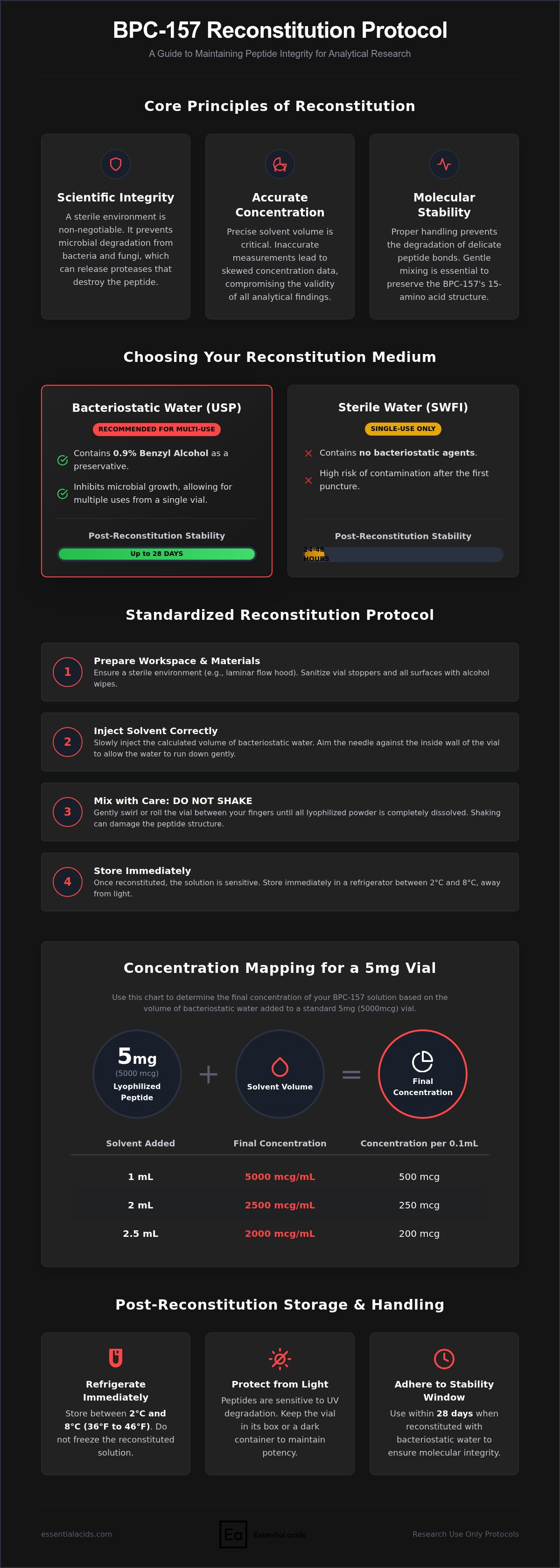
Concentration Mapping and Reconstitution Calculations
Precision in concentration mapping is the primary safeguard against analytical error in laboratory research. The mathematical foundation of bpc 157 reconstitution relies on the specific ratio between the total mass of the lyophilized peptide and the volume of the diluent introduced. While 5mg vials are the standard research size, 10mg vials are frequently utilized for high-throughput assays. Calculating micrograms (mcg) per milliliter (mL) allows for the high-precision measurements required for advanced cellular and metabolic studies. It's essential that these values are determined before the first drop of diluent is added to the vial.
The formula for determining concentration is functional: Total Peptide Mass (mg) divided by Diluent Volume (mL) equals Concentration (mg/mL). To determine the value per unit of volume, researchers convert milligrams to micrograms by multiplying by 1,000. For example, a 5mg vial reconstituted with 2.0 mL of Bacteriostatic Water yields a concentration of 2.5 mg/mL, or 2,500 mcg/mL. This standardized approach ensures that data collected across different laboratory sessions remains consistent and reproducible.
Reconstitution Chart for 5mg Vials
The 5mg vial is the most common specification for analytical research. The following mapping provides the concentration data for standard diluent volumes:
- 1.0 mL BAC Water: 5,000 mcg/mL (500 mcg per 0.1mL)
- 2.0 mL BAC Water: 2,500 mcg/mL (250 mcg per 0.1mL)
- 2.5 mL BAC Water: 2,000 mcg/mL (200 mcg per 0.1mL)
Reconstitution Chart for 10mg Vials
For assays requiring larger volumes or higher concentrations, 10mg vials are preferred. These calculations reflect the doubled peptide mass:
- 2.0 mL BAC Water: 5,000 mcg/mL (500 mcg per 0.1mL)
- 4.0 mL BAC Water: 2,500 mcg/mL (250 mcg per 0.1mL)
- 5.0 mL BAC Water: 2,000 mcg/mL (200 mcg per 0.1mL)
Adjusting the volume for high-precision micro-dosing in analytical assays is a common strategy when the target measurement is below 100 mcg. A higher volume of diluent, such as 5.0 mL in a 10mg vial, creates a less concentrated solution. This makes it easier to accurately measure minute quantities; it reduces the risk of significant volumetric errors that occur in more concentrated samples. To maintain the integrity of your mathematical models, you should only utilize batch-verified BPC-157 for analytical research. This ensures that the physical mass in the vial matches your calculated concentration, upholding the scientific integrity of the assay results.
Maintaining Molecular Integrity: Storage and Handling Post-Reconstitution
The technical success of bpc 157 reconstitution is finalized by the implementation of rigorous post-reconstitution storage protocols. Once the peptide is in an aqueous state, its susceptibility to environmental stressors increases significantly. Maintaining molecular integrity requires strict adherence to cold chain standards and the mitigation of electromagnetic radiation, specifically ultraviolet (UV) light. Peptide bonds are sensitive to photon-induced degradation; exposure to direct light can catalyze the cleavage of the 15-amino acid sequence, resulting in a loss of analytical potency. Laboratory vials should be stored in opaque containers or dark environments to prevent this degradation pathway.
Scientific integrity dictates that research materials showing any signs of physical change must be discarded. Contamination or degradation often manifests as visible cloudiness, the formation of particulates, or a shift in the color of the solution. These indicators suggest that the compound is no longer suitable for high-purity analytical assays. Standard laboratory policy requires the immediate disposal of such materials in accordance with biohazardous waste regulations to prevent the introduction of variables into the research data. It's a disciplined requirement that ensures every assay reflects the true biochemical properties of the compound.
Cold Chain Management for Research
Consistent refrigeration between 2°C and 8°C (36°F to 46°F) is the established research standard for maintaining peptide stability. Thermal fluctuations outside this range accelerate the rate of hydrolysis, which is the primary chemical pathway for peptide breakdown. It's necessary to store vials in a dedicated laboratory refrigerator that is monitored for temperature consistency. Vials must be clearly labeled with the date of the initial bpc 157 reconstitution and the final concentration. This practice ensures that researchers can track the 28-day stability window accurately and avoid using degraded reagents in sensitive experiments.
Long-Term Stability Considerations
Data verified for 2026 confirms that BPC-157 reconstituted with 0.9% benzyl alcohol remains stable for approximately 28 days when refrigerated. Stability beyond this period is not guaranteed; research data indicates a progressive decline in molecular integrity over 30, 60, and 90-day intervals. Frequent freeze-thaw cycles must be avoided after the initial reconstitution. The formation of ice crystals during the freezing process can exert mechanical pressure on the peptide chains, causing structural shearing that is irreversible. For long-term analytical projects, it's more effective to reconstitute smaller batches as needed rather than attempting to preserve a single solution over several months. Ensure your research uses the highest grade materials by choosing to order BPC-157 for laboratory use to maintain consistent baseline data across all assay phases.
Upholding Scientific Integrity in Peptide Research
Maintaining rigorous laboratory standards requires a disciplined approach to every stage of the analytical process. Successful bpc 157 reconstitution is achieved only through exact mathematical mapping and the deliberate mitigation of mechanical shear stress during dissolution. By prioritizing these clinical protocols, researchers ensure that the molecular structure of the pentadecapeptide remains uncompromised for the duration of the 28-day stability window. This attention to detail prevents the costly degradation of research materials and safeguards the accuracy of downstream assay results.
Reliability in metabolic research is fundamentally rooted in the quality of the raw materials and the transparency of their analytical documentation. Essential Acids facilitates this by providing high-purity compounds accompanied by batch-specific COAs; this ensures that every vial meets strict laboratory research standards. Our commitment to scientific integrity is reflected in our streamlined procurement process and fast national shipping across Australia. This allows your laboratory to operate with the precision required for advanced biochemical analysis without unnecessary delays.
Secure High-Purity BPC-157 for Your Research and establish a baseline of excellence for your upcoming analytical trials.
Frequently Asked Questions
How much BAC water should I use for 5mg of BPC-157?
The volume of Bacteriostatic Water utilized for 5mg of BPC-157 depends entirely on the required analytical concentration. A volume of 1.0 mL creates a concentration of 5,000 mcg/mL, while 2.0 mL yields 2,500 mcg/mL. Researchers often select 2.0 mL to allow for more precise volumetric measurements during micro-dosing assays. It's essential that the target molarity is established prior to the bpc 157 reconstitution process to ensure data consistency.
Can I use normal saline for BPC-157 reconstitution in a lab?
Normal saline (0.9% Sodium Chloride) can be utilized for reconstitution, but it lacks the bacteriostatic properties of benzyl alcohol. Solutions prepared with saline are strictly for single-use applications and must be utilized within 24 hours. For multi-use research vials, Bacteriostatic Water is the laboratory standard. It prevents microbial proliferation and extends the analytical lifespan of the peptide solution to the full 28-day stability window.
How long does BPC-157 remain stable after being reconstituted with BAC water?
Reconstituted BPC-157 remains stable for up to 28 days when stored in a controlled environment between 2°C and 8°C. This specific timeframe applies only when Bacteriostatic Water containing 0.9% benzyl alcohol is used as the diluent. If sterile water without a preservative is employed, the peptide's primary structure begins to degrade via hydrolysis much faster, typically requiring use within 24 to 48 hours to maintain scientific integrity.
Is it necessary to wait for the BPC-157 vial to reach room temperature before mixing?
Vials should be allowed to reach room temperature before the bpc 157 reconstitution protocol begins. Introducing cold diluent to a cold lyophilized powder can significantly decrease the rate of solubility, often leading to the formation of undissolved aggregates. These clusters are difficult to disperse and can result in an inhomogeneous solution. Ensuring both components are at ambient temperature facilitates a rapid, clear dissolution without the need for aggressive mechanical agitation.
What should I do if the BPC-157 solution remains cloudy after reconstitution?
If the solution remains cloudy or contains visible particulates after gentle rotation, the vial must be discarded immediately. A clear, colorless solution is the only acceptable result for high-purity research compounds. Cloudiness is a primary indicator of microbial contamination, improper pH levels, or significant peptide denaturation. Using compromised materials in analytical assays introduces unquantifiable variables and directly violates the "research-use only" policy regarding scientific accuracy.
Can I freeze BPC-157 after it has been reconstituted with bacteriostatic water?
Reconstituted peptides should not be frozen after the initial liquid transition has occurred. The formation of ice crystals during the freezing process exerts mechanical shear stress on the amino acid chains, which can lead to irreversible structural damage. While lyophilized powder is stable in a freezer, the aqueous solution is best maintained at refrigeration temperatures (2°C to 8°C). Avoiding freeze-thaw cycles is critical for preserving the batch-specific integrity of the compound.
Does BPC-157 require protection from light during storage?
BPC-157 requires strict protection from ultraviolet (UV) light to maintain its molecular stability. Light exposure can catalyze the cleavage of peptide bonds, leading to rapid degradation of the 15-amino acid sequence. Laboratory vials should be stored in a dark environment or within light-shielding containers inside the refrigerator. This precaution is a standard component of professional handling protocols designed to safeguard the compound’s analytical potency over its intended shelf-life.
What is the difference between reconstitution and dilution in peptide research?
Reconstitution is the process of returning a lyophilized solid to a liquid state, whereas dilution involves adding further solvent to an already liquid solution to reduce its concentration. In peptide research, reconstitution is the primary step performed once the vacuum seal of the vial is breached. Dilution is typically a secondary step used to achieve specific micro-molar concentrations required for highly sensitive assays or comparative analytical studies.
Legal Disclaimer
All products sold on this website are intended exclusively for laboratory research purposes and not for human or veterinary use, diagnosis, cure, treatment, or prevention of any disease or condition. None of the statements on this site have been reviewed or evaluated by the U.S. Food and Drug Administration (FDA) or comparable regulatory authorities. Purchasing or using these products for any unintended purpose, including human consumption, may violate federal or local laws and poses safety risks.