

The 2026 reclassification of BPC-157 by regulatory bodies has fundamentally shifted the requirements for laboratory-grade procurement from simple acquisition to rigorous analytical verification. Procuring a reliable bpc-157 research chemical requires more than a cursory glance at a digital storefront; it demands a disciplined assessment of batch-specific data. You're likely aware of the professional risks associated with inconsistent sequences or the lack of transparent HPLC/MS documentation that can jeopardize an entire study's validity.
This technical profile provides a comprehensive analysis of the molecular properties and synthetic pathways of BPC-157 to support your scientific integrity. We'll examine the specific analytical standards required for 2026 research protocols, including the necessity of ≥99% purity verification. You'll also find detailed data on molecular stability and the precise storage requirements needed to prevent degradation. This exploration ensures your laboratory maintains the highest level of accuracy while adhering to the philosophy of making better, normal.
Key Takeaways
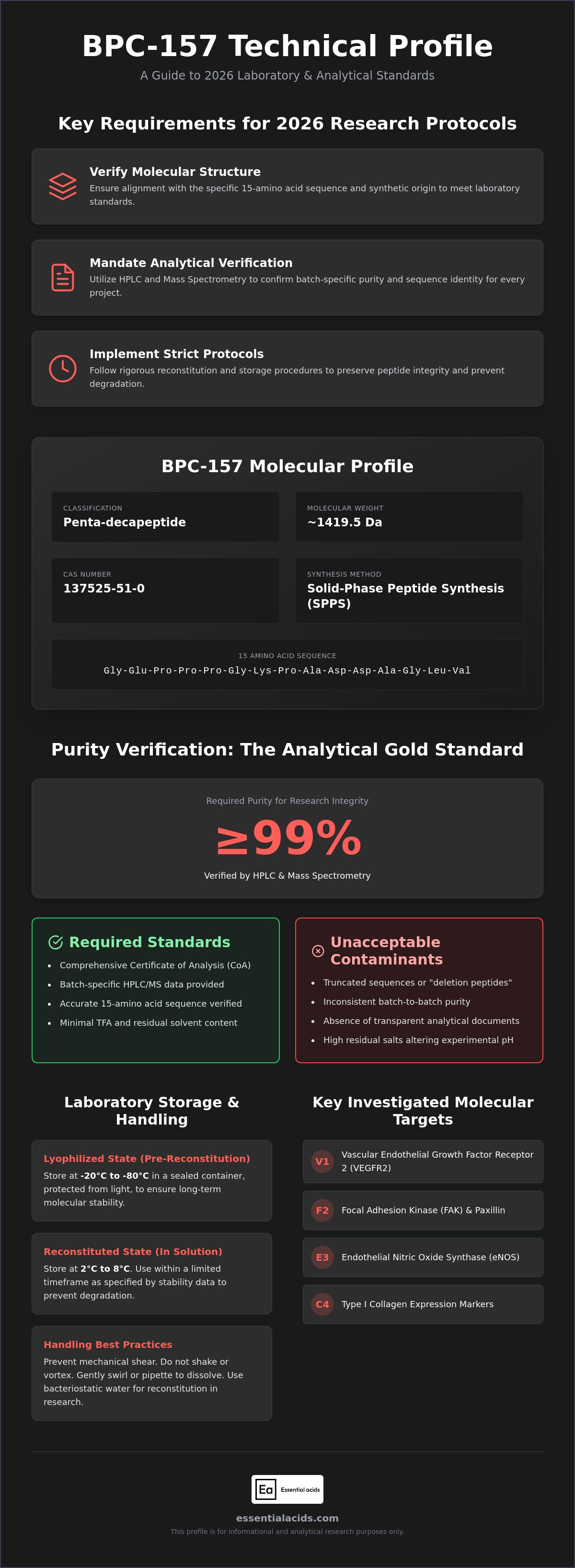
- Identify the precise molecular structure and synthetic origins of the bpc-157 research chemical to ensure alignment with 2026 laboratory standards.
- Master the analytical requirements of HPLC and Mass Spectrometry to verify batch-specific purity and sequence identity for every research project.
- Implement rigorous reconstitution and storage protocols to preserve the molecular integrity of lyophilized peptide chains and prevent mechanical shear.
- Establish a framework for selecting suppliers that prioritize scientific transparency and provide comprehensive, verified Certificates of Analysis (CoA).
- Analyze the biochemical pathways of BPC-157, specifically focusing on its interaction with Vascular Endothelial Growth Factor (VEGF) in controlled environments.
Defining BPC-157: Molecular Structure and Synthetic Origin
BPC-157 is defined as a penta-decapeptide, a synthetic chain comprising 15 specific amino acids: Gly-Glu-Pro-Pro-Pro-Gly-Lys-Pro-Ala-Asp-Asp-Ala-Gly-Leu-Val. Although this sequence is biologically modeled after a protective protein found in human gastric juice, any viable BPC-157 utilized in a laboratory setting is produced through sophisticated synthetic processes. As a bpc-157 research chemical, it serves as a critical tool for investigating cellular signaling and tissue modulation. It's strictly classified as a research-only compound, which mandates its use be confined to analytical studies and controlled experimentation. This classification ensures that the focus remains on its molecular properties within a rigorous scientific framework, avoiding the complications of non-regulated applications.
Chemical Properties and CAS 137525-51-0
The molecular weight of BPC-157 is established at approximately 1419.5 Da, a figure that's consistently verified through mass spectrometry in high-integrity laboratories. It's officially cataloged under CAS 137525-51-0, providing a universal reference for researchers to confirm the identity of their materials. The 15-amino acid chain is prized for its structural resilience, which is a key advantage in longitudinal molecular biology studies. Unlike more volatile proteins, this peptide maintains its primary sequence integrity under varied laboratory conditions, provided storage protocols are followed. Verification of this sequence via mass-to-charge ratio measurements is the baseline requirement for establishing scientific integrity before any experimental work begins.
Synthetic Pathways in 2026 Laboratory Standards
Modern laboratory standards for 2026 emphasize the use of advanced Solid-Phase Peptide Synthesis (SPPS) to ensure the highest degree of sequence accuracy. This manufacturing pathway is designed to prevent the formation of truncated sequences or "deletion peptides" that can compromise research outcomes. By utilizing automated synthesis platforms, manufacturers can achieve a level of precision that was previously unattainable. A significant focus of 2026 protocols is the rigorous removal of trifluoroacetic acid (TFA) and other residual solvents used during the synthesis and purification stages. High-purity research grades are characterized by their minimal TFA content, as residual salts can alter the pH of experimental buffers and lead to skewed data. This disciplined approach to manufacturing reflects a dedication to the "making better, normal" philosophy, where the quality of the research material is never a variable in the experiment.
Investigating Molecular Pathways: Angiogenesis and Tissue Repair
Current biochemical research focuses heavily on the bpc-157 research chemical and its potential to modulate systemic signaling pathways. Unlike simpler peptide sequences, this 15-amino acid chain demonstrates a multifaceted interaction with endogenous repair mechanisms in laboratory models. The primary objective of these studies is to map the specific receptors involved in tissue response, particularly within the vascular and musculoskeletal systems. This research is conducted under strict analytical standards to ensure every observation contributes to the broader understanding of molecular integrity. By isolating these pathways, scientists can better understand the biological triggers that lead to cellular stabilization.
Angiogenic Signaling and Growth Factor Interaction
The molecular mechanism behind the upregulation of VEGFR2 expression is a central theme in angiogenic research. Angiogenesis is the physiological process through which new blood vessels form from pre-existing vessels. In controlled environments, BPC-157 has been observed to influence the VEGF signaling cascade without the immediate degradation often seen in less stable compounds. This molecular stability is critical for longitudinal studies. When compared to other high-purity peptides, BPC-157 provides a unique profile of nitric oxide (NO) synthesis modulation. This specific pathway suggests a regulatory role that extends beyond simple growth factor stimulation, involving complex cross-talk between endothelial cells and the surrounding matrix.
Key molecular targets currently identified in BPC-157 research protocols include:
- Vascular Endothelial Growth Factor Receptor 2 (VEGFR2)
- Focal Adhesion Kinase (FAK) and Paxillin
- Endothelial Nitric Oxide Synthase (eNOS)
- Type I Collagen expression markers
Cellular Response and Extracellular Matrix Research
Cellular response studies provide insight into how the bpc-157 research chemical affects the extracellular matrix (ECM). Research focuses on the proliferation of tendon fibroblasts and the synthesis of collagen in vitro. A key discovery in this area is the activation of the FAK-paxillin signaling pathway, which is essential for cell adhesion and migration. By analyzing these metabolic pathways, scientists can observe the structural reorganization of tissues at a microscopic level. These studies are fundamental to advancing our understanding of cellular ageing and biological resilience. Maintaining high-purity standards is the only way to ensure these delicate signaling pathways aren't interrupted by synthetic impurities. This commitment to precision reflects the "Making better, normal" philosophy that guides high-level analytical research.
Purity Verification: The Role of HPLC and Mass Spectrometry
Analytical transparency is the cornerstone of modern biochemical study. For any bpc-157 research chemical, establishing a definitive purity profile is the first step toward scientific integrity. In 2026, the minimum purity threshold for reliable analytical data is ≥98%. Anything below this standard introduces uncontrolled variables that can compromise cellular assays or signaling observations. Researchers must prioritize compounds that undergo rigorous testing to ensure the absence of heavy metals, residual solvents, or cross-contamination from other peptide sequences. This level of scrutiny isn't just a preference; it's a requirement for maintaining the "making better, normal" standard in high-level laboratories.
Interpreting HPLC Chromatograms for Research Peptides
High-Performance Liquid Chromatography (HPLC) remains the definitive analytical method for quantifying the percentage of the target peptide within a given sample. When reviewing a report, the focus is on the primary peak, which represents the BPC-157 sequence. The area under the curve (AUC) is used to calculate the total purity relative to any detected impurities. Surrounding "noise" or smaller peaks indicate the presence of truncated sequences or synthesis byproducts. For a detailed breakdown of these technical documents, researchers should consult our guide on How to Verify Peptide Purity: A Guide to Reading HPLC and Mass Spectrometry Reports. Understanding the resolution of these peaks is vital for distinguishing between high-purity material and low-tier alternatives.
Mass Spectrometry: Confirming Molecular Integrity
While HPLC measures quantity, Mass Spectrometry (MS) confirms identity. This process measures the mass-to-charge ratio to ensure the synthesized peptide matches the intended molecular structure. The experimental mass peak must align with the theoretical molecular weight of 1419.5 Da. Significant deviations from this number suggest errors in the amino acid sequence or the presence of salt adducts. MS analysis is also instrumental in identifying oxidation or degradation products that might occur during the final stages of lyophilization. Every batch-specific report should show a clear, dominant peak at the expected mass, providing a verified "fingerprint" of the bpc-157 research chemical. Without this data, the identity of the compound remains an unverified assumption.
Strict adherence to these analytical standards ensures that laboratory resources aren't wasted on compromised materials. Essential Acids maintains a professional distance from the casual market by insisting on these rigorous benchmarks. Scientific integrity is preserved through the provision of comprehensive documentation for every research-use only compound. This disciplined approach to quality assurance allows researchers to focus exclusively on their data, knowing the molecular foundation of their study is stable and verified.
Laboratory Protocols: Reconstitution, Storage, and Stability
Maintaining the molecular integrity of a bpc-157 research chemical requires a disciplined approach to physical handling and environmental control. Most high-purity peptides are provided as a lyophilized powder to ensure maximum stability during transit and long-term storage. This freeze-dried state protects the 15-amino acid sequence from hydrolytic degradation, which can occur rapidly in aqueous environments. Researchers must understand that the transition from a solid to a liquid state is a critical point where the peptide's primary structure is most vulnerable to mechanical stress. Precision in these protocols is non-negotiable for achieving reproducible data in 2026 laboratory environments.
Reconstitution Standards in Research Environments
Solvent selection is the first technical decision in the reconstitution process. For multi-use analytical vials, bacteriostatic water containing 0.9% benzyl alcohol is the standard. If a study requires the absence of preservatives, sterile saline or water may be used, though this significantly reduces the stability window. The solvent should be introduced slowly down the side of the vial to minimize impact. Gentle swirling is the only acceptable method for dissolution. Vigorous vortexing must be avoided, as it can cause mechanical shear of the peptide chain. This leads to truncated sequences and invalidates the analytical results of the study.
Thermal Stability and Storage Requirements for 2026
Unreconstituted BPC-157 is stable for 24 months or longer when stored at -20°C or colder and protected from light. Once reconstituted with bacteriostatic water, the solution must be refrigerated at 2°C to 8°C. Data indicates that under these refrigerated conditions, the peptide remains stable for up to 28 days. However, if sterile water without preservatives is used, the solution should be used within 24 hours. Repeated freeze-thaw cycles are detrimental to the molecular structure and must be avoided. To ensure your study utilizes materials that meet these rigorous standards, you can procure verified BPC-157 with batch-specific documentation.
BPC-157 is notably stable across a range of pH environments, which distinguishes it from many other growth-promoting peptides. This characteristic is a primary focus of ongoing research into its resilience within various biological systems. Maintaining this stability during experimentation requires careful buffering to prevent extreme shifts that could eventually lead to denaturation. Every step of the handling process, from the initial thaw to the final assay, must reflect a commitment to scientific integrity. By following these established laboratory protocols, researchers uphold the "Making better, normal" philosophy and ensure the validity of their cellular response studies.
Sourcing High-Purity BPC-157 for Analytical Research
Selecting a source for a bpc-157 research chemical requires a fundamental shift from commercial convenience to analytical necessity. In 2026, the regulatory environment for laboratory procurement in Australia has become increasingly precise, demanding a higher standard of transparency from suppliers. Researchers must vet partners based on their ability to provide verifiable data rather than marketing claims. This disciplined approach to sourcing ensures that the molecular foundation of a study is stable and documented. By prioritizing scientific accuracy, laboratories can avoid the risks of cross-contamination and batch inconsistency that often plague low-tier research materials.
Criteria for Selecting Research Chemical Suppliers
The primary indicator of a reputable supplier is the immediate availability of batch-specific Certificates of Analysis (CoA). These documents must include the HPLC and Mass Spectrometry data required to verify sequence identity and the ≥98% purity threshold. Transparency regarding manufacturing origins and the specific synthesis methods used is equally vital for maintaining scientific integrity. For a broader perspective on these requirements, researchers should consult our guide on Buy Research Peptides Australia: A Technical Guide to Laboratory Procurement in 2026. This level of documentation serves as a technical filter, ensuring that only high-integrity materials enter the laboratory environment.
Procurement via Essential Acids
Essential Acids facilitates streamlined access to a diverse catalog of research compounds, including BPC-157 and 5-Amino-1MQ. By maintaining an Australian-based distribution network, we eliminate the logistical delays and potential temperature fluctuations associated with international shipping. This localized approach is critical for preserving the molecular stability of lyophilized peptides during transit. Our commitment to "Making better, normal" is reflected in our rigorous adherence to safety protocols and the provision of high-purity materials that support visionary research in metabolic health and neuroscience. We function as a reliable partner for analytical facilities that prioritize precision over marketplace trends.
Scientific integrity is maintained through a strict "research-use only" policy. Essential Acids does not offer medical consultations or human-grade pharmaceuticals. All compounds, including the bpc-157 research chemical, are intended exclusively for laboratory, analytical, and scientific research purposes. This disciplined adherence to regulatory boundaries protects the research community and ensures that experimental outcomes remain untainted by non-compliant variables. Every procurement decision is viewed as a commitment to the advancement of biological knowledge, where the quality of the compound is expected to speak for itself through the clarity of the resulting data.
Advancing Scientific Integrity in Peptide Research
The transition toward more rigorous analytical standards in 2026 necessitates a disciplined approach to laboratory procurement. Every study's validity relies on the elimination of molecular impurities and the verification of sequence identity through batch-specific documentation. As established, achieving reproducible results with a bpc-157 research chemical requires a strict adherence to ≥98% purity thresholds and precise thermal storage protocols. These benchmarks ensure that the focal signaling pathways, such as VEGF modulation and fibroblast migration, are observed without the interference of synthetic byproducts. Maintaining this level of control is essential for any laboratory dedicated to high-integrity biochemical analysis.
Essential Acids supports the scientific community by providing high-purity compounds backed by comprehensive HPLC and Mass Spectrometry data. Our Australian-based distribution ensures logistical efficiency and minimizes the risk of thermal degradation during transit. All materials are strictly research-use only, reflecting a firm commitment to regulatory compliance and the philosophy of making better, normal. You can Secure High-Purity BPC-157 for Your Laboratory Research to ensure your next study begins with a verified molecular foundation. Precision in the laboratory today defines the scientific breakthroughs of tomorrow.
Frequently Asked Questions
What is the primary molecular function of BPC-157 in a laboratory setting?
The primary function is the modulation of vascular signaling pathways, specifically the upregulation of Vascular Endothelial Growth Factor Receptor 2 (VEGFR2). In a laboratory setting, this allows for the observation of angiogenic processes and cellular repair mechanisms in vitro. Scientists utilize the bpc-157 research chemical to study these interactions within controlled musculoskeletal and gastric models. This research helps map the specific biochemical triggers for tissue stabilization.
Is BPC-157 approved for human or veterinary use in Australia?
No, BPC-157 isn't approved for human or veterinary use in Australia as of 2026. It's strictly classified as a research chemical intended for laboratory experimentation and analytical studies. Procurement is limited to facilities that adhere to rigorous research-only compliance standards. Any use outside of a documented laboratory environment is non-compliant with current distribution policies and regulatory frameworks governing high-purity peptides.
How should BPC-157 be stored to ensure long-term stability for research?
Long-term stability is maintained by storing the lyophilized powder at -20°C or colder, protected from light. In this unreconstituted state, the peptide remains viable for approximately 24 months. Once reconstituted, the solution must be refrigerated at 2°C to 8°C and used within the established stability window of 28 days if bacteriostatic water is used. Avoiding repeated freeze-thaw cycles is critical for preserving the primary amino acid sequence.
What purity level is required for BPC-157 to be used in analytical studies?
A purity level of ≥99% is the established standard for reliable analytical data in 2026. This threshold, verified by High-Performance Liquid Chromatography (HPLC), ensures that experimental outcomes aren't skewed by truncated sequences or residual solvents. High-purity materials are essential for maintaining the scientific integrity of cellular response studies. Using the bpc-157 research chemical at this grade minimizes variables that could compromise longitudinal data sets.
Can BPC-157 be used for clinical diagnosis or therapeutic applications?
No, BPC-157 cannot be used for clinical diagnosis or therapeutic applications. It's exclusively for scientific research and analytical purposes. Essential Acids maintains a firm boundary regarding these negatives to ensure compliance with regulatory standards and to protect the integrity of the research community. The compound isn't a pharmaceutical drug and shouldn't be treated as such under any circumstances, regardless of the research context.
What solvent is recommended for the reconstitution of BPC-157 research chemicals?
Bacteriostatic water, which contains 0.9% benzyl alcohol, is the recommended solvent for multi-use analytical vials. This solvent inhibits bacterial growth and extends the stability of the reconstituted peptide solution. Sterile saline is an alternative for studies requiring the absence of preservatives, though it necessitates a much shorter usage window of approximately 24 hours. Proper solvent choice is a fundamental step in ensuring the molecular structure remains intact.
How does Essential Acids verify the purity of its research peptides?
Essential Acids verifies the integrity of every compound through batch-specific HPLC and Mass Spectrometry (MS). HPLC quantifies the purity percentage, while MS confirms the molecular weight of 1419.5 Da. These documents are provided to researchers to ensure complete transparency and to uphold the "making better, normal" philosophy. This analytical verification ensures that every vial meets the rigorous standards required for modern biochemistry and neuroscience research.
What is the significance of the CAS number 137525-51-0 for BPC-157?
CAS number 137525-51-0 serves as the unique chemical identifier for BPC-157, allowing researchers to verify the compound's identity in global databases. It's a critical marker used in mass spectrometry and procurement to distinguish this specific 15-amino acid sequence from other peptide chains. This standardization is vital for accurate data tracking across different laboratory facilities and ensures the correct sequence is used in all experimental protocols.
Legal Disclaimer
All products sold on this website are intended exclusively for laboratory research purposes and not for human or veterinary use, diagnosis, cure, treatment, or prevention of any disease or condition. None of the statements on this site have been reviewed or evaluated by the U.S. Food and Drug Administration (FDA) or comparable regulatory authorities. Purchasing or using these products for any unintended purpose, including human consumption, may violate federal or local laws and poses safety risks.