

In 2026, the gap between consumer-grade longevity supplements and analytical-grade cofactors has never been more critical for laboratory integrity. Many researchers find that "boosters" marketed for human consumption fail to meet the rigorous purity standards required for metabolic study design. When you look to buy NAD+ Australia for laboratory use, the presence of batch-specific HPLC and Mass Spectrometry documentation is the only reliable metric for scientific validity. It's a landscape where the distinction between a retail product and a research-grade compound determines the success of your data.
You likely understand the frustration of navigating unreliable purity levels and the confusion caused by recent TGA import enforcement on peptides and related cofactors. This guide provides a definitive framework for acquiring high-purity, lyophilized NAD+ specifically for laboratory analysis. We will outline the essential molecular standards, discuss the importance of batch-specific COA documentation, and provide a clear path through the Australian research procurement process. By prioritizing scientific integrity and "making better, normal," you can ensure your laboratory remains compliant while maintaining the highest analytical standards.
Key Takeaways
- Understand the fundamental role of Nicotinamide Adenine Dinucleotide as a primary electron carrier and its critical function in DNA repair and ATP production.
- Differentiate between consumer-grade oral precursors and the high-purity lyophilized cofactors required for rigorous laboratory study when you buy NAD+ Australia.
- Identify the analytical gold standards for procurement, focusing on the necessity of batch-specific HPLC and Mass Spectrometry for molecular verification.
- Ensure regulatory compliance for your facility by following established protocols for the acquisition of research-only metabolic standards within the 2026 Australian framework.
- Gain insight into the specific molecular profile and handling requirements of research-grade NAD+ (500mg) to maintain compound integrity during experimental phases.
Understanding NAD+ (Nicotinamide Adenine Dinucleotide) in a Research Context
Nicotinamide adenine dinucleotide (NAD+) is a central coenzyme found in all living cells, serving as a critical electron carrier in metabolic redox reactions. Its presence is a fundamental requirement for life, facilitating the transfer of electrons from one molecule to another to drive cellular energy production. Researchers who seek to buy NAD+ Australia for laboratory analysis often focus on its role as a substrate for enzymes that regulate genomic stability and metabolic pathways. It exists in two states: the oxidized form, NAD+, and the reduced form, NADH. This structural transition is the engine behind mitochondrial function, as the ratio between these two states dictates the cellular redox potential.
The ubiquity of this cofactor doesn't diminish its complexity. In high-purity research settings, the stability of the compound is paramount. Analytical studies depend on the precise concentration of the oxidized state to measure enzymatic activity accurately. Because NAD+ is involved in over 300 biochemical reactions, it remains one of the most studied molecules in biochemistry and neuroscience, particularly concerning the maintenance of cellular homeostasis under physiological stress. Scientific integrity requires that these studies use compounds with verified molecular profiles to avoid experimental variance.
The Molecular Structure of NAD+
Chemically, NAD+ is a dinucleotide consisting of two nucleotides joined through their phosphate groups. One nucleotide contains an adenine base, while the other contains nicotinamide. This specific arrangement allows the nicotinamide ring to accept or donate electrons, making it the reactive component of the molecule. The phosphate groups provide the necessary molecular stability for the compound to function within the aqueous environment of the cytoplasm and mitochondria. While it shares structural similarities with NADP+, the addition of an extra phosphate group in NADP+ changes its biological role entirely; it primarily directs that molecule toward anabolic reactions rather than the catabolic processes associated with NAD+.
Why NAD+ Concentration Matters in Scientific Inquiry
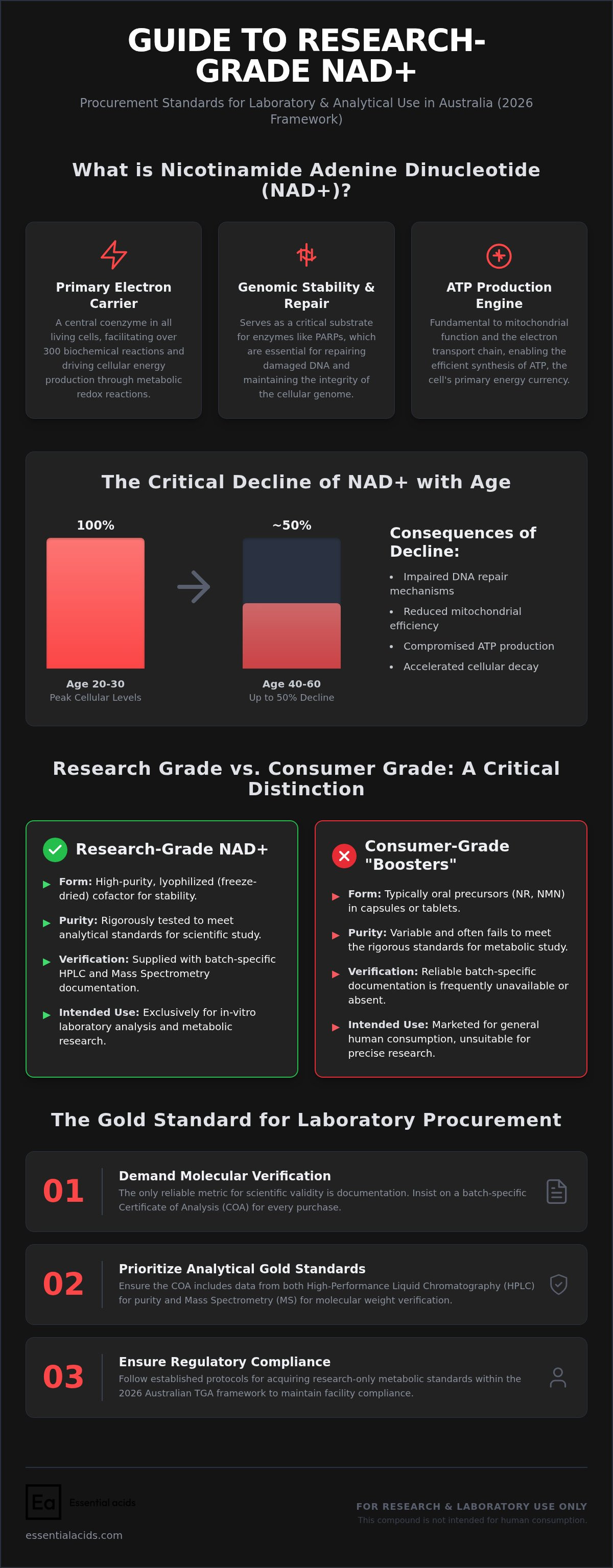
The motivation to buy NAD+ Australia for research often stems from the observed decline of this cofactor in biological ageing models. Data suggests that NAD+ levels can decline by up to 50% between the ages of 40 and 60. This reduction has significant implications for cellular resilience and metabolic homeostasis. As a rate-limiting factor, its availability determines the efficiency of several enzymatic pathways, including those managed by sirtuins and poly(ADP-ribose) polymerases (PARPs). When concentrations drop, the cell's ability to repair DNA and produce ATP is compromised, making the quantification of these levels a primary focus for researchers investigating cellular decay and metabolic dysfunction.
The Molecular Mechanism: NAD+ as a Critical Research Cofactor
The molecular utility of NAD+ extends far beyond its role as a simple electron shuttle. In the Citric Acid Cycle, it acts as a mandatory co-substrate for key dehydrogenases, directly facilitating the conversion of biochemical energy from nutrients into cellular fuel. Beyond energy metabolism, NAD+ serves as a critical signaling molecule that regulates the activity of sirtuins (SIRT1-7). These NAD+-dependent deacetylases are central to the regulation of metabolic homeostasis, stress resistance, and cellular longevity. When researchers buy NAD+ Australia for in vitro models, they are often investigating how the depletion of this cofactor triggers mitochondrial dysfunction and the subsequent breakdown of nuclear-mitochondrial communication. A cell can't maintain its genomic stability without sufficient NAD+ flux, making the concentration of this molecule a primary variable in experimental biology.
Mitochondrial Energy and ATP Synthesis
The efficiency of ATP synthesis is inextricably linked to the NAD+/NADH ratio within the mitochondrial matrix. During the electron transport chain, NADH serves as the primary electron donor for Complex I, initiating the proton gradient necessary for energy production. Research suggests that increasing the availability of NAD+ can stimulate mitochondrial biogenesis, which is the process by which cells increase their mitochondrial mass and functional capacity. Oxidative phosphorylation represents the final stage of cellular respiration where the energy from electrons carried by NADH is used to synthesize ATP across the inner mitochondrial membrane. For laboratory analysis, maintaining a stable supply of high-purity cofactors is essential to avoid experimental artifacts in energy throughput measurements. Disruption in these ratios often leads to increased production of reactive oxygen species, further complicating the study of metabolic decay.
DNA Repair and PARP Enzymes
Genomic integrity is maintained through the action of Poly(ADP-ribose) polymerases (PARPs), a family of enzymes that identify and repair DNA damage. PARPs are significant consumers of NAD+; they break down the molecule to build ADP-ribose polymers on target proteins. This consumption creates a metabolic trade-off. High levels of DNA damage can exhaust cellular NAD+ pools, leading to a deficit in ATP production and eventual cellular senescence or death. Harvard research on NAD+ modulation provides a comprehensive view of how these repair pathways compete with metabolic processes for the same cofactor pool. This competition is a focal point in oncology and senescence research, where researchers examine how exogenous cofactors might influence cellular survival under genotoxic stress. If your study requires verified molecular standards to ensure data accuracy, you can buy NAD+ Australia with the assurance of batch-specific analytical reports.
Research Grade vs. Consumer Grade: Navigating the Australian Landscape
The Australian marketplace often conflates the procurement of NAD+ with its oral precursors, Nicotinamide Riboside (NR) and Nicotinamide Mononucleotide (NMN). As of 2026, NMN is a permitted ingredient for listed medicines on the Australian Register of Therapeutic Goods (ARTG), provided it is sourced through authorized suppliers. However, products marketed as direct NAD+ or NADH supplements remain in a regulatory grey area and aren't approved for use in listed medicines. This distinction is critical for those who need to buy NAD+ Australia for legitimate laboratory study. Research-grade NAD+ is the direct Nicotinamide Adenine Dinucleotide molecule, provided in a high-purity format that bypasses the metabolic conversion steps required by precursors. The Role of NAD+ in Cellular Metabolism highlights how these molecules function as substrates for signaling enzymes, a process that requires exact concentrations to yield valid data.
Scientific integrity demands a clear separation between retail supplements and analytical standards. Consumer products are formulated for physiological absorption, often containing stabilizers that interfere with biochemical assays. In contrast, research-grade cofactors are designed for precision. This "quiet authority" of technical data ensures that experimental results are reproducible and free from the variables introduced by food-grade manufacturing processes. When the success of a study depends on molecular weight accuracy and chemical stability, the choice of procurement source becomes the primary variable.
Bioavailability vs. Analytical Purity
In a clinical research setting, the concept of "bioavailability" is secondary to analytical purity. Consumer-facing brands emphasize how well a precursor survives the digestive tract, but this metric is irrelevant for in-vitro assays where the molecule is applied directly to the target site. Researchers require lyophilized powder because it provides a stable, concentrated form of the cofactor that can be reconstituted to specific molarities. Encapsulated retail products contain fillers, binders, and lubricants that would contaminate an analytical environment. For a broader understanding of sourcing these materials, consult our technical guide on buying research peptides in Australia.
Regulatory Compliance in Australia
Compliance in the Australian research sector relies on a clear boundary between therapeutic goods and research chemicals. The TGA oversees products intended for human therapeutic use, but high-purity NAD+ for laboratory analysis is classified as a research material. Since February 2026, the TGA has implemented stricter import enforcement for peptides and related cofactors, requiring formal declarations of intended use. Institutional researchers must ensure that their acquisition protocols reflect this non-therapeutic intent. This isn't just a legal formality; it's a mark of scientific integrity that ensures the compound has not been degraded by food-grade stabilizers.
Procurement Standards: Verifying Purity and Integrity
Experimental validity in biochemical research is non-negotiable. When professionals seek to buy NAD+ Australia, the procurement process must transcend mere transaction and become a rigorous verification exercise. High-Performance Liquid Chromatography (HPLC) serves as the primary analytical tool for determining chemical purity, separating the NAD+ molecule from any residual solvents or synthesis byproducts. Without these metrics, research data remains susceptible to interference from unverified compounds. Low-purity cofactors can introduce exogenous variables that compromise the integrity of cellular assays, leading to skewed metabolic profiles and irreproducible results.
A mandatory component of ethical procurement is the Certificate of Analysis (CoA). This document must be batch-specific, rather than a generic template, providing a transparent record of the specific vial's chemical makeup. It acts as a protective boundary, ensuring that the laboratory only utilizes substances that meet established molecular standards. Relying on unverified suppliers introduces unnecessary risk into the study design, potentially invalidating months of specialized work due to inconsistent reagent quality. Scientific integrity requires that every compound used in a study is backed by a verifiable analytical trail.
Reading an HPLC Report
An HPLC report provides a visual representation of a compound's purity through a series of peaks on a chromatogram. The primary peak should represent the NAD+ molecule, and its area relative to the total chromatogram determines the purity percentage. For molecular research, a rating of 99% or higher is the expected standard to ensure minimal experimental interference. Baseline noise in HPLC can obscure low-level contaminants that may significantly alter metabolic flux in sensitive assays. Identifying these minor deviations is essential for maintaining the quiet authority of your laboratory's output and ensuring that the coenzyme performs as expected in redox reactions.
Mass Spectrometry Verification
While HPLC confirms purity, Mass Spectrometry (MS) confirms molecular identity. This technique measures the mass-to-charge ratio of the molecule, verifying that the substance is indeed Nicotinamide Adenine Dinucleotide and not a structurally similar impurity. For NAD+, researchers should look for a primary mass peak of approximately 663.4 g/mol. This verification is vital for identifying potential degradation products that can accumulate in older or poorly stored batches. You can find more detail on interpreting these technical documents in our guide to verifying peptide purity. Ensuring your materials meet these precise specifications is the only way to uphold the standards of "making better, normal" in a laboratory setting. To secure a verified supply for your next study, you can buy NAD+ Australia with full analytical documentation.
Essential Acids: High-Purity NAD+ for Scientific Analysis
Essential Acids operates with a core commitment to scientific integrity. Our mission of "Making better, normal" is realized through the provision of high-purity compounds that meet the exacting standards of modern biochemistry. When researchers choose to buy NAD+ Australia from our catalog, they receive materials specifically curated for laboratory analysis. Each 500mg lyophilized vial is a product of rigorous quality control, ensuring that the molecular profile remains consistent across different batches. This dedication to precision allows scientists to focus on experimental outcomes rather than reagent variability. It is a persona defined by expertise and a firm adherence to the rules of analytical chemistry.
Transparency is maintained through our batch-specific analytical documentation. Every compound is accompanied by verified HPLC and Mass Spectrometry reports, which are accessible through our digital library. This level of detail is essential for maintaining a formal, detached perspective on laboratory standards. We don't rely on marketing flair; instead, we let the technical data define the value of our cofactors. By providing a clear analytical trail, we support the regulatory compliance and transparency required by Australian research institutions. Our "research-use only" policy acts as a linguistic filter, ensuring our audience understands the technical nature of these substances.
Technical Specifications and Handling
NAD+ stability is highly dependent on proper storage and handling. Our 500mg vials contain lyophilized powder, which should be stored at -20°C for long-term preservation of the molecular structure. When preparing for laboratory use, reconstitution protocols often involve the use of bacteriostatic water to ensure compound stability during the experimental phase. Reconstituted solutions are more sensitive to degradation and should be used promptly or stored according to specific study requirements. Access to the Essential Acids CoA library ensures that researchers can verify the integrity of each batch before integrating it into a study design.
National Distribution and Support
Efficiency in procurement is vital for time-sensitive metabolic studies. We provide fast national shipping across Australia, ensuring that high-purity cofactors reach your facility without unnecessary delays. Our support team is available to address technical inquiries regarding molecular profiles or analytical reports, maintaining a professional distance that respects your professional focus. This commitment to scientific accuracy and regulatory transparency establishes Essential Acids as a stable partner in the Australian research landscape. We maintain a strict research-use only policy to ensure all materials are utilized within appropriate biological study designs, reflecting a deep commitment to the gravity of laboratory research.
Advancing Metabolic Research with Analytical Integrity
The integrity of metabolic study design in 2026 relies on the clear distinction between retail-grade precursors and high-purity analytical cofactors. As researchers navigate the complexities of cellular ageing and DNA repair, the requirement for verified molecular standards remains absolute. By prioritizing substances with batch-specific HPLC and Mass Spectrometry verification, laboratories can eliminate the variables introduced by unverified compounds. This commitment to scientific integrity ensures that experimental data remains reproducible and compliant with Australian research standards.
When you choose to buy NAD+ Australia through a dedicated research supplier, you secure access to high-purity lyophilized 500mg vials designed for precise reconstitution. Essential Acids facilitates this process with fast national shipping and a comprehensive library of batch-specific analytical documentation. Maintaining these high standards is the only way to uphold the principles of "making better, normal" in a professional laboratory setting. We invite you to Secure High-Purity NAD+ for Laboratory Research and advance your study with compounds that meet the highest technical specifications. Accurate data begins with the quality of your reagents.
Frequently Asked Questions
Is NAD+ available for human consumption in Australia?
Direct NAD+ isn't approved for human consumption as a listed medicine in Australia. While Nicotinamide Mononucleotide (NMN) is a permitted ingredient for listed medicines on the Australian Register of Therapeutic Goods (ARTG) as of 2026, pure NAD+ remains restricted to laboratory research. It is strictly for research-use only and is not intended for therapeutic applications or human administration in any capacity.
What is the difference between NAD+ and NMN for research?
The primary difference lies in the metabolic pathway required for cellular utilization. NAD+ is the active coenzyme, whereas NMN is a precursor that must undergo enzymatic conversion to become NAD+. For researchers who buy NAD+ Australia, the direct cofactor is often preferred in in-vitro models to bypass conversion variables and measure direct enzymatic response within the study design.
How should research-grade NAD+ be stored in the laboratory?
Research-grade NAD+ should be stored as a lyophilized powder at -20°C to maintain molecular stability and prevent degradation. Once reconstituted, the solution becomes highly sensitive and should be kept refrigerated at 2°C to 8°C for short-term use. For long-term experimental integrity, researchers should aliquot the reconstituted solution to minimize freeze-thaw cycles that can compromise the dinucleotide structure.
What purity level is required for NAD+ analytical studies?
Analytical studies typically require a purity level of 99% or higher as verified by High-Performance Liquid Chromatography (HPLC). Lower purity levels can introduce exogenous contaminants that interfere with delicate metabolic assays or redox signaling pathways. Maintaining this threshold is a core component of scientific integrity, ensuring that observed biological effects are attributable solely to the Nicotinamide Adenine Dinucleotide molecule.
Does Essential Acids provide HPLC reports for NAD+?
Yes, Essential Acids provides batch-specific HPLC and Mass Spectrometry reports for all NAD+ orders. These documents verify the chemical identity and purity of the specific lot, ensuring the compound meets the required analytical standards for laboratory use. Access to these reports is provided to support the documentation requirements of institutional research procurement and experimental transparency.
How long does shipping take for NAD+ orders within Australia?
Shipping typically takes 1 to 3 business days for national delivery across Australia. We utilize fast national shipping services to ensure that time-sensitive research materials reach their destination promptly. All orders are processed with a focus on maintaining the stability of the lyophilized vials during transit to ensure the integrity of the compound upon arrival at the laboratory.
Can NAD+ be used in conjunction with 5-Amino-1MQ in research models?
NAD+ is frequently used alongside 5-Amino-1MQ in metabolic research models to study synergistic effects on mitochondrial function. While 5-Amino-1MQ acts as an NNMT inhibitor to prevent the depletion of methyl donors, NAD+ provides the necessary substrate for sirtuin activation. This combination is often studied to observe changes in cellular energy homeostasis and metabolic flux in laboratory settings.
What is the CAS number for NAD+ used in laboratory settings?
The CAS number for Nicotinamide Adenine Dinucleotide (NAD+) is 53-84-9. This unique numerical identifier is used globally to ensure the correct chemical substance is identified in laboratory databases and safety data sheets. Referencing this number when you buy NAD+ Australia ensures that the material meets the specific molecular classification required for rigorous biochemical analysis and regulatory compliance.
Legal Disclaimer
All products sold on this website are intended exclusively for laboratory research purposes and not for human or veterinary use, diagnosis, cure, treatment, or prevention of any disease or condition. None of the statements on this site have been reviewed or evaluated by the U.S. Food and Drug Administration (FDA) or comparable regulatory authorities. Purchasing or using these products for any unintended purpose, including human consumption, may violate federal or local laws and poses safety risks.