

The efficacy of a growth hormone secretagogue research model is not determined by the potency of a single peptide but by the precision of its signaling synergy. Many investigators recognize that maintaining analytical integrity is difficult when faced with inconsistent material purity or the technical ambiguity surrounding DAC and No DAC variants. This guide serves as a technical reference on the dual-pathway mechanisms of cjc 1295 ipamorelin, offering a detailed profile of how these compounds interact at the pituitary level to maximize growth hormone signaling in laboratory settings.
You will gain a clear understanding of the molecular structures involved and the specific protocols required for stable reconstitution. We provide a rigorous analysis of the synergistic relationship between GHRH analogs and GHRPs, alongside standardized handling procedures to ensure research reliability. By the conclusion of this profile, the criteria for selecting specific variants based on study duration will be established, supporting the pursuit of making better, normal through scientific integrity. This resource is intended strictly for research-use only and adheres to the highest standards of laboratory transparency.
Key Takeaways
- Identify the distinct biochemical roles of GHRH analogs and GHRP mimetics in stimulating growth hormone secretion within laboratory environments.
- Analyze the dual-pathway signaling mechanism that defines the cjc 1295 ipamorelin synergy to maximize pituitary response in research models.
- Evaluate the structural impact of the Drug Affinity Complex (DAC) on peptide half-life to select the correct variant for specific study timelines.
- Establish standardized reconstitution protocols using bacteriostatic water to preserve the molecular integrity of lyophilized research compounds.
- Recognize the necessity of batch-specific verification and high-purity standards to ensure the analytical accuracy of research findings.
Molecular Profile of CJC-1295 and Ipamorelin in Laboratory Research
The study of metabolic signaling and cellular aging often utilizes synthetic peptides to probe the intricacies of the growth hormone axis. CJC-1295 and Ipamorelin represent two distinct classes of secretagogues frequently investigated for their ability to influence endogenous hormone production. While both compounds target the pituitary gland, their mechanisms of action and molecular structures are fundamentally different. These substances are strictly intended for laboratory research and analytical applications; they aren't for human consumption. Researchers utilize cjc 1295 ipamorelin to observe how dual-pathway stimulation affects the amplitude and frequency of growth hormone pulses in vitro and in vivo models.
The integrity of laboratory data depends on the researcher's understanding of these molecular profiles. Analytical studies focusing on cellular rejuvenation and metabolic pathways require high-purity compounds that exhibit consistent behavior in controlled environments. By examining these peptides through a clinical lens, scientists can better understand how specific ligands interact with receptors to modulate biological processes. This commitment to scientific integrity ensures that observations remain objective and reproducible across different research cycles.
CJC-1295: The GHRH Analogue
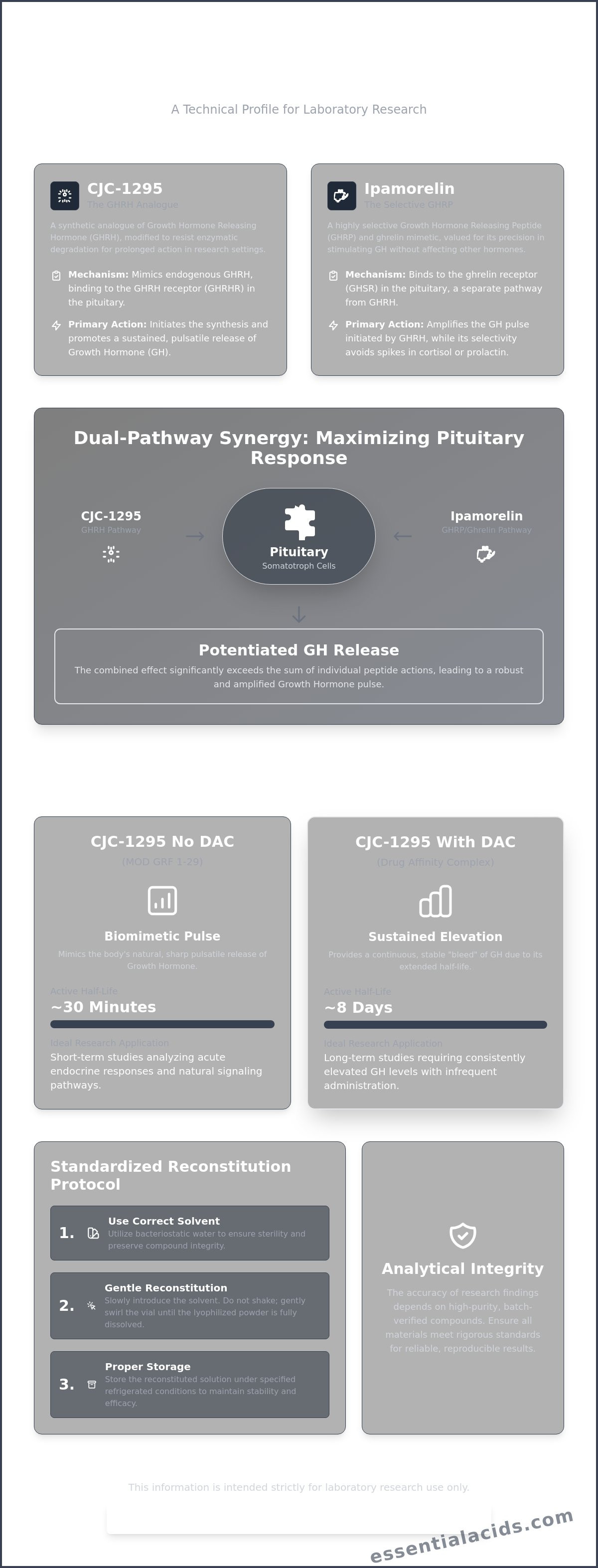
CJC-1295 is a synthetic analogue of Growth Hormone Releasing Hormone (GHRH). It's a modified version of the first 29 amino acids of the natural GHRH peptide, often referred to as GHRH (1-29) or Sermorelin. The primary research focus of this compound is its binding affinity for the GHRH receptor (GHRHR) located in the anterior pituitary. By mimicking endogenous GHRH, it initiates the signaling cascade necessary for growth hormone synthesis. Laboratory studies emphasize its role in maintaining a sustained, pulsatile release of GH, which preserves the biological rhythm of the endocrine system. The structural modifications in CJC-1295 are designed to resist enzymatic degradation, allowing for a longer window of observation in metabolic research.
Ipamorelin: The Selective GHRP
Ipamorelin is a selective Growth Hormone Releasing Peptide (GHRP) and a ghrelin mimetic. As a pentapeptide (Aib-His-D-2-Nal-D-Phe-Lys-NH2), it exhibits high selectivity for the growth hormone secretagogue receptor (GHSR). This specificity is a critical factor in analytical research. Unlike earlier GHRPs, Ipamorelin doesn't significantly increase the secretion of secondary hormones such as prolactin or cortisol. This makes it a refined tool for isolating the effects of GH stimulation without the interference of stress-related hormonal spikes. For a more comprehensive technical breakdown, researchers should consult our Ipamorelin: A Molecular Profile and Technical Overview for Laboratory Research. The compound's high selectivity supports the brand's philosophical signature of making better, normal through precise scientific exploration. This research-use only peptide remains a cornerstone in modern biochemistry for investigating cellular growth signaling.
The Synergistic Mechanism: GHRH and GHRP Interaction
The interaction between these two classes of secretagogues is characterized by a potentiation effect that exceeds the sum of their individual activities. When investigating cjc 1295 ipamorelin, researchers observe a synchronized activation of the growth hormone axis. This synergy occurs because the compounds stimulate two distinct pituitary pathways simultaneously. While mono-compound studies show moderate increases in growth hormone (GH) levels, the combination creates a robust signaling environment that maximizes endogenous production. The biochemical coordination between a GHRH analog and a GHRP is a primary focus for studies involving cellular metabolic signaling.
Dual-Pathway Signaling in Cellular Models
In cellular models, this interaction takes place within the somatotroph cells of the anterior pituitary gland. CJC-1295 acts as the initiator, binding to the GHRH receptor (GHRHR) to stimulate GH synthesis and secretion. Concurrently, Ipamorelin targets the growth hormone secretagogue receptor (GHSR). This dual binding triggers a surge in intracellular calcium signaling, which is a critical precursor to peptide-induced GH secretion. Peer-reviewed research on CJC-1295's molecular effects demonstrates how these signaling cascades ultimately influence IGF-1 (Insulin-like Growth Factor 1) expression in research subjects. The resulting increase in GH pulse amplitude is often reported as multi-fold compared to isolated peptide applications.
Inhibiting Somatostatin: The Secret to Potentiation
Understanding the synergy requires analyzing the role of somatostatin, the primary inhibitory hormone of the GH axis. Somatostatin acts as a biochemical "brake," preventing the pituitary from releasing stored growth hormone even when GHRH signals are present. Ipamorelin serves a dual role; it is both a GHRP and a ghrelin mimetic that helps neutralize somatostatin-mediated inhibition. By removing this inhibitory pressure, Ipamorelin allows for a larger release of the hormone that CJC-1295 has signaled the pituitary to produce. Effectively, CJC-1295 maximizes the "gas" by increasing GHRHR activation, while Ipamorelin ensures the "brake" is disengaged.
This coordination is why research models show such a high degree of efficacy in metabolic signaling studies. For laboratories requiring consistent data, sourcing high-purity compounds from a supplier focused on scientific integrity is essential to avoid analytical artifacts. This research-use only synergy remains a focal point for studies concerning cellular aging and metabolic optimization. The precision of this dual-pathway signaling ensures that research outcomes reflect the true potential of the growth hormone axis under controlled conditions.
Comparative Analysis: CJC-1295 with DAC vs. No DAC
The selection of a GHRH analog for laboratory research requires a precise understanding of pharmacokinetic differences. The primary distinction between the two variants of CJC-1295 lies in the inclusion of the Drug Affinity Complex (DAC). This complex involves the addition of a lysine linker to maleimidoproprionic acid, a modification that fundamentally alters the peptide’s behavior in a biological environment. By enabling the peptide to bind covalently to endogenous albumin, DAC significantly extends the half-life of the compound. In research models investigating cjc 1295 ipamorelin synergy, this structural difference determines whether the growth hormone signaling is acute or sustained.
Analytical data indicates that CJC-1295 No DAC, often referred to as Mod GRF 1-29, exhibits a rapid clearance rate. Conversely, CJC-1295 With DAC provides Prolonged Stimulation of Growth Hormone, maintaining elevated GH levels for several days after a single administration in a research setting. This sustained elevation contrasts with the natural pulsatile rhythm of the endocrine system, making the choice of variant a critical variable in study design. Investigators must align the peptide's kinetic profile with the specific metabolic signaling pathways they intend to observe.
Choosing the Right Variant for Research Timelines
Research protocols are often divided between short-term metabolic response studies and long-term cellular observation. CJC-1295 No DAC is typically preferred for studies requiring precise, acute GH spikes that mimic physiological pulses. This variant allows researchers to observe the immediate cellular response without long-term receptor saturation. In contrast, CJC-1295 With DAC is utilized for long-term studies where constant GH elevation is necessary to observe cumulative effects on cellular receptors or metabolic markers. Dosing frequency in laboratory protocols is directly dictated by these half-life variations, with No DAC requiring more frequent administration to maintain signaling integrity.
Stability and Binding Affinity
The stability of these compounds is a direct result of their molecular engineering. The albumin binding facilitated by the DAC modification influences the distribution of the peptide throughout the research subject, protecting it from rapid enzymatic degradation. While this provides stability, it also results in a "bleeding" effect of GH release rather than distinct pulses. For studies that demand high resolution of individual signaling events, the shorter-acting version is superior. The half-life of Mod GRF 1-29 is 30 minutes for research precision. This brief window ensures that researchers can isolate specific biological responses without the interference of residual peptide activity from previous cycles. Maintaining scientific integrity requires this level of granular control over laboratory variables.
Technical Protocols: Reconstitution and Stability
The stability of cjc 1295 ipamorelin during laboratory handling is a prerequisite for generating reproducible data. These compounds are typically supplied as lyophilized (freeze-dried) powder. This state ensures maximum molecular stability during transit and storage by removing the moisture that could otherwise facilitate enzymatic degradation. Reconstitution is the most critical phase where peptide integrity is at risk. It requires the use of BAC Water or sterile saline to create a solution suitable for analytical applications. The choice of diluent is not arbitrary; bacteriostatic water contains 0.9% benzyl alcohol, which inhibits bacterial growth and maintains the pH balance necessary for peptide longevity in multi-dose research vials.
Precise handling isn't just a recommendation; it's a requirement for scientific integrity. Peptides are essentially chains of amino acids held together by peptide bonds. These bonds are susceptible to mechanical stress. If a researcher handles the vial with insufficient care, the molecular structure can be altered, leading to a loss of biological activity. This section outlines the standardized protocols required to preserve the analytical value of these research-use only compounds.
Standard Laboratory Reconstitution Procedure
Precision starts before the solvent touches the powder. It's necessary to allow the vial to reach room temperature before introducing the diluent to prevent thermal shock to the peptide structure. Introduce the solvent slowly down the side of the glass wall rather than directly onto the lyophilized cake. This technique minimizes the risk of mechanical stress and foam formation. Mechanical agitation or vigorous shaking can shear the delicate peptide bonds, rendering the sample useless for research. Gentle swirling is required to facilitate dissolution. Researchers must verify complete dissolution and a clear solution before proceeding with any analytical testing. If the powder doesn't dissolve completely, the concentration of the resulting solution will be inaccurate, compromising the entire study.
Maintaining Peptide Integrity
Molecular degradation is often caused by improper environmental controls. Avoiding repeated freeze-thaw cycles is mandatory. Each cycle creates ice crystals that can physically damage the peptide chains. For short-term preservation, reconstituted solutions should be kept at 2–8°C. Long-term storage of the lyophilized powder is best maintained at -20°C to ensure the compounds remain stable for up to 24 months. Light sensitivity is another factor. Opaque storage containers or dark environments are necessary to protect research compounds from UV-induced degradation. Investigators should visually inspect vials for signs of degradation, such as cloudiness, precipitation, or discoloration. If any of these signs are present, the integrity of the cjc 1295 ipamorelin sample is compromised. Maintaining the highest standards of laboratory practice ensures that your data remains untainted by handling errors. For researchers committed to scientific integrity, sourcing verified components from Essential Acids provides the necessary foundation for high-level analytical studies.
Sourcing High-Purity Research Compounds for Analytical Studies
The validity of any laboratory study investigating cjc 1295 ipamorelin is contingent upon the chemical purity of the reagents. Inconsistent material quality introduces uncontrolled variables that can obscure metabolic signaling data or produce false-positive results. Scientific integrity requires that each compound is verified through rigorous analytical methods before it's introduced into a research environment. Essential Acids maintains a commitment to transparency by ensuring that every batch undergoes High-Performance Liquid Chromatography (HPLC) and Mass Spectrometry. These tests confirm both the molecular identity of the peptide and its purity levels, providing researchers with the stability needed for precise analytical studies. This rigorous approach supports the brand's philosophical signature of making better, normal through high-purity laboratory materials.
Analytical research depends entirely on the consistency of these compounds. When compounds lack batch-specific verification, the reliability of the resulting data is compromised. Researchers must move beyond general claims of quality and demand specific data that reflects the actual contents of the vial. This level of scrutiny is what distinguishes high-level scientific inquiry from speculative observation. It's the foundation of a stable and well-regulated laboratory operation.
The Importance of Batch-Specific Documentation
A Certificate of Analysis (CoA) is the primary document used to verify the integrity of a peptide. Researchers should be trained to read these documents, focusing on the purity percentage and the presence of residual substances. One critical consideration is the absence of Trifluoroacetic acid (TFA). TFA is often used as a counter-ion during peptide synthesis, but its presence in high concentrations can be toxic to certain cellular models. Ensuring that contaminants are minimized is a pillar of reliable research. Transparency in sourcing allows investigators to account for every molecular component within their study, ensuring that the observed effects are a result of the peptides themselves rather than impurities.
Essential Acids: A Partner in Scientific Discovery
Essential Acids serves as a reliable partner for researchers by providing national distribution across Australia for controlled research environments. The catalog is specialized to meet the needs of modern biochemistry, featuring high-purity CJC-1295 No DAC and Ipamorelin. Each product is handled with a firm adherence to research-only distribution policies, maintaining a professional distance from the trends of the commercial marketplace. By prioritizing the precision of the laboratory over aggressive marketing, the brand ensures that the quality of the compounds speaks for itself. This disciplined approach ensures that investigators have access to the exact molecular profiles required for their specific study timelines, upholding the highest standards of scientific integrity in the pursuit of metabolic and cellular research.
Advancing Analytical Accuracy in Secretagogue Research
The integration of GHRH analogs and GHRP mimetics provides a sophisticated framework for investigating the growth hormone axis. By understanding the dual-pathway signaling of cjc 1295 ipamorelin, researchers can design studies that accurately reflect physiological potentiation and receptor response. Success in these analytical environments depends on the strict adherence to reconstitution protocols and the selection of kinetic variants that align with specific study durations. Maintaining this level of control ensures that metabolic data remains reproducible and transparent across all research cycles.
Scientific integrity is maintained only through the use of verified, high-purity materials that ensure observations are free from the interference of contaminants. Essential Acids provides strictly research-grade compounds supported by batch-specific HPLC and Mass Spec documentation. We facilitate secure national shipping across Australia to support controlled laboratory environments and rigorous data collection. View our high-purity CJC-1295 and Ipamorelin research compounds to secure the analytical foundation required for your next study. Adhering to these professional standards supports the pursuit of making better, normal through disciplined scientific discovery.
Frequently Asked Questions
What is the primary difference between CJC-1295 No DAC and Mod GRF 1-29?
There is no primary difference; CJC-1295 No DAC and Mod GRF 1-29 are synonymous terms for the same tetrasubstituted peptide. Mod GRF 1-29 represents the modified version of the first 29 amino acids of growth hormone-releasing hormone. The term CJC-1295 No DAC was adopted by the research community to distinguish it from the version containing the Drug Affinity Complex. Both terms describe a compound with a half-life of approximately 30 minutes in research models.
How does the synergy between GHRH and GHRP affect somatostatin inhibition?
The synergy between GHRH and GHRP involves the simultaneous stimulation of growth hormone production and the inhibition of somatostatin. While CJC-1295 activates the GHRH receptor to initiate synthesis, Ipamorelin acts as a ghrelin mimetic that suppresses somatostatin, the hormone responsible for halting GH release. This dual-pathway mechanism prevents the "brake" of somatostatin from interfering with the signaling "gas" provided by the GHRH analog. It's a fundamental concept in pituitary signaling research.
Can CJC-1295 and Ipamorelin be reconstituted in the same vial for research?
Yes, CJC-1295 and Ipamorelin can be reconstituted in the same vial for specific analytical studies, provided the total volume of the diluent is adjusted for both concentrations. However, many protocols prefer separate vials to maintain precise control over the ratio of each compound. Combining them in a single solution is common in research models investigating the cjc 1295 ipamorelin synergy, but long-term stability of the combined solution should be verified through HPLC.
What is the recommended storage temperature for lyophilized CJC-1295?
Lyophilized CJC-1295 should be stored at -20°C for long-term preservation and maximum molecular stability. While the freeze-dried powder remains stable at room temperature for short periods during transit, consistent sub-zero temperatures are required to prevent degradation over months or years. For short-term laboratory use, the lyophilized vials may be kept at 2 to 8°C. These compounds are strictly for research-use only and must be handled under controlled conditions.
How long is reconstituted CJC-1295/Ipamorelin stable in a 4°C laboratory environment?
Reconstituted CJC-1295 and Ipamorelin are typically stable for 7 to 14 days when stored in a 4°C laboratory environment. The use of bacteriostatic water as a diluent is essential for this duration, as the benzyl alcohol inhibits bacterial growth that could otherwise degrade the peptide bonds. After 14 days, the analytical integrity of the solution may begin to decline. Researchers should prioritize fresh reconstitution for studies requiring the highest degree of scientific integrity.
Why is Ipamorelin preferred over GHRP-2 or GHRP-6 in certain research models?
Ipamorelin is preferred in specific research models because of its high selectivity for the growth hormone secretagogue receptor. Unlike GHRP-2 or GHRP-6, Ipamorelin doesn't induce significant elevations in secondary hormones such as prolactin or cortisol. This selectivity allows investigators to isolate the effects of growth hormone signaling without the interference of stress-related or lactogenic hormonal spikes. It's a more refined tool for metabolic and cellular aging research.
Is a Certificate of Analysis (CoA) provided for every batch of CJC-1295?
A Certificate of Analysis (CoA) is provided for every batch to ensure research transparency and material purity. This documentation includes HPLC and Mass Spectrometry data to verify the molecular identity and purity percentage of the compound. Essential Acids prioritizes these verification steps to maintain scientific integrity across all analytical studies. Access to batch-specific documentation is a critical requirement for researchers who must account for every variable in their laboratory protocols.
What diluent is most suitable for maintaining peptide stability during research?
Bacteriostatic water is the most suitable diluent for maintaining peptide stability during multi-day research studies. The inclusion of 0.9% benzyl alcohol serves as a preservative, preventing microbial contamination that could lead to peptide cleavage. While sterile saline is an alternative for immediate, single-use applications, it lacks the preservative properties necessary for long-term stability in a reconstituted state. Maintaining a stable pH through proper diluent selection is vital for cjc 1295 ipamorelin research.
Legal Disclaimer
All products sold on this website are intended exclusively for laboratory research purposes and not for human or veterinary use, diagnosis, cure, treatment, or prevention of any disease or condition. None of the statements on this site have been reviewed or evaluated by the U.S. Food and Drug Administration (FDA) or comparable regulatory authorities. Purchasing or using these products for any unintended purpose, including human consumption, may violate federal or local laws and poses safety risks.