

Selecting a peptide based solely on half-life duration often leads to compromised data in Growth Hormone (GH) axis research. While the extended stability of certain analogues appears advantageous, the choice between cjc 1295 with dac vs no dac fundamentally dictates whether a study models natural physiological pulsatility or sustained metabolic elevation. Researchers often struggle with the persistent nomenclature ambiguity surrounding Mod GRF 1-29 and its counterparts. This uncertainty is frequently compounded by the difficulty of sourcing batch-verified, analytical-grade compounds within the Australian research sector.
We understand that maintaining scientific integrity requires absolute clarity on molecular structures and albumin binding affinities. This technical comparison delivers a clinical analysis of the pharmacokinetic differences between these two variants, ensuring your laboratory selects the appropriate tool for its specific biological model. You'll gain verified data on storage requirements and reconstitution protocols tailored for 2026 laboratory standards. By moving beyond marketing jargon, we'll examine how these peptides interact with the GH axis to help you achieve the goal of making better, normal through rigorous experimentation.
Key Takeaways
- Understand the fundamental pharmacokinetic divergence between cjc 1295 with dac vs no dac to determine whether your research model requires physiological pulsatility or chronic elevation.
- Identify the role of the Drug Affinity Complex in albumin binding and how it alters the metabolic clearance rates of the GHRH(1-29) amino acid sequence.
- It's essential to differentiate between modeling circadian rhythms using No DAC variants and achieving sustained GH axis stimulation for longitudinal metabolic studies.
- Implement rigorous laboratory standards for storage and reconstitution, ensuring peptide integrity is maintained at temperatures as low as -80°C.
- Evaluate the 2026 Australian procurement landscape by identifying high-integrity suppliers who provide batch-specific analytical documentation, including HPLC and Mass Spectrometry reports.
Structural Biochemistry of CJC-1295 and the Drug Affinity Complex (DAC)
CJC-1295 is a synthetic tetrasubstituted peptide analog of endogenous Growth Hormone Releasing Hormone (GHRH). The bioactive core is derived from the GHRH(1-29) amino acid sequence, which represents the minimal fragment required for full receptor activation. To enhance metabolic stability, four specific molecular substitutions are integrated into the chain: D-Alanine at position 2, Glutamine at position 8, Alanine at position 15, and Leucine at position 27. These modifications primarily serve to inhibit enzymatic degradation by dipeptidyl peptidase-4 (DPP-IV), a protease that otherwise cleaves the N-terminal dipeptide from native GHRH within minutes of secretion.
Precise nomenclature is essential for Australian researchers evaluating the utility of cjc 1295 with dac vs no dac. In most peer-reviewed literature, the variant lacking the Drug Affinity Complex is identified as Modified GRF (1-29) or Mod GRF 1-29. This distinction ensures that laboratory protocols correctly identify the pharmacokinetic profile of the intended compound, especially when comparing these analogs to other secretagogues like Ipamorelin. Researchers don't typically encounter this nomenclature issue with standard GHRH, but synthetic modifications necessitate strict classification to avoid confounding data.
The Mechanism of the Drug Affinity Complex (DAC)
The Drug Affinity Complex (DAC) is a non-peptidic moiety composed of a linker and a reactive maleimido group. Upon introduction into an animal research environment, the maleimido group undergoes a Michael addition with the free thiol group on Cys34 of serum albumin. This covalent bonding creates a stable peptide-albumin conjugate. Because albumin is a large transport protein with a long circulatory lifespan, this process effectively prevents rapid renal filtration. The resulting molecular weight of the conjugate exceeds the 60-70 kDa threshold for renal clearance, ensuring the bioactive peptide remains in systemic circulation for an extended duration compared to its unconjugated counterpart. This mechanism transforms the peptide into a long-acting secretagogue capable of sustained receptor interaction.
Structure-Activity Relationship (SAR) in GHRH Analogs
The structure-activity relationship (SAR) of these analogs depends on the integrity of the N-terminal region for receptor binding. Modifications at the Lysine residue on the C-terminus allow for the attachment of the DAC without compromising the peptide's affinity for the GHRH receptor. Laboratory stability tests indicate that the peptide-albumin complex remains resilient when exposed to common laboratory reagents and varying pH levels. Selecting the correct molecular structure in the cjc 1295 with dac vs no dac comparison is the primary factor in determining the sustained efficacy of the SAR in vivo. The DAC modification serves as a specialized tool for extending peptide half-life via albumin conjugation. Researchers must verify the purity of these variants through batch-specific HPLC reports to ensure that the SAR remains predictable across different study cohorts.
Pharmacokinetic Divergence: Half-Life and Metabolic Clearance Rates
The fundamental divergence between cjc 1295 with dac vs no dac is defined by the interaction with endogenous transport proteins and the resulting metabolic clearance rates. In porcine and rodent models, the volume of distribution for the DAC variant is significantly lower because the peptide-albumin conjugate remains primarily within the vascular compartment. This sequestration prevents the rapid systemic clearance typical of smaller peptides that lack a binding moiety. While both variants target the same receptors, their temporal profiles in plasma dictate the nature of the Growth Hormone (GH) response in a laboratory setting.
Metabolic pathways differ significantly between these analogs. The version without DAC is subject to rapid proteolytic degradation and renal filtration. Conversely, the DAC-bound version bypasses these primary clearance routes by leveraging the long circulatory lifespan of albumin. Peak plasma concentrations (Cmax) for the No DAC variant are achieved rapidly, typically within 10 to 15 minutes in rodent models, whereas the DAC variant reaches a steady-state concentration that persists for days. For researchers requiring analytical-grade research peptides for comparative pharmacokinetic studies, these baseline metrics are critical for calculating precise dosing intervals.
CJC-1295 No DAC: The Short-Acting Profile
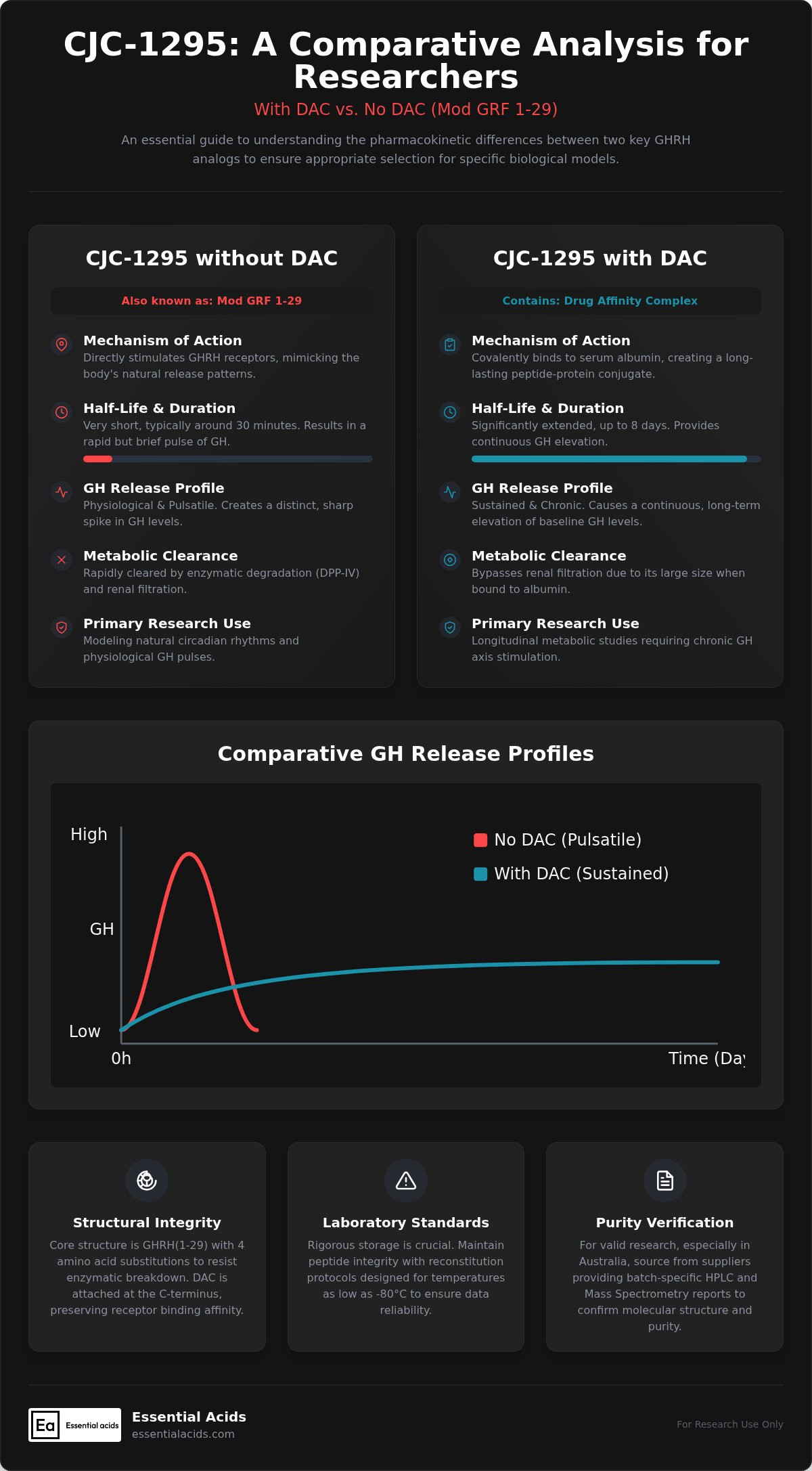
CJC-1295 No DAC exhibits a typical plasma half-life of approximately 30 minutes in vivo research models. This short duration is the result of its susceptibility to enzymatic cleavage and its small molecular size, which allows for rapid renal clearance. The peptide's rapid receptor dissociation makes it an ideal tool for studying acute neuroendocrine responses. It's specifically suited for experiments designed to mimic natural physiological GH pulses, as the peptide is cleared from the system before it can cause sustained receptor desensitisation. Researchers often utilize this variant when the objective is to observe immediate, transient shifts in GH levels without altering the long-term baseline of the GH axis.
CJC-1295 With DAC: The Extended-Release Profile
In contrast, CJC-1295 With DAC demonstrates sustained bioactivity that often exceeds 6 to 8 days in research subjects. By maintaining steady-state concentrations, it avoids the "peaks and valleys" associated with shorter-acting secretagogues. This provides a model of chronic GHRH receptor stimulation, which is valuable for longitudinal studies on metabolic rate and cellular ageing. However, it's vital to note that chronic stimulation of the pituitary can lead to alterations in pituitary morphology in animal models. This sustained elevation of GH and IGF-1 levels provides a distinct research environment compared to the pulsatile nature of the No DAC variant, allowing for the observation of cumulative metabolic effects over several weeks.
Selecting the Appropriate Variant for Pulsatile vs. Sustained GH Research Models
The selection between cjc 1295 with dac vs no dac is determined by the specific neuroendocrine model being investigated. Researchers must decide whether their study requires the preservation of natural physiological pulsatility or the induction of chronic GH axis elevation. CJC-1295 No DAC is the preferred choice for researchers aiming to mimic circadian rhythms, as its short half-life allows the pituitary to return to baseline between administrations. This variant is frequently used in synergistic protocols alongside Ipamorelin to observe acute, high-amplitude GH releases that mirror endogenous secretory patterns.
Conversely, the DAC variant is utilized for chronic elevation studies where the goal is consistent upregulation of Insulin-like Growth Factor 1 (IGF-1). A common question in laboratory procurement is whether one variant is more potent than the other. From a technical perspective, potency shouldn't be confused with duration. While the No DAC version may produce a more intense immediate pulse, the DAC version provides a higher cumulative exposure over time. The choice isn't about which peptide is "stronger" but which temporal profile fits the experimental design.
Research Applications for CJC-1295 No DAC
Studies focused on mimicking natural pulsatile secretion patterns rely on the rapid clearance of the No DAC variant. This allows for the observation of immediate IGF-1 responses without the confounding variable of sustained receptor occupancy. In vitro assays also benefit from this version because it provides precise control over exposure duration, enabling researchers to wash out the compound and observe recovery phases. It's an essential tool for metabolic research where the timing of the GH pulse relative to feeding or light cycles is a critical variable in the study of animal models.
Research Applications for CJC-1295 With DAC
CJC-1295 With DAC is specifically suited for long-term studies on cellular ageing and metabolic health indicators. Because it requires less frequent administration, it significantly reduces the confounding stress variables associated with daily handling and injection of research subjects. This is particularly valuable in longitudinal protocols investigating the effects of sustained GH axis elevation on bone density and tissue repair. By providing a steady-state concentration, researchers can isolate the effects of chronic GHRH receptor stimulation on systemic metabolic rate without the fluctuations inherent in short-acting analogs. This makes it a reliable model for investigating the cumulative physiological changes associated with prolonged growth hormone secretagogue exposure.
Laboratory Stability, Reconstitution, and Storage Standards
Maintaining the structural integrity of growth hormone secretagogues is paramount for reproducible results. Lyophilized powder exhibits high stability when stored at -20°C for up to 24 months, while storage at -80°C is recommended for multi-year longitudinal studies. When comparing cjc 1295 with dac vs no dac, researchers must account for the susceptibility of the peptide bonds to environmental degradation once the vacuum seal is breached. Analytical-grade variants require strict adherence to temperature-controlled environments to prevent premature hydrolysis of the amino acid chain.
Post-reconstitution degradation rates are a critical variable. While the DAC variant possesses a more complex molecular structure, both analogs are prone to rapid activity loss if kept at room temperature. In refrigerated environments (2-8°C), reconstituted peptides generally maintain over 95% purity for 14 to 21 days, though this timeline varies based on the solvent used. To ensure your study utilizes the highest quality compounds, you can buy research peptides in Australia that meet 99% minimum purity standards and include batch-specific documentation.
Best Practices for Reconstitution
Selection of the appropriate solvent is the first step in successful reconstitution. Sterile laboratory-grade Bacteriostatic water (0.9% benzyl alcohol) is preferred for multi-dose vials to inhibit microbial growth, whereas 0.9% NaCl may be used for immediate, single-use applications. The solvent should be introduced slowly along the side of the vial wall to prevent the formation of bubbles. Gentle swirling is required to achieve a clear solution; mechanical agitation or vigorous shaking must be avoided as it causes peptide shear stress and disrupts the secondary structure. The optimal temperature range for maintaining peptide integrity post-reconstitution is 2°C to 8°C.
Storage and Batch Verification
Scientific integrity depends on the verification of peptide quality before a study commences. Every vial should be cross-referenced with batch-specific HPLC and Mass Spectrometry data to confirm identity and purity. Laboratory exposure to UV light and oxygen poses significant oxidation risks, particularly for peptides containing sensitive residues. Vials must remain in light-shielded containers and be clearly labeled with the date of reconstitution and the specific concentration. Proper tracking in multi-vial protocols ensures that no degraded material is introduced into the research environment, preserving the validity of the GH axis study model.
Procurement of Analytical-Grade CJC-1295 Variants in Australia
Navigating the landscape of buying research peptides in Australia in 2026 requires a focus on analytical precision rather than commercial availability. The distinction between cjc 1295 with dac vs no dac is often blurred by vendors targeting the wellness market, which can compromise the integrity of laboratory data. High-integrity procurement for Australian facilities depends on selecting suppliers who prioritize scientific transparency. This ensures that the specific secretagogue variants used in a study are exactly what's documented in the protocol. Researchers must look for established supply chains that offer national distribution and predictable delivery timelines to maintain study schedules.
Analytical-grade compounds are the only appropriate choice for modelling the growth hormone axis. Essential Acids provides high-purity (99%+) variants that are specifically intended for the rigours of laboratory experimentation. By maintaining a professional distance from the trends of the marketplace, we ensure that the focus remains on the quality of the compounds. This disciplined approach to supply allows researchers to conduct their work without the uncertainty of batch-to-batch variability.
Verifying Peptide Purity
Scientific integrity is maintained through the rigorous interpretation of analytical documentation. For CJC-1295, Mass Spectrometry (MS) reports provide the molecular weight verification necessary to confirm the peptide's identity. HPLC chromatograms are equally essential; they identify the presence of impurities or residual solvents that could interfere with cellular assays. Essential Acids provides batch-specific transparency by including these reports with every order. This level of detail allows researchers to verify that the cjc 1295 with dac vs no dac variants meet a minimum 99% purity threshold before the first vial is reconstituted. Identifying single-peak chromatograms is the standard for ensuring that no truncated sequences or oxidized variants are present in the sample.
Compliance and Research-Only Standards
Adherence to national research regulations is a prerequisite for any legitimate laboratory operation in Australia. All compounds provided by Essential Acids are strictly for laboratory research use only. The use of these peptides in human or veterinary applications is strictly prohibited. This boundary-setting ensures that the procurement process remains aligned with the professional standards of the scientific community. By providing streamlined access to high-purity variants, we support the Australian research sector in its pursuit of objective data. Our commitment to "Making better, normal" is reflected in these rigorous standards, ensuring that every compound is a reliable tool for investigating the GH axis. The stability and quality of the compounds speak for themselves, requiring no aggressive marketing to validate their utility in a controlled research environment.
Standardizing Precision in Growth Hormone Axis Research
The technical divergence between cjc 1295 with dac vs no dac remains a primary factor in the design of growth hormone axis studies. Researchers must align their selection with the intended biological model, whether that requires the sustained metabolic elevation of the DAC variant or the physiological pulsatility of Modified GRF 1-29. Scientific integrity in these environments depends on the use of high-purity compounds that have undergone rigorous analytical verification. Ambiguity in nomenclature shouldn't compromise the accuracy of laboratory data or the outcomes of metabolic research.
Essential Acids supports the Australian scientific community by providing batch-specific HPLC and Mass Spectrometry reports with every order. Our commitment to transparency ensures that your laboratory receives compounds with a 99% minimum purity standard. You can explore high-purity CJC-1295 variants for laboratory research to ensure your study protocols meet the highest technical benchmarks. By prioritizing verified documentation and clinical-grade standards, we help you focus on the vital work of making better, normal through disciplined experimentation. We look forward to supporting your next breakthrough in neuroendocrine research.
Frequently Asked Questions
What is the primary difference in half-life between CJC-1295 with DAC and without DAC?
The primary difference in half-life is approximately 30 minutes for the variant without DAC compared to 6 to 8 days for the version with DAC. This divergence occurs because the Drug Affinity Complex allows for covalent bonding with serum albumin, extending the peptide's presence in systemic circulation. Researchers comparing cjc 1295 with dac vs no dac must account for this temporal gap when designing dosing protocols for animal models.
Is CJC-1295 No DAC the same compound as Mod GRF 1-29?
Yes, CJC-1295 No DAC is synonymous with Modified GRF (1-29) in technical research literature. Both terms describe the tetrasubstituted analog of the first 29 amino acids of Growth Hormone Releasing Hormone. Using the "No DAC" label clarifies that the peptide lacks the Drug Affinity Complex moiety, which is essential for maintaining nomenclature accuracy in Australian laboratory environments.
How does the Drug Affinity Complex (DAC) alter the binding properties of the peptide?
The Drug Affinity Complex (DAC) alters binding properties by facilitating a covalent bond with the free thiol group on Cys34 of serum albumin. This bond creates a large peptide-albumin conjugate that exceeds the threshold for renal filtration. By anchoring the peptide to a transport protein with a long circulatory lifespan, DAC prevents rapid metabolic clearance without compromising the secretagogue's affinity for the GHRH receptor.
Which variant is more suitable for mimicking physiological growth hormone pulses?
CJC-1295 No DAC is the more suitable variant for mimicking physiological growth hormone pulses because its short half-life allows for rapid systemic clearance. This profile prevents sustained receptor stimulation and allows the pituitary to return to baseline secretory states between administrations. It's often paired with other secretagogues in acute neuroendocrine studies to observe transient, high-amplitude GH releases.
What are the recommended storage temperatures for lyophilized CJC-1295 variants?
Lyophilized CJC-1295 variants should be stored at -20°C for standard laboratory use or -80°C for long-term preservation exceeding two years. These temperatures inhibit peptide hydrolysis and maintain the integrity of the amino acid sequence. Once reconstituted, the solution must be kept in a refrigerated environment between 2°C and 8°C to minimize degradation from environmental exposure.
Can these peptides be used in research involving IGF-1 upregulation?
Both variants are effective tools for research involving IGF-1 upregulation, though they model different metabolic outcomes. The version with DAC is utilized for longitudinal studies on chronic IGF-1 elevation, while the No DAC version is preferred for observing acute, pulsatile shifts. When evaluating cjc 1295 with dac vs no dac, the choice depends on whether the study aims to investigate sustained metabolic rate changes or transient secretagogue responses.
What reconstitution fluid is standard for CJC-1295 research applications?
Sterile Bacteriostatic water (0.9% benzyl alcohol) is the standard reconstitution fluid for multi-dose research applications because it inhibits microbial growth. For single-use laboratory assays, sterile 0.9% NaCl is a viable alternative. The selection of solvent depends on the intended duration of the experiment and the specific sensitivity of the cellular model being investigated.
How is the purity of CJC-1295 verified for laboratory use?
Purity is verified through a combination of High-Performance Liquid Chromatography (HPLC) and Mass Spectrometry (MS). HPLC identifies the percentage of the target peptide relative to impurities, while MS confirms the exact molecular weight of the compound. Essential Acids provides batch-specific documentation for all variants to ensure laboratory compliance with 99% minimum purity standards in the Australian research sector.
Legal Disclaimer
All products sold on this website are intended exclusively for laboratory research purposes and not for human or veterinary use, diagnosis, cure, treatment, or prevention of any disease or condition. None of the statements on this site have been reviewed or evaluated by the U.S. Food and Drug Administration (FDA) or comparable regulatory authorities. Purchasing or using these products for any unintended purpose, including human consumption, may violate federal or local laws and poses safety risks.