

The presence of the zuclomiphene isomer in traditional clomiphene mixtures often compromises the integrity of endocrine models by introducing unwanted estrogenic activity that obscures experimental data. Most investigators recognize that high-fidelity enclomiphene citrate research depends entirely on the successful isolation of the trans-isomer to ensure predictable receptor-binding outcomes. It's a common frustration to encounter batch-to-batch inconsistency or a lack of technical documentation that meets the standards of a modern laboratory audit in Australia.
This article provides a rigorous scientific analysis of the molecular structure and isomeric purity of enclomiphene citrate for 2026 research environments. You'll gain a technical understanding of the mechanism behind pituitary estrogen receptor antagonism and how it differs from mixed-isomer alternatives. Since no specific USP monograph currently exists for enclomiphene citrate, we'll detail the analytical methods used to verify purity, including HPLC and mass spectrometry, alongside standardized protocols for storage to maintain molecular integrity. This profile serves as a definitive guide for researchers who require absolute transparency and scientific precision in their analytical work.
Key Takeaways
- Identify the structural distinctions between the trans-isomer and the cis-isomer to eliminate estrogenic agonist interference in endocrine laboratory models.
- Establish rigorous analytical standards for enclomiphene citrate research by utilizing batch-specific HPLC and mass spectrometry to verify isomeric purity.
- Understand the precise mechanism of selective estrogen receptor antagonism in the anterior pituitary gland and its effect on blocking negative feedback.
- Implement standardized laboratory handling protocols, including specific solubility parameters for DMSO and ethanol, to ensure experimental reproducibility.
- Review updated 2026 storage and stability requirements to maintain the molecular integrity of high-purity crystalline powder across long-term research durations.
Molecular Profile: Understanding Enclomiphene Citrate in Research
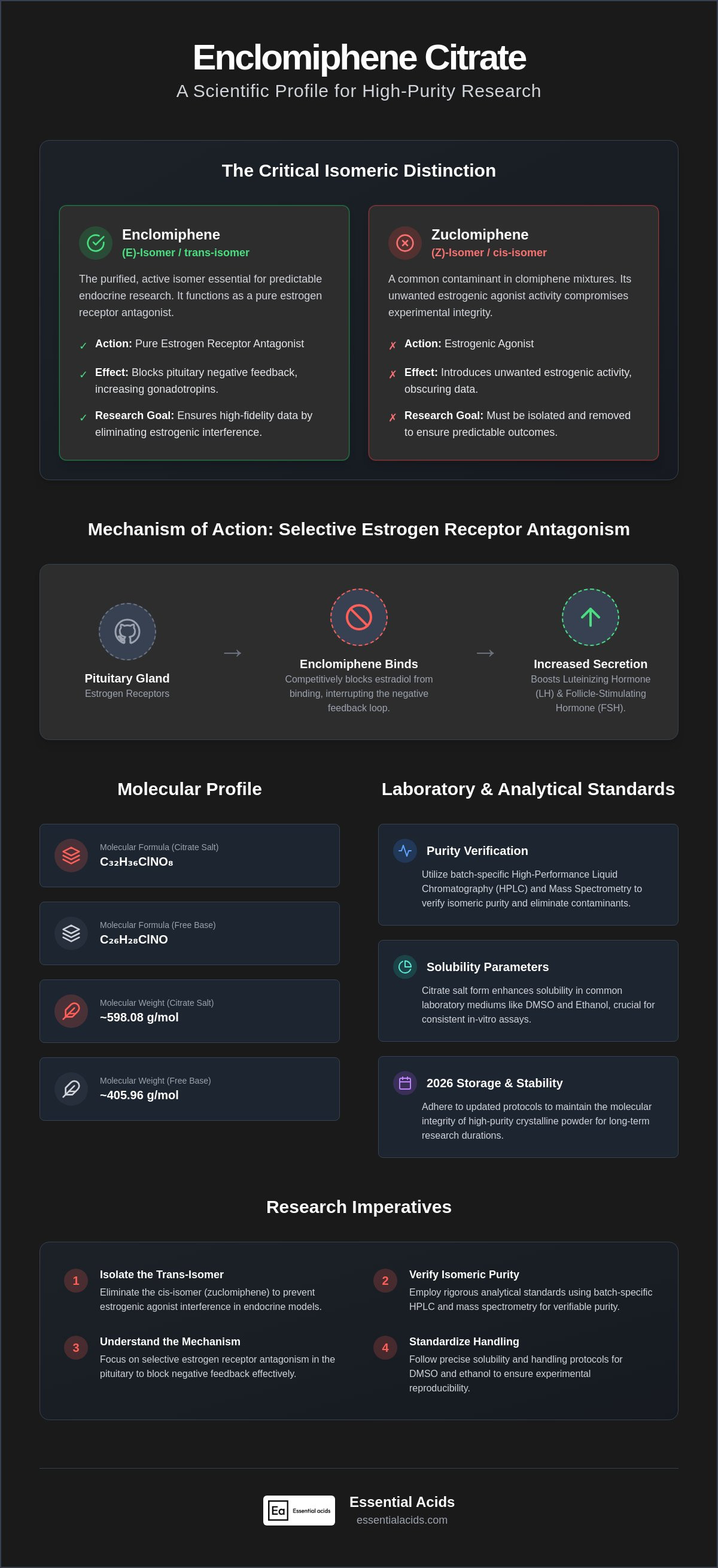
Enclomiphene citrate research is fundamentally defined by the isolation and characterisation of the trans-isomer of clomiphene. While clomiphene citrate is traditionally provided as a racemic mixture of two geometric isomers, enclomiphene represents the purified (E)-isomer. This molecular isolation is necessary for researchers who require a non-steroidal antagonist of the estrogen receptor without the long-lasting agonist activity of the cis-isomer, zuclomiphene. The compound is strictly classified as a Selective Estrogen Receptor Modulator (SERM) with a high affinity for receptors located within the anterior pituitary gland.
The molecular identity of the compound varies based on its salt state. As a free base, the molecular formula is recorded as C26H28ClNO. However, for most laboratory applications, the molecule is provided as a citrate salt, resulting in a molecular formula of C32H36ClNO8. This salt form is the standard for enclomiphene citrate research because it provides the chemical stability required for precise analytical reproducibility. It's the primary tool for investigating the Enclomifene mechanism of action in endocrine models, particularly those exploring the feedback loops of the Hypothalamic-Pituitary-Gonadal (HPG) axis.
Chemical Structure and IUPAC Nomenclature
The structural integrity of enclomiphene centers on the (E)-isomer configuration at its triphenylethylene core. This specific geometry ensures that the molecule functions as a potent antagonist in the pituitary. The molecular weight of the free base is verified at approximately 405.96 g/mol, while the citrate salt version increases this value to approximately 598.08 g/mol. The addition of the citrate salt isn't just for stability; it's essential for improving solubility in common laboratory mediums like DMSO or ethanol. Without this salt, achieving a homogenous solution for in-vitro assays becomes significantly more difficult, which can lead to inconsistent data points.
Research Applications in Endocrinology
Investigators frequently use this molecule to study the regulation of gonadotropin secretion. Because it blocks the negative feedback effect of circulating estrogens, it's a critical component in research regarding secondary hypogonadotropic hypogonadism. In these experimental models, the objective is often to observe how the pituitary responds when estrogen receptors are occupied by an antagonist. Common research methodologies include:
- Utilizing in-vitro assays to measure changes in gonadotropin-releasing hormone (GnRH) pulse frequency and amplitude.
- Monitoring the secretion of luteinizing hormone (LH) and follicle-stimulating hormone (FSH) in response to receptor blockade.
- Analysing the downstream effects on gonadal steroidogenesis within animal models.
These applications rely on the high isomeric purity of the compound. If any zuclomiphene contamination is present, the resulting data might reflect estrogenic agonist activity, which would invalidate the study's focus on pure antagonism. Scientific integrity in this field requires a disciplined approach to compound sourcing, ensuring that the (E)-isomer remains free from its cis-counterpart throughout the duration of the study.
Mechanism of Action: Selective Estrogen Receptor Antagonism
Enclomiphene’s primary utility in enclomiphene citrate research is its ability to occupy estrogen receptors (ER) within the anterior pituitary gland. By competitively binding to these sites, it prevents endogenous estradiol from exerting its inhibitory effects. This interruption of the negative feedback loop is the primary catalyst for increased gonadotropin secretion. Researchers often focus on this mechanism because it allows for the stimulation of the HPG axis while maintaining the endogenous pulsatile rhythm of hormone release, a feature often lost in exogenous replacement models.
The molecular configuration of the compound determines its binding kinetics and receptor occupancy time. A thorough understanding of Enclomiphene chemical properties is required to model its displacement of estradiol in competitive binding assays. Unlike traditional clomiphene mixtures, the isolated trans-isomer acts as a pure antagonist in the pituitary. This is essential for isolating the effects of estrogen blockade from the mixed agonist/antagonist profiles often seen in racemic compounds that contain zuclomiphene.
Pituitary vs. Peripheral Receptor Binding
Enclomiphene demonstrates a high affinity for both ERα and ERβ isoforms within the pituitary. Its intracellular signaling profile is characterized by a lack of significant estrogenic transcription in peripheral tissues, which distinguishes it from the cis-isomer. When enclomiphene binds to the receptor, it induces a specific conformational change that prevents the recruitment of co-activators. This shift in the gonadotroph cell response leads to an increased sensitivity to GnRH, facilitating a more robust and frequent release of LH and FSH into the systemic circulation.
Endogenous Hormone Modulation
The downstream effects of this pituitary blockade are observed in the stimulation of Leydig cells and the subsequent synthesis of testosterone. In male research models, the elevation of FSH is particularly relevant for maintaining markers of spermatogenesis. Because the molecule doesn't suppress the HPG axis like exogenous testosterone interventions, it provides a unique window into the natural regulatory mechanisms of the endocrine system. It’s a powerful tool for secretagogue potency studies where preserving the natural hormonal cadence is a priority. For investigators requiring materials for these precise endocrine models, obtaining high-integrity Enclomiphene Citrate ensures that experimental outcomes aren't skewed by isomeric impurities.
Enclomiphene vs. Clomiphene Citrate: The Isomeric Distinction
The primary challenge in enclomiphene citrate research involves the elimination of "isomeric noise" caused by zuclomiphene. Clomiphene citrate is traditionally supplied as a racemic mixture, typically consisting of approximately 60% enclomiphene and 40% zuclomiphene. While enclomiphene is the trans-isomer responsible for pure estrogen receptor antagonism, zuclomiphene is the cis-isomer characterized by long-acting estrogenic agonist properties. In many research models, the presence of zuclomiphene obscures the intended data by introducing estrogenic activity that contradicts the antagonistic goals of the study.
Investigators must recognize that clomiphene's overall effect is the net result of these two opposing isomers. Using the purified trans-isomer allows for a more precise investigation into the Enclomiphene Citrate Mechanism of Action without the confounding variables introduced by its cis-counterpart. This distinction is critical for establishing high-fidelity endocrine models where the objective is to isolate the specific feedback mechanisms of the pituitary gland.
Pharmacokinetic Divergence
The two isomers exhibit vastly different metabolic profiles. Enclomiphene has a relatively short half-life of approximately 10 hours, allowing for rapid clearance and precise control over experimental variables. Conversely, zuclomiphene possesses a half-life that can extend up to 30 days. This discrepancy creates significant complications for longitudinal studies. If a researcher uses a racemic mixture, the zuclomiphene isomer accumulates in systemic circulation, potentially exerting estrogenic effects long after the enclomiphene isomer has been cleared.
Establishing a clean washout period is nearly impossible when zuclomiphene is present in the compound. This makes purified enclomiphene a superior choice for investigators who need to transition between different phases of an endocrine study. For those comparing secretagogue efficacy, the Ipamorelin molecular profile provides a useful technical contrast, as peptide-based secretagogues operate via distinct ghrelin receptor pathways rather than estrogen receptor modulation.
Structural Stability and Isomerization Risks
Maintaining the isomeric integrity of a sample is a primary concern for laboratory audits. Under certain conditions, such as exposure to specific UV wavelengths or extreme thermal fluctuations, the trans-isomer may undergo unwanted isomerization back into a racemic state. This degradation compromises the analytical reproducibility of the entire batch. High-integrity research in 2026 demands a verification of 99%+ trans-isomer content to ensure that the experimental results reflect pure antagonism.
Isomeric purity is defined as the quantitative measure of the trans-isomer relative to its cis-counterpart, serving as the primary benchmark for scientific integrity in 2026 laboratory standards. To prevent degradation, samples must be stored in light-protected, temperature-controlled environments. Without these precautions, the risk of "isomeric drift" increases, leading to inconsistent data that fails to meet the rigorous requirements of modern peer-reviewed publications.
Analytical Standards: Verifying Purity via HPLC and Mass Spectrometry
Scientific integrity within the context of 2026 laboratory standards requires comprehensive, batch-specific analytical documentation. High-Performance Liquid Chromatography (HPLC) remains the primary method for quantifying overall compound purity. It works by separating the constituents of a sample based on their interaction with a stationary phase, typically a C18 column in enclomiphene citrate research. The resulting chromatogram allows investigators to verify that the sample consists almost entirely of the trans-isomer. This level of detail is necessary to ensure that experimental variables aren't compromised by unknown contaminants.
While HPLC provides purity percentages, Mass Spectrometry (MS) is used to confirm the molecular identity and weight of the compound. For the citrate salt version of enclomiphene, MS should reflect a molecular weight consistent with the C32H36ClNO8 formula. This dual-layered verification ensures that the material isn't just pure, but is also precisely the intended molecule. A critical aspect of this process is the verification of the absence of zuclomiphene peaks. In a high-integrity sample, the cis-isomer peak should be negligible or non-existent, preventing the "isomeric noise" discussed in previous sections of this profile.
Interpreting HPLC Reports for Enclomiphene
Researchers must be capable of identifying the specific retention time associated with the trans-isomer within their chromatographic profile. Purity levels are determined by analysing peak area percentages; 2026 standards for high-fidelity research generally target a threshold of >99%. Any additional peaks observed outside the primary enclomiphene retention window are indicative of impurities or degradation markers. These markers are often seen in aged or improperly stored samples where oxidation or unwanted isomerization has occurred. Monitoring these baseline shifts is essential for maintaining analytical reproducibility across multiple experimental trials.
Procurement Integrity for Australian Laboratories
Evaluating supplier transparency is a fundamental step in laboratory procurement. Australian researchers should prioritize suppliers that provide accessible analytical libraries containing batch-specific reports. The role of Certificates of Analysis (COAs) is central to research documentation, as they provide the verified data needed for laboratory audits. For those establishing new experimental protocols, it's beneficial to consult our guide on buying research peptides in Australia to understand the current procurement standards. Ensuring that every compound is accompanied by verified HPLC and MS data is the only way to safeguard the scientific integrity of your findings. To ensure your laboratory models are built on high-purity foundations, you can order Enclomiphene Citrate with batch-specific verification.
Laboratory Handling, Storage, and Stability Protocols
The physical state of the compound significantly influences its stability and handling within a laboratory environment. Enclomiphene Citrate is typically supplied as a high-purity crystalline powder, requiring specific environmental controls to prevent molecular degradation. Managing the sensitivity of the molecule to light and thermal fluctuations is essential for maintaining the integrity of enclomiphene citrate research. Standardized protocols ensure that the compound remains chemically stable throughout the duration of in-vitro studies, preventing the formation of degradation products that could interfere with receptor-binding assays.
Solubility parameters are a primary consideration for investigators preparing stock solutions. The molecule is highly soluble in dimethyl sulfoxide (DMSO) and ethanol, which are the preferred solvents for most endocrine research models. Conversely, the compound is only sparingly soluble in water. Attempting to reconstitute the citrate salt in aqueous mediums without a proper co-solvent often leads to precipitation, resulting in inaccurate molar concentrations and compromised experimental data.
Storage Conditions for Lyophilized Powder
Long-term storage of the crystalline powder must be conducted at -20°C to minimize the risk of hydrolysis and thermal decomposition. It is necessary to keep the material in a desiccated environment, as moisture ingress can facilitate chemical instability over time. For short-term laboratory use, the compound may be stored at 2-8°C for up to 3 months, provided it remains in its original, sealed container.
Protection from direct UV exposure is mandatory. The triphenylethylene core of the molecule is susceptible to photo-degradation, which can trigger unwanted isomerization or the cleavage of functional groups. Samples should be kept in amber vials or wrapped in foil to mitigate these risks. Failure to control light exposure can lead to a shift in the HPLC profile, indicating a loss of isomeric purity and a reduction in the potency of the antagonist effect.
Reconstitution and Solution Stability
Selecting the appropriate laboratory solvent depends heavily on the intended assay and the tolerance of the biological model to the vehicle. DMSO is frequently chosen for its ability to maintain high-concentration stock solutions, though investigators must account for its potential cytotoxic effects in sensitive cell cultures. Precise molar calculations are required to ensure consistent laboratory dosing, especially when observing the frequency of GnRH pulses or LH secretion.
Once reconstituted, the stability of the solution decreases compared to the dry powder form. Stock solutions stored at -20°C should be aliquoted to avoid repeated freeze-thaw cycles, which can accelerate the degradation of the molecule. Researchers may find it helpful to review BPC-157 stability standards for comparative data on handling sensitive research materials. Adhering to these rigorous handling protocols is the only method to ensure that the results of any endocrine study reflect the true pharmacological profile of the trans-isomer.
Advancing Endocrine Models with Isomeric Precision
The evolution of enclomiphene citrate research in 2026 demands a shift from generic clomiphene mixtures toward purified trans-isomer standards. By isolating the (E)-isomer, investigators successfully eliminate the confounding agonist activity of zuclomiphene. This ensures experimental data reflects pure pituitary estrogen receptor antagonism without the long-acting interference of the cis-isomer. Maintaining this precision requires a disciplined adherence to analytical verification and standardized storage protocols, as even minor environmental fluctuations can compromise molecular integrity.
Scientific integrity is preserved through the use of batch-specific HPLC and mass spectrometry reports that confirm both molecular identity and purity. These documents serve as the foundation for reproducible laboratory audits and peer-reviewed outcomes. We provide high-purity trans-isomer standards strictly for research-use only, ensuring that your laboratory models are built on a stable and verified chemical foundation.
For investigators requiring verified compounds for their next study, you can view high-purity Enclomiphene Citrate for laboratory research at Essential Acids. Every batch includes comprehensive analytical documentation to support your commitment to professional research standards. We look forward to supporting the precision of your laboratory investigations.
Frequently Asked Questions
What is the difference between Enclomiphene and Clomiphene in a research context?
Enclomiphene is the purified (E)-isomer of clomiphene, whereas clomiphene citrate is a racemic mixture containing both enclomiphene and zuclomiphene. In a laboratory setting, using the isolated trans-isomer allows researchers to study pure estrogen receptor antagonism. This avoids the confounding variables introduced by zuclomiphene, which acts as a long-acting estrogen agonist and can accumulate in systemic circulation for up to 30 days.
How does Enclomiphene Citrate affect Luteinizing Hormone (LH) in laboratory models?
Enclomiphene Citrate increases the secretion of LH by competitively binding to estrogen receptors in the anterior pituitary gland. This action blocks the negative feedback normally exerted by circulating estrogens. As a result, the frequency and amplitude of gonadotropin-releasing hormone (GnRH) pulses increase, leading to a more robust release of LH and FSH into the experimental system.
Is Enclomiphene Citrate considered an estrogen agonist or antagonist?
The trans-isomer is characterized specifically as a non-steroidal estrogen receptor antagonist within the pituitary gland. While clomiphene mixtures exhibit mixed agonist/antagonist properties due to the presence of zuclomiphene, purified enclomiphene is utilized in research for its ability to block receptor activity. It lacks the significant estrogenic agonist effects seen in the cis-isomer configuration.
What is the molecular weight of Enclomiphene Citrate (citrate salt)?
The molecular weight of the citrate salt form is approximately 598.08 g/mol, corresponding to the formula C32H36ClNO8. Investigators must use this specific value rather than the free base weight of 405.96 g/mol when calculating molar concentrations for laboratory assays. Precise weight verification is essential for ensuring the accuracy of dose-response curves in enclomiphene citrate research.
How should Enclomiphene powder be stored to ensure long-term stability?
High-purity crystalline powder should be stored at -20°C in a desiccated environment to prevent hydrolysis. It's necessary to protect the compound from direct UV exposure, as the triphenylethylene core is susceptible to photo-degradation. For short-term laboratory use, the material remains stable at 2-8°C for up to 3 months if kept in a sealed, light-protected container.
Why is the removal of Zuclomiphene important for scientific research?
Removing zuclomiphene is critical to eliminate unwanted "isomeric noise" that compromises the precision of endocrine models. Because zuclomiphene has a significantly longer half-life and possesses agonist properties, its presence can obscure the antagonistic data researchers aim to collect. Successful enclomiphene citrate research depends on 99%+ trans-isomer purity to ensure that observed outcomes reflect pure receptor blockade.
What solvents are recommended for dissolving Enclomiphene Citrate for in-vitro studies?
Dimethyl sulfoxide (DMSO) and ethanol are the primary solvents recommended for achieving high-concentration stock solutions. The citrate salt is only sparingly soluble in water, so aqueous mediums are generally avoided for initial reconstitution. Researchers should aliquot stock solutions after preparation to prevent repeated freeze-thaw cycles, which can degrade the molecular integrity of the compound.
How is the purity of Enclomiphene Citrate verified by Essential Acids?
Scientific integrity is maintained through the provision of batch-specific HPLC and Mass Spectrometry reports. HPLC quantifies the overall purity and confirms the absence of zuclomiphene peaks, while Mass Spectrometry verifies the molecular weight and identity of the trans-isomer. These analytical standards ensure that every batch meets the rigorous requirements for reproducibility in modern laboratory research.
Legal Disclaimer
All products sold on this website are intended exclusively for laboratory research purposes and not for human or veterinary use, diagnosis, cure, treatment, or prevention of any disease or condition. None of the statements on this site have been reviewed or evaluated by the U.S. Food and Drug Administration (FDA) or comparable regulatory authorities. Purchasing or using these products for any unintended purpose, including human consumption, may violate federal or local laws and poses safety risks.