

Can a single isomer truly isolate the antagonistic effects of a compound without the interference of its agonistic counterpart? In the field of Enclomiphene Citrate research, the answer lies in the precise molecular distinction between the trans-isomer and its cis counterpart, zuclomiphene. While standard clomiphene citrate contains both, the specific use of purified enclomiphene allows for a more controlled analysis of estrogen receptor antagonism in the hypothalamus. You've likely encountered the frustration of conflicting data caused by the long half-life and estrogenic profile of zuclomiphene, which often skews results in endocrine signaling models.
Essential Acids recognizes that scientific integrity depends on analytical-grade materials that meet rigorous purity standards. This overview provides a comprehensive analysis of the chemical properties of enclomiphene citrate, its mechanism for stimulating luteinizing hormone, and its role as an investigational drug. We'll explore validated laboratory protocols and the regulatory landscape of 2026, where enclomiphene remains an investigational compound despite clinical trials using daily doses of 12.5 mg to 25 mg. Every compound discussed is strictly for research-use only, as we continue our commitment to making better, normal.
Key Takeaways
- Differentiate between the pharmacological profiles of trans-clomiphene and zuclomiphene to isolate pure estrogen receptor antagonism in laboratory environments.
- Analyze the specific mechanisms through which Enclomiphene Citrate research models stimulate the hypothalamic-pituitary-gonadal axis for endocrine evaluation.
- Implement rigorous validation protocols using High-Performance Liquid Chromatography (HPLC) to ensure the absence of estrogenic contaminants in research samples.
- Establish criteria for sourcing high-purity compounds by prioritizing batch-specific verification and scientific integrity in procurement processes.
- Review the latest 2026 regulatory updates concerning the investigational status and compounding restrictions of high-purity analytical materials.
Defining Enclomiphene Citrate in a Research Context
Enclomiphene Citrate represents a specific isomer-pure approach to selective estrogen receptor modulation. Within the broader scope of Enclomiphene Citrate research, the compound is identified as the trans-isomer of clomiphene citrate. Unlike the racemic mixture found in traditional clomiphene, enclomiphene is isolated through precise chemical synthesis to remove the cis-isomer, zuclomiphene. This isolation is critical for laboratory models that require a purely antagonistic effect on estrogen receptors, particularly within the pituitary gland and hypothalamus. It's this purity that allows for the study of specific endocrine pathways without the confounding variables introduced by mixed agonistic activity.
In research environments, enclomiphene functions by competing with endogenous estrogen for receptor binding sites. By blocking these sites in the pituitary, the compound prevents the negative feedback loop typically mediated by estrogen. This leads to a measurable increase in the secretion of gonadotropins, specifically luteinizing hormone (LH) and follicle-stimulating hormone (FSH). Laboratory applications often utilize research-grade lyophilized powder rather than clinical oral formulations. Researchers don't typically use clinical tablets because they contain excipients that can interfere with sensitive analytical assays. High-purity powder allows for precise analytical weighing and reconstitution in specific solvents tailored to the experimental design, ensuring that the results reflect the compound's intrinsic biochemical properties.
Molecular Structure and Chemical Properties
The molecular profile of Enclomifene is defined by the chemical formula C26H28ClNO, with a molecular weight of approximately 405.96 g/mol for the free base. Its IUPAC nomenclature is (E)-2-[4-(2-chloro-1,2-diphenylethenyl)phenoxy]-N,N-diethylethanamine. For in vitro studies, researchers must account for its solubility profiles. The compound demonstrates high solubility in dimethyl sulfoxide (DMSO) and moderate solubility in ethanol. However, it shows limited solubility in standard aqueous buffers, often requiring specialized preparation protocols to maintain stability. The citrate salt form is preferred in laboratory settings due to its enhanced crystalline stability and predictable shelf life when stored under controlled conditions, typically at -20°C to prevent degradation.
Enclomiphene vs. Clomiphene: The Research Distinction
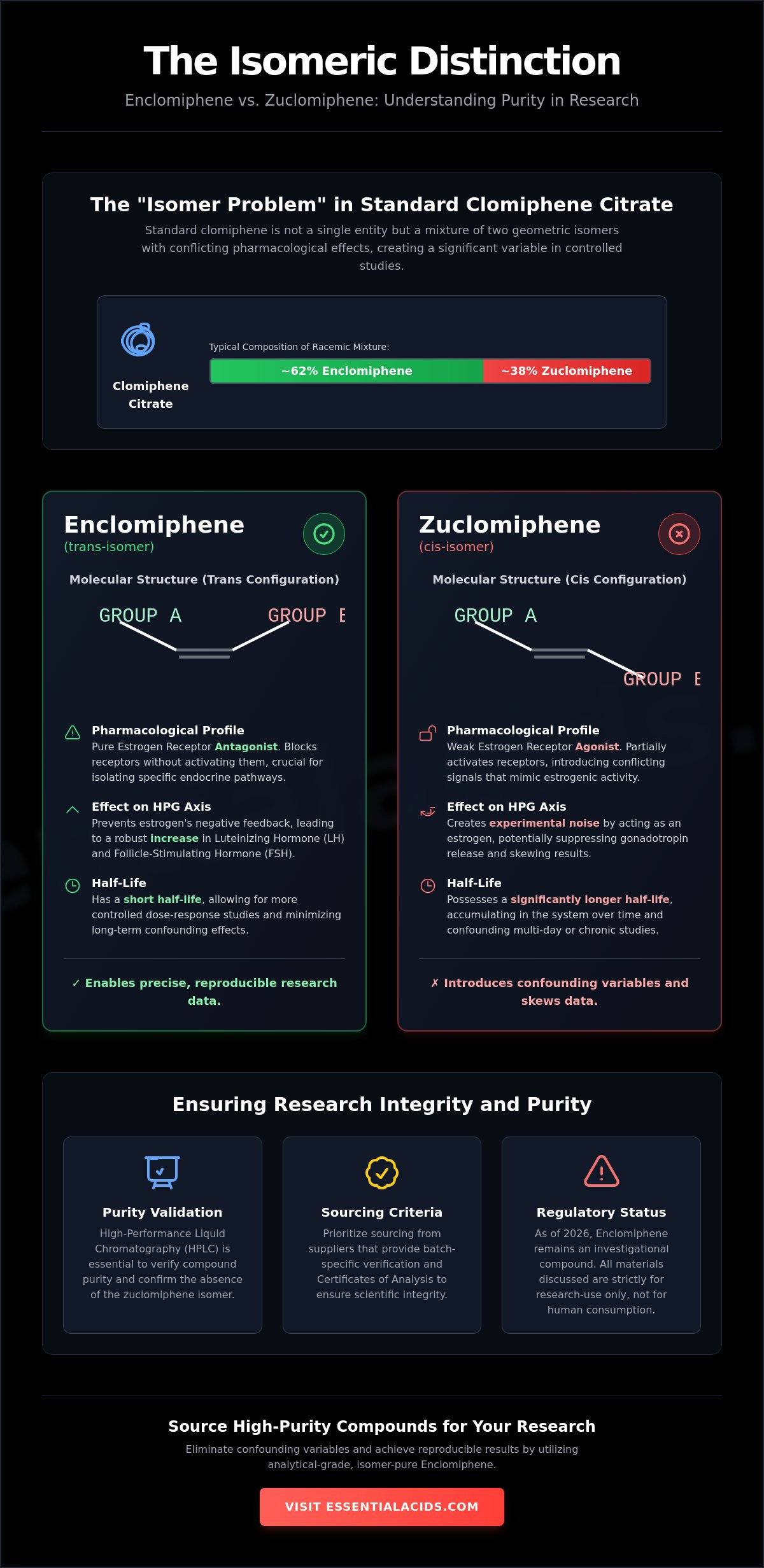
Standard clomiphene introduces significant experimental noise because it contains zuclomiphene, a cis-isomer with distinct pharmacological properties. Zuclomiphene acts as a weak estrogen agonist and possesses a significantly longer half-life compared to enclomiphene. This mixed profile can confound data in studies focusing on pure receptor antagonism. Utilizing purified enclomiphene is a necessity for researchers aiming to isolate specific signaling pathways without the agonistic "drift" caused by the cis-isomer. In endocrine disruption studies, the presence of zuclomiphene can mask the true potency of estrogenic or anti-estrogenic interactions, making Enclomiphene Citrate research essential for data integrity and reproducibility. By removing these variables, laboratories can produce more accurate models of hypothalamic-pituitary-gonadal (HPG) axis modulation.
The Isomeric Distinction: Enclomiphene vs. Zuclomiphene
Standard clomiphene citrate isn't a single compound but a racemic mixture. This creates a significant "isomer problem" in Enclomiphene Citrate research. The mixture typically consists of approximately 60% enclomiphene (the trans-isomer) and 40% zuclomiphene (the cis-isomer). These two molecules are geometric isomers; they share the same chemical formula but differ in their spatial arrangement around the double bond. This structural variance leads to a complete pharmacological divergence. Enclomiphene acts as a high-affinity antagonist at the Estrogen Receptor Alpha (ERα) and Beta (ERβ). Conversely, zuclomiphene functions as a weak estrogen agonist. The trans-orientation of enclomiphene allows it to occupy the ligand-binding domain without inducing the conformational change required for co-activator recruitment.
In Hypothalamic-Pituitary-Gonadal (HPG) axis models, this distinction is critical. When both isomers are present, the agonistic activity of zuclomiphene can counteract the antagonistic goals of the study. Research documented in Enclomiphene Citrate for Secondary Male Hypogonadism illustrates that the trans-isomer is the primary driver of gonadotropin stimulation. Laboratories focusing on pure signaling pathways must account for these conflicting mechanisms to ensure data integrity. Without isolating the trans-isomer, researchers risk gathering data that reflects a net effect rather than the specific mechanism of estrogen receptor antagonism.
Antagonistic Activity of the Trans-Isomer
Enclomiphene achieves its effects by blocking the negative feedback of estradiol at the hypothalamic level. It competes directly with endogenous estrogen for binding sites. When these receptors are occupied by the trans-isomer, the hypothalamus fails to detect circulating estrogen levels. This triggers a compensatory release of Gonadotropin-Releasing Hormone (GnRH), which subsequently increases the production of Luteinizing Hormone (LH) and Follicle-Stimulating Hormone (FSH) from the pituitary. In competitive binding assays, enclomiphene demonstrates a potent ability to displace estradiol, making it a reliable tool for quantifying HPG axis responsiveness in mammalian research models.
The Agonistic Interference of Zuclomiphene
Zuclomiphene introduces unwanted variables into controlled experiments. Its estrogenic activity persists far longer than enclomiphene due to a significantly extended biological half-life. While enclomiphene is cleared relatively quickly, zuclomiphene can remain detectable in research models for weeks. This persistence leads to an accumulation of estrogenic signaling, which can suppress the very testosterone production the researcher intends to study. Non-purified clomiphene often results in "estrogenic drift," where the initial antagonistic surge is eventually dampened by the cis-isomer's agonism. Laboratories requiring precise results should consider sourcing from suppliers that prioritize analytical-grade isomers to avoid these confounding variables. Additionally, isomer-specific degradation rates during storage can alter the ratio of a racemic mixture over time, further compromising experimental reproducibility.
Key Mechanisms in Endocrine and Metabolic Research Models
The stimulation of endogenous hormone production remains a focal point of Enclomiphene Citrate research. Unlike exogenous testosterone replacement, which often leads to the suppression of the hypothalamic-pituitary-gonadal (HPG) axis, enclomiphene promotes the body's natural production of gonadotropins. This distinction is vital in reproductive health studies. Research models utilizing enclomiphene focus on preserving the signaling pathways necessary for spermatogenesis. By antagonizing estrogen receptors in the pituitary, the compound prevents the negative feedback that would otherwise inhibit the release of luteinizing hormone (LH) and follicle-stimulating hormone (FSH). This mechanism is particularly relevant when investigating alternatives to traditional hormone therapies that might compromise fertility in mammalian subjects.
HPG Axis Modulation and Gonadotropin Signaling
In laboratory environments, researchers analyze the frequency and amplitude of Gonadotropin-Releasing Hormone (GnRH) pulses. Enclomiphene's presence in the hypothalamus modulates these pulses, leading to increased downstream steroidogenesis. This activity is measured within Leydig and Sertoli cell models to quantify the production of intratesticular testosterone and the support of germ cell development. Clinical data from 2026 research indicates that daily doses ranging from 12.5 mg to 25 mg can significantly elevate total testosterone levels in models of secondary hypogonadism. Additionally, enclomiphene is a primary candidate for investigating the reversal of opioid-induced endocrine dysfunction. These models demonstrate how chronic opioid exposure blunts GnRH secretion, a process that enclomiphene appears to counteract by restoring receptor sensitivity. Understanding these interactions requires a clear distinction between Clomiphene and enclomiphene, as the purity of the trans-isomer dictates the reliability of the signaling data.
Metabolic Homeostasis and Cellular Response
The impact of enclomiphene extends beyond primary reproductive signaling into secondary metabolic pathways. Investigating the cross-talk between selective estrogen receptor modulators (SERMs) and metabolic homeostasis involves analyzing lipid metabolism and bone density markers. Estrogen receptors play a critical role in maintaining mineral density; therefore, research must determine if pure antagonism in the pituitary translates to unwanted effects in peripheral tissues. Furthermore, studies often explore interactions with the growth hormone axis, specifically focusing on Insulin-like Growth Factor 1 (IGF-1) levels. Some research suggests that SERMs may influence hepatic IGF-1 production, a variable that must be controlled in metabolic research. For a broader perspective on how high-purity compounds affect tissue signaling and repair, researchers often compare these findings with the BPC-157 5mg molecular profile. This comparative analysis helps establish a more comprehensive understanding of how different research-only compounds influence cellular ageing and metabolic integrity across various mammalian models.
Methodological Considerations for High-Purity Compound Analysis
Validating the chemical integrity of materials is a prerequisite for any reproducible study. Within the context of Enclomiphene Citrate research, the primary technical challenge involves the precise quantification of the trans-isomer relative to any residual cis-isomer. High-Performance Liquid Chromatography (HPLC) is the standard for this verification. This technique allows for the separation of enclomiphene from zuclomiphene based on their distinct elution times within a stationary phase. Without this separation, researchers cannot be certain that the biological responses observed are solely attributable to estrogen receptor antagonism. Mass Spectrometry (MS) complements this process by confirming the molecular weight of 405.96 g/mol and screening for synthesis byproducts or heavy metal contaminants that could interfere with cellular signaling.
The accuracy of these sophisticated analytical tools is fundamentally dependent on high-performance electronic circuitry; for those interested in the supply chains that support such high-precision hardware, you can discover Adage Components.
Every laboratory batch must be accompanied by a batch-specific Certificate of Analysis (CoA). This document acts as a formal record of the compound's analytical profile, detailing the results of both HPLC and MS testing. Researchers should scrutinize the CoA for purity levels, moisture content, and the absence of residual solvents. To ensure experimental accuracy, laboratories should procure analytical-grade Enclomiphene Citrate that meets these stringent benchmarks. Relying on verified materials is the only way to maintain scientific integrity across long-term endocrine studies.
HPLC Analysis: Quantifying Isomeric Ratios
The separation of geometric isomers requires optimized chromatographic conditions to identify distinct peaks. In a high-purity sample, the enclomiphene peak should be dominant, with minimal to no detectable signal for zuclomiphene. For high-integrity laboratory research, a minimum purity standard of >99% is required to prevent the agonistic drift discussed in previous sections. HPLC serves as the primary analytical tool to verify the >99% purity required for generating valid experimental data. Any deviation from this threshold introduces confounding variables that can compromise the reliability of HPG axis modeling.
Laboratory Storage and Reconstitution Best Practices
The stability of the citrate salt form is dependent on controlled environmental conditions. Enclomiphene citrate is sensitive to light, temperature, and moisture, all of which can accelerate oxidative degradation or isomerization. Stock materials should be stored in an airtight container at -20°C, shielded from UV exposure. When preparing solutions for in vitro use, dimethyl sulfoxide (DMSO) or ethanol are the recommended solvents for creating stable stock solutions. Aqueous buffers should only be used for final dilutions immediately prior to application, as the compound's stability in water is limited. Maintaining sterile handling procedures in a laminar flow hood is essential to prevent microbial contamination of the analytical environment during the reconstitution process. Proper storage protocols ensure that the results of Enclomiphene Citrate research remain consistent from the first assay to the last.
Procuring Research-Grade Enclomiphene for Controlled Studies
Procurement within the scientific community requires a transition from simple acquisition to rigorous validation. For Enclomiphene Citrate research, the selection of a supplier is a critical variable that directly impacts the validity of the resulting data. High-integrity research demands more than a commercial transaction; it requires a partnership rooted in scientific integrity and transparency. Within the 2026 regulatory framework, enclomiphene remains an investigational drug, necessitating a strict boundary between laboratory materials and clinical products. Researchers must ensure that their sources adhere to "research-use only" policies to maintain compliance and ethical standards. In the Australian research landscape, where regulatory scrutiny of selective estrogen receptor modulators is particularly high, adhering to these procurement standards is essential for institutional compliance and the protection of experimental protocols.
The gravity of laboratory research means that the quality of the compounds must speak for itself. Every procurement decision should be backed by a commitment to regulatory transparency. Materials that aren't verified through independent analytical testing shouldn't enter a controlled study. This objective approach ensures that the focus remains on the biochemical interactions rather than the variables introduced by inconsistent sourcing. By maintaining a professional distance from market trends, researchers can prioritize the precision required for high-level endocrine investigations.
Ensuring Experimental Reproducibility
Data reproducibility is the cornerstone of biochemistry. When purity levels fluctuate between batches, the resulting endocrine signaling data becomes unreliable. Variations as small as 1% in the isomeric ratio can introduce significant noise in HPG axis models, as the agonistic activity of residual zuclomiphene begins to interfere with the antagonistic goals of the study. Essential Acids addresses this by prioritizing batch-specific analytical documentation for every vial. A transparent supply chain allows researchers to trace the chemical history of their compounds, ensuring that the materials used in 2026 are consistent with those used in previous studies. This commitment to documentation prevents the "isomeric drift" that often plagues studies using lower-grade clomiphene mixtures, where the ratio of trans to cis isomers isn't strictly controlled.
Essential Acids: A Partner in Scientific Discovery
The role of Essential Acids extends beyond the provision of compounds. We function as a technical resource for national research institutions and independent laboratories. By providing high-purity Enclomiphene Citrate, we enable precise investigations into metabolic and reproductive signaling without the confounding effects of impurities. Our team offers support for compound handling and the interpretation of analytical data, ensuring that every research protocol is built on a foundation of verified quality. Researchers can explore the full catalog of research materials at Essential Acids, where each product category is defined by biological classification rather than market trends. This approach ensures that our partners have access to the high-integrity compounds required for making better, normal, while strictly adhering to the regulatory requirements of laboratory-only applications. We maintain a firm adherence to the rules of scientific conduct, ensuring that all materials are handled within the boundaries of ethical laboratory practice.
Advancing Endocrine Research Through Isomeric Precision
The integrity of laboratory data depends on the absolute molecular separation of enclomiphene from its cis-isomer counterpart. By prioritizing the trans-isomer, researchers successfully isolate estrogen receptor antagonism in the hypothalamus without the confounding variables of zuclomiphene. This methodological discipline ensures that HPG axis models remain accurate and reproducible across diverse mammalian studies. Enclomiphene Citrate research continues to provide vital insights into gonadotropin signaling and metabolic homeostasis when conducted with high-purity, analytical-grade materials.
Essential Acids maintains a firm commitment to scientific integrity by providing strictly research-only compounds to analytical laboratories. Every vial is supported by batch-specific HPLC and Mass Spec reports to confirm purity levels exceed 99%. Our national distribution network ensures that high-integrity materials are accessible for rigorous endocrine investigations. We provide the technical documentation necessary to uphold the standards of national research institutions.
Secure High-Purity Enclomiphene Citrate for Your Laboratory Research and ensure the reproducibility of your experimental data. We remain a dedicated partner in your scientific discovery, helping you maintain the highest standards while making better, normal.
Frequently Asked Questions
Is Enclomiphene Citrate the same as Clomid for research purposes?
No, they're distinct materials. Clomid is a pharmaceutical trademark for clomiphene citrate, which is a racemic mixture of two isomers. For research purposes, enclomiphene citrate is the isolated trans-isomer. Using the mixture introduces zuclomiphene, a cis-isomer that acts as an estrogen agonist. This presence can confound data in studies requiring pure receptor antagonism, making the isolated isomer necessary for high-integrity endocrine signaling models.
What is the primary mechanism of Enclomiphene in an in vitro model?
Enclomiphene functions as a selective estrogen receptor antagonist. In cellular models, it competitively binds to estrogen receptors in the pituitary and hypothalamus without inducing a conformational change for co-activator recruitment. This blockade prevents the negative feedback loop usually mediated by endogenous estrogen. Consequently, the model demonstrates an increased secretion of gonadotropin-releasing hormone and downstream gonadotropins, allowing for the study of HPG axis modulation.
How do researchers verify the purity of Enclomiphene Citrate samples?
Verification is achieved through High-Performance Liquid Chromatography (HPLC) and Mass Spectrometry (MS). HPLC separates the isomers to ensure the sample is free from zuclomiphene contamination, while Mass Spectrometry confirms the molecular weight of 405.96 g/mol. These analytical methods detect residual solvents or synthesis byproducts. High-level laboratories rely on batch-specific reports to ensure the compound meets the required purity threshold of over 99% before starting a protocol.
What are the recommended storage conditions for lyophilized Enclomiphene?
Lyophilized powder must be stored in an airtight, light-shielded container at -20°C. Maintaining these conditions is essential to prevent oxidative degradation and unintended isomerization over time. Exposure to moisture or UV light can compromise the crystalline stability of the citrate salt form. Adhering to these storage benchmarks ensures that Enclomiphene Citrate research remains consistent across multiple experimental phases and prevents the loss of analytical integrity.
Can Enclomiphene Citrate be used in veterinary or human research?
No, enclomiphene citrate is strictly for laboratory and in vitro research use only. It isn't for human or veterinary consumption. Essential Acids enforces a rigorous policy that these materials are intended only for scientific investigation by qualified professionals. All compounds are handled within a framework of regulatory compliance, prioritizing the gravity of laboratory research and the safety of the scientific process over any off-label applications.
Why is the isomer ratio critical in SERM research?
The ratio determines the net pharmacological effect on estrogen receptors. Since enclomiphene is an antagonist and zuclomiphene is an agonist, any deviation from a pure trans-isomer profile alters the signaling outcome. High-integrity Enclomiphene Citrate research requires a purity level exceeding 99% to isolate specific pathways accurately. Without this precision, researchers risk gathering data that reflects mixed agonistic activity rather than the intended pure antagonistic response.
What solvents are best for reconstituting Enclomiphene Citrate in the lab?
Dimethyl sulfoxide (DMSO) and ethanol are the most effective solvents for creating stable stock solutions. Enclomiphene has limited solubility in aqueous buffers, which can lead to precipitation if used as a primary solvent. Researchers should use analytical-grade solvents to prevent introducing impurities. Aqueous solutions should only be prepared for final dilutions immediately prior to application to ensure the compound remains stable and biologically active during the assay.
How does Enclomiphene impact LH and FSH signaling in rodent models?
In rodent models, enclomiphene increases the pulse frequency and amplitude of luteinizing hormone (LH) and follicle-stimulating hormone (FSH). By blocking the estrogenic feedback at the hypothalamic level, it stimulates the hypothalamic-pituitary-gonadal (HPG) axis. This results in measurable increases in downstream steroidogenesis within Leydig and Sertoli cell models. These rodents are often used to study the recovery of endogenous hormone production and the preservation of reproductive signaling pathways.
Legal Disclaimer
All products sold on this website are intended exclusively for laboratory research purposes and not for human or veterinary use, diagnosis, cure, treatment, or prevention of any disease or condition. None of the statements on this site have been reviewed or evaluated by the U.S. Food and Drug Administration (FDA) or comparable regulatory authorities. Purchasing or using these products for any unintended purpose, including human consumption, may violate federal or local laws and poses safety risks.