

The integrity of epithalon research hinges not on the volume of available data, but on the precise molecular fidelity of the Ala-Glu-Asp-Gly sequence. It's a reality that many investigators face; the distinction between crude pineal extracts and high-purity synthetic tetrapeptides is often blurred by imprecise documentation, which complicates the pursuit of "Making better, normal" within a controlled setting. You've likely encountered the frustration of inconsistent results caused by varying reconstitution methods or the rapid degradation of samples that haven't been stored under strict atmospheric controls.
This technical profile serves as a definitive guide to the 2026 standards for laboratory handling and molecular analysis within the Australian scientific community. We'll provide a rigorous examination of the binding affinity of the peptide and the specific mechanisms by which it facilitates telomerase activation. By establishing standardized protocols for reconstitution and storage, this overview ensures that your analytical work remains compliant with high-integrity research requirements. We'll also detail the latest verification methods for telomere extension to help you maintain scientific integrity throughout your study.
Key Takeaways
- Define the precise Ala-Glu-Asp-Gly sequence and its 390.35 Da molecular mass to confirm chemical identity during laboratory analysis.
- Examine the mechanism of hTERT upregulation and telomerase induction as the core focus of current epithalon research into cellular ageing.
- Implement 2026 handling protocols for lyophilised powders, including the use of high-purity solvents like BAC Water to maintain molecular stability.
- Secure the scientific integrity of your findings by requiring batch-specific HPLC and Mass Spectrometry documentation for every analytical compound.
- Review the latest investigative applications for Epithalon, ranging from pineal-axis regulation to experimental oncology and tumor suppression pathways.
Molecular Architecture of Epithalon (Ala-Glu-Asp-Gly)
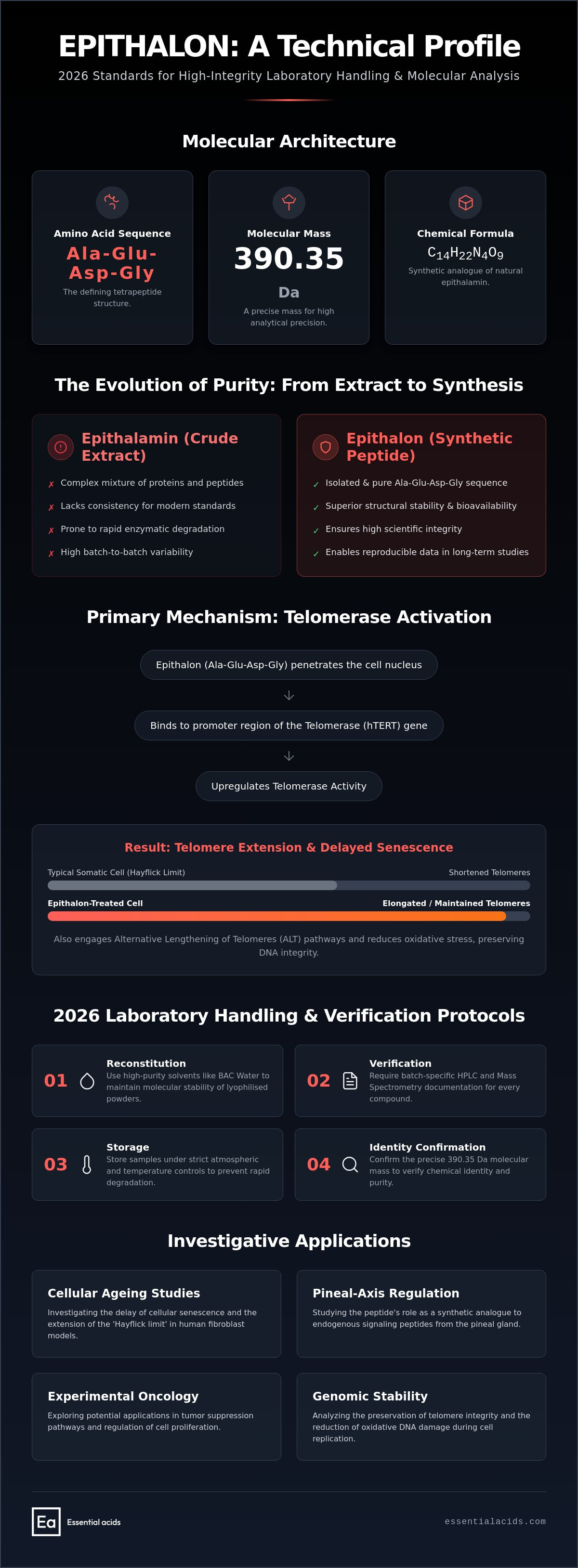
Epithalon is a synthetic tetrapeptide comprised of the specific amino acid sequence L-alanyl-L-glutamyl-L-aspartyl-glycine. Within the context of epithalon research, this compound is defined as a short-chain peptide research tool designed for high-affinity interaction with DNA regulatory regions. Its molecular formula is expressed as C14H22N4O9, and it possesses a precise molecular mass of approximately 390.35 Da. This specific mass allows for a level of analytical precision that isn't achievable with crude biological extracts. The compound serves as a synthetic analogue of the natural peptide epithalamin, which was originally isolated from the bovine pineal gland. For laboratory applications, it's provided as a high-purity lyophilised powder to ensure the scientific integrity of the research-use only material.
Chemical Evolution: From Epithalamin to Epithalon
The transition from crude bovine pineal extracts to the isolated synthetic tetrapeptide represents a shift toward higher scientific integrity in laboratory studies. Early investigations relied on epithalamin, a complex mixture of proteins and peptides that lacked the consistency required for modern analytical standards. Through the isolation of the Ala-Glu-Asp-Gly sequence, researchers have developed a variant that ensures high bioavailability in various research models. Synthetic high-purity variants offer superior structural stability compared to natural extracts. These natural extracts are often prone to rapid enzymatic degradation and batch-to-batch variability. This stability is critical for establishing reproducible data in long-term cellular ageing studies conducted within Australian institutions.
Structural Integrity and Molecular Weight Standards
The small molecular size of Epitalon is a primary factor in its ability to penetrate both cellular and nuclear membranes. This accessibility is required for the peptide to interact directly with the promoter region of the telomerase gene. By mimicking endogenous signaling peptides, the sequence triggers the upregulation of telomerase activity (hTERT). When evaluating molecular complexity, one might compare this tetrapeptide to the tirzepatide structure, which involves a much larger, 39-amino acid chain. While larger peptides often require complex delivery systems, the streamlined architecture of Epithalon allows for direct interaction with epigenetic mechanisms. This simplicity facilitates more straightforward laboratory handling and predictable metabolic pathways during epithalon research. The sequence is specifically designed to remain stable under standardized laboratory storage conditions, provided the proper reconstitution protocols are followed.
Primary Mechanisms: Telomerase Activation and Pineal Regulation
The primary focus of current epithalon research is the peptide’s capacity to upregulate telomerase (hTERT) activity within somatic cells. This molecular interaction occurs when the Ala-Glu-Asp-Gly sequence binds to the promoter region of the telomerase gene, facilitating telomerase activity and telomere elongation. Unlike simpler compounds, Epithalon facilitates telomere maintenance through a dual-action mechanism that leverages both telomerase-dependent pathways and the Alternative Lengthening of Telomeres (ALT) pathways. This comprehensive approach ensures that chromosomal stability is addressed at multiple genomic checkpoints during cellular replication.
Telomere Extension and Cellular Senescence
Investigations using human fibroblast research models frequently document an extension of the 'Hayflick limit', which is the finite number of times a somatic cell population will divide before growth ceases. By delaying the onset of cellular senescence, the peptide provides a stable framework for studying cellular ageing within the broader scope of epithalon research. The impact on the Alternative Lengthening of Telomeres (ALT) pathway is particularly relevant in specialized cell lines where traditional telomerase activity is absent or suppressed. Additionally, the peptide demonstrates a capacity to reduce oxidative stress markers. Since oxidative damage is a primary driver of telomere attrition, this reduction preserves the integrity of the DNA sequence during repetitive replication cycles. Investigators seeking to maintain high-integrity standards should utilize verified Epithalon to ensure reproducible outcomes across longitudinal studies.
Neuroendocrine and Pineal Axis Modulation
A secondary but equally significant mechanism involves the restoration of pineal gland sensitivity. This interaction allows for the normalization of circadian rhythm signaling, which often degrades in aging research models. By improving the synthesis and secretion of endogenous melatonin, the peptide restores a critical component of the neuroendocrine axis. This systemic hormonal balance is necessary for the regulation of metabolic and immunological functions. Higher melatonin levels don't just regulate sleep cycles; they also act as a potent buffer for the antioxidant defense systems, neutralizing free radicals before they can induce genomic instability. This dual-layered protection, targeting both the nucleus and the endocrine system, reflects a disciplined commitment to understanding the full scope of biological restoration. Scientific integrity must be maintained in every laboratory protocol, and all materials remain strictly for research-use only applications.
The scope of epithalon research has evolved to encompass systemic biological systems far beyond the initial focus on chromosomal caps. Investigators are currently examining how the Ala-Glu-Asp-Gly sequence influences systemic antioxidant capacity and the reversal of specific biomarkers of ageing. This research is particularly relevant in the study of neuroendocrine decline, where the peptide’s interaction with the pineal gland is analyzed for its potential to stabilize circadian rhythm disorders. Specialized studies also include retinitis pigmentosa research, where the modulation of melatonin-related pathways is explored for its protective effects on retinal tissue.Oncology and Tumor Suppression Models
Analytical models frequently use murine subjects to investigate the inhibition of spontaneous carcinogenesis. These studies focus on whether the peptide can reduce the incidence of both mammary and colon tumors in aging populations. A primary point of analysis is the upregulation of pro-apoptotic genes in malignant cell lines, which may signal a shift toward tumor suppression. Researchers must carefully differentiate between telomerase induction in healthy somatic cells and the activity within malignant environments. While telomerase is a hallmark of many cancers, current data suggests that Epithalon doesn't promote the uncontrolled proliferation of tumor cells, but rather supports the genomic integrity of non-malignant tissue. This distinction is vital for maintaining scientific integrity in any oncological study.
Metabolic and Immunological Research
The intersection of metabolic function and cellular ageing represents a significant domain of inquiry. Research models focus on the peptide’s ability to improve glucose metabolism and restore insulin sensitivity, which often declines in senescent models. From an immunological standpoint, investigators observe changes in thymus gland morphology and the resulting maturation of T-cell populations. There is significant cross-talk between telomere length and systemic inflammatory responses. By modulating these pathways, the peptide may influence the rate of immunological decline. These studies remain strictly for research-use only, adhering to the disciplined standards required to advance the philosophy of "Making better, normal" through empirical evidence.
Analytical Standards: Handling, Reconstitution, and Stability
Maintaining the molecular integrity of the Ala-Glu-Asp-Gly sequence is a prerequisite for any credible epithalon research. Because peptides are inherently susceptible to hydrolysis and enzymatic breakdown, the compound is supplied as a lyophilised powder. This state ensures that the molecular structure remains stable during transit and long-term storage. To initiate analytical procedures, researchers must use high-purity solvents, specifically BAC Water, which prevents peptide degradation by maintaining a sterile environment. The delicate peptide bonds of the Ala-Glu-Asp-Gly sequence are highly susceptible to denaturation when exposed to direct UV radiation or excessive mechanical agitation, which can lead to fragmented peptide chains and compromised research data.
Reconstitution Protocol for Laboratory Use
Precise reconstitution is required to ensure that the concentration of the solution remains consistent across various testing phases. Following a disciplined procedure prevents the loss of material and maintains the scientific integrity of the sample.
- Step 1: Equilibrate the vial to room temperature, approximately 20-25°C, before breaking the vacuum seal. This prevents moisture from forming inside the vial, which could introduce instability.
- Step 2: Introduce the solvent slowly by directing the stream against the interior vial wall. This technique prevents the formation of air bubbles or foaming, which can structurally compromise the peptide.
- Step 3: Gently swirl the vial in a circular motion until the lyophilised powder is completely dissolved. Researchers don't vortex the solution, as the resulting kinetic energy can disrupt the tetrapeptide's sequence.
Storage and Thermal Stability Parameters
The shelf life of the compound is strictly dependent on thermal management and light exposure. For long-term preservation, the lyophilised powder should be stored at -20°C, where it maintains its integrity for up to 24 months. Once the solution is reconstituted, it becomes significantly more fragile. It's best kept at 2°C to 8°C and utilized within a maximum of 21 days to ensure the accuracy of the analytical results. Photodegradation is a critical concern; therefore, the use of amber glass vials or storage in a dark environment is necessary to prevent the breakdown of peptide bonds caused by light exposure. Adhering to these 2026 standards ensures that epithalon research remains objective and verifiable.
Procuring High-Purity Epithalon for Scientific Integrity
Procurement of high-purity compounds for epithalon research is a process that demands absolute transparency and technical verification. Within the Australian scientific sector, the distinction between analytical-grade materials and non-verified substances is critical for the validity of any experimental dataset. High-Performance Liquid Chromatography (HPLC) is the industry standard for verifying peptide sequence identity; it ensures that the sample isn't contaminated with synthesis by-products. Complementary to this, Mass Spectrometry (MS) serves as a definitive safeguard, confirming the precise molecular mass and identifying any potential cross-contamination. Essential Acids maintains a disciplined commitment to providing batch-specific analytical reports for every compound, ensuring that researchers can buy research peptides Australia with full confidence in their chemical profile.
Interpreting HPLC and MS Documentation
A rigorous review of the Certificate of Analysis (CoA) is the first step in maintaining scientific integrity. On an HPLC chromatogram, the primary purity peak must exceed 99% to meet the requirements for high-level cellular research. Any secondary peaks indicate impurities that could introduce uncontrolled variables into a study. Mass Spectrometry analysis provides the second layer of verification by confirming the molecular weight of 390.35 Da. This data point ensures that the Ala-Glu-Asp-Gly sequence is intact and free from structural deviations. Transparency in these reports allows investigators to verify the stability and concentration of the peptide before initiating any laboratory protocols.
Compliance and Research-Use Only Protocols
The legal framework for acquiring Epithalon in Australia is strictly defined by its application in laboratory and analytical settings. All procurement must adhere to research-use only protocols, which establish a clear boundary between experimental inquiry and clinical application. Essential Acids operates within this cautious and objective atmosphere, prioritizing regulatory compliance over market trends. Our philosophy of "Making better, normal" is rooted in the belief that human potential is best understood through the lens of precise, empirical data. By ensuring that all acquisition is restricted to controlled, non-human research environments, we protect the integrity of the scientific process. This steady and predictable approach to supply ensures that Australian institutions have a reliable partner for advancing the study of cellular ageing and genomic stability. Every batch is verified, and every protocol is designed to uphold the highest standards of laboratory research.
Advancing Genomic Stability Through Standardized Analytical Protocols
The pursuit of "Making better, normal" requires a disciplined adherence to the analytical standards established for 2026. The success of epithalon research depends entirely on the molecular fidelity of the Ala-Glu-Asp-Gly sequence and the rigor of laboratory handling protocols. By implementing precise thermal management and utilizing high-purity solvents, investigators can effectively mitigate the risk of peptide denaturation during complex longitudinal studies. Scientific integrity is further reinforced through the requirement of batch-specific documentation, ensuring that every compound meets the 99%+ purity threshold necessary for reproducible outcomes in telomerase induction models.
These technical foundations allow for a more accurate exploration of neuroendocrine regulation and cellular ageing within strictly controlled environments. Maintaining research-use only laboratory standards is not merely a regulatory necessity; it's a commitment to the objective truth of biochemical data. We invite you to View Epithalon Laboratory Research Specifications to review our latest batch-specific HPLC and Mass Spectrometry documentation. Establishing a stable and verifiable baseline is the definitive first step toward advancing the field of molecular restoration with confidence.
Frequently Asked Questions
What is the difference between Epithalon and Epithalamin?
Epithalon is a synthetic tetrapeptide consisting of the specific Ala-Glu-Asp-Gly sequence, whereas Epithalamin is a crude biological extract derived from the bovine pineal gland. While Epithalamin contains a complex mixture of proteins and peptides, Epithalon provides a precise, high-purity molecular profile required for standardized laboratory work. This synthetic nature eliminates the batch-to-batch variability and potential for cross-contamination that is inherent in animal-derived extracts.
How does Epithalon activate the telomerase enzyme?
Epithalon facilitates telomerase activation by binding directly to the promoter region of the telomerase (hTERT) gene. This interaction induces the expression of the enzyme, which subsequently adds TTAGGG repeats to the ends of chromosomes to prevent attrition. This specific mechanism of telomere elongation is a core focus of current epithalon research, providing a molecular pathway for studying cellular longevity and genomic stability in various somatic cell lines.
What is the recommended solvent for Epithalon reconstitution?
Bacteriostatic Water (BAC Water) is the recommended solvent for reconstituting Epithalon for analytical use. The inclusion of 0.9% benzyl alcohol acts as a preservative that inhibits the growth of microorganisms, which is essential for maintaining the stability of the peptide bonds during short-term refrigerated storage. Using high-purity solvents ensures that the analytical integrity of the compound isn't compromised by biological contaminants during the testing phase.
How should lyophilised Epithalon be stored for long-term stability?
Lyophilised Epithalon should be stored at -20°C in a light-shielded environment to ensure long-term molecular stability. Maintaining this sub-zero temperature prevents the degradation of the Ala-Glu-Asp-Gly sequence for a period of up to 24 months. It's necessary to ensure the vial remains sealed and protected from moisture; humidity can lead to peptide hydrolysis even in a frozen state, which would compromise the scientific integrity of the sample.
Is Epithalon research-grade peptide legal for laboratory use in Australia?
Yes, Epithalon is legal for procurement and use within Australia when it's strictly intended for laboratory and analytical research. These compounds are classified as research chemicals and must not be used for human consumption or clinical applications. Australian institutions must adhere to established safety and disposal protocols to remain compliant with local regulations regarding the handling of synthetic peptides in a controlled, research-use only setting.
What is the molecular weight of the Epithalon tetrapeptide?
The molecular weight of the Epithalon tetrapeptide is approximately 390.35 Da. This specific mass corresponds to the C14H22N4O9 molecular formula of the L-alanyl-L-glutamyl-L-aspartyl-glycine sequence. Verifying this mass through Mass Spectrometry is a standard requirement to confirm the chemical identity of the compound. It ensures that no structural deviations or incorrect amino acid sequences occurred during the solid-phase synthesis process.
How long does reconstituted Epithalon remain stable at 4°C?
Reconstituted Epithalon remains stable for a maximum of 21 days when stored at 2°C to 8°C. Beyond this period, the risk of peptide chain fragmentation increases, which can lead to inconsistent data in epithalon research. To prevent photodegradation, the solution should be kept in amber glass vials or a dark container throughout the duration of the experiment. Solutions showing any signs of precipitation or cloudiness should be discarded immediately.
Why is HPLC verification critical for Epithalon research?
High-Performance Liquid Chromatography (HPLC) verification is critical because it confirms the purity and sequence identity of the peptide. A purity level of 99% or higher is required to ensure that experimental results aren't skewed by synthesis by-products or residual reagents. This level of analytical transparency is fundamental to maintaining scientific integrity. It ensures that the observed biological effects are attributable solely to the intended Ala-Glu-Asp-Gly sequence.
Legal Disclaimer
All products sold on this website are intended exclusively for laboratory research purposes and not for human or veterinary use, diagnosis, cure, treatment, or prevention of any disease or condition. None of the statements on this site have been reviewed or evaluated by the U.S. Food and Drug Administration (FDA) or comparable regulatory authorities. Purchasing or using these products for any unintended purpose, including human consumption, may violate federal or local laws and poses safety risks.