

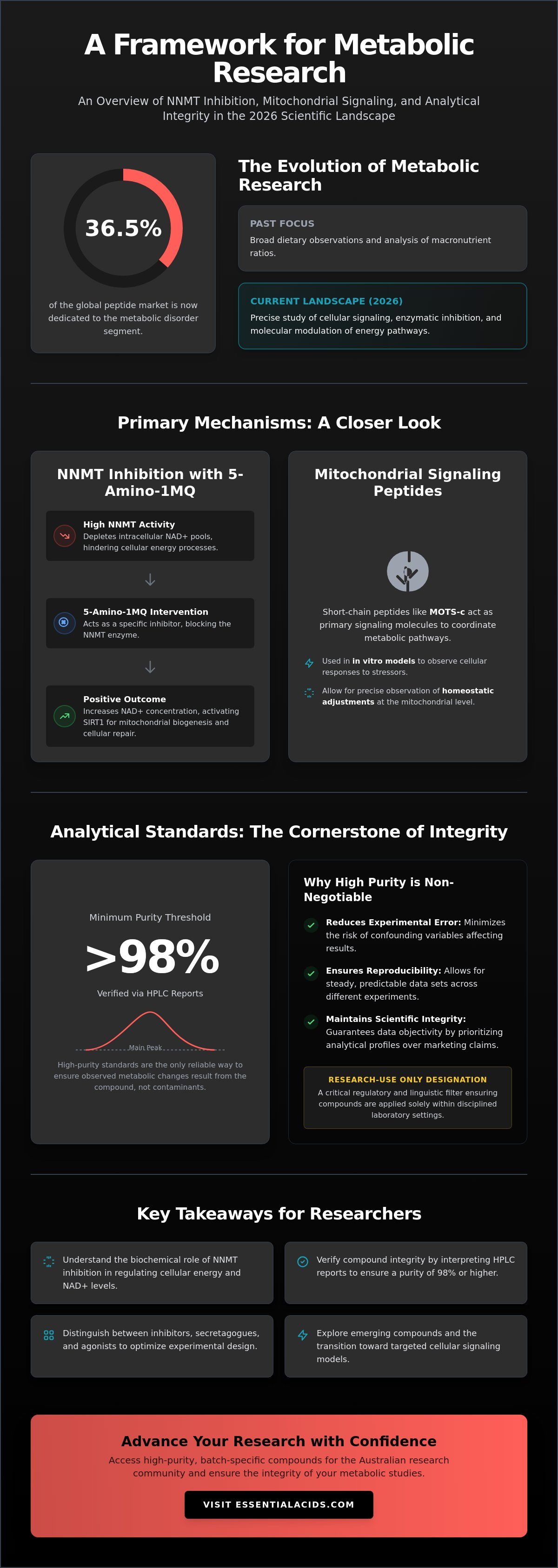
The metabolic disorder segment now accounts for 36.5% of the global peptide market, a figure that reflects a fundamental transition in how scientists approach cellular ageing and energy regulation. Researchers frequently encounter significant hurdles when synthesizing complex data or verifying the purity of laboratory materials, especially as regulatory scrutiny over research-only compounds intensifies in the 2026 landscape. It's a challenging environment where the distinction between high-purity analytical standards and unregulated materials is often blurred by inconsistent data.
This overview establishes a disciplined framework for Essential Acids metabolic research, offering precise analytical profiles for compounds such as 5-Amino-1MQ and MOTS-c. We'll examine the specific mechanisms of NNMT inhibition and mitochondrial signaling while outlining the rigorous quality standards required for high-integrity laboratory applications. By the end of this profile, you'll have a clear understanding of the current regulatory environment and the technical data necessary to ensure scientific integrity in Australian research settings. Our commitment remains focused on making better, normal, through the provision of verified, batch-specific data for the scientific community.
Key Takeaways
- Understand the biochemical role of NNMT inhibition in cellular energy regulation and its impact on NAD+ concentrations during laboratory analysis.
- Identify the critical benchmarks for verifying compound integrity; this includes the interpretation of HPLC reports to ensure a minimum purity threshold of 98%.
- Distinguish between the functional mechanisms of secretagogues, inhibitors, and receptor agonists to optimize experimental design in metabolic studies.
- Gain a comprehensive overview of Essential Acids metabolic research and the molecular modulation strategies defining the 2026 scientific landscape.
- Explore emerging compounds and the transition toward targeted cellular signaling models for advanced biochemical investigations within the Australian research community.
The Evolution of Essential Acids in Metabolic Research
Metabolic research has transitioned from broad dietary observations to the precise study of cellular signaling and enzymatic inhibition. Historically, investigations focused on macronutrient ratios; however, the current focus lies in the molecular modulation of energy pathways. Essential Acids metabolic research emphasizes the use of high-purity compounds to probe these complex systems. This evolution allows for a more granular understanding of how specific molecules influence cellular energy homeostasis and ATP production. Researchers now target individual enzymes to observe the downstream effects on metabolic efficiency within controlled in vitro environments.
Maintaining scientific integrity requires a strict adherence to the "research-use only" designation. This classification serves as both a linguistic and regulatory filter, ensuring that compounds are applied solely within disciplined laboratory settings. It eliminates the ambiguity that often accompanies consumer-facing health products. By prioritizing analytical profiles over marketing claims, researchers ensure that their data remains objective and reproducible. The gravity of laboratory research demands this level of transparency and caution to avoid confounding variables during metabolic modeling.
Defining Essential Acids in a Laboratory Context
In a laboratory setting, researchers distinguish between standard dietary amino acids and synthetic research analogs. While dietary acids support basic protein and amino acid synthesis, research-grade analogs are engineered for specific enzymatic interactions. These specialized acids are used to either activate or inhibit metabolic enzymes, such as Nicotinamide N-methyltransferase (NNMT). Identifying these materials requires a rigorous assessment of batch-specific verification. High-purity standards are the only reliable way to ensure that the observed metabolic changes result from the compound itself rather than contaminants.
The Role of Peptides in Homeostatic Modeling
Short-chain peptides act as primary signaling molecules that coordinate metabolic pathways. Synthetic analogs are frequently used in vitro to model cellular responses to various stressors. These peptides, such as 5-Amino-1MQ or MOTS-c, allow for the observation of homeostatic adjustments at the mitochondrial level. High-purity peptides are the preferred medium for this work because they offer the precision necessary for modern Essential Acids metabolic research. When purity levels reach or exceed 98%, the risk of experimental error is significantly reduced, allowing for a clearer analysis of mitochondrial signaling. This focus on precision reflects a commitment to making better, normal, through rigorous scientific inquiry and steady, predictable data sets.
Primary Mechanisms: NNMT Inhibition and Mitochondrial Signaling
Nicotinamide N-methyltransferase (NNMT) is a cytosolic enzyme that regulates the methylation of nicotinamide using S-adenosylmethionine (SAM) as the methyl donor. In metabolic research models, high levels of NNMT activity are associated with the depletion of intracellular NAD+ pools. This depletion occurs because NNMT converts nicotinamide into 1-methylnicotinamide, effectively removing it from the NAD+ salvage pathway. Essential Acids metabolic research utilizes 5-Amino-1MQ as a specific inhibitor to reverse this process. By blocking NNMT, researchers can observe an increase in intracellular NAD+ concentrations. This increase subsequently activates sirtuins, particularly SIRT1, which are critical for mitochondrial biogenesis and cellular repair. The study of Essential Amino Acids and their derivatives remains foundational to understanding how these synthetic inhibitors interact with endogenous metabolic cycles.
NNMT Inhibition and Cellular Energy Regulation
The mechanism of 5-Amino-1MQ focuses on the direct inhibition of NNMT activity within adipose and muscle tissue models. When NNMT is suppressed, the cellular environment shifts toward a more efficient energy state. Research findings indicate that this modulation leads to increased energy expenditure and reduced lipid accumulation in metabolic tissue simulations. This process is highly dependent on the availability of NAD+, which serves as a co-substrate for enzymes involved in DNA repair and metabolic regulation. Laboratory data suggests that sustained NNMT inhibition can restore mitochondrial-nuclear communication, a critical factor in maintaining homeostatic balance under metabolic stress.
Mitochondrial Signaling and MOTS-c Pathways
Mitochondrial-derived peptides (MDPs) represent a relatively new frontier in homeostatic modeling. MOTS-c, a 16-amino acid peptide, is unique because it's encoded within the mitochondrial 12S rRNA gene. This origin allows it to function as a signaling molecule that facilitates retrograde communication from the mitochondria to the nucleus. In laboratory simulations, MOTS-c has been shown to influence glucose metabolism by promoting the uptake of glucose into muscle cells independent of insulin. It primarily achieves this through the activation of the AMP-activated protein kinase (AMPK) pathway. Researchers interested in these signaling pathways can find high-purity MOTS-c for laboratory analysis to ensure data accuracy and experimental reliability.
The interaction between NNMT inhibition and mitochondrial signaling creates a complex feedback loop. When NNMT is inhibited, the resulting surge in NAD+ supports mitochondrial efficiency. Conversely, MDPs like MOTS-c provide signals that adjust nuclear gene expression to match mitochondrial capacity. This bidirectional communication is the basis for cellular energy homeostasis. Essential Acids metabolic research focuses on these mechanisms to determine how molecular interventions can stabilize energy expenditure in metabolic tissue models. The precision of these models depends entirely on the analytical standards of the research materials used, ensuring that all observed effects are the result of targeted molecular interaction.
Comparative Profiles of Metabolic Research Compounds
The classification of metabolic research compounds depends on their specific interaction with biological targets. Secretagogues, such as Ibutamoren, stimulate the endogenous release of hormones, while inhibitors like 5-Amino-1MQ block enzymatic activity. Receptor agonists, conversely, mimic natural ligands to activate cellular pathways. In modern Essential Acids metabolic research, the selection of these tools is dictated by the specific metabolic pathway under investigation. While foundational knowledge often begins with Essential Amino Acids in Human Nutrition, current scientific focus has moved toward synthetic analogs that provide greater precision in laboratory simulations.
Strategic compound selection is critical for accurate modeling. Researchers studying lipid metabolism often compare 5-Amino-1MQ and AOD-9604. 5-Amino-1MQ functions as an NNMT inhibitor to increase NAD+ levels, whereas AOD-9604 acts as a lipolytic fragment. These mechanisms are distinct. One targets enzymatic pathways to alter cellular energy states; the other mimics the C-terminus of growth hormone to stimulate fat oxidation without systemic growth effects. These differences allow for the isolation of specific metabolic variables within a controlled environment.
Incretin Mimetics in Research: Semaglutide and Tirzepatide
The study of incretin mimetics has expanded beyond single-receptor models. Semaglutide acts as a GLP-1 receptor agonist, while Tirzepatide introduces dual agonism by targeting both GIP and GLP-1 receptors. This multi-receptor approach is a focal point in Essential Acids metabolic research. Dual agonism results in complex cellular responses in vitro, particularly regarding glucose-dependent insulin secretion. Structural differences between these molecules dictate their binding affinity and half-life in laboratory environments.
Lipolytic Fragments: AOD-9604 and Growth Hormone Research
AOD-9604 represents a molecular fragment approach to metabolic modeling. It's a synthetic analog of the C-terminal fragment of human growth hormone (hGH 177-191). Unlike full-sequence growth hormone, AOD-9604 is studied specifically for its lipolytic activity. It doesn't appear to influence insulin resistance or systemic growth. This allows researchers to isolate lipid metabolism pathways without the confounding variables of growth factor signaling, making it highly effective for targeted metabolic tissue research.
Analytical Standards for Metabolic Research Materials
High-purity standards reaching a minimum threshold of 98% are mandatory for reliable Essential Acids metabolic research. Without these benchmarks, experimental data becomes compromised by impurities that can skew enzymatic response or cellular signaling results. Research-grade materials differ from pharmaceutical-grade drugs primarily in their intended application and the specific regulatory framework governing their procurement. While pharmaceutical-grade items are produced for clinical use, research-grade compounds are optimized for analytical precision in laboratory models. This distinction is critical for maintaining scientific integrity and ensuring that all observed metabolic changes are attributable to the compound under investigation rather than unlisted contaminants.
HPLC and Mass Spectrometry: The Gold Standard
High-Performance Liquid Chromatography (HPLC) serves as the primary method for determining chemical purity in a laboratory setting. When interpreting an HPLC report, researchers must look for the "purity peak" area relative to the total chromatogram. A single, sharp peak indicates a high-purity compound, while multiple smaller peaks suggest the presence of synthesis byproducts or residual solvents. Mass Spectrometry (MS) complements this by verifying the molecular weight and identity of the metabolic compound. This ensures that the material provided matches the intended molecular structure. Batch-specific documentation is essential for scientific reproducibility; generic reports are insufficient for high-integrity laboratory work. Researchers should identify common contaminants like trifluoroacetic acid (TFA) salts or moisture content, as these can impact the concentration of the actual peptide within the lyophilized cake.
Storage Integrity and Reconstitution Protocols
The stability of metabolic research peptides depends heavily on storage conditions and handling. Lyophilized vials are generally stable at room temperature for short periods during shipping, but long-term projects require storage at -20°C to prevent degradation. Peptides like MOTS-c are particularly sensitive to temperature fluctuations, which can lead to peptide bond hydrolysis or oxidation. Once a compound is reconstituted, its stability window narrows significantly. Using bacteriostatic water is a standard practice, yet the resulting solution must be kept refrigerated and used within a specific timeframe to maintain its analytical profile. For a detailed example of these benchmarks, researchers can review the BPC-157 5mg molecular profile for laboratory research standards.
Reliability in metabolic modeling is impossible without verified materials. Every batch must undergo independent testing to confirm it meets the stated analytical profile before application. This level of transparency allows researchers in Australia to proceed with confidence, knowing their Essential Acids metabolic research compounds are free from unlisted additives or degradation products. For those requiring verified materials, you can access high-purity research peptides that include comprehensive batch-specific documentation. Maintaining these rigorous standards ensures that the focus remains on the precision of the laboratory rather than the variability of the materials.
Future Directions in Metabolic Research and Procurement
The landscape of Essential Acids metabolic research is evolving rapidly as we move through 2026. While some industry perspectives suggest a plateau in peptide development, the actual data indicates a surge in the engineering of new synthetic analogs. The focus is shifting from broad metabolic markers to complex cellular signaling networks. Advanced compounds are being developed to target specific mitochondrial pathways with higher binding affinity and reduced off-target effects. This progression necessitates a stable supply of high-purity materials that can withstand the rigors of long-term longitudinal studies in Australian laboratory settings.
Research into cellular energy homeostasis is increasingly focused on the synergy between different molecular classes. Future studies are expected to explore the combined effects of NNMT inhibitors and mitochondrial-derived peptides to map the full spectrum of metabolic flexibility. This requires a procurement partner that understands the gravity of laboratory research and the necessity for absolute chemical precision. As these new analogs emerge, the requirement for rigorous analytical verification will remain the primary safeguard against experimental error.
Essential Acids’ Commitment to Scientific Integrity
Scientific integrity is the core value that dictates our approach to sourcing and verification. Every batch of material undergoes a rigorous analytical process to confirm its chemical structure and purity levels. Transparency in batch testing is non-negotiable; researchers require verified data to ensure the reproducibility of their metabolic models. By providing batch-specific HPLC and MS documentation, Essential Acids supports the Australian scientific community in maintaining high laboratory standards. This disciplined approach ensures that the quality of the compounds speaks for itself, allowing researchers to focus on data acquisition rather than material variability.
Procurement Compliance for Laboratory Environments
Navigating the regulatory landscape requires a firm adherence to established safety protocols. All materials provided are for research-use only and are strictly not for human consumption. This policy is a fundamental boundary that protects the integrity of the research and the safety of the laboratory environment. It's essential that laboratory facilities meet specific storage requirements, particularly regarding the temperature-sensitive peptides mentioned in earlier sections. Ensuring these standards are met is the first step in any advanced metabolic investigation. The future of Essential Acids metabolic research begins with verified analytical materials that meet the demanding criteria of 2026 research models.
Our commitment to "Making better, normal" is realized through the provision of high-purity compounds that enable visionary research into human potential. As metabolic research continues to uncover new molecular targets, the necessity for reliable procurement partners becomes even more pronounced. Essential Acids remains a no-nonsense gatekeeper for quality, ensuring that the precision of the laboratory is never compromised by the trends of the marketplace.
Advancing Analytical Precision in Metabolic Modeling
The evolution of metabolic research in 2026 demands a transition from general observations to the precise modulation of enzymatic and mitochondrial pathways. This guide has detailed how compounds like 5-Amino-1MQ and MOTS-c facilitate a deeper understanding of cellular energy homeostasis and retrograde signaling. Maintaining scientific integrity in these studies relies entirely on the quality of the materials used. Essential Acids metabolic research is defined by a commitment to transparency and batch-specific verification. Every compound provided meets a minimum purity standard of 98%; this is verified through comprehensive HPLC and Mass Spectrometry reports provided with every order. By prioritizing these analytical benchmarks, researchers eliminate material variability and focus on the acquisition of objective data.
Researchers seeking high-integrity materials for laboratory applications are invited to explore our catalog of high-purity metabolic research compounds. Our specialized focus on metabolic signaling compounds ensures that your laboratory has access to the precise tools required for advanced modeling. We remain dedicated to making better, normal, through rigorous scientific standards and reliable data. We look forward to supporting your next breakthrough in the laboratory.
Frequently Asked Questions
What is the primary role of NNMT in metabolic research?
Nicotinamide N-methyltransferase (NNMT) functions as a cytosolic enzyme that regulates the methylation of nicotinamide using S-adenosylmethionine as a donor. In laboratory models, it's primarily studied for its role in depleting intracellular NAD+ pools, which subsequently impacts sirtuin activity and cellular energy regulation. Researchers target this enzyme to observe changes in energy expenditure and lipid metabolism within specific tissue simulations.
How do mitochondrial-derived peptides like MOTS-c influence cellular metabolism?
MOTS-c acts as a signaling molecule that facilitates retrograde communication from the mitochondria to the nucleus. It influences glucose metabolism in laboratory simulations by activating the AMP-activated protein kinase (AMPK) pathway, which promotes glucose uptake independent of insulin signaling. This mechanism is a focal point of Essential Acids metabolic research regarding mitochondrial-nuclear cross-talk and homeostatic adjustments.
Why is 98% purity the standard for metabolic research peptides?
A purity threshold of 98% or higher is required to ensure that all observed biological effects are attributable solely to the compound under investigation. Lower purity levels introduce unlisted contaminants or synthesis byproducts that can skew enzymatic assays and compromise the reproducibility of the data. Maintaining this analytical benchmark is essential for the scientific integrity of high-level laboratory research.
Can 5-Amino-1MQ be used in conjunction with other metabolic modulators in a lab setting?
Yes, 5-Amino-1MQ is frequently studied alongside other modulators to observe synergistic effects on cellular energy homeostasis. Researchers often combine NNMT inhibitors with mitochondrial signaling peptides or lipolytic fragments like AOD-9604 to map complex metabolic feedback loops. These multi-compound studies are conducted within strictly controlled in vitro or animal models to isolate specific variables.
How should lyophilized metabolic research compounds be stored for maximum stability?
Lyophilized vials should be stored in a stable, temperature-controlled environment, ideally at -20°C for long-term projects. While these compounds are generally stable at room temperature during short-term transit, extended exposure to heat can lead to peptide bond hydrolysis or oxidation. Once a compound is reconstituted, it must be kept refrigerated and used within a narrow timeframe to prevent degradation.
What is the difference between GLP-1 and GIP receptor agonists in research models?
GLP-1 receptor agonists primarily mimic the glucagon-like peptide-1 to study insulin secretion and gastric emptying mechanisms in vitro. GIP agonists target the glucose-dependent insulinotropic polypeptide receptor, which has distinct effects on lipid metabolism and glucagon secretion. Dual agonists are utilized in Essential Acids metabolic research to analyze the integrated cellular response when both pathways are activated simultaneously.
How does HPLC verify the identity of a metabolic research compound?
HPLC verifies purity by separating the components of a sample and measuring the area under the primary peak relative to the total chromatogram. While it's highly effective for determining chemical purity, it's typically paired with Mass Spectrometry to confirm the molecular weight and specific chemical identity of the compound. This dual-verification process ensures that the material provided matches the required molecular structure.
Are Essential Acids products intended for diagnostic or therapeutic use?
No, all compounds provided are strictly for research-use only and are not intended for human consumption. They don't have applications in diagnostic procedures, medical consultations, or therapeutic treatments. This policy is strictly enforced to maintain regulatory compliance and ensure that these high-purity materials are used exclusively within disciplined laboratory environments for analytical purposes.
Legal Disclaimer
All products sold on this website are intended exclusively for laboratory research purposes and not for human or veterinary use, diagnosis, cure, treatment, or prevention of any disease or condition. None of the statements on this site have been reviewed or evaluated by the U.S. Food and Drug Administration (FDA) or comparable regulatory authorities. Purchasing or using these products for any unintended purpose, including human consumption, may violate federal or local laws and poses safety risks.