

In the rigorous environment of laboratory research, a minor variance in peptide purity isn't just a statistical outlier; it's a direct threat to the integrity of longitudinal study results. Most investigators recognize that Essential Acids quality assurance must address the persistent issues of batch-to-batch inconsistency and opaque documentation that often compromise biochemical data. It's difficult to maintain experimental control when a lack of transparent COA reporting leaves the stability of lyophilized materials in question.
You'll gain a technical overview of the rigorous analytical protocols used to verify 98% plus purity levels through batch-specific verification. This article examines our adherence to the updated USP General Chapter 1052 guidelines and FDA 21 CFR Part 111 requirements for identity, strength, and composition. We'll preview the specific scientific standards, including precolumn NBD-F derivatization and testing for emerging contaminants like PFAS, that ensure the scientific integrity of our research-use only compounds. By prioritizing precise biochemical verification over traditional marketing, we uphold our commitment to making better, normal, ensuring the quality of our compounds remains the primary focus for the scientific community.
Key Takeaways
- Identify the multi-stage verification framework that distinguishes high-purity laboratory research compounds from standard commercial products.
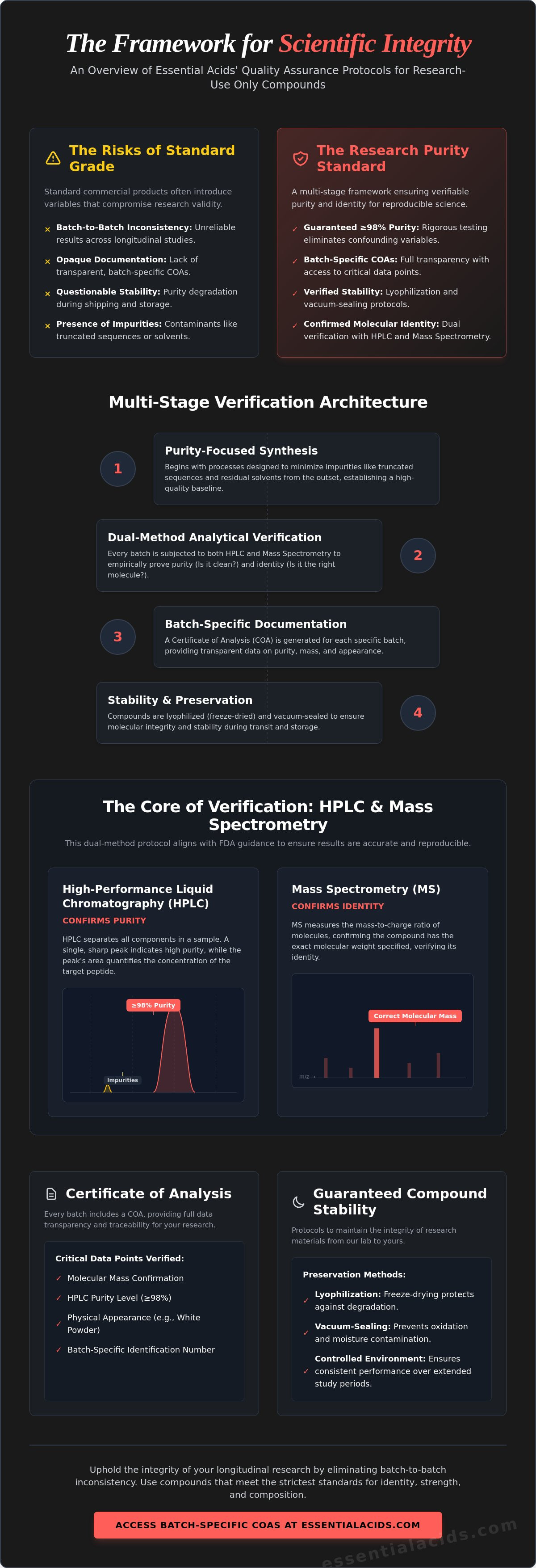
- Examine the role of HPLC and Mass Spectrometry in confirming 98% plus purity and precise molecular identification for every batch.
- Access batch-specific Certificates of Analysis to verify critical data points including molecular mass, purity levels, and physical appearance.
- Understand how lyophilization and vacuum-sealing protocols maintain the stability and integrity of research materials during distribution.
- Learn how Essential Acids quality assurance protocols protect the integrity of longitudinal research by eliminating batch-to-batch inconsistency.
The Essential Acids Quality Assurance Framework
Essential Acids quality assurance is defined by a multi-stage verification architecture designed for the strict requirements of laboratory research. Unlike commercial-grade supplements, which are formulated for dietary reference intakes, research compounds must meet precise analytical benchmarks. Scientific integrity is preserved through batch-specific testing rather than generic catalog-wide certifications. This ensures that every vial distributed meets the exact specifications required for reproducible results in metabolic and cellular aging studies. High-purity peptides serve as the baseline for experimental control. Without this precision, researchers risk introducing confounding variables that can compromise the validity of an entire study.
The protocols used to maintain these standards align with Analytical Quality Control principles. These processes ensure that laboratory results are consistent, accurate, and precise across different testing cycles. By adhering to these rigorous standards, Essential Acids provides a level of transparency that is often absent in the broader chemical supply market. The focus remains strictly on the biochemical properties of the compounds, ensuring that the quality of the materials speaks for itself through documented data.
The 'Research-Use Only' Mandate
A strict mandate is maintained where all compounds are intended for research-use only. This policy excludes all human or veterinary applications. Compliance is enforced through rigorous boundary-setting within the laboratory and the digital storefront. The brand acts as a gatekeeper, ensuring that compounds like Ipamorelin or TB-500 remain within controlled environments. This professional distance prevents the casual misuse common in the broader e-commerce landscape. Safety and policy sections are written with a formal, detached perspective to emphasize the gravity of laboratory compliance.
Defining Purity in Peptide Synthesis
Purity in peptide synthesis is a specific measurement of the target molecule's presence relative to total content. Achieving 98% plus purity requires the removal of truncated sequences and residual solvents during the purification phase. When investigating compounds such as bpc 157 5mg, the baseline for molecular weight and isomer consistency must be absolute. Impurities can introduce variables into neurological or metabolic research models, potentially invalidating longitudinal data. Essential Acids quality assurance ensures that cellular responses are the result of the compound itself, not unexpected contaminants or degraded sequences. This level of stability is critical for researchers who require consistent performance over extended study periods.
Analytical Verification: HPLC and Mass Spectrometry Protocols
Verification of research peptides requires a disciplined analytical approach that goes beyond visual inspection or basic solubility tests. It requires empirical proof. Essential Acids quality assurance utilizes a rigorous dual-method protocol to confirm both the purity and the identity of every compound in the catalog. This methodology aligns with the FDA guidance on analytical procedure validation, which provides the necessary framework for ensuring that testing results are both accurate and reproducible. Without these protocols, researchers can't guarantee that the metabolic responses observed in their models are attributable to the target molecule rather than synthesis byproducts.
Dual-method verification is non-negotiable for research integrity because it addresses two distinct biochemical questions: is the material clean, and is the material what it claims to be? By combining High-Performance Liquid Chromatography (HPLC) with Mass Spectrometry (MS), we eliminate the ambiguity that often plagues the research chemical market. This level of precision is the foundation of the trust placed in our materials by the scientific community.
High-Performance Liquid Chromatography (HPLC)
HPLC separates chemical mixtures into individual components based on their interactions with a stationary phase. In a research-grade report, the chromatogram must display a single, sharp peak. Secondary peaks or "shoulders" indicate the presence of truncated sequences or residual solvents. The retention time provides a predictable baseline for purity, while the peak area percentage quantifies the concentration of the target peptide. We ensure that every batch meets the 98% plus threshold before it is cleared for distribution. Researchers seeking these specific purity benchmarks can find verified materials at essentialacids.com.
Mass Spectrometry (MS) and Identity Confirmation
While HPLC confirms purity, Mass Spectrometry confirms identity. It measures the mass-to-charge ratio of ions to determine the exact molecular weight of the peptide. This step is critical for complex chains like 5-Amino-1MQ or long-chain peptides where structural integrity is paramount. By comparing the theoretical mass to the observed mass, we eliminate the risk of mislabeled or counterfeit materials entering the supply chain. This process identifies the specific amino acid sequence, ensuring the compound's structural integrity matches the intended research model. Identifying and quantifying residual solvents like trifluoroacetic acid (TFA) or acetonitrile is a standard part of this verification cycle. These synthesis byproducts must be kept within strictly defined limits to prevent cellular toxicity in sensitive research models.
Interpreting Batch-Specific Documentation and COAs
Analytical data is only as valuable as the documentation that records it. Essential Acids quality assurance protocols mandate the provision of batch-specific Certificates of Analysis (COAs) for every research vial. A COA acts as the definitive record of a compound's identity and purity, bridging the gap between laboratory synthesis and experimental application. Researchers must verify that the documentation matches the specific lot number of the material in their possession. Generic or 'stock' analytical reports are insufficient for high-level research because they don't account for the minute variances that occur during different synthesis cycles.
A valid COA should clearly state the date of testing and the laboratory of origin. This documentation framework aligns with FDA 21 CFR Part 111 regulations, which require the verification of identity, purity, and composition for all incoming ingredients. Transparency in these data points allows for an analytical audit, ensuring that the results haven't been recycled from previous years. We make this information available prior to procurement, allowing investigators to review the biochemical profile of a compound before it enters their facility. This proactive transparency supports the rigorous standards required for longitudinal studies and metabolic modeling.
Critical Components of a Certificate of Analysis
- Sequence Verification: The COA confirms that the amino acid sequence of the peptide matches the intended research target, preventing the use of truncated or incorrect chains.
- Purity Analysis: Documentation must distinguish between actual peptide concentration and residual salt content. High-purity materials often contain counterions like trifluoroacetic acid (TFA), which must be quantified to determine the net peptide weight accurately.
- Solubility Data: This section provides critical instructions for preparing laboratory reagents, detailing the specific solvents and concentrations required for optimal stability and reconstitution.
- Physical Appearance: A description of the lyophilized material, typically a white powder, serves as an initial, non-destructive verification of the compound's state upon arrival.
Transparency as a Core Research Value
Scientific integrity relies on objective results. Essential Acids avoids the use of internal, non-verified reports that can be prone to bias. Third-party verification is utilized to provide an independent layer of oversight. This ensures that the purity percentages and mass spectrometry data are verified by an external analytical body. Researchers can request specific documentation for auditing purposes, reinforcing our position as a disciplined gatekeeper in the chemical supply landscape. We don't rely on marketing claims; we rely on the verifiable data contained within our batch-specific reports. This commitment ensures that your focus remains on the precision of your laboratory results rather than the reliability of your supplier.
Stability, Lyophilization, and Storage Standards
The preservation of biochemical integrity requires more than just high-purity synthesis. It requires a stable physical state that can withstand the variables of distribution and long-term storage. Essential Acids quality assurance protocols integrate advanced lyophilization (freeze-drying) to ensure that research compounds remain stable from the laboratory to the end-user. While HPLC and MS confirm the initial purity, the lyophilization process preserves that purity by removing moisture that would otherwise facilitate enzymatic degradation or bacterial growth. This ensures that the research-use only materials maintain their molecular profile throughout the duration of a study.
Temperature fluctuations can trigger the unfolding of complex peptide chains, rendering them biologically inactive for research purposes. Essential Acids quality assurance necessitates that unconstituted peptides are shielded from these thermal stressors. Vacuum-sealed integrity is verified for every batch to ensure no atmospheric moisture enters the vial during transit. This protective measure is vital because even trace amounts of humidity can catalyze hydrolytic reactions. By maintaining these strict environmental controls, we uphold the scientific integrity required for high-level metabolic and neurological modeling.
The Lyophilization Process
Lyophilization involves the sublimation of water from a frozen state under a high vacuum. This process creates a stable "cake" of material that's significantly more resistant to heat than a liquid solution. Mannitol or other specific cryoprotectants are often included in the formulation to protect the peptide during the freezing phase. This prevents the formation of ice crystals that could shear the delicate molecular chains. A well-executed lyophilization cycle ensures rapid and complete reconstitution; this allows researchers to maintain precise laboratory math when preparing reagents for cellular studies. It's the standard for preserving the stability of lyophilized materials.
Storage Protocols for Research Continuity
Proper laboratory storage is the final step in ensuring research-use only compounds perform as expected. Short-term storage of lyophilized vials is generally acceptable at 4°C, but long-term research continuity requires temperatures between -20°C and -80°C. These extreme temperatures inhibit molecular motion and prevent the slow degradation that occurs even in a dry state. UV-induced degradation is another risk factor; therefore, all materials should be stored in the dark to prevent photochemical reactions. Maintaining the cold chain during distribution is a non-negotiable standard within our operation. Researchers can secure high-stability materials for their next study at essentialacids.com.
Establishing a Reliable Supply Chain for Research Excellence
Essential Acids serves as a critical infrastructure partner within the Australian and global research landscape. While the analytical protocols discussed in earlier sections establish molecular purity, the logistical framework ensures that these standards are maintained until the moment of laboratory application. Essential Acids quality assurance extends beyond the spectrometer; it encompasses a streamlined procurement process designed to eliminate the delays and uncertainties common in the acquisition of high-purity analytical materials. By providing direct access to batch-verified compounds, we enable investigators to maintain the momentum of their studies without the risk of supply-related variables.
Ethical Procurement and Compliance
A secure and compliant e-commerce environment is essential for the distribution of laboratory chemicals. We maintain a rigorous chain of custody from the point of synthesis through to final laboratory delivery. This integrity in the supply chain is as vital as the integrity of the results generated within the lab. Every stage of the movement of materials is documented to prevent contamination or unauthorized access. By acting as a disciplined scientific gatekeeper, we ensure that all transactions adhere to the strict research-use only policy. This professional distance reinforces our commitment to regulatory transparency and laboratory safety.
Advancing Scientific Discovery
The availability of high-purity compounds like Ipamorelin and CJC-1295 is fundamental to advancing endocrine and metabolic research. These materials allow for the development of precise cellular response models that can accurately predict biological outcomes. As the field of metabolic research evolves, the demand for verified, stable compounds will only increase. Essential Acids quality assurance provides the stable foundation necessary for these future discoveries. Our philosophical signature, "Making better, normal," reflects a commitment to elevating the baseline of scientific precision across the industry. This visionary outlook is rooted in the objective reality of the data we provide.
Researchers are encouraged to conduct a thorough review of the current catalog to identify the specific analytical materials required for upcoming study designs. Technical consultations are available for investigators who require specific batch data or stability profiles beyond the standard documentation. You can explore our batch-verified research catalog at Essential Acids to begin the procurement process. By selecting a partner that prioritizes scientific accuracy over marketing flair, you ensure that your research remains focused on the precision of the laboratory rather than the limitations of the supply chain.
Securing the Future of Scientific Integrity
Maintaining experimental reproducibility depends on the baseline purity of your research compounds. Essential Acids quality assurance provides this foundation by integrating dual-method HPLC and Mass Spectrometry verification for every unique batch. This disciplined approach ensures that your laboratory results are driven by the target molecule rather than synthesis byproducts or degraded sequences. By prioritizing batch-specific documentation over generic catalog claims, we provide the transparency necessary for rigorous analytical auditing.
Our commitment to scientific integrity includes 98% plus purity standards and a specialized national distribution network with a cold-chain focus. These protocols protect the stability of lyophilized materials from synthesis through delivery. This logistical precision ensures that the structural integrity of your compounds remains intact regardless of transit variables. You can view our batch-specific analytical reports and research catalog to secure the high-purity materials required for your next study. We remain dedicated to making better, normal, by serving as a reliable partner in the pursuit of metabolic and cellular discovery. Your focus shouldn't be on supplier reliability; it should be on the precision of your laboratory data.
Frequently Asked Questions
How does Essential Acids verify the purity of its research peptides?
Essential Acids verifies purity through a dual-method analytical protocol involving High-Performance Liquid Chromatography and Mass Spectrometry. This process ensures that every compound meets the 98% plus purity threshold required for scientific integrity. By utilizing these methods, we confirm the absence of truncated sequences and residual synthesis solvents in every distributed batch.
What is the difference between HPLC and Mass Spectrometry in quality assurance?
High-Performance Liquid Chromatography (HPLC) measures the purity of a compound, while Mass Spectrometry (MS) confirms its specific molecular identity. HPLC separates components to quantify the concentration of the target peptide. MS determines the exact molecular weight to ensure the amino acid sequence is correct. Both are required to ensure the compound is both clean and correctly identified.
Are the Certificates of Analysis (COA) batch-specific?
Yes, every Certificate of Analysis provided by Essential Acids is strictly batch-specific. Essential Acids quality assurance protocols reject the use of generic or outdated reports. Each lot undergoes individual testing to account for the minute variances that occur during different synthesis cycles, providing researchers with accurate data for their specific materials.
What should I do if my lyophilized peptide appears different between batches?
Differences in the physical appearance of a lyophilized "cake" are common and typically don't indicate a change in biochemical purity. Variations in texture or shape often result from the specific conditions during the freeze-drying process, such as the rate of sublimation. Researchers should rely on the HPLC and MS data provided in the COA to verify the integrity of the material rather than visual markers.
Why is 98% purity the standard for research-grade compounds?
A 98% purity level is the established benchmark for research-grade compounds to minimize confounding variables in experimental models. Impurities at higher concentrations can interfere with cellular signaling or metabolic pathways, potentially invalidating longitudinal data. This standard ensures that observed biological responses are attributable solely to the target peptide and not to synthesis byproducts.
How are Essential Acids products shipped to ensure stability?
All products are shipped in vacuum-sealed vials to prevent atmospheric moisture from compromising the stability of the lyophilized material. We maintain a strict cold-chain focus during national distribution to protect temperature-sensitive peptides from thermal degradation. This logistical precision ensures the structural integrity of the compounds is preserved from the laboratory to the end-user.
Can Essential Acids peptides be used for human diagnostic purposes?
No, Essential Acids peptides are strictly for research-use only and cannot be used for human diagnostic or therapeutic purposes. Our compounds are intended solely for in vitro laboratory studies and animal research models. We maintain a professional distance from all clinical applications to ensure full compliance with regulatory and safety standards regarding non-human use.
How do I interpret the peak area on an HPLC chromatogram?
The peak area on an HPLC chromatogram represents the relative concentration of the target molecule compared to any detected impurities. A single, sharp peak with a high area percentage indicates a high-purity compound. By calculating the area under the target peak relative to the total area of all peaks, we determine the exact purity level of the research material.
Legal Disclaimer
All products sold on this website are intended exclusively for laboratory research purposes and not for human or veterinary use, diagnosis, cure, treatment, or prevention of any disease or condition. None of the statements on this site have been reviewed or evaluated by the U.S. Food and Drug Administration (FDA) or comparable regulatory authorities. Purchasing or using these products for any unintended purpose, including human consumption, may violate federal or local laws and poses safety risks.