

The precision of a growth & metabolic study in 2026 no longer relies on broad-spectrum secretagogues, but on the verifiable selectivity of receptor-mediated signaling. You understand that the primary challenge in modern biochemistry isn't just sourcing compounds, but ensuring those compounds provide the analytical consistency required for replicable data. With the FDA moving to reclassify 12 restricted peptides as of April 2026, the laboratory landscape is shifting toward more rigorous, formal standards. It's a reality where the "research-use only" designation must be backed by batch-specific verification to overcome the inherent ambiguity of receptor affinity.
This guide provides a clinical framework for selecting high-purity peptides to model growth signaling and metabolic pathways in controlled environments. You'll gain clarity on the technical distinctions between metabolic inhibitors and growth factors, addressing the common difficulty of comparing these distinct classes. We'll preview the procurement protocols necessary to ensure scientific integrity and explain how to navigate the current regulatory flux. Our objective is to support the pursuit of making better, normal through disciplined, objective research.
Key Takeaways
- Differentiate between receptor-mediated signaling pathways to accurately model cellular growth and repair within the somatotropic axis.
- Evaluate the high selectivity of compounds like Ipamorelin to target the GHSR while avoiding the analytical confounding of cortisol elevation.
- Analyze the role of NNMT inhibitors such as 5-Amino-1MQ in modeling muscle-specific signaling for advanced growth & metabolic research.
- Implement a rigorous procurement protocol using HPLC and Mass Spectrometry reports to ensure batch-specific analytical consistency.
- Apply a clinical framework to distinguish between GHRH analogs and Ghrelin mimetics when designing specialized endocrine modeling protocols.
Understanding Growth & Metabolic Signaling in Laboratory Research
Growth and metabolic research focuses on the transduction of extracellular signals into intracellular responses. This process typically involves Peptide Hormones that act as ligands for specific cell-surface receptors. In a laboratory setting, researchers model these interactions to understand how the somatotropic axis regulates cellular proliferation and tissue repair. By 2026, the threshold for analytical integrity has risen significantly. It's no longer sufficient to observe a general physiological change; investigators must isolate the specific signaling cascade responsible for the effect.
The somatotropic axis serves as a primary framework for modeling growth. This involves the rhythmic release of growth hormone and its subsequent stimulation of insulin-like growth factor 1 (IGF-1). Modern growth & metabolic research complements this by analyzing energy homeostasis and biochemical flux. Researchers examine how cells partition nutrients between immediate energy expenditure and long-term storage. High-integrity research in 2026 demands compounds with verifiable purity levels, as impurities can lead to off-target receptor activation that compromises the validity of the study.
Receptor-Mediated Signaling Systems
GHSR (Growth Hormone Secretagogue Receptor) agonism is a core focus of growth modeling. This pathway, often targeted by ghrelin mimetics, influences both growth hormone secretion and appetite signaling. Conversely, GHRH (Growth Hormone Releasing Hormone) pathway modeling provides a different mechanism for observing pituitary response. Selectivity is the defining metric here. If a ligand lacks binding specificity, it may inadvertently trigger the HPA axis, leading to elevated cortisol or prolactin levels. Such cross-reactivity introduces confounding variables that can invalidate growth & metabolic data.
Metabolic Regulation and Bioenergetics
Modeling mitochondrial signaling is essential for understanding cellular energy expenditure. This involves tracking how specific peptides influence the efficiency of the electron transport chain and ATP production. Enzyme inhibition, such as targeting Nicotinamide N-methyltransferase (NNMT), allows researchers to study changes in metabolic flux and NAD+ availability. Distinguishing between anabolic signaling, which promotes tissue synthesis, and catabolic modulation, which drives energy mobilization, requires precise control over the laboratory environment. The use of high-purity, research-use only compounds ensures that these subtle biochemical interactions are isolated and accurately recorded.
Selecting Peptides for Somatotropic and Endocrine Modeling
Analytical precision in endocrine research depends on the selection of ligands with high receptor affinity. Investigators must categorize compounds based on their interaction with either the GHRH receptor or the GHSR (Growth Hormone Secretagogue Receptor). The Metabolic effects of growth hormone encompass a wide range of physiological responses, including protein synthesis and lipid mobilization. Selecting the correct analog allows for the isolation of these specific growth & metabolic outcomes without the interference of unintended hormonal spikes.
Ghrelin Mimetics vs. GHRH Analogs
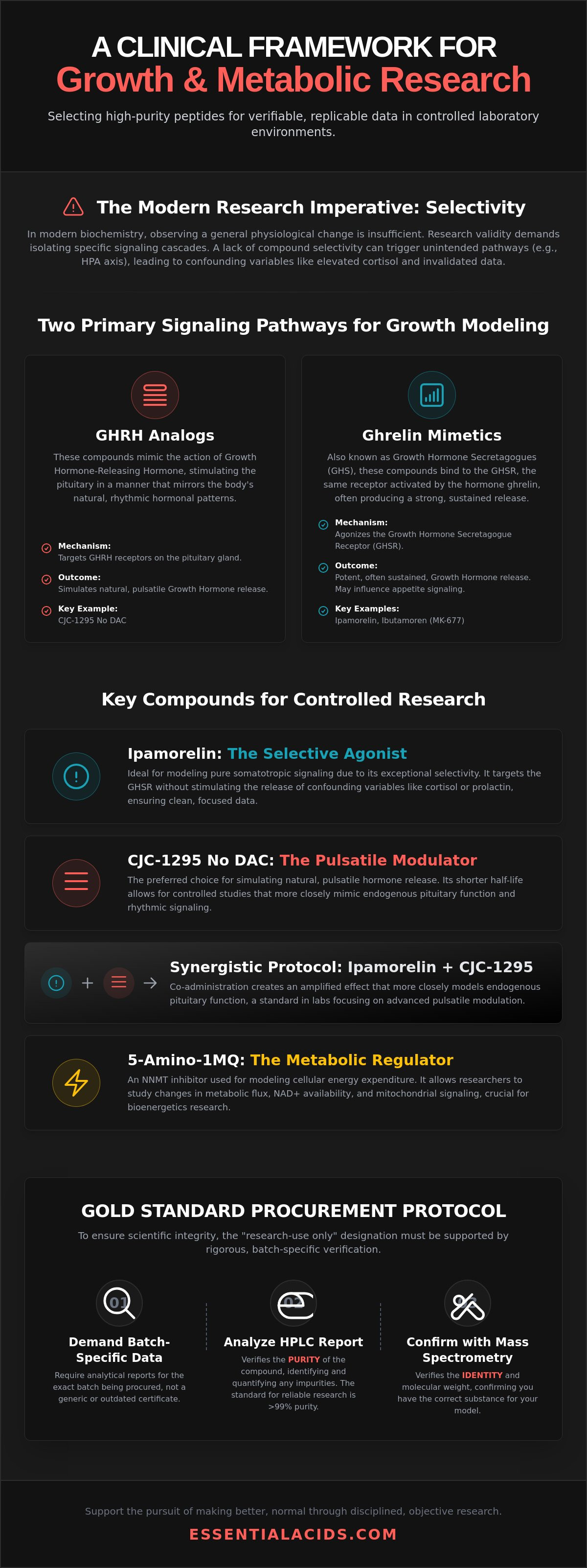
Ipamorelin is frequently selected for its exceptional selectivity. Unlike earlier generation secretagogues, it doesn't stimulate the release of cortisol or prolactin. This makes it an ideal candidate for modeling pure somatotropic signaling. Ibutamoren (MK-677) offers a similar mechanism as a GHSR agonist but features a significantly longer half-life. It's often used in longitudinal studies to observe the effects of sustained growth signaling in non-clinical models.
CJC-1295 No DAC remains the preferred choice for simulating natural, pulsatile hormone release. When co-administered with Ipamorelin, it creates a synergistic effect that more closely mirrors endogenous pituitary function. This combination is a standard in laboratory environments focusing on pulsatile modulation. Researchers seeking high-purity compounds for these protocols can review the growth & metabolic collection for batch-verified materials.
Advanced Growth Pathway Compounds
Tesamorelin is a stabilized GHRH analog consisting of 44 amino acids. Its specific structure makes it particularly effective for modeling the reduction of visceral adipose tissue and investigating lipid metabolism. In contrast, Sermorelin Acetate represents the foundational 1-29 fragment of GHRH. It's used primarily to assess pituitary reserve and basic endocrine stimulation. Accuracy in 2026 research requires matching the peptide's half-life to the specific requirements of the metabolic model being studied.
Stability profiles vary significantly between these compounds. CJC-1295 With DAC utilizes Drug Affinity Complex technology to extend its presence in the research model, whereas No DAC versions require more frequent administration to maintain signaling. Choosing the correct version is critical for researchers attempting to distinguish between steady-state hormone elevation and natural rhythmic secretion.
Compounds for Metabolic Regulation and Cellular Homeostasis
While somatotropic secretagogues modulate growth through the pituitary gland, a separate class of compounds targets intracellular enzymes and mitochondrial organelles directly. This distinction is critical for researchers building comprehensive growth & metabolic models. NNMT inhibitors, specifically 5-Amino-1MQ, represent a shift toward localized metabolic partitioning. These small molecules don't act on the GHSR; instead, they inhibit the enzyme responsible for methylating nicotinamide, which preserves cellular NAD+ pools. By maintaining higher NAD+ levels, researchers can observe changes in energy homeostasis that are independent of the somatotropic axis.
NNMT Inhibition and Muscle Research
In laboratory environments, 5-Amino-1MQ is utilized to investigate the reversal of diet-induced obesity and the preservation of muscle mass. Researchers observe that by decreasing NNMT activity, cells increase energy expenditure and fatty acid oxidation. This makes it a vital tool for studying muscle atrophy and metabolic syndrome analogs. Because 5-Amino-1MQ doesn't cross the blood-brain barrier, its effects remain peripheral, allowing for targeted muscle-specific signaling data. Scientific integrity in these studies depends on using high-purity, batch-specific compounds to ensure the observed metabolic flux isn't the result of systemic contaminants.
Lipolytic and Mitochondrial Signaling
AOD-9604 serves as a specialized model for fat metabolism. It's a synthetic analog of the C-terminal fragment of human growth hormone. Unlike the full-length molecule, it stimulates lipolysis without inducing insulin resistance or affecting IGF-1 levels. This selectivity allows for the study of adipose tissue regulation in isolation from the broader somatotropic axis. Current research into Peptide Hormones in Adipose Tissue Regulation highlights how these fragments interact with beta-3 adrenergic receptors to drive thermogenesis in non-clinical models.
Mitochondrial-derived peptides like MOTS-c introduce another layer of complexity to growth & metabolic research. MOTS-c is encoded by the mitochondrial genome and acts as a signaling molecule that regulates nuclear gene expression in response to metabolic stress. It's often classified as an exercise mimetic in non-clinical environments because it promotes glucose uptake and improves insulin sensitivity. Comparing mitochondrial regulators like MOTS-c with systemic regulators like AOD-9604 provides a more holistic view of cellular homeostasis. These materials are strictly for research-use only, serving as essential tools for making better, normal through the lens of rigorous biochemical inquiry.
Key Procurement Criteria for Laboratory-Grade Compounds
Scientific integrity in growth & metabolic research is predicated on the analytical verification of the compounds utilized. Without empirical data, the reproducibility of a study is fundamentally compromised. In 2026, the standard for laboratory procurement requires more than a simple product label. It demands a transparent supply chain where every batch is accompanied by specific analytical reports. This rigorous approach ensures that the observed biological responses are the result of the intended ligand rather than unforeseen contaminants or synthesis byproducts.
High-Performance Liquid Chromatography (HPLC) reports are the primary tool for verifying purity. A purity level of 98% or higher is the accepted benchmark for high-integrity laboratory research. Mass Spectrometry (MS) provides the secondary layer of verification by confirming the molecular weight and identity of the peptide. Together, these tests identify common impurities such as truncated sequences or residual solvents left over from the synthesis process. These impurities can inadvertently alter cellular signaling or induce localized toxicity, making their exclusion vital for accurate metabolic modeling.
Analytical Verification Standards
Interpreting an HPLC chromatogram requires a focus on the peak area percentage. A single, sharp peak indicates a high-purity compound with minimal related substances. Mass Spectrometry confirms that the synthesized chain matches the target amino acid sequence. If the molecular mass deviates from the theoretical value, the compound's identity is in question. Identifying these factors before the commencement of a study prevents the waste of laboratory resources and ensures that the "research-use only" compounds meet the necessary technical specifications.
Storage, Reconstitution, and Stability
The stability of lyophilized peptides depends on strict adherence to storage protocols. Long-term storage requires a temperature-controlled environment, typically at -20°C or below. Exposure to UV light and moisture must be minimized to prevent peptide bond hydrolysis and oxidation. Once a vial is reconstituted, its stability profile changes rapidly. Researchers must use sterile diluents and maintain refrigerated conditions to preserve the compound's integrity during the active phase of the study. Rapid degradation can lead to inconsistent dosing and unreliable data points in longitudinal models.
Ethical procurement is a cornerstone of professional research. Sourcing materials from non-verified suppliers introduces unnecessary risks to the research supply chain. High-integrity laboratories prioritize partners who provide batch-specific documentation and maintain a clear research-use only policy. This disciplined approach to procurement is essential for making better, normal through reliable scientific inquiry. Researchers can secure these high-purity materials by visiting the growth & metabolic collection.
Essential Acids Growth & Metabolic Collection Overview
Effective laboratory research in 2026 requires access to compounds that meet the highest standards of analytical transparency. The Growth & Metabolic collection at Essential Acids is curated to provide researchers with these high-purity materials. Every compound within this category is designated for research-use only, ensuring that the focus remains on the precision of biological modeling rather than commercial trends. By providing batch-specific documentation, Essential Acids maintains a position of quiet authority as a rigorous scientific gatekeeper.
Standout Compounds for 2026 Research
5-Amino-1MQ remains a cornerstone of the collection for those investigating NNMT inhibition and metabolic flux. As analyzed in previous sections, its ability to preserve cellular NAD+ pools makes it a premium tool for muscle-specific signaling research. For investigators focusing on lipolytic pathways, AOD-9604 provides a specialized fragment for modeling fat metabolism without off-target effects on glucose. MOTS-c serves as an essential mitochondrial-derived peptide for exercise-mimetic studies, offering a unique perspective on cellular homeostasis under metabolic stress.
Advanced endocrine modeling often requires the use of GHRH analogs and ghrelin mimetics. Tesamorelin and Ibutamoren are available for studies requiring long-acting secretagogue mechanisms. These compounds allow for complex longitudinal observations that shorter-acting analogs cannot provide. Researchers can also procure Ipamorelin and CJC-1295 (both No DAC and With DAC) to study the nuances of pulsatile versus steady-state somatotropic signaling. Each of these materials is verified through rigorous analytical testing to prevent the introduction of confounding variables into the research environment.
The Essential Acids Quality Commitment
Scientific integrity is the core value that dictates every procurement decision at Essential Acids. The brand prioritizes the quality of the compounds over traditional marketing flair, allowing the analytical data to speak for itself. This commitment is reflected in the provision of HPLC and Mass Spectrometry reports for every batch, facilitating research reproducibility across the scientific community. The philosophical signature, "Making better, normal," drives this focus on providing the tools necessary for visionary research into human potential.
Maintaining a professional distance and a disciplined atmosphere ensures that the supply chain remains secure and ethical. Researchers are invited to browse the full catalog of Growth & Metabolic peptides to identify the specific ligands required for their next study. By adhering to a strict research-only policy and providing verified compounds, Essential Acids stands as a reliable partner for high-integrity laboratory research. This approach respects the professional focus of the user while upholding the gravity of biochemical inquiry.
Advancing Analytical Standards in Growth and Metabolic Modeling
The landscape of laboratory research in 2026 demands a departure from generalized observations toward precise, receptor-mediated data. You've identified how selecting high-selectivity compounds, such as Ipamorelin or localized inhibitors like 5-Amino-1MQ, allows for the isolation of specific signaling cascades. Scientific integrity isn't a static goal; it's a continuous process maintained through rigorous procurement protocols. By prioritizing batch-specific HPLC and Mass Spectrometry reports, your laboratory ensures that every growth & metabolic model is built on a foundation of analytical consistency.
Essential Acids supports this commitment to accuracy by providing high-purity compounds synthesized specifically for research applications. With nationwide fulfillment and a transparent supply chain, the focus remains on the data rather than the logistics of procurement. It's about moving toward a standard of making better, normal through disciplined inquiry. To secure verified materials for your next study, Explore the Growth & Metabolic Collection and access the documentation required for replicable results. We're committed to the precision of your research environment.
Frequently Asked Questions
What is the difference between GHRH and GHRP research peptides?
GHRH analogs mimic endogenous growth hormone-releasing hormone to stimulate the pituitary directly, while GHRPs act as agonists for the ghrelin receptor. These two classes operate through distinct signaling pathways to achieve somatotropic secretion. Researchers often categorize GHRH analogs by their 1-29 or 1-44 amino acid fragments. GHRPs are frequently selected for their ability to trigger a more rapid, acute release of growth hormone in laboratory models.
Why is 5-Amino-1MQ considered a breakthrough in metabolic research?
5-Amino-1MQ is valued in growth & metabolic research for its ability to inhibit the NNMT enzyme without affecting systemic hormone levels. This mechanism preserves intracellular NAD+ pools, which are essential for energy homeostasis and mitochondrial function. By targeting the metabolic rate at the cellular level, it provides a unique model for studying muscle-specific signaling and the reversal of metabolic partitioning abnormalities.
How should Growth & Metabolic peptides be stored to maintain maximum stability?
Lyophilized peptides should be stored in a stable, temperature-controlled environment at -20°C for long-term preservation. Exposure to ultraviolet light and moisture must be prevented to avoid peptide bond degradation. Once the compound is reconstituted with BAC water, it must be kept refrigerated between 2°C and 8°C. Maintaining these rigorous storage conditions is necessary to ensure the analytical integrity of the research model remains intact.
Are Essential Acids products suitable for human consumption?
No, Essential Acids products are strictly for research-use only and are absolutely not for human or animal consumption. This policy is fundamental to our commitment to regulatory compliance and scientific integrity. These compounds are sold exclusively for laboratory experimentation and in-vitro studies. Any use of these materials outside of a controlled research environment is strictly prohibited and violates the terms of procurement.
What analytical documentation is provided with each peptide order?
Every peptide order includes batch-specific HPLC and Mass Spectrometry (MS) reports. These documents provide empirical evidence of the compound's purity and molecular identity. The HPLC report verifies the peak area percentage, while the Mass Spectrometry report confirms that the synthesized amino acid sequence matches the target molecular weight. This level of transparency is required for replicable laboratory data and professional quality assurance.
Can different growth peptides be used together in a single research model?
Co-administration of different peptides is a standard practice for modeling synergistic endocrine responses. Combining a GHRH analog with a GHRP allows researchers to simulate the natural, rhythmic pulses of hormone release seen in biological systems. This approach provides a more comprehensive view of growth & metabolic pathways than using a single ligand. Such stacks must be carefully calibrated to ensure the observed signaling data remains isolated.
What is the significance of 'DAC' in CJC-1295 research?
DAC stands for Drug Affinity Complex, a technology used to extend the half-life of peptides by binding to plasma albumin. The DAC version remains active in the research model for a significantly longer duration than its non-DAC counterpart. This allows researchers to model steady-state signaling rather than the pulsatile release seen with natural GHRH. Selecting the correct version depends on whether the study requires constant hormone elevation or rhythmic secretion.
How do I verify the purity of the peptides I purchase for my lab?
Researchers verify purity by analyzing the chromatogram provided in the HPLC report for a single, prominent peak. A purity level of 98% or higher is the benchmark for high-integrity laboratory compounds. Mass Spectrometry must also be reviewed to ensure the amino acid sequence hasn't been truncated during synthesis. Relying on batch-specific documentation from a trusted supplier prevents the use of degraded or impure materials in sensitive metabolic experiments.
Legal Disclaimer
All products sold on this website are intended exclusively for laboratory research purposes and not for human or veterinary use, diagnosis, cure, treatment, or prevention of any disease or condition. None of the statements on this site have been reviewed or evaluated by the U.S. Food and Drug Administration (FDA) or comparable regulatory authorities. Purchasing or using these products for any unintended purpose, including human consumption, may violate federal or local laws and poses safety risks.