

If your laboratory findings fail to replicate, the discrepancy often originates from the unverified biochemical integrity of your molecular agents rather than a flaw in the experimental design. In the rigorous research environment of 2026, the application of intracellular signalling peptides and proteins demands more than a standard catalog order; it requires a disciplined approach to molecular stability and nomenclature. You're likely familiar with the frustration caused by shifting regulatory landscapes and the persistent ambiguity surrounding the procurement of high-purity compounds for metabolic or neurological models.
This technical guide delivers a comprehensive analysis of the molecular mechanisms and classifications essential for precise signal transduction research. We provide a clear framework for identifying specific peptides and establishing verified sourcing protocols that prioritize analytical documentation, including batch-specific HPLC and mass spectrometry data. By the conclusion of this text, you'll possess the technical insight necessary to maintain compound stability and uphold the highest standards of scientific integrity in your laboratory. Our focus remains strictly on the objective requirements of the research-use only sector, ensuring your data reflects biological reality rather than molecular degradation.
Key Takeaways
- Identify the critical biochemical distinctions between extracellular ligands and intracellular effector proteins to ensure accurate classification based on molecular weight and binding affinity.
- Analyze the kinetics of phosphorylation-dephosphorylation cycles and GPCR pathways to accurately map signal transduction cascades in diverse cellular environments.
- Implement rigorous environmental controls to mitigate the proteolytic degradation of intracellular signalling peptides and proteins by monitoring pH and temperature-sensitive folding.
- Evaluate the functional divergence between mitochondrial-derived metabolic peptides like MOTS-c and neurogenic signalling molecules such as Semax for targeted research applications.
- Standardize laboratory procurement protocols by requiring batch-specific HPLC and Mass Spectrometry data to maintain scientific integrity and regulatory transparency.
Defining Intracellular Signalling Peptides and Proteins in 2026
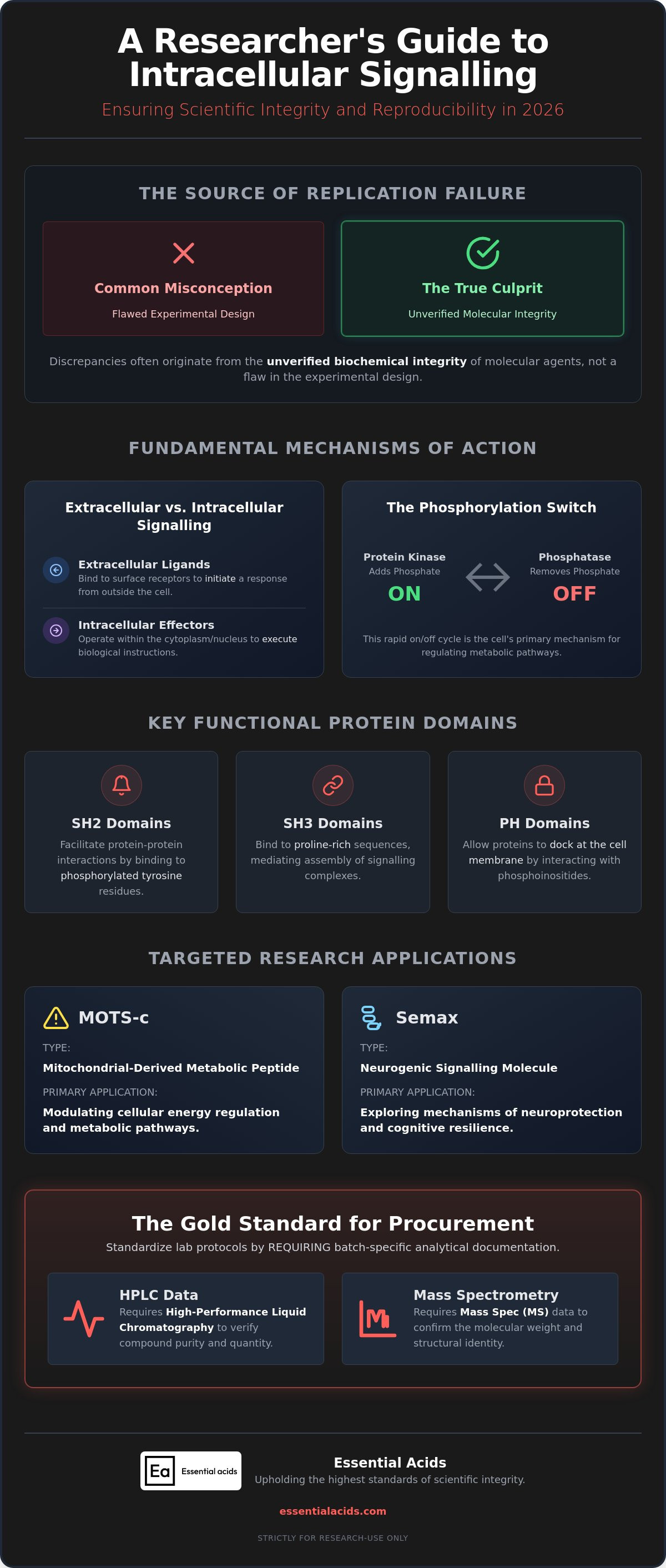
Biological regulation within a cellular environment is a complex, multi-layered process. While extracellular ligands initiate the initial response at the cell membrane, it's the intracellular signalling peptides and proteins that execute the actual biological instruction. These molecules function as the primary mediators of Signal transduction, converting external stimuli into specific, quantifiable cellular outcomes. Unlike extracellular ligands that bind to surface receptors, intracellular effectors operate within the cytoplasm or nucleus. They're classified based on molecular weight, binding affinity, and their specific role within the cascade. Small regulatory peptides often act as rapid modulators; larger proteins serve as structural scaffolds or enzymatic catalysts.
Modern research in 2026 has seen a significant evolution in the development of peptidomimetics. These synthetic compounds mimic the structure of natural peptides while offering enhanced stability against proteolytic enzymes. They're designed to bypass traditional receptor-mediated pathways, allowing for direct modulation of internal cellular machinery. Secondary messengers, such as cyclic AMP or calcium ions, play a critical role in this process. They amplify the signal generated by these peptides, ensuring a robust and coordinated cellular response even at low molecular concentrations. This precision is fundamental to the brand's objective of "Making better, normal" through rigorous scientific exploration.
Molecular Classification Systems
Classification depends on functional domains and structural motifs. Regulatory peptides are distinguished from structural proteins by their transient nature and high specificity for target enzymes. Key domains include:
- SH2 and SH3 domains: These facilitate protein-protein interactions by binding to phosphorylated tyrosine residues or proline-rich sequences.
- PH domains: These allow proteins to dock at the cell membrane by interacting with phosphoinositides.
Post-translational modifications, including phosphorylation and ubiquitination, serve as molecular switches. These modifications determine the fidelity of the signal, ensuring the message is transmitted without interference from competing pathways. Scientific integrity in research requires precise identification of these domains to avoid cross-reactivity.
The Scope of Intracellular Research Applications
The applications for these molecules in a laboratory setting are broad and technically demanding. Researchers use enzymatic inhibition to modulate metabolic pathways, often focusing on compounds like 5-Amino-1MQ or MOTS-c for their role in cellular energy regulation. In the study of cellular senescence, proteins that regulate protein synthesis and DNA repair are prioritized. Neuroprotective research frequently utilizes peptides like Semax to explore mechanisms of cognitive resilience. For those involved in laboratory procurement, understanding the technical specifications of research peptides Australia is essential for maintaining experimental reproducibility. These compounds are strictly for research-use only and require rigorous analytical verification.
Mechanisms of Signal Transduction and Cascade Modulation
The regulation of cellular function depends on the precise coordination of signal transduction cascades. Within these networks, intracellular signalling peptides and proteins act as the primary biological switches. The most prevalent mechanism for this regulation is the phosphorylation-dephosphorylation cycle. Protein kinases add phosphate groups to specific amino acid residues, typically serine, threonine, or tyrosine, while phosphatases remove them. This binary system allows the cell to rapidly activate or deactivate metabolic pathways in response to fluctuating environmental conditions. The precision of these cycles determines the fidelity of the cellular response, making them a focal point for analytical research.
G-protein coupled receptors (GPCRs) represent a significant entry point for these signals. When an extracellular ligand binds to a GPCR, it triggers a conformational change that activates intracellular G-proteins. This activation initiates a series of downstream events, often involving secondary messengers like cyclic AMP (cAMP) or calcium ions. These Pathways of Intracellular Signal Transduction ensure that a single molecular event at the membrane translates into a widespread and coordinated cellular response. Understanding these pathways is essential for researchers investigating how cells interpret their external environment.
Kinase and Phosphatase Interactions
The specificity of these interactions is governed by protein-protein interaction (PPI) interfaces. These interfaces are highly selective, ensuring that kinases only target their intended substrates while ignoring adjacent proteins. Targeting these kinases is a cornerstone of modern metabolic research, particularly when investigating cellular energy homeostasis and insulin sensitivity. Signal amplification within a kinase cascade occurs when a single activated upstream enzyme catalyzes the phosphorylation of multiple downstream targets, exponentially increasing the initial stimulus throughout the cellular environment.
Enzymatic Inhibition as a Research Tool
Research into metabolic signalling frequently utilizes small molecule inhibitors to isolate specific pathway functions. A primary example is the use of 5-Amino-1MQ to inhibit nicotinamide N-methyltransferase (NNMT). NNMT is a cytosolic enzyme that regulates the methylation of various substrates, impacting the availability of methyl donors within the cell. By inhibiting this enzyme, researchers can observe the subsequent impact on intracellular signalling homeostasis and cellular metabolism. High NNMT activity is often associated with altered metabolic states; therefore, precise inhibition allows for the study of cellular ageing and energy expenditure without the interference of systemic variables.
Nuclear translocation represents the final stage for many signalling complexes. Once activated in the cytoplasm, certain peptide-protein complexes migrate through the nuclear pore to modulate gene expression. This process is highly regulated and requires specific nuclear localization signals (NLS) to bypass the nuclear envelope. For researchers seeking to maintain high levels of scientific integrity, verifying the purity of these compounds is paramount. You can explore our range of verified research compounds to ensure your laboratory data remains accurate and reproducible.
Stability Challenges in Intracellular Signalling Research
Maintaining the structural integrity of intracellular signalling peptides and proteins is a primary challenge in modern laboratory environments. These molecules are inherently susceptible to proteolytic degradation, a process where specific peptide bonds are targeted and cleaved by endogenous enzymes. Identifying these vulnerable sites is critical for researchers who require consistent signal fidelity across multiple experimental batches. Unlike extracellular ligands, which may benefit from more robust structural configurations, intracellular effectors often possess flexible domains that make them prone to rapid breakdown if environmental conditions deviate from strict parameters.
Temperature and pH fluctuations represent the most significant threats to protein folding and signal integrity. Even minor deviations from physiological pH can cause irreversible denaturation, rendering the signalling molecule biologically inactive. In 2026, researchers frequently utilize BPC-157 5mg as a benchmark for molecular stability studies. Its relatively resilient structural profile, compared to more labile signalling proteins, provides a reliable control for assessing degradation rates in various buffer systems. Establishing these benchmarks is essential for upholding the scientific integrity of metabolic and neurological research models.
Laboratory Storage and Reconstitution Protocols
Standardization of storage is mandatory for research-grade lyophilized peptides. These compounds should be maintained at -20°C or -80°C to minimize thermal kinetic energy and secondary reactions. Reconstitution protocols must be followed with clinical precision. The use of bacteriostatic water is a standard requirement to maintain research integrity by preventing microbial contamination during the study period. Freeze-thaw cycles are particularly damaging; they must be mitigated by aliquoting the reconstituted solution into single-use vials. Additionally, managing peptide oxidation in analytical environments is vital, as the exposure of sulfur-containing amino acids to atmospheric oxygen can lead to the formation of inactive disulphide bridges.
Enhancing Bioavailability in In Vitro Models
To overcome the inherent fragility of these molecules, researchers employ specific chemical modifications. Cyclization and N-terminal acetylation are common strategies used to shield the peptide from exopeptidases, thereby extending its functional half-life within the cellular environment. These modifications ensure the molecule remains active for the duration of the signal transduction cascade. Current research also explores advanced peptide delivery systems, such as cell-penetrating peptides (CPPs), to facilitate deeper intracellular penetration. Rigorous purity verification is an absolute prerequisite in stability testing to ensure that experimental outcomes are not skewed by residual contaminants or degraded molecular fragments. This level of analytical scrutiny is what distinguishes high-level laboratory research from more commercialized applications.
Comparative Analysis of Intracellular Signalling Molecules
The distinction between mitochondrial-derived peptides and nuclear-encoded intracellular signalling peptides and proteins is a fundamental concept in metabolic research. While the vast majority of signalling proteins are encoded within the nucleus, a subset of regulatory peptides originates directly from the mitochondrial genome. This genomic divergence dictates their unique regulatory roles. Nuclear-encoded proteins often serve as broad-spectrum effectors in complex cascades; conversely, mitochondrial-derived peptides (MDPs) act as localized sensors that communicate the metabolic status of the organelle to the rest of the cell. Understanding this crosstalk is essential for researchers investigating cellular energy balance and stress adaptation.
Peptide length serves as a critical determinant of signalling specificity. Shorter amino acid sequences often exhibit higher binding affinities for specific receptor pockets, whereas larger proteins frequently possess multiple functional domains. This structural variation allows for a tiered approach to experimental design. For instance, the Semax peptide is prioritized in neuro-signalling research for its ability to modulate brain-derived neurotrophic factor (BDNF) expression. Its compact structure enables targeted interaction with the melanocortin system, distinguishing it from larger, more complex neuro-proteins that may trigger broader, less specific cellular responses.
Mitochondrial-Nuclear Communication
MOTS-c functions as a primary regulator of systemic metabolic homeostasis. During periods of cellular stress, this peptide translocates from the mitochondria to the nucleus to coordinate the expression of genes involved in glucose metabolism. Research in 2026 emphasizes the role of MDPs in maintaining cellular integrity during the ageing process. By restoration of mitochondrial-nuclear communication, researchers can observe significant changes in metabolic health markers. These studies provide a technical foundation for exploring the biophysics of cellular ageing without the use of invasive models.
Neuro-Signalling and Cognitive Research Models
In the study of synaptic plasticity and neurogenesis, the selection of signalling molecules is paramount. Research into growth hormone secretagogues frequently utilizes Ipamorelin to investigate the ghrelin receptor pathway. This specific signalling route is integral to understanding how cells regulate growth and repair mechanisms. By comparing diverse signalling peptides, researchers can achieve more targeted outcomes in cognitive research models. To ensure the scientific integrity of your findings, you can buy research peptides from our verified, batch-specific catalog, supporting the philosophical commitment of making better, normal through rigorous laboratory standards.
Procurement Standards for High-Purity Research Compounds
Analytical verification relies on two primary methodologies: High-Performance Liquid Chromatography (HPLC) and Mass Spectrometry (MS). HPLC is used to determine the chemical purity of the peptide by separating the target molecule from any synthesis byproducts. Mass Spectrometry provides a definitive confirmation of the molecular mass, ensuring the amino acid sequence is correct. For those navigating the complexities of research peptides Australia, these documents are mandatory for laboratory documentation and regulatory compliance. Without these verified data points, the integrity of the intracellular research is fundamentally undermined.
Analytical Documentation and Quality Assurance
Interpreting a Certificate of Analysis (CoA) requires a specialized understanding of purity thresholds. Analytical grade materials for signalling research typically require a purity level of 95% or higher, as determined by HPLC. Common contaminants identified during synthesis include residual trifluoroacetic acid (TFA), organic solvents, and truncated peptide sequences. These impurities can interfere with protein-protein interactions and skew results. Batch-specific documentation ensures that every vial used in a study matches the precise specifications required for reproducible research outcomes.
Essential Acids: Commitment to Scientific Integrity
Essential Acids provides a specialized catalog of high-purity compounds designed for rigorous intracellular signalling research. Our operation is guided by the philosophy of "Making better, normal," which reflects a disciplined commitment to elevating laboratory standards. We maintain a strict research-use only policy, ensuring that all products are handled within the appropriate legal and ethical frameworks. This boundary is essential for maintaining the safety and stability of the research environment. Procurement protocols for Australian research institutions are streamlined through our digital storefront, providing direct access to verified compounds like 5-Amino-1MQ, MOTS-c, and Semax. Every compound is backed by the analytical data necessary to uphold the highest levels of scientific integrity in the laboratory.
Advancing Precision in Molecular Signalling Research
Achieving reliable outcomes requires access to high-purity materials supported by transparent documentation. Essential Acids remains committed to this standard by providing batch-specific HPLC and Mass Spectrometry reports for every compound in our catalog. Our Australian-based distribution ensures consistent support for national institutions engaged in analytical research. By prioritizing these standards, you uphold the quality of your data and contribute to the broader objective of making better, normal through disciplined exploration. Explore High-Purity Peptides for Laboratory Research at Essential Acids to secure the verified compounds necessary for your next experimental phase. Your commitment to precision ensures that the potential of cellular research is fully realized within a strictly research-use only framework.
Frequently Asked Questions
What is the primary difference between intracellular signalling peptides and proteins?
The distinction originates from molecular size and structural complexity. Peptides are generally defined as chains containing fewer than 50 amino acids, while proteins consist of longer sequences with intricate tertiary or quaternary folding. In the study of intracellular signalling peptides and proteins, this structural variation determines the molecule's half-life and the specificity of its interaction with enzymatic substrates within the cytoplasm.
How do 5-Amino-1MQ and other inhibitors affect intracellular metabolic signalling?
5-Amino-1MQ functions as a selective inhibitor of nicotinamide N-methyltransferase (NNMT), a cytosolic enzyme that regulates the methylation of various substrates. By suppressing NNMT activity, the compound alters metabolic signalling by increasing NAD+ availability and modulating energy expenditure pathways. This allows researchers to isolate the effects of methyl donor depletion on cellular ageing and metabolic homeostasis in controlled in vitro models.
Why is HPLC verification critical for research-grade signalling molecules?
High-Performance Liquid Chromatography (HPLC) is essential for confirming the chemical purity of a compound before experimental initiation. It allows for the identification of residual solvents or truncated sequences that could interfere with signal transduction cascades. Scientific integrity requires the use of batch-specific HPLC data to ensure that experimental results are a direct consequence of the target molecule rather than unidentified contaminants.
Can intracellular signalling peptides be used for human research in Australia?
No, these compounds are strictly intended for laboratory research-use only. In Australia, the procurement of these molecules is regulated for in vitro and animal models to advance scientific understanding. Essential Acids does not provide products for human consumption or clinical application. All documentation and procurement protocols are designed to support the rigorous standards of national research institutions and laboratory environments.
What are the storage requirements for maintaining the stability of signalling proteins?
Lyophilized signalling proteins must be stored at -20°C or -80°C to maintain molecular stability and prevent premature degradation. Once reconstituted with bacteriostatic water, the solution should be aliquoted into single-use vials to mitigate the damaging effects of repeated freeze-thaw cycles. Protection from light and moisture is also required to prevent the oxidation of sensitive amino acid residues, ensuring the signal remains intact.
How do mitochondrial-derived peptides like MOTS-c coordinate cellular response?
MOTS-c coordinates cellular responses by acting as a mediator in mitochondrial-nuclear communication. Under conditions of metabolic stress, this peptide translocates from the mitochondria to the nucleus to regulate the expression of genes associated with glucose metabolism and insulin sensitivity. This unique signalling route allows the cell to adapt its global metabolic state based on the functional capacity of its mitochondria.
What role do G-protein coupled receptors play in intracellular signal transduction?
G-protein coupled receptors (GPCRs) serve as the primary interface between the extracellular environment and internal signalling pathways. Upon ligand binding, GPCRs undergo a conformational change that activates intracellular G-proteins, initiating a cascade that involves secondary messengers like cAMP or calcium. This process is fundamental to signal transduction, allowing external stimuli to be translated into specific and quantifiable intracellular responses.
How does molecular weight influence the penetration of peptides into the intracellular space?
Molecular weight is a primary determinant of a molecule's ability to traverse cellular membranes and enter the intracellular space. Smaller peptides generally exhibit higher passive permeability, whereas larger proteins often require specialized delivery systems, such as cell-penetrating peptides (CPPs), to bypass the lipid bilayer. Understanding this correlation is critical when designing experiments that target specific cytosolic or nuclear receptors for signal modulation.
Legal Disclaimer
All products sold on this website are intended exclusively for laboratory research purposes and not for human or veterinary use, diagnosis, cure, treatment, or prevention of any disease or condition. None of the statements on this site have been reviewed or evaluated by the U.S. Food and Drug Administration (FDA) or comparable regulatory authorities. Purchasing or using these products for any unintended purpose, including human consumption, may violate federal or local laws and poses safety risks.