

Most growth hormone secretagogues inherently trigger non-selective hormonal cascades, yet ipamorelin maintains a unique profile of absolute GHSR-1a selectivity without elevating ACTH or cortisol. Inconsistent batch-specific documentation often hinders the reproducibility of analytical data, creating significant barriers for high-integrity laboratory research. You likely recognize the difficulty of sourcing compounds that meet strict purity standards while lacking clear, standardized reconstitution protocols for sensitive in vitro applications. Maintaining scientific integrity requires more than just a chemical; it requires precise data on molecular identity and stability.
This technical overview provides the rigorous data required for precise laboratory work, focusing on molecular integrity and verified handling protocols. We offer a comprehensive analysis of the Aib-His-D-2-Nal-D-Phe-Lys-NH2 pentapeptide sequence, including its specific receptor binding affinity and metabolic stability. You will also find standardized procedures for reconstitution using bacteriostatic water and specific storage requirements to ensure the chemical integrity of your research materials remains uncompromised throughout the analytical process. This guide serves as a clinical reference for understanding the compound's behavior in a controlled research environment.
Key Takeaways
- Identify the specific pentapeptide sequence and classification of the compound within the growth hormone secretagogue family.
- Analyze the selective binding affinity of ipamorelin to the GHS-R1a receptor and its lack of impact on ACTH or cortisol levels.
- Differentiate this agent from earlier secretagogues by understanding its unique interaction with the hypothalamus and pituitary gland.
- Implement standardized laboratory protocols for the reconstitution and handling of lyophilized compounds to maintain molecular stability.
- Verify research integrity through the technical interpretation of High-Performance Liquid Chromatography and Mass Spectrometry reports.
What is Ipamorelin? Molecular Structure and Classification
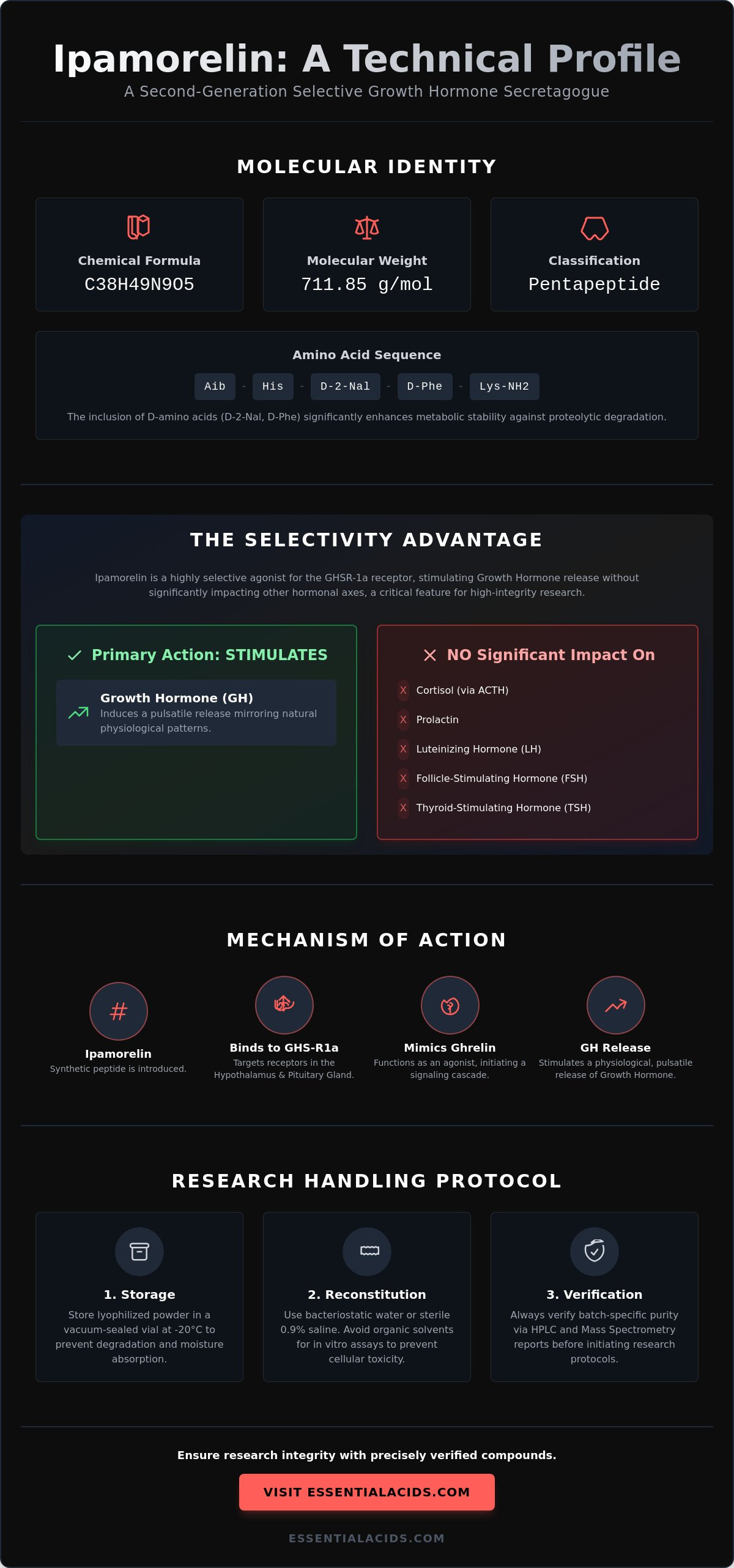
Ipamorelin is a synthetic pentapeptide categorized within the growth hormone secretagogue (GHS) family. Its primary structure is defined by the amino acid sequence Aib-His-D-2-Nal-D-Phe-Lys-NH2. This compound represents a second-generation growth hormone-releasing peptide (GHRP), marking a significant advancement in peptide engineering toward increased receptor specificity. Originally developed by researchers at Novo Nordisk, it was designed to mitigate the non-selective hormonal stimulation associated with earlier compounds like GHRP-2. For precise laboratory identification, the chemical formula is C38H49N9O5, with a molecular weight of 711.85 g/mol. As a research-use only substance, its utility lies in its ability to mimic endogenous ligands without the typical cross-reactivity seen in first-generation secretagogues. It's often utilized in studies regarding pituitary function and cellular metabolism due to its high degree of purity and predictable binding behavior. The compound's development reflects a disciplined approach to biochemistry, prioritizing the isolation of specific biological pathways over broad, multi-receptor activation.
The Significance of the Pentapeptide Sequence
The structural integrity of this compound is derived from its concise five-amino acid chain. This sequence allows for high binding affinity to the Growth Hormone Secretagogue Receptor (GHS-R1a) while maintaining selectivity. The integration of D-amino acids, specifically D-2-Nal and D-Phe, is essential for metabolic stability. These configurations resist proteolytic degradation in biological research models. Compared to larger sequences like BPC-157 5mg, which utilizes fifteen amino acids, this pentapeptide structure is streamlined. This brevity minimizes the risk of secondary folding that might interfere with receptor binding data during analytical sessions.
Chemical Properties and Solubility
Researchers typically receive this substance as a white, lyophilized powder. It's characterized by high solubility in aqueous environments, with bacteriostatic water or sterile 0.9% saline being the standard solvents for reconstitution. While it's soluble in organic solvents like DMSO, aqueous buffers are preferred for in vitro assays to avoid cellular toxicity. The lyophilized form is highly hygroscopic, meaning it readily absorbs atmospheric moisture. To maintain scientific integrity, vials must remain vacuum-sealed and stored at -20°C. Batch-specific purity is verified through HPLC and mass spectrometry to ensure consistency with the C38H49N9O5 formula before beginning any research protocols.
Mechanism of Action: The Ghrelin Receptor Interaction
Ipamorelin functions as a selective agonist of the Growth Hormone Secretagogue Receptor (GHS-R1a). It mimics the endogenous ligand, ghrelin, primarily within the hypothalamus and the anterior pituitary gland. Unlike first-generation secretagogues, its interaction is highly targeted. Data found in the PubChem entry for Ipamorelin confirms its role as a potent stimulator of growth hormone (GH) secretion. In controlled research environments, GH release follows a pulsatile pattern that closely resembles physiological secretion. This mimicry is achieved without the sudden, non-physiological spikes often observed with less selective peptides.
One of the most critical aspects of this compound's profile is its hormonal selectivity. Many research models are compromised by the non-selective stimulation of other pituitary hormones. However, ipamorelin doesn't significantly alter levels of adrenocorticotropic hormone (ACTH), luteinizing hormone (LH), follicle-stimulating hormone (FSH), or thyroid-stimulating hormone (TSH). This allows researchers to isolate the metabolic effects of growth hormone without the confounding variables of elevated cortisol or prolactin. For those conducting high-precision longitudinal studies, maintaining this isolation is vital, and utilizing high-purity ipamorelin ensures the integrity of the hormonal data collected.
GHS-R1a Binding and Signaling
The binding of the peptide to the GHS-R1a receptor initiates a cascade involving G-protein coupled receptor (GPCR) activation. This process triggers the phospholipase C (PLC) pathway, leading to the production of inositol trisphosphate (IP3). Subsequently, intracellular calcium mobilization occurs within the somatotrophs of the pituitary. This rise in cytoplasmic calcium is the primary precursor to the exocytosis of GH-containing vesicles. Beyond GH secretion, ghrelin receptors are increasingly being investigated in metabolic research for their roles in gastric motility and energy homeostasis, providing a broader scope for laboratory investigation.
Potency and Efficacy Benchmarks
When evaluating maximal effect (Emax), this pentapeptide demonstrates a potency and efficacy nearly identical to GHRP-6. Despite this high efficacy, it maintains a superior profile regarding the avoidance of non-target hormone elevation in research models. The metabolic half-life varies depending on the research media but generally stays within a range that supports consistent pulsatile activity. The binding affinity (Ki) for GHS-R1a is approximately 1.3 nM, establishing its technical authority as a primary research ligand. These benchmarks make it a reliable standard for comparative studies involving growth hormone secretagogues.
Comparative Analysis: Ipamorelin vs. Other GHRPs
Ipamorelin distinguishes itself from first-generation growth hormone-releasing peptides (GHRPs) through its unprecedented selectivity. While GHRP-2 and GHRP-6 are effective at stimulating growth hormone release, they often induce secondary effects that complicate research data. For instance, GHRP-6 is known to stimulate neuropeptide Y (NPY) in the hypothalamus, leading to significant hunger responses in animal models. The peptide does not exhibit this "ghost" effect, allowing researchers to study growth hormone pathways without the interference of altered caloric intake or appetite-driven metabolic shifts. This distinction is foundational for studies where nutritional variables must remain strictly controlled. Researchers often find that the absence of NPY activation results in more stable baseline data across longitudinal metabolic trials.
Selectivity and Non-Target Stimulation
The clinical superiority of this compound is most evident in its impact on the hypothalamic-pituitary-adrenal (HPA) axis. Research documented in Ipamorelin: A Selective Growth Hormone Secretagogue demonstrates that this peptide fails to increase plasma ACTH or cortisol levels, even at dosages significantly higher than those required for maximal GH release. In contrast, Hexarelin and GHRP-2 consistently demonstrate a dose-dependent increase in both cortisol and prolactin, which can skew results in stress-sensitive research models. This selectivity is highly specialized; it differs significantly from the tirzepatide structure, which is engineered to target multiple pathways, specifically GIP and GLP-1 receptors. For researchers, the choice of ipamorelin is often dictated by the need for a "clean" signal that doesn't trigger broad hormonal cascades.
Research Applications and Model Suitability
Suitability for longitudinal research is a primary selection criterion for GHS compounds. The compound is frequently selected for studies focusing on bone mineral density and skeletal muscle metabolism because it maintains physiological-like pulsatility without desensitizing the pituitary over extended periods. In neuroscience, it serves as a precise tool for mapping ghrelin receptor distribution without the confounding presence of elevated stress hormones. Its stability and predictable performance in various research media make it the preferred ligand for models requiring minimal hormonal interference. By ensuring that only the target pathway is activated, laboratories can maintain a higher degree of scientific integrity and reduce the likelihood of false positives in metabolic assays.
Laboratory Standards and Reconstitution Protocols
Maintaining the structural integrity of ipamorelin requires a disciplined approach to laboratory handling. In its lyophilized state, the peptide remains relatively stable, yet the transition into a liquid medium introduces several variables that can compromise analytical results. Scientific integrity depends on the precision of the reconstitution process and the subsequent storage conditions. Researchers must prioritize the prevention of peptide bond cleavage, which occurs when the compound is exposed to mechanical stress or thermal instability. All procedures should be conducted within a sterile environment to ensure that the research-use only material remains free from contaminants that could interfere with metabolic assays.
The selection of a solvent is the first critical step in the protocol. For most analytical work, bacteriostatic water containing 0.9% benzyl alcohol is preferred because it inhibits the growth of microorganisms in multiple-entry vials. If the research model requires the absence of preservatives, sterile 0.9% saline is a viable alternative, though it lacks the antimicrobial protection necessary for long term storage. To ensure the highest level of purity for your research, it's essential to source verified ipamorelin that has been vacuum-sealed to prevent premature oxidation.
Reconstitution Best Practices
Precision in calculating concentration is vital for reproducible data. Researchers should determine the required mg/mL ratio before introducing the solvent. When adding the diluent, the liquid should be aimed at the side of the vial rather than directly onto the lyophilized powder. This reduces the risk of mechanical shear. Avoid vigorous agitation; instead, use a gentle swirling motion to dissolve the powder. Shaking the vial can lead to the denaturation of the peptide chain. Once reconstituted, the solution remains stable for a period of 4 to 6 weeks when maintained at 2-8°C before the peptide begins to undergo significant proteolytic degradation.
Environmental Stability and Degradation Factors
Lyophilized peptides must be stored at temperatures between -20°C and -80°C to ensure long term stability. Exposure to UV light and thermal fluctuations can rapidly accelerate the breakdown of the pentapeptide sequence. Vacuum sealing serves as a primary defense against oxidative damage, which can alter the molecular weight and binding affinity of the compound. In shared research environments, strict adherence to labeling and dedicated storage zones is necessary to prevent cross-contamination. Monitoring the humidity levels within the laboratory is also important, as the hygroscopic nature of the powder can lead to moisture absorption if the seal is compromised during handling.
Analytical Verification and Research Integrity
Scientific integrity in the laboratory is contingent upon the analytical verification of research materials. Without rigorous testing, researchers risk introducing variables that can invalidate metabolic data or compromise the reproducibility of in vitro models. High-purity compounds are the baseline requirement for establishing a reliable research environment. Verification protocols must confirm both the molecular identity and the chemical purity of the ipamorelin batch before any experimental procedures commence. This disciplined approach ensures that observations regarding GHSR-1a activation are directly attributable to the peptide rather than secondary contaminants or degradation products.
The verification process relies on two primary analytical techniques: High-Performance Liquid Chromatography (HPLC) and Mass Spectrometry (MS). While MS is utilized to confirm the molecular identity by measuring the mass-to-charge ratio, HPLC is necessary to determine the quantitative purity of the sample. For ipamorelin, the MS report should reflect a molecular weight consistent with the 711.85 g/mol standard identified in earlier structural analyses. Discrepancies in these values indicate a lack of molecular integrity, which can lead to unpredictable receptor binding behavior. Essential Acids maintains a commitment to providing batch-specific analytical documentation to ensure that every vial meets these stringent laboratory standards.
Interpreting HPLC Purity Reports
Understanding an HPLC report requires an analysis of the peak area percentages. The primary peak represents the target peptide, while smaller, secondary peaks indicate the presence of impurities or residual solvents. In the field of analytical-grade peptides, 98% purity is established as the industry standard. This threshold is critical because even a 2% variance in purity can introduce enough non-target material to skew sensitive biological assays. High purity levels correlate directly with laboratory data reliability, as they minimize the risk of cross-reactivity with non-target receptors. Researchers should always cross-reference the batch number on the vial with the corresponding HPLC chromatogram to verify the integrity of their materials.
The Essential Acids Standard
The "Making better, normal" philosophy is upheld through a rigorous adherence to batch-specific testing and transparent documentation. Every compound in the inventory undergoes verification to ensure it aligns with the stated chemical profile. We maintain strict "research-use only" protocols to preserve the scientific integrity of the global research community. By providing verified, high-purity ligands, we enable laboratories to focus on the precision of their metabolic and neuroscience research without the ambiguity of chemical inconsistency. This stable and well-regulated operation reflects our role as a no-nonsense scientific gatekeeper for the industry.
Review our catalog of high-purity research compounds to ensure the analytical accuracy of your next laboratory project.
Advancing Research Integrity with High-Purity Ligands
The technical profile of ipamorelin confirms its status as a highly selective tool for investigating growth hormone pathways without the confounding variables of non-target hormonal stimulation. By maintaining absolute specificity for the GHS-R1a receptor, this pentapeptide allows for the isolation of metabolic data in complex research models. Reproducible results depend on strict adherence to standardized laboratory handling, including precise reconstitution protocols and low-temperature storage to prevent peptide degradation. Scientific integrity is only possible when researchers have access to compounds verified by rigorous analytical standards.
Essential Acids provides the necessary documentation to support these high-level research requirements. Every compound is accompanied by batch-specific HPLC and Mass Spectrometry reports to confirm both molecular identity and chemical purity. Our manufacturing processes prioritize the precision required for scientific integrity, ensuring that each vial meets the strict standards of modern laboratory research.
Explore the Essential Acids Research Catalog to source verified materials for your next analytical project. We look forward to supporting your commitment to high-integrity scientific discovery.
Frequently Asked Questions
Is Ipamorelin classified as a growth hormone releasing peptide (GHRP)?
Ipamorelin is classified as a second-generation growth hormone-releasing peptide (GHRP) within the growth hormone secretagogue (GHS) family. It consists of a synthetic pentapeptide sequence designed to mimic the action of endogenous ghrelin. This classification distinguishes it from earlier analogues by its high degree of receptor selectivity. In laboratory models, it functions as a potent agonist of the GHS-R1a receptor, facilitating growth hormone secretion while maintaining a research-use only status for analytical work.
What is the molecular weight of Ipamorelin for laboratory calculations?
The molecular weight of the compound is 711.85 g/mol, which is essential for determining precise molar concentrations in laboratory assays. This value corresponds to the chemical formula C38H49N9O5. Accurate calculations of molecular mass are necessary for ensuring the reproducibility of in vitro research data. Researchers must utilize this specific weight when preparing stock solutions to maintain the scientific integrity of their metabolic studies and analytical protocols.
How should Ipamorelin be stored to maintain its chemical stability?
Lyophilized ipamorelin must be stored at temperatures between -20°C and -80°C to ensure long-term chemical stability and prevent proteolytic degradation. The compound should be kept in a vacuum-sealed vial, protected from light and moisture. Once reconstituted, the solution must be refrigerated at 2-8°C and used within four to six weeks. Adhering to these storage parameters is vital for maintaining the integrity of the pentapeptide sequence during longitudinal research projects.
Does Ipamorelin stimulate the release of cortisol or prolactin in research models?
This peptide does not significantly stimulate the secretion of cortisol or prolactin in controlled research models. Unlike first-generation secretagogues such as GHRP-2 or GHRP-6, it exhibits absolute selectivity for the growth hormone pathway. It fails to trigger the hypothalamic-pituitary-adrenal axis, meaning ACTH levels remain stable during analytical observations. This clean profile allows laboratories to isolate growth hormone activity without the confounding influence of stress-related hormonal cascades or appetite-driven metabolic shifts.
What solvent is recommended for the reconstitution of Ipamorelin?
Bacteriostatic water containing 0.9% benzyl alcohol is the primary recommended solvent for the reconstitution of this compound. This diluent provides an antimicrobial environment that extends the stability of the solution for multi-entry use. Alternatively, sterile 0.9% saline may be used for research models where preservatives are contraindicated. The solvent should be introduced slowly down the side of the vial to minimize mechanical stress and prevent the denaturation of the peptide chain.
How can I verify the purity of an Ipamorelin batch?
Purity verification requires High-Performance Liquid Chromatography (HPLC) to measure the peak area percentages and identify potential impurities. Mass Spectrometry (MS) should also be utilized to confirm the molecular identity and ensure it matches the theoretical mass of 711.85 g/mol. Research integrity is maintained by reviewing batch-specific analytical reports provided by the supplier. High-purity compounds should demonstrate a purity level of 98% or higher to ensure consistent performance in sensitive laboratory assays.
What is the half-life of Ipamorelin in a laboratory setting?
The metabolic half-life of the compound is approximately two hours in most biological research models. While it is short-lived, its high binding affinity for the GHS-R1a receptor ensures a potent and efficacious pulsatile release of growth hormone. In a laboratory setting, the stability of the reconstituted peptide depends heavily on temperature and pH levels. Researchers must account for this duration when designing the timing of their analytical assays and sample collection protocols.
Why is Ipamorelin often studied alongside CJC-1295 in research?
These compounds are often studied together because they target different pathways to stimulate growth hormone release synergistically. While ipamorelin mimics ghrelin at the GHS-R1a receptor, CJC-1295 functions as a GHRH analogue. Combining a growth hormone secretagogue with a GHRH agonist typically results in a significantly larger GH pulse than either compound could achieve individually. This interaction is a common focus in studies investigating pituitary response and the maximization of endogenous hormonal signaling in research models.
Legal Disclaimer
All products sold on this website are intended exclusively for laboratory research purposes and not for human or veterinary use, diagnosis, cure, treatment, or prevention of any disease or condition. None of the statements on this site have been reviewed or evaluated by the U.S. Food and Drug Administration (FDA) or comparable regulatory authorities. Purchasing or using these products for any unintended purpose, including human consumption, may violate federal or local laws and poses safety risks.