

Can a non-peptide molecule effectively replicate the complex signaling of endogenous ghrelin without the stability issues of injectable secretagogues? In the field of MK-677 research, this question remains central to understanding the compound's sustained utility within laboratory settings. You've likely encountered the frustration of inconsistent purity levels or the conflicting data that often surfaces between formal clinical trials and informal reports. Navigating these discrepancies is essential for any study requiring strict metabolic precision and reliable cellular data.
This technical profile provides a comprehensive analysis of Ibutamoren's biochemical mechanism and its specific interaction with the GHSR-1a signaling pathway. You'll gain a clear understanding of how this molecule functions as a potent agonist and how its performance data compares to other growth hormone secretagogues. We also establish rigorous guidelines for verifying analytical purity to ensure your laboratory standards remain uncompromised. By focusing on batch-specific integrity and the 2026 regulatory framework, this analysis supports the pursuit of making better, normal, through disciplined scientific inquiry and a commitment to research transparency.
Key Takeaways
- Distinguish non-peptide agonists from traditional peptide secretagogues based on molecular classification and receptor affinity.
- Map the GHSR-1a signaling pathway to understand the mechanism behind sustained pituitary growth hormone release.
- Evaluate primary applications in metabolic modeling, specifically regarding protein catabolism and bone mineral density research.
- Utilize comparative data on half-life and bioavailability to refine experimental parameters for MK-677 research.
- Interpret analytical verification tools like HPLC and Mass Spectrometry to ensure the scientific integrity of all laboratory materials.
What is MK-677? Molecular Structure and Classification
Ibutamoren, recognized in laboratory settings by its developmental code MK-677, is a potent, non-peptide agonist of the ghrelin receptor. It represents a distinct class of compounds that differ significantly from traditional peptide-based growth hormone secretagogues (GHS). While peptides often require specific delivery methods to bypass enzymatic degradation, the chemical structure of MK-677 provides a unique experimental profile. It's a long-acting compound, designed to maintain elevated levels of growth hormone and IGF-1 in research models over a 24-hour period. This characteristic makes it an invaluable tool for MK-677 research into the regulation of the somatotropic axis and its downstream metabolic effects.
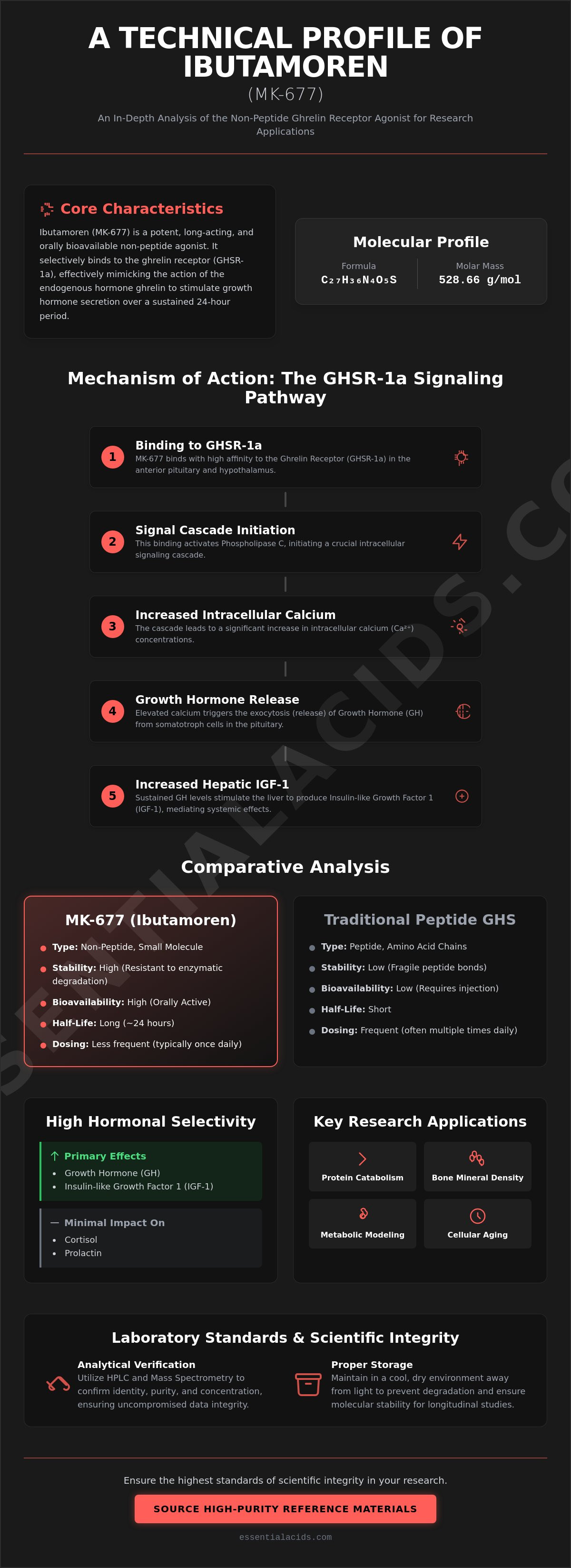
The molecular profile of the compound is highly precise. Its molecular formula is C27H36N4O5S, and it carries a molecular weight of 528.66 g/mol. These values are essential for maintaining scientific integrity during laboratory preparation and molar calculations. Unlike GH-releasing peptides, which consist of amino acid chains, MK-677 is a small molecule. This distinction isn't merely structural; it dictates how the compound interacts with cellular receptors and influences its metabolic half-life in a laboratory environment. By mimicking the endogenous ligand ghrelin, the molecule initiates a signaling cascade that results in the secretion of growth hormone from the anterior pituitary gland.
Chemical Synthesis and Stability
The molecular stability of Ibutamoren (MK-677) is a primary reason for its widespread use in longitudinal studies. Its sulfonamide-based structure protects the molecule from rapid hydrolysis, allowing for high oral bioavailability in animal models. This stability is a key advantage during long-term experimental protocols. Researchers don't have to manage the immediate breakdown typical of fragile peptide bonds. Instead, focus remains on the metabolic outcomes of sustained GHSR-1a activation. Proper storage remains vital for experimental accuracy. Maintaining the compound in a cool, dry environment away from light ensures that analytical purity remains consistent across different research batches, supporting the goal of making better, normal, through reproducible data.
Classification within the GHS Category
MK-677 is classified as a potent, non-peptidic agonist of the GHSR-1a receptor, often referred to as the ghrelin receptor. It mimics the action of endogenous ghrelin, the hormone responsible for stimulating growth hormone release and modulating energy homeostasis. Its historical development centered on identifying compounds that could mitigate protein catabolism without the need for frequent dosing. Within the GHS category, it's viewed as a benchmark for sustained receptor agonism. For those engaged in MK-677 research, the compound provides a reliable method for exploring metabolic pathways, cellular ageing, and the physiological effects of chronic growth hormone elevation. Its classification as a small molecule ensures it remains a stable and predictable variable in complex biological models.
Mechanism of Action: GHSR-1a Agonism and Signaling
The primary function of MK-677 is its high-affinity binding to the growth hormone secretagogue receptor (GHSR-1a), which is a G-protein coupled receptor situated predominantly in the anterior pituitary and the hypothalamus. This receptor is the biological target for endogenous ghrelin. When the molecule binds to GHSR-1a, it initiates a signaling cascade that involves the activation of phospholipase C. This activation leads to an increase in intracellular calcium concentrations, which then triggers the exocytosis of growth hormone from the somatotroph cells. This mechanism is distinct from direct GH administration because it leverages the existing physiological architecture of the subject's endocrine system.
A defining characteristic in MK-677 research is the compound's remarkable selectivity. Unlike other secretagogues that may cause broad hormonal shifts, this molecule stimulates the somatotropic axis without inducing significant increases in cortisol or prolactin levels. This specificity is crucial for laboratory precision, as it allows for the isolation of growth hormone effects without the confounding variables of stress-related or lactogenic hormone interference. Furthermore, the sustained release of GH leads to a predictable and measurable rise in hepatic Insulin-like Growth Factor 1 (IGF-1) production. This secondary signaling is responsible for many of the compound's systemic metabolic outcomes, including the modulation of cellular ageing and protein turnover.
The Somatotropic Axis in Research
MK-677 maintains growth hormone secretion through a multi-faceted approach. It acts by stimulating the release of Growth Hormone Releasing Hormone (GHRH) while simultaneously reducing the inhibitory influence of somatostatin. This dual action ensures that the natural pulsatility of growth hormone is preserved, which is essential for maintaining receptor sensitivity and preventing down-regulation. Evidence of these effects can be seen in preclinical models, such as the documented MK-677 effects on somatic growth in rats. By preserving the endogenous rhythm of the somatotropic axis, the compound provides a more accurate model for long-term metabolic study. For researchers focused on these precise pathways, utilizing high-purity MK-677 ensures that experimental variables remain controlled and data remains reproducible.
Non-Pituitary Signaling Pathways
The expression of GHSR-1a is not limited to the pituitary gland. These receptors are also found in the hypothalamus, where they play a central role in appetite regulation and energy homeostasis. This makes the compound a significant subject for research into metabolic disorders and nutrient partitioning. Additionally, ghrelin receptors are present in extra-pituitary tissues, including the hippocampus and the cardiovascular system. Researchers are currently investigating the implications of this extra-pituitary signaling in models of neuroprotection and cardiac remodeling. The ability of a non-peptide molecule to cross the blood-brain barrier and activate these central pathways offers a unique advantage for MK-677 research into complex neurological and metabolic systems.
Primary Research Applications: Metabolic and Cellular Modeling
The application of MK-677 in metabolic modeling centers on its ability to shift nutrient partitioning and influence systemic energy homeostasis. A primary focus of MK-677 research involves the reversal of protein catabolism, particularly in environments where nitrogen loss is a significant variable. By measuring urinary nitrogen excretion, researchers can quantify the compound's efficacy in preserving lean tissue during calorie-restricted or hypercatabolic states. This makes the molecule a vital tool for studying muscle wasting conditions without the confounding variables of androgenic signaling. The objective is to determine how sustained GHSR-1a activation can stabilize metabolic rates and prevent the degradation of functional tissue in cellular and animal models.
In the context of skeletal integrity, the compound serves as a model for exploring bone mineral density and remodeling. Because it elevates both growth hormone and IGF-1, it influences the dual processes of bone formation and resorption. Historical data, including a Clinical trial of MK-677 in older adults, has demonstrated measurable increases in bone turnover markers. Laboratory studies in 2026 continue to utilize these findings to model the prevention of age-related endocrine decline. Researchers analyze how the compound stimulates osteoblast activity, providing a clearer picture of the molecular mechanisms that govern skeletal architecture over long-term experimental periods.
Metabolic research also examines the compound's impact on lipid metabolism and glucose homeostasis. While the molecule is effective at increasing IGF-1, it's also known to alter glucose sensitivity, a factor that must be strictly monitored in laboratory settings. These alterations in glucose metabolism are often studied alongside changes in sleep architecture. MK-677 is one of the few secretagogues that has been shown to increase the duration of REM sleep and improve overall sleep quality in research subjects. This makes it an essential subject for studies regarding circadian rhythm modulation and the neurological impact of restorative sleep cycles.
Muscle and Tissue Preservation Models
Nitrogen balance serves as a critical biomarker in catabolic research environments. MK-677 is frequently utilized to evaluate protein synthesis rates and the potential for musculoskeletal recovery. In regenerative studies, researchers often analyze the compound's performance in conjunction with other repair-focused molecules. For example, investigating the synergy between this secretagogue and a high-purity BPC-157 5mg specimen allows for a more comprehensive understanding of tissue repair pathways. These models are essential for identifying how different biochemical signals interact to accelerate recovery in musculoskeletal injury simulations.
Bone Density and Endocrine Health
Osteoblast activity is modulated through the sustained elevation of GH and IGF-1, which promotes the mineralization of the bone matrix. MK-677 research in this field focuses on identifying the threshold at which these hormonal increases translate into significant changes in bone mineral density. Cellular models are also used to research the mitigation of endocrine decline. By analyzing how the ghrelin mimetic maintains pituitary output, scientists can study the long-term preservation of metabolic health. These studies frequently utilize synergistic designs, observing how the compound interacts with other metabolic peptides to influence cellular ageing and endocrine stability.
Comparative Analysis: MK-677 vs. Peptide GHS
The primary distinction between non-peptide agonists and peptide-based growth hormone secretagogues (GHS) lies in their pharmacokinetic profiles and delivery methods. While compounds like Ipamorelin and CJC-1295 consist of amino acid chains susceptible to enzymatic degradation, the sulfonamide structure of MK-677 allows for sustained stability. This results in a half-life of approximately 24 hours, contrasting sharply with the two-hour half-life typical of Ipamorelin. In MK-677 research, this extended duration facilitates a chronic elevation of IGF-1 levels through a single daily administration, whereas peptides often require multiple pulses to achieve similar systemic exposure.
Pulsatility remains a critical factor in endocrine modeling. Exogenous growth hormone administration typically suppresses natural secretion through negative feedback loops. In contrast, MK-677 mimics the natural rhythm of GH release by increasing the amplitude of endogenous pulses without abolishing the physiological cadence. This differs from peptide secretagogues, which generally produce a single, isolated spike in GH concentration. For long-term research models, the ability of a non-peptide to maintain this pulsatile rhythm while avoiding rapid receptor desensitization is a significant advantage. It allows for the study of the somatotropic axis over weeks or months without the diminishing returns often seen with high-frequency peptide dosing.
Pharmacokinetic Distinctions
The following data points highlight the structural and functional differences between these research tools:
- Half-Life: MK-677 maintains a 24-hour profile, while Ipamorelin clears within 30 to 120 minutes.
- Administration: Non-peptides allow for oral dosing models, whereas peptides require parenteral delivery to avoid gastric breakdown.
- Secretory Pattern: MK-677 enhances the amplitude of existing pulses; peptides create acute, independent peaks.
- Receptor Affinity: Both target the GHSR-1a, but the non-peptide's small-molecule nature provides superior metabolic stability.
Metabolic clearance rates significantly impact how experimental data is interpreted. When researchers use oral dosing models, the higher experimental consistency of non-peptide secretagogues reduces the variables associated with injection site irritation or fluctuating plasma concentrations. This stability is essential for maintaining scientific integrity across multi-phase studies. Researchers requiring verified materials for longitudinal comparative modeling can buy MK-677 to ensure batch-specific consistency and high analytical purity.
Choosing the Right Secretagogue for Research
Selecting a secretagogue depends entirely on the experimental design. If a study requires acute, high-magnitude GH elevation for short-term observation, a peptide like Ipamorelin or CJC-1295 No DAC might be the appropriate choice. However, for research focused on chronic metabolic changes, such as bone remodeling or cellular ageing, the 24-hour duration of MK-677 is more effective. Batch-specific documentation is vital in these comparisons. It ensures that the observed differences in GH secretion are due to the compound's molecular nature rather than variations in material quality. By adhering to these rigorous selection criteria, laboratories can produce more reliable data regarding the long-term modulation of the somatotropic axis.
Laboratory Standards: Scientific Integrity in MK-677 Research
Scientific integrity serves as the foundation of reliable data within the laboratory environment. In the context of MK-677 research, the precision of the molecular profile is directly tied to the purity of the material utilized in the study. Without high-purity compounds, experimental results are often skewed by impurities or structural isomers that interfere with the GHSR-1a signaling pathway. Analytical verification isn't a luxury; it's a fundamental requirement for researchers who aim to produce reproducible metabolic and cellular data. Laboratory standards must prioritize these rigorous verification processes to ensure that the somatotropic axis is being modulated by the intended molecule rather than unknown contaminants.
High-Performance Liquid Chromatography (HPLC) and Mass Spectrometry (MS) are the primary tools used to establish the identity and purity of Ibutamoren. HPLC measures the concentration of the compound by separating its components, ensuring the sample is free from degradation products or related substances. Mass Spectrometry confirms the molecular weight, which for MK-677 must consistently align with the 528.66 g/mol benchmark. These reports provide the empirical evidence necessary for scientific transparency. Adherence to "Research-Use Only" protocols is strictly maintained to reflect the gravity of laboratory inquiry and to comply with the 2026 regulatory framework. Procurement standards must involve identifying batch-specific analytical documentation to maintain a stable and well-regulated experimental environment.
Verifying Peptide and Non-Peptide Purity
A Certificate of Analysis (CoA) is only as reliable as its specificity. Researchers should look for batch-specific documentation rather than general specification sheets. The presence of contaminants or structural isomers can lead to unintended biological responses, which compromises the integrity of metabolic modeling. These impurities often arise during the chemical synthesis process if quality control measures are inadequate. Essential Acids prioritizes scientific transparency by ensuring that every compound is verified through independent analytical testing. This no-nonsense approach to quality assurance acts as a linguistic and physical filter, ensuring that only the highest-purity materials are introduced into the research community.
Handling and Storage Protocols
The integrity of the sulfonamide structure is robust, yet it isn't immune to environmental degradation. Best practices for MK-677 research dictate that lyophilized materials should be stored in a vacuum-sealed environment at temperatures below -20°C for long-term stability. Once the compound is reconstituted for laboratory use, it becomes more susceptible to thermal degradation and should be kept at a steady 2-8°C. UV exposure must be strictly minimized, as light can trigger photodegradation of the molecular bonds, altering the compound's potency and analytical profile. By maintaining these disciplined handling protocols, researchers ensure that the quality of the compounds speaks for itself through consistent and accurate data. This commitment to precision is what defines the pursuit of making better, normal, through rigorous scientific inquiry.
Advancing Somatotropic Modeling Through Analytical Precision
The molecular profile of Ibutamoren provides a unique opportunity to study the somatotropic axis with a level of stability that peptide analogs cannot match. By leveraging its 24-hour half-life and high affinity for the GHSR-1a receptor, researchers can observe chronic metabolic shifts without the experimental instability of frequent dosing. This stability is central to the success of MK-677 research focused on cellular ageing and protein turnover. Maintaining scientific integrity requires more than just understanding these pathways; it necessitates the use of verified, high-purity materials supported by empirical data.
Precision in the laboratory is only possible when variables are strictly controlled. Essential Acids ensures this control by providing batch-specific analytical documentation and high-purity, laboratory-grade compounds that meet the most rigorous standards. Every specimen is governed by a strict research-use only policy to maintain regulatory compliance and transparency. To secure the integrity of your next study, explore high-purity compounds for your research at Essential Acids. We remain committed to supporting the scientific community in the pursuit of making better, normal, through disciplined inquiry and transparent data.
Frequently Asked Questions
Is MK-677 considered a SARM in research literature?
MK-677 is not a Selective Androgen Receptor Modulator (SARM). Literature classifies it strictly as a non-peptide growth hormone secretagogue and ghrelin receptor agonist. While SARMs interact with androgen receptors in muscle and bone, MK-677 targets the GHSR-1a receptor to stimulate the somatotropic axis. Misclassification often occurs in non-scientific circles, but laboratory standards require precise categorization to ensure experimental accuracy and receptor-specific data collection during any study.
How does MK-677 affect IGF-1 levels in laboratory models?
The compound induces a sustained increase in serum Insulin-like Growth Factor 1 (IGF-1) levels through its action on the pituitary gland. As growth hormone is secreted in response to GHSR-1a agonism, it triggers the liver to synthesize and release IGF-1 into systemic circulation. In MK-677 research, this secondary elevation is often the primary metric for evaluating the compound's impact on cellular ageing and metabolic homeostasis over extended experimental durations.
What is the half-life of MK-677 in metabolic studies?
The terminal half-life of MK-677 is approximately 24 hours. This duration allows for a stable, once-daily dosing schedule in animal models, providing a consistent elevation of growth hormone levels. This pharmacokinetic profile is a significant departure from peptide-based secretagogues, which often clear within two hours. This extended presence in the system facilitates the study of chronic metabolic changes without the fluctuations associated with shorter-acting compounds or fragile peptide chains.
Can MK-677 be used for human consumption or clinical therapy?
No, MK-677 is strictly for laboratory research-use only. It's not an FDA-approved pharmaceutical for human consumption, nor is it a medical treatment. Essential Acids maintains a firm boundary regarding the application of these compounds; they're sold exclusively for in vitro and in vivo scientific inquiry. Any use outside of a controlled laboratory setting violates regulatory compliance and compromises the safety standards established for high-purity research materials and scientific integrity.
Does MK-677 research require specific storage temperatures?
Specific temperature controls are mandatory to preserve the compound's molecular integrity. Lyophilized powder should be stored at -20°C to prevent long-term degradation. Once reconstituted for laboratory use, the solution must be kept at 2-8°C and protected from UV light. Failure to maintain these conditions can lead to the breakdown of the sulfonamide structure, resulting in inaccurate experimental data and a loss of analytical purity during MK-677 research protocols.
How is the purity of MK-677 verified for laboratory use?
Purity is verified through High-Performance Liquid Chromatography (HPLC) and Mass Spectrometry (MS). These analytical tools confirm the chemical identity and ensure the absence of contaminants or structural isomers. A batch-specific Certificate of Analysis (CoA) provides the necessary transparency for verifying materials. Scientific integrity depends on these reports to guarantee that the metabolic responses observed during a study are caused by the pure compound itself rather than unexpected chemical byproducts.
What are the common secondary hormones affected by MK-677?
The compound primarily influences the somatotropic axis by stimulating Growth Hormone Releasing Hormone (GHRH) and inhibiting somatostatin. Unlike non-selective secretagogues, it doesn't significantly elevate cortisol or prolactin levels in most research models. This selectivity is vital for isolating the effects of growth hormone and IGF-1. By avoiding broad hormonal shifts, researchers can more accurately model specific biological processes like bone remodeling and nutrient partitioning without confounding endocrine variables.
How does MK-677 differ from injectable growth hormone (HGH)?
MK-677 is a secretagogue that stimulates the body's endogenous production of growth hormone, whereas HGH is an exogenous hormone replacement. Because it mimics ghrelin signaling, MK-677 preserves the natural pulsatile rhythm of GH release. Exogenous HGH often suppresses the subject's natural pituitary output through negative feedback loops. This distinction makes the ghrelin mimetic a more appropriate tool for studying the physiological regulation and feedback mechanisms of the somatotropic axis.
Legal Disclaimer
All products sold on this website are intended exclusively for laboratory research purposes and not for human or veterinary use, diagnosis, cure, treatment, or prevention of any disease or condition. None of the statements on this site have been reviewed or evaluated by the U.S. Food and Drug Administration (FDA) or comparable regulatory authorities. Purchasing or using these products for any unintended purpose, including human consumption, may violate federal or local laws and poses safety risks.