

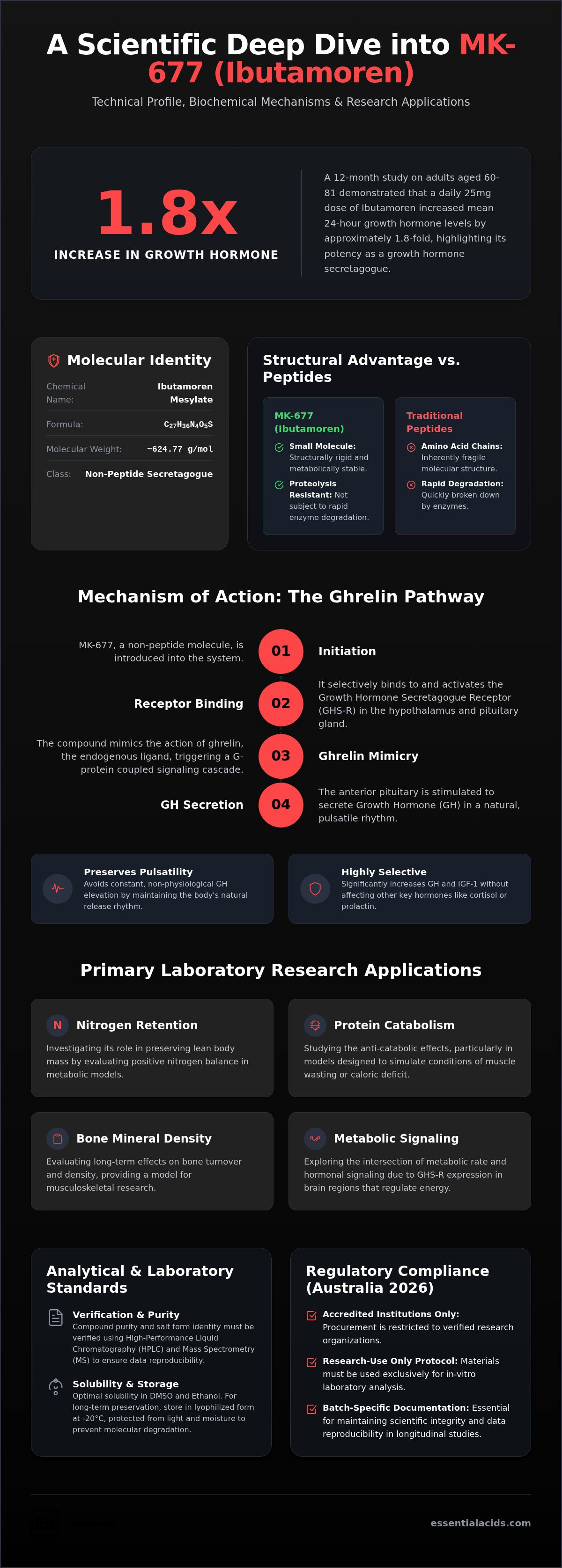
A 12-month study of adults aged 60 to 81 demonstrated that a daily 25mg dose of Ibutamoren increased mean 24-hour growth hormone levels by approximately 1.8-fold. While these figures are compelling, the bridge between clinical data and laboratory application is often obstructed by inconsistent material purity and regulatory ambiguity. You understand that the integrity of your mk-677 research depends entirely on the precision of your chemical inputs and the stability of your analytical standards.
This technical profile provides a rigorous scientific analysis of the MK-677 molecular profile and its specific mechanism as a growth hormone secretagogue. We promise to clarify the complexities of GHS-R binding pathways and establish the current standards for analytical research in Australia. Our review covers the essential biochemical properties, the latest 2026 regulatory updates, and the verification protocols required to ensure absolute data reproducibility in a laboratory setting.
Key Takeaways
- Understand the molecular identity of Ibutamoren Mesylate (C27H36N4O5S) and its function as a non-peptide growth hormone secretagogue that mimics endogenous ghrelin.
- Identify specific laboratory applications for mk-677 research, particularly in models evaluating nitrogen retention, protein catabolism, and bone mineral density.
- Learn to interpret analytical data from High-Performance Liquid Chromatography (HPLC) and Mass Spectrometry (MS) to verify compound purity and salt form identity.
- Navigate the Australian regulatory landscape for 2026, ensuring procurement remains compliant with strict research-use only protocols for accredited institutions.
- Maintain scientific integrity by utilizing batch-specific documentation to ensure data reproducibility in longitudinal metabolic and musculoskeletal studies.
Molecular Profile and Chemical Composition of MK-677
MK-677, scientifically identified as Ibutamoren Mesylate, represents a significant departure from traditional peptide-based growth hormone secretagogues. It's a potent, non-peptide agonist of the ghrelin receptor. In the context of mk-677 research, this compound is primarily utilized to investigate pulsatile growth hormone release without the rapid enzymatic degradation common to peptide structures. Its molecular architecture is categorized as a spiroindoline, a class of compounds known for their structural rigidity and metabolic stability. This structural integrity allows for diverse experimental applications that are often limited when using more fragile peptide chains.
The chemical composition of Ibutamoren (MK-677) is defined by the molecular formula C27H36N4O5S. For analytical verification, researchers must account for the Mesylate salt form, which results in a total molecular weight of approximately 624.77 g/mol. This specific salt form is selected for laboratory applications due to its superior crystallinity and predictable solubility profile compared to the free base. Unlike peptides such as Ipamorelin or CJC-1295, which consist of amino acid chains, MK-677 is a small molecule. This distinction is critical for experimental design. It dictates the compound's interaction with cellular membranes and its inherent resistance to proteolysis, making it a robust tool for Australian research institutions conducting longitudinal metabolic studies.
Chemical Synthesis and Structural Integrity
The synthetic pathway of Ibutamoren Mesylate involves a multi-step organic synthesis designed to yield a high-purity crystalline solid. Structural integrity is a hallmark of this compound; its non-peptide nature prevents the spontaneous hydrolysis that often complicates studies involving peptide mimetics. In rigorous mk-677 research environments, the presence of impurities such as unreacted synthetic precursors or residual solvents is monitored via batch-specific HPLC analysis. High-purity standards are essential to ensure that observed metabolic effects are attributable solely to GHS-R agonism rather than secondary chemical contaminants or degraded fragments.
Solubility and Laboratory Preparation
Achieving a homogeneous solution is paramount for accurate dosing in vitro. Ibutamoren Mesylate exhibits optimal solubility in polar organic solvents, specifically Dimethyl Sulfoxide (DMSO) and anhydrous Ethanol. While it's soluble in aqueous buffers, the Mesylate salt's stability is highest at a slightly acidic to neutral pH. Researchers should avoid high-alkaline environments, which can compromise the molecular structure over time. For long-term preservation, the compound should be stored in its lyophilized form at -20°C, protected from light and moisture. Once reconstituted, the solution's shelf life is reduced, necessitating the use of aliquots to prevent repeated freeze-thaw cycles that could lead to molecular degradation.
Biochemical Mechanisms: GHS-R Binding and GH Secretion
MK-677 functions through the selective activation of the growth hormone secretagogue receptor (GHS-R), located primarily in the hypothalamus and pituitary gland. It serves as a potent mimic of ghrelin, the endogenous ligand responsible for signaling energy deficiency and growth hormone release. This binding triggers a G-protein coupled signaling cascade that stimulates the anterior pituitary to secrete growth hormone. In mk-677 research, the most notable characteristic is the preservation of the natural pulsatile rhythm of GH secretion. This avoids the constant, non-physiological elevation often associated with exogenous growth hormone administration, allowing for more accurate biological modeling.
Rigorous controlled studies indicate that this mechanism is highly specific. Data shows that while GH and IGF-1 levels rise, there's no significant impact on other pituitary hormones such as cortisol or prolactin. This selectivity is vital for researchers who require a clean metabolic model to isolate specific variables. The integrity of mk-677 research depends on using analytical grade Ibutamoren that adheres to strict purity standards, ensuring that metabolic observations aren't skewed by chemical contaminants.
The Ghrelin Receptor Pathway
The activation of GHS-R by Ibutamoren mimics the orexigenic and somatotropic signals of endogenous ghrelin. This pathway is a primary focus for studying the somatotropic axis. Because the receptor is expressed in areas of the brain that regulate energy homeostasis, researchers use this compound to explore the intersection of metabolic rate and hormonal signaling. The pulsatile nature of the release ensures that the feedback loops within the pituitary-hypothalamic axis remain functional during the study period. This is particularly relevant when investigating cellular ageing and metabolic decline in research models, as it maintains the physiological integrity of the endocrine system.
Downstream Signaling and IGF-1 Modulation
The primary downstream effect of increased GH is the stimulation of hepatic Insulin-like Growth Factor 1 (IGF-1) production. In a 12-month study involving a 25mg daily dose, 24-hour mean GH levels increased by approximately 1.8-fold. Correspondingly, IGF-1 levels saw a 1.5-fold increase compared to baseline. These biomarkers are essential for quantifying the activity of the compound in laboratory assays. While MK-677 is a non-peptide, it's often compared to peptide secretagogues like Ipamorelin in terms of receptor selectivity. Ibutamoren provides a unique advantage in research models due to its extended half-life and oral bioavailability, which contrast with the rapid clearance of most peptide analogs. This stability allows for sustained observation of IGF-1 modulation without the need for frequent administration, facilitating more reliable longitudinal data collection.
Primary Research Applications in Laboratory Models
The stability and oral bioavailability of Ibutamoren facilitate its use in diverse experimental frameworks. In mk-677 research, investigators prioritize its role as a metabolic tool, particularly in models designed to simulate or reverse catabolic states. Beyond simple growth hormone stimulation, researchers utilize this compound to analyze systemic physiological changes in protein metabolism, skeletal integrity, and neurological health. Its ability to maintain pulsatile GH release makes it a preferred alternative to direct GH administration in longitudinal studies.
Metabolic and Catabolic Research
A primary endpoint in metabolic studies is the measurement of nitrogen balance. MK-677 has demonstrated a capacity to reverse diet-induced nitrogen loss, a critical factor in models of protein wasting. By stimulating the somatotropic axis, the compound promotes nitrogen retention, which is often used as a proxy for anabolic efficiency in research subjects. In a 12-month study of elderly adults, a daily 25mg dose resulted in an increase in fat-free mass of approximately 1.1 kg, providing a concrete benchmark for metabolic research. In sophisticated research designs, investigators may explore synergistic pathways by pairing Ibutamoren with 5-Amino-1MQ. This combination allows for the simultaneous study of GHS-R activation and NNMT inhibition, providing a broader view of metabolic health and energy expenditure.
Bone and Tissue Integrity Studies
The impact of sustained GH and IGF-1 elevation on musculoskeletal tissue is a significant focus of current laboratory study. Research models evaluating bone mineral density often track markers of collagen turnover and osteoblast activity. Ibutamoren stimulates bone turnover by increasing both resorption and formation markers, though long-term data suggests a net increase in bone mass. This makes it a valuable tool for investigating sarcopenia and frailty models, where maintaining musculoskeletal integrity is the primary research objective. Researchers often measure bone-specific alkaline phosphatase and osteocalcin to quantify these effects with high precision.
Neurological and sleep architecture research provides another avenue for exploration. In age-related cognitive models, the GH/IGF-1 axis is scrutinized for its role in maintaining neuronal health. Additionally, study subjects often exhibit alterations in sleep patterns, specifically an increase in REM sleep duration. This allows researchers to investigate the relationship between deep sleep, pituitary function, and systemic recovery processes. By documenting these multifaceted effects, laboratory institutions can build a comprehensive understanding of the compound’s systemic influence. Maintaining scientific integrity through batch-specific documentation ensures that these complex interactions are recorded with the accuracy required for data reproducibility.
Analytical Standards: HPLC and Mass Spectrometry Verification
Data reproducibility in mk-677 research is fundamentally reliant on the analytical verification of the compound's purity and identity. Without rigorous testing, experimental outcomes may be confounded by unknown variables such as synthetic byproducts or residual solvents. High-Performance Liquid Chromatography (HPLC) and Mass Spectrometry (MS) serve as the dual pillars of quality assurance in modern laboratory settings. These methods ensure that the Ibutamoren Mesylate utilized in an assay matches its theoretical molecular profile and remains free from contaminants that could skew metabolic data.
Establishing a "research-only" quality threshold is a prerequisite for high-integrity study. In the Australian context, where laboratory standards are strictly monitored, using materials with unverified purity can lead to significant data discrepancies. Validating the chemical integrity of each batch before application allows researchers to maintain a disciplined and objective experimental environment. Scientific integrity is preserved only when the chemical inputs are as precise as the analytical tools used to measure them.
Reading HPLC and MS Reports for MK-677
Interpreting an HPLC chromatogram requires an analysis of the primary peak's area relative to the baseline. For a compound to be considered analytical grade, the primary peak should typically represent over 98% of the total area. Any secondary peaks, or "noise," indicate the presence of impurities that may interfere with GHS-R binding studies. Mass Spectrometry complements this by confirming the molecular mass. For Ibutamoren Mesylate, the mass-to-charge ratio must align with the theoretical molecular weight of 624.77 g/mol. This verification is essential to distinguish the Mesylate salt from the free base or other less stable variants. Researchers should align their procurement with established buy research peptides Australia standards to ensure their materials meet these rigorous benchmarks.
Quality Assurance in Research Procurement
The presence of unreacted precursors or residual solvents such as acetonitrile can compromise cell culture viability and induce unintended biochemical responses. To mitigate these risks, Essential Acids protocols mandate batch-specific analytical transparency. Every batch is subjected to third-party testing to produce a Certificate of Analysis (CoA) that documents its specific purity and identity. This level of transparency is critical for longitudinal studies where consistency between batches is required for valid data comparison. Maintaining these standards prevents the introduction of sub-standard chemicals into sensitive research models. For institutions requiring documented purity, reviewing the Essential Acids analytical standards is a necessary step in the procurement process to ensure all research-only materials meet the highest possible integrity thresholds.
Regulatory Compliance and Laboratory Procurement in 2026
In Australia, the procurement of Ibutamoren is governed by stringent regulatory frameworks that distinguish between therapeutic use and analytical study. MK-677 is classified strictly as a research-use only compound. Accredited research institutions and laboratories must adhere to established protocols for the handling, storage, and disposal of growth hormone secretagogues. These requirements are designed to ensure that mk-677 research remains within the boundaries of disciplined scientific inquiry. Essential Acids serves as a high-integrity supplier, providing the national scientific community with materials that meet these rigorous standards without the need for aggressive marketing flair.
Institutional compliance requires a formalised approach to chemical management. This includes maintaining secure storage environments to prevent molecular degradation and following specific hazardous waste protocols for disposal. By adhering to these standards, laboratories maintain the professional distance required for objective data collection. The gravity of this research demands a commitment to regulatory transparency that reflects the clinical authority of the institution involved.
The "Research-Use Only" Boundary
The legal framework for 2026 reinforces the absolute prohibition of human or veterinary consumption in laboratory settings. This boundary is not merely a regulatory hurdle; it's an ethical cornerstone of growth hormone secretagogue research. In vitro and animal models must be conducted under the oversight of institutional review boards to ensure scientific integrity. Regulatory updates for 2026 have introduced more precise requirements for laboratory chemical distribution, necessitating that suppliers verify the credentials of the purchasing institution. These measures are intended to restrict the availability of high-purity analytical compounds to legitimate scientific entities, thereby protecting the integrity of the research community.
Procurement Strategy for Research Integrity
Selecting a supplier for mk-677 research should be based on the availability of batch-specific analytical documentation rather than commercial trends. A reliable partner provides verified HPLC and MS reports that confirm the compound's identity and purity. Researchers frequently integrate Ibutamoren into complex experimental designs, such as BPC-157 5mg synergistic studies, to explore the intersection of growth hormone signaling and tissue repair pathways. This multi-compound approach requires a high degree of confidence in the chemical inputs to ensure data reproducibility.
The value of MK-677 in modern laboratory study lies in its capacity to provide a stable, non-peptide tool for investigating the somatotropic axis. By prioritizing high-purity manufacturing and rigorous third-party testing, researchers can contribute to a body of work that defines the future of metabolic science. This disciplined adherence to laboratory standards is what allows for the realization of the Essential Acids philosophical signature: "Making better, normal."
Advancing Metabolic Science through Analytical Precision
The molecular stability of Ibutamoren Mesylate provides a robust framework for investigating the somatotropic axis without the limitations of peptide-based analogs. By maintaining the natural pulsatile rhythm of growth hormone secretion, mk-677 research allows for a more accurate simulation of metabolic and musculoskeletal processes in laboratory models. Success in these complex studies depends on the transition from broad biochemical theory to disciplined analytical application. It's the precision of the input that determines the validity of the output.
Data reproducibility is only achievable when the chemical inputs meet strict purity thresholds. Essential Acids supports the Australian scientific community by providing high-purity materials backed by batch-specific documentation. Every order includes verified HPLC and MS reports to ensure molecular identity and structural integrity. This commitment to scientific integrity ensures that your focus remains on the precision of your results rather than the variability of your compounds.
Secure high-purity MK-677 for your laboratory research to ensure your procurement aligns with strict research-use only standards and high-integrity protocols. We look forward to supporting your institutional objectives as you continue the vital work of making better, normal.
Frequently Asked Questions
What is the molecular weight of MK-677 (Ibutamoren Mesylate)?
The molecular weight of Ibutamoren Mesylate is approximately 624.77 g/mol. This specific value includes the Mesylate salt, which is the standard form used in analytical mk-677 research to ensure crystallinity and stability. The molecular formula for the base compound is C27H36N4O5S.
Is MK-677 a peptide or a non-peptide compound?
MK-677 is a non-peptide compound. It belongs to the spiroindoline class of small molecules. This non-peptide nature distinguishes it from other secretagogues, as it's not subject to the rapid enzymatic hydrolysis that typically degrades peptide chains in laboratory environments.
How does MK-677 differ from GHRP-6 in research models?
MK-677 differs from GHRP-6 primarily through its chemical stability and duration of action. While GHRP-6 is a peptide with a short half-life, MK-677 is a non-peptide that demonstrates significantly higher metabolic stability. In research models, Ibutamoren maintains elevated growth hormone and IGF-1 levels for a longer duration than the transient spikes observed with GHRP-6.
What is the optimal storage temperature for lyophilized MK-677?
Lyophilized MK-677 should be stored at -20°C for long-term stability. The compound must be kept in a desiccated environment and protected from light to prevent oxidative degradation. Once reconstituted in a solvent such as DMSO, it's recommended to aliquot the solution and store it at -80°C to maintain molecular integrity.
How is the purity of MK-677 verified for laboratory use?
Purity is verified through High-Performance Liquid Chromatography (HPLC) and Mass Spectrometry (MS). HPLC identifies the purity percentage by analyzing the primary peak area, while MS confirms the molecular mass matches the theoretical profile of Ibutamoren Mesylate. These analytical standards are essential for ensuring data reproducibility in mk-677 research.
Can MK-677 be used for human diagnosis or therapy?
No, MK-677 is strictly prohibited for human or veterinary consumption, diagnosis, or therapy. It's classified as a research-use only compound in Australia. Essential Acids maintains a disciplined adherence to regulatory standards, ensuring that all compounds are supplied exclusively for laboratory and analytical study.
Does MK-677 influence cortisol levels in research subjects?
Controlled studies demonstrate that MK-677 does not have a significant impact on cortisol or prolactin levels. It's a highly selective agonist of the GHS-R pathway. This selectivity is vital for researchers who need to isolate the somatotropic axis without the interference of stress-related hormonal variables.
Is a Certificate of Analysis provided with each research batch?
Yes, a batch-specific Certificate of Analysis (CoA) is provided with every research order. This document includes the HPLC and MS reports required to verify the chemical identity and purity of the specific batch. Providing this documentation is a fundamental part of our commitment to scientific integrity and transparency.
Legal Disclaimer
All products sold on this website are intended exclusively for laboratory research purposes and not for human or veterinary use, diagnosis, cure, treatment, or prevention of any disease or condition. None of the statements on this site have been reviewed or evaluated by the U.S. Food and Drug Administration (FDA) or comparable regulatory authorities. Purchasing or using these products for any unintended purpose, including human consumption, may violate federal or local laws and poses safety risks.