
In laboratory research, the quality of your reagent isn't a secondary consideration; it's the entire foundation of experimental validity. For researchers engaged in mk-677 research australia, this reality is particularly acute. The local market for research-grade compounds has grown considerably, yet inconsistent purity profiles, absent batch documentation, and confusion between medical-grade and research-grade materials continue to compromise data integrity across institutions.
That frustration is well understood. When a supplier can't provide verified analytical documentation for a specific batch, every downstream result becomes suspect. Rigorous science demands rigorous sourcing, and the two can't be separated.
This article addresses exactly that problem. It examines MK-677's molecular mechanisms, its established applications within metabolic and endocrine research contexts, the purity standards that define a analytically reliable reagent, and the storage and stability parameters that preserve compound integrity over time. Regulatory compliance considerations specific to Australian laboratory use are also covered. What follows is a structured, evidence-grounded resource designed to support researchers in making informed, defensible procurement decisions.
Key Takeaways
- MK-677 operates as a synthetic growth hormone secretagogue with a distinct molecular mechanism that sets it apart from traditional growth hormone therapies — understanding this distinction is foundational to designing valid metabolic research protocols.
- For researchers conducting mk-677 research australia, compound purity verification through HPLC and mass spectrometry data is non-negotiable; this article explains precisely what those documents should contain and how to interpret them.
- Long-term compound integrity depends on strict storage parameters — lyophilized MK-677 requires specific temperature conditions, and improper reconstitution can compromise an entire experimental dataset.
- Batch-specific Certificates of Analysis are the minimum acceptable standard for research-grade procurement; this article outlines what separates analytically reliable sourcing from commercially motivated alternatives.
- Essential Acids positions MK-677 within a broader suite of metabolic research compounds, offering researchers the batch-documented, research-use-only materials required to maintain scientific integrity across comparative studies.
Understanding MK-677 as a Synthetic Research Chemical
MK-677, also known by its research designations ibutamoren and nutrabol, is a synthetic compound developed specifically for investigative use in metabolic health contexts. Its classification is precise and consequential: it is a research chemical intended for in vitro experimentation and controlled animal model studies. It is not a pharmaceutical product, not a therapeutic agent, and not approved for human or veterinary administration under any research protocol.
That distinction matters more than it might initially appear. A significant portion of available literature, including content from major clinical reference sources, frames MK-677 as a "drug" or "medication," conflating its pharmacological activity with therapeutic approval. That framing is analytically inaccurate. For researchers engaged in mk-677 research australia, the compound's regulatory classification as a laboratory reagent determines procurement pathways, documentation requirements, and institutional compliance obligations.
Molecular Composition and Mechanism of Action
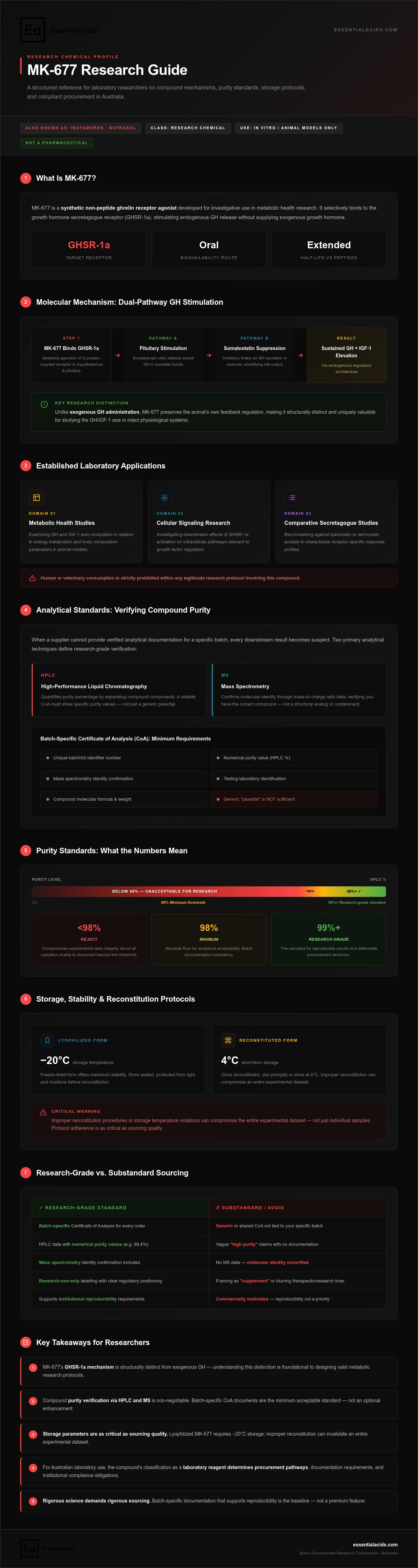
MK-677 functions as a non-peptide ghrelin receptor agonist, binding selectively to the growth hormone secretagogue receptor (GHSR-1a). This binding stimulates endogenous growth hormone release from the pituitary gland without directly supplying exogenous GH, which is precisely what makes it a structurally distinct and research-relevant compound. Its oral bioavailability in animal models and its extended half-life relative to peptide secretagogues make it particularly useful for studying sustained GH and IGF-1 axis activity. For a detailed breakdown of its molecular architecture, see our MK-677 structure profile for laboratory research.
Intended Laboratory Applications
Within controlled research environments, MK-677 is applied across several investigative domains:
- Metabolic health studies: Examining GH and IGF-1 axis modulation in relation to energy metabolism and body composition parameters in animal models.
- Cellular signaling research: Investigating downstream effects of GHSR-1a activation on intracellular pathways relevant to growth factor regulation.
- Comparative secretagogue studies: Benchmarking against peptide-based secretagogues such as ipamorelin or sermorelin acetate to characterize receptor-specific response profiles.
Human or veterinary consumption is strictly prohibited within any legitimate research protocol involving this compound. Institutional review requirements and ethical frameworks governing laboratory use are non-negotiable parameters, not procedural suggestions.
The 2026 research landscape reflects a measurable increase in demand for analytically verified metabolic compounds. Institutions require not just the compound itself, but batch-specific documentation that supports reproducibility. For researchers sourcing materials for mk-677 research australia, that verification standard is the baseline, not an optional enhancement.
Molecular Mechanisms: Growth Hormone Secretagogue Action
MK-677's research utility stems directly from the precision of its receptor engagement. Unlike exogenous growth hormone administration, which bypasses endogenous regulatory feedback entirely, MK-677 operates through selective agonism of the growth hormone secretagogue receptor 1a (GHSR-1a), a G protein-coupled receptor expressed primarily in the hypothalamus and pituitary. This distinction isn't semantic; it determines the entire physiological cascade that follows compound administration in research models.
GHSR-1a activation triggers a dual-pathway response. First, it stimulates somatotroph cells within the anterior pituitary to release stored growth hormone in pulsatile bursts. Second, it suppresses somatostatin signaling, the primary inhibitory brake on GH secretion, which amplifies net GH output beyond what either mechanism would produce independently. The result is a sustained elevation of both GH and downstream insulin-like growth factor 1 (IGF-1), operating through the animal's own regulatory architecture rather than circumventing it.
This mechanistic profile is precisely what separates MK-677 from traditional GH therapies in a research context. Recombinant human GH administration produces a pharmacokinetic profile that doesn't replicate physiological pulsatility. MK-677, by contrast, preserves the pulsatile character of GH release while modulating its amplitude and duration, making it a structurally more appropriate tool for studying GH axis dynamics under controlled laboratory conditions.
Mechanism of Action in Research Models
In animal model studies, GHSR-1a activation by MK-677 produces measurable downstream effects on metabolic processes, including shifts in lipid oxidation, alterations in lean mass parameters, and changes in energy expenditure at the cellular level. MK-677 plays a defined role in enhancing nutrient partitioning by modulating GH-driven substrate utilization toward lean tissue maintenance over adipose accumulation in controlled experimental settings. These effects make it particularly relevant for body composition research designs where isolating GH axis contributions is methodologically necessary.
Research Implications for Metabolic Health
Beyond body composition parameters, MK-677's ghrelin-mimetic activity introduces appetite regulation as a measurable variable in energy balance studies. Ghrelin itself is an orexigenic signal, and GHSR-1a agonism replicates aspects of that signaling, which creates opportunities to investigate the intersection of hunger regulation and GH axis activity within the same experimental model.
Serum GH analysis following MK-677 administration in animal models requires careful temporal sampling given the compound's influence on pulsatile release patterns. Receptor affinity and selectivity data are equally critical considerations when designing comparative protocols. For researchers conducting mk-677 research australia, pairing MK-677 with complementary secretagogues such as ipamorelin or sermorelin acetate can yield receptor-specific response profiles that single-compound studies cannot capture alone.
Researchers building comparative metabolic study designs can explore Essential Acids' full range of analytically documented growth hormone secretagogue compounds to support multi-compound protocol development.
Analytical Standards: Verifying Compound Purity and Integrity
Compound purity isn't a procurement preference; it's the variable that determines whether experimental results are scientifically defensible or analytically worthless. For researchers conducting mk-677 research australia, this distinction is operationally critical. A reagent with unverified purity introduces confounding variables that no statistical method can retroactively correct.
Two analytical techniques form the non-negotiable baseline for compound verification: High-Performance Liquid Chromatography (HPLC) and mass spectrometry (MS). HPLC separates compound components by their interaction with a stationary phase, producing a chromatographic profile that quantifies the relative concentration of each constituent. The area under the target peak, expressed as a percentage of total peak area, gives the purity figure. Mass spectrometry confirms molecular identity by measuring the mass-to-charge ratio of ionized fragments, allowing direct comparison against MK-677's theoretical molecular weight of 528.66 g/mol. Neither technique alone is sufficient; together, they establish both quantitative purity and qualitative identity.
The 99%+ purity threshold isn't an arbitrary marketing figure. It reflects the minimum concentration at which a compound can be treated as analytically uniform across a study population. Below that threshold, unknown residuals begin to exert measurable biological activity in sensitive assay systems, particularly those examining receptor binding kinetics or downstream signaling cascades. A compound at 95% purity carries a 5% unknown variable by mass; in a tightly controlled dose-response study, that margin is not acceptable.
Identifying Contaminants and Degradants
Purity verification exists because synthesis and storage both introduce risk. Common impurities in research chemical production include residual solvents from synthesis, unreacted precursor compounds, and oxidative degradants that form when compounds are exposed to moisture or temperature fluctuations during transit. Each category presents a distinct analytical signature detectable through HPLC profiling. Essential Acids addresses this through batch-specific testing protocols, ensuring that the chromatographic data supplied with each compound reflects the actual material shipped, not a representative batch from a prior production run. Purity verification is not a quality enhancement; it's the scientific prerequisite for any result worth publishing.
Documenting Research Materials
Batch-specific Certificates of Analysis are the primary evidentiary document linking a compound's analytical profile to a specific research dataset. During institutional audits or peer-review scrutiny, a COA must demonstrate the compound's identity, purity percentage, testing methodology, and the specific batch identifier traceable to that document. Generic or undated COAs don't satisfy this requirement. Researchers sourcing materials for laboratory use should verify that supplier documentation includes the HPLC chromatogram, MS confirmation data, and a batch number that cross-references the physical product received.
Manufacturing standards matter equally. Compounds produced under controlled synthesis conditions with documented quality checkpoints carry a demonstrably lower contamination risk than those sourced through unverified intermediaries. Researchers can learn more about procurement standards and what verified documentation should contain in the guide to buying research peptides with verified documentation.
For researchers building reproducible protocols around metabolic compounds, the documentation chain from synthesis to delivery isn't administrative overhead. It's the audit trail that makes the science defensible.
Laboratory Protocols: Stability, Storage, and Reconstitution
Analytical data is only as reliable as the compound that generated it. Even a batch-verified reagent with confirmed 99%+ purity will produce unreliable results if storage conditions are mismanaged or reconstitution is handled without precision. For researchers conducting mk-677 research australia, compound integrity across the full experimental timeline is a protocol requirement, not an afterthought.
Lyophilized MK-677 powder maintains long-term stability at -20°C for routine storage, with -80°C recommended for archival preservation extending beyond twelve months. These temperatures suppress oxidative degradation and limit hydrolytic activity that would otherwise compromise molecular structure over time. Once reconstituted, MK-677 in solution should be used within 30 days when stored at 4°C under sterile conditions; beyond that window, degradant accumulation becomes a measurable variable in sensitive assay systems.
Reconstitution requires bacteriostatic water or sterile saline, introduced slowly along the vial wall rather than directly onto the lyophilized cake. Aggressive injection disrupts the powder matrix and can introduce mechanical shear stress to the compound. Gentle swirling, not vortex agitation, completes dissolution. Repeated freeze-thaw cycles are among the most common sources of compound degradation in active laboratory settings; aliquoting stock solutions into single-use volumes before freezing eliminates this risk entirely.
Handling Lyophilized Peptides
Precise milligram-level weighing demands an analytical balance calibrated to at least 0.1 mg resolution, with the compound equilibrated to ambient temperature before the vial is opened. This equilibration step is non-negotiable: cold vials draw atmospheric moisture inward the moment they're unsealed, and even brief exposure can alter the powder's mass and compromise solubility. Weighing should occur in a low-humidity environment, with desiccant present if a controlled dry room isn't available. Nitrile gloves and appropriate laboratory PPE are required for all handling of synthetic research compounds; direct skin contact is not acceptable under any research protocol.
Assay-Specific Concentration Calculations
For in vitro cellular response experiments, converting mass-based measurements to molar concentrations is essential. MK-677's molecular weight of 528.66 g/mol serves as the conversion baseline. A 10 mM stock solution, for example, requires 5.29 mg dissolved in 1 mL of solvent, which can then be serially diluted to working concentrations appropriate for receptor binding or downstream signaling assays. Stock solutions should be prepared in volumes that accommodate the full experimental series without requiring repeated reconstitution from lyophilized material. Researchers working with structurally analogous compounds can reference our guide on BPC-157 5mg handling protocols for parallel reconstitution and concentration calculation methodologies applicable across research-grade peptide formats.
Researchers sourcing analytically verified MK-677 for controlled laboratory use can review Essential Acids' batch-documented compound specifications to confirm storage and handling parameters align with institutional protocol requirements before procurement.
Procuring Research-Grade Compounds: The Essential Acids Standard
Scientific transparency isn't a marketing position at Essential Acids; it's the operational baseline from which every procurement decision flows. The brand's guiding principle, "Making better, normal," reflects a commitment to elevating research standards through compound quality and documentation rigor, not through promotional language. For researchers engaged in mk-677 research australia, that distinction matters: a supplier oriented toward scientific integrity behaves differently at every stage of the procurement process than one oriented toward volume.
Compounds supplied by Essential Acids are developed specifically for analytical and scientific research contexts. Each product in the catalog is positioned as a laboratory reagent, not a consumer product, and that classification shapes everything from synthesis protocols to the documentation accompanying each shipment. Batch-specific Certificates of Analysis, HPLC chromatographic data, and mass spectrometry confirmation are standard inclusions, not premium additions.
The Research-Only Mandate
Non-human use policy isn't a legal formality at Essential Acids; it's a principled position that defines the supplier relationship from the outset. Researchers procuring compounds through Essential Acids operate within a framework that reinforces institutional compliance obligations rather than creating ambiguity around them. The ethical responsibility for appropriate laboratory use rests with the researcher, and Essential Acids supports that responsibility by maintaining unambiguous distribution standards. This is what "quiet authority" looks like in practice: a supplier whose policies are consistent, whose documentation is traceable, and whose catalog doesn't require interpretation.
Expanding the Research Catalog
Comparative metabolic studies rarely depend on a single compound. Essential Acids maintains a catalog of analytically verified research chemicals that support multi-compound protocol development without requiring researchers to source from multiple suppliers with inconsistent documentation standards. Complementary compounds relevant to GH axis and neuropeptide research include:
- Ipamorelin: A selective GH secretagogue peptide useful for receptor-specific comparative studies alongside MK-677.
- Semax: A synthetic neuropeptide relevant to neurotrophin signaling research, with documented analytical profiles available for institutional review.
- Sermorelin Acetate, CJC-1295, Tesamorelin, and AOD-9604: Additional growth hormone axis compounds that extend comparative study design options across receptor binding and metabolic response parameters.
Procurement for national research institutions and independent laboratories follows a streamlined process built around documentation accessibility. Researchers don't need to chase analytical data after ordering; it's part of the standard supply chain. That consistency supports reproducibility across study timelines and simplifies institutional audit preparation.
For researchers building rigorous, defensible protocols around metabolic compounds, the catalog at Essential Acids represents a single-source solution for batch-documented, research-use-only materials verified to the analytical standards that serious science requires.
Advancing Metabolic Research With Verified Compounds
Rigorous mk-677 research australia demands more than scientific intent; it requires a supply chain that supports every stage of experimental design. The compound's GHSR-1a mechanism makes it a precise and analytically valuable tool, but that value is only realized when purity is confirmed, storage protocols are followed, and documentation is traceable to the specific batch in your laboratory.
Three things determine whether your results are defensible: compound identity verified through HPLC and mass spectrometry, batch-specific COAs that survive institutional audit, and specialized laboratory-grade logistics that preserve integrity from synthesis to delivery. These aren't optional enhancements; they're the conditions under which reliable data is produced.
Essential Acids provides exactly that foundation. Batch-documented, research-use-only compounds with the analytical verification your protocols require are available now.
Secure High-Purity MK-677 for Your Research Project and build your next study on a reagent supply chain that's as rigorous as your methodology.
Frequently Asked Questions About MK-677 Research in Australia
Is MK-677 research chemical the same as the pharmaceutical version?
No. Research-grade MK-677 is a laboratory reagent classified for in vitro experimentation and controlled animal model studies, not a pharmaceutical product. Pharmaceutical compounds carry therapeutic approval, clinical manufacturing standards, and prescribing frameworks that don't apply to research chemicals. The two classifications exist in entirely separate regulatory categories, and conflating them misrepresents both the compound's legal status and its intended use context.
Research-grade MK-677 is supplied with batch-specific analytical documentation that supports scientific reproducibility. Pharmaceutical-grade materials are produced under different regulatory mandates entirely. Researchers procuring materials for laboratory use should understand that research-grade classification determines procurement pathways, institutional compliance obligations, and documentation requirements from the outset.
What is the recommended purity for MK-677 in laboratory research?
A minimum purity of 99%+ is the accepted analytical standard for research-grade MK-677. Below that threshold, unknown residuals constitute a measurable mass fraction that can exert biological activity in sensitive assay systems, particularly those examining receptor binding kinetics or downstream signaling cascades. A compound at 95% purity carries a 5% unknown variable, which isn't acceptable in controlled dose-response designs where isolating specific variables is methodologically necessary.
Purity should be confirmed through both HPLC chromatographic profiling and mass spectrometry confirmation. Neither technique alone is sufficient; together they establish quantitative purity and qualitative molecular identity against MK-677's theoretical molecular weight.
Can MK-677 research chemical be used for human trials?
No. MK-677 supplied as a research chemical is strictly prohibited from human or veterinary administration under any legitimate research protocol. It's classified as a laboratory reagent, not a therapeutic agent, and that classification is non-negotiable. Researchers operating within institutional frameworks are bound by ethical review requirements and compliance obligations that explicitly exclude research chemicals from human use contexts.
This isn't a procedural suggestion; it's a foundational boundary that defines the entire supplier relationship. Essential Acids maintains an unambiguous research-use-only distribution standard, and the ethical responsibility for appropriate laboratory use rests entirely with the procuring researcher and their institution.
How should lyophilized MK-677 be stored for maximum stability?
Lyophilized MK-677 powder should be stored at -20°C for routine laboratory use. For archival preservation extending beyond twelve months, -80°C is recommended. These temperatures suppress oxidative degradation and limit hydrolytic activity that would otherwise compromise molecular structure over time. Cold vials must be equilibrated to ambient temperature before opening; skipping this step draws atmospheric moisture inward and can alter the powder's mass and solubility profile.
Once reconstituted, MK-677 in solution should be used within 30 days when stored at 4°C under sterile conditions. Aliquoting stock solutions into single-use volumes before freezing is the most reliable method for eliminating degradation from repeated freeze-thaw cycles, which remain among the most common sources of compound integrity loss in active laboratory settings.
What analytical reports are provided with MK-677 research chemicals?
Batch-specific Certificates of Analysis are the standard documentation supplied with research-grade MK-677. These documents should include the HPLC chromatogram confirming purity percentage, mass spectrometry data confirming molecular identity, the testing methodology applied, and a batch identifier that cross-references the physical product received. Generic or undated COAs don't meet the evidentiary standard required for institutional audit or peer-review scrutiny.
Essential Acids includes this analytical documentation as a standard supply chain inclusion, not a premium addition. Researchers conducting mk-677 research australia should verify that any supplier's COA reflects the specific batch shipped, not a representative sample from a prior production run. The distinction is critical for maintaining reproducibility across study timelines.
What is the molecular weight of research-grade MK-677?
Research-grade MK-677 has a molecular weight of 528.66 g/mol. This figure serves as the baseline for all molar concentration calculations during reconstitution and assay preparation. For example, preparing a 10 mM stock solution requires 5.29 mg dissolved in 1 mL of appropriate solvent, which can then be serially diluted to working concentrations suitable for receptor binding or downstream signaling assays.
Mass spectrometry confirmation during purity testing measures the mass-to-charge ratio of ionized molecular fragments against this theoretical value, providing direct verification of compound identity. Any significant deviation from the expected molecular mass profile indicates contamination or degradation that would compromise experimental validity.
How do I reconstitute MK-677 for in vitro research?
Reconstitution requires bacteriostatic water or sterile saline, introduced slowly along the vial wall rather than directly onto the lyophilized powder cake. Gentle swirling completes dissolution; vortex agitation isn't appropriate as it introduces mechanical shear stress that can compromise compound integrity. All handling requires nitrile gloves and appropriate laboratory PPE; direct skin contact is not acceptable under any research protocol.
Weighing should occur on an analytical balance calibrated to at least 0.1 mg resolution, in a low-humidity environment with desiccant present if a controlled dry room isn't available. Prepare stock solutions in volumes that accommodate the full experimental series without requiring repeated reconstitution from lyophilized material, then aliquot into single-use volumes before storage to preserve integrity across the study timeline.
Why is MK-677 significant for metabolic research in 2026?
MK-677's significance in current metabolic research stems from its mechanistic precision: it stimulates endogenous growth hormone release through GHSR-1a agonism while preserving the pulsatile character of GH secretion, making it a structurally appropriate tool for studying GH axis dynamics without the confounding pharmacokinetic profile of exogenous GH administration. That distinction is increasingly relevant as researchers design studies requiring tighter control over GH-driven substrate utilization and body composition parameters in animal models.
For researchers conducting mk-677 research australia, the compound's oral bioavailability in animal models and its extended half-life relative to peptide secretagogues also support study designs where sustained GH and IGF-1 axis activity is the primary variable under investigation. Paired with complementary secretagogues such as ipamorelin or sermorelin acetate, it enables receptor-specific comparative protocols that single-compound studies can't produce.
Legal Disclaimer
All products sold on this website are intended exclusively for laboratory research purposes and not for human or veterinary use, diagnosis, cure, treatment, or prevention of any disease or condition. None of the statements on this site have been reviewed or evaluated by the U.S. Food and Drug Administration (FDA) or comparable regulatory authorities. Purchasing or using these products for any unintended purpose, including human consumption, may violate federal or local laws and poses safety risks.