

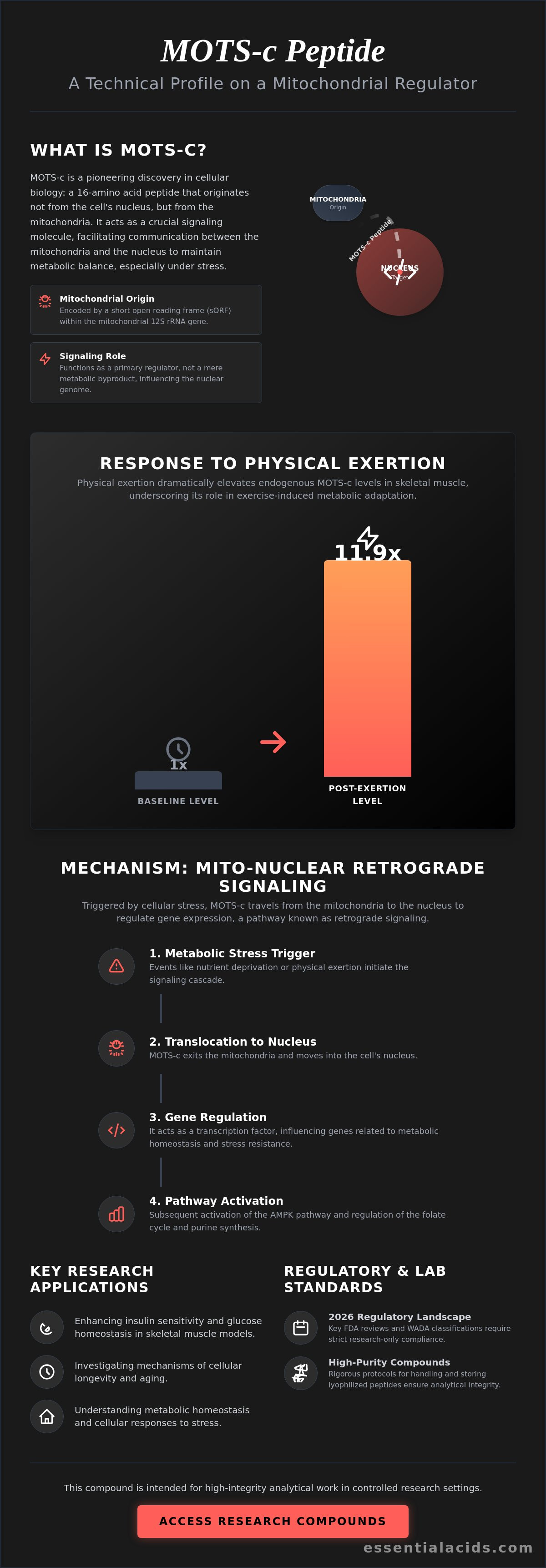
Evidence indicates that physical exertion can elevate endogenous levels of the mots c peptide in skeletal muscle by approximately 11.9-fold, highlighting its role as a potent mitochondrial-encoded regulator rather than a simple metabolic byproduct. You likely recognize the difficulty in distinguishing between various mitochondrial-derived peptides while maintaining laboratory stability in a shifting regulatory landscape. Confusing data regarding research-only compounds often hinders the precision required for high-integrity analytical work, especially as the FDA's Pharmacy Compounding Advisory Committee prepares for its July 23-24, 2026, review.
This technical profile offers a rigorous overview of the peptide's molecular profile, focusing on its unique signaling and its function in maintaining metabolic homeostasis. The mito-nuclear retrograde pathway is analyzed alongside the April 2026 removal of the compound from the FDA's Category 2 list to provide researchers with necessary regulatory clarity. We'll also establish the parameters for utilizing high-purity compounds in a controlled research setting. Our commitment to scientific integrity ensures that your focus remains on the data. Making better, normal requires this level of disciplined inquiry into cellular aging and metabolic signaling.
Key Takeaways
- Identify the unique mitochondrial origins of the 16-amino acid mots c peptide and its role as a primary regulator of the nuclear genome.
- Analyze the specific mechanism of mito-nuclear retrograde signaling and the subsequent activation of the AMPK pathway during cellular stress.
- Evaluate current research applications regarding insulin sensitivity and glucose homeostasis within skeletal muscle and cellular longevity models.
- Establish rigorous laboratory protocols for the handling and long-term storage of lyophilized compounds to ensure analytical integrity.
- Navigate the 2026 regulatory landscape, including WADA classifications and the mandatory requirements for research-use-only compliance.
What is MOTS-c? The Discovery of Mitochondrial-Derived Peptides
The MOTS-c (mitochondrial open reading frame of the 12S rRNA-c) is a 16-amino acid peptide that signifies a paradigm shift in mitochondrial biology. Historically, the scientific community classified mitochondria almost exclusively as the "powerhouse of the cell," tasked with ATP production through oxidative phosphorylation. However, current analytical data characterizes these organelles as dynamic signaling hubs. The mots c peptide is a primary example of this regulatory capacity. It's a mitochondrial-derived peptide (MDP) that facilitates communication between the mitochondria and the nucleus, a process essential for maintaining cellular integrity during metabolic stress. This compound is strictly for research-use only and serves as a tool for understanding the underlying mechanisms of metabolic homeostasis.
Unlike the vast majority of peptides which are encoded within the nuclear genome, MOTS-c originates from the mitochondrial DNA (mtDNA). This distinction is fundamental for laboratory research. The peptide's existence proves that the 16.5kb mitochondrial genome is not merely a vestigial blueprint for respiratory chain subunits. It's a source of bioactive molecules that influence systemic physiology. In laboratory models, the presence of this peptide is linked to the regulation of nuclear gene expression, specifically those genes involved in lipid and glucose metabolism. These findings suggest that the mitochondria exert a level of "quiet authority" over cellular function that was previously unrecognized.
The Genomic Origin of MOTS-c
The genomic architecture of the mots c peptide involves a short open reading frame (sORF) located within the 12S ribosomal RNA (rRNA) gene of the mitochondria. While traditional genetics often dismissed sORFs as non-functional sequences, high-resolution sequencing has confirmed their role in generating functional peptides. When cellular stress occurs, this sORF is translated into a bioactive molecule. This mechanism mirrors other MDPs, such as Humanin and various Small Humanin-like Peptides (SHLPs), yet MOTS-c maintains a distinct molecular profile. Its specific 16-amino acid sequence allows for targeted interaction with metabolic pathways that other MDPs do not influence. Scientific integrity requires the use of batch-specific, high-purity compounds to accurately map these genomic origins in analytical studies.
Historical Context of MDP Research
Research into mitochondrial-derived peptides began in 2001 with the discovery of Humanin. However, MOTS-c was not identified until 2015 by researchers at the University of Southern California. This discovery was pivotal because it provided the first evidence of a mitochondrial peptide that specifically translocates to the nucleus to regulate metabolic genes. Since 2015, the scope of inquiry has transitioned from basic metabolic observation to the study of complex signaling networks. In 2026, the peptide remains a central focus for researchers investigating cellular ageing and insulin sensitivity. The objective of current laboratory work is to refine the understanding of how these peptides act as retrograde signals, ultimately supporting the philosophical commitment to making better, normal through precise scientific inquiry.
Mechanism of Action: Mito-Nuclear Retrograde Signaling
The biological efficacy of the mots c peptide depends on its capacity to function as a mobile messenger between distinct cellular compartments. While most mitochondrial proteins are imported from the cytoplasm, this peptide exhibits the unique ability to exit the mitochondria and translocate to the nucleus. This movement is typically triggered by metabolic stress, such as nutrient deprivation or physical exertion. Once in the nucleus, the peptide functions as a transcription factor, directly influencing the expression of genes that govern metabolic homeostasis and stress resistance. A comprehensive MOTS-c scientific review indicates that this translocation is a core component of the organelle's adaptive response. Retrograde signaling is a mitochondrial-to-nuclear communication pathway that allows organelles to influence genomic responses to environmental changes.
Research models demonstrate that the peptide significantly impacts the folate cycle and de novo purine synthesis. By inhibiting the folate cycle at the level of 5,10-methenyltetrahydrofolate, it leads to the accumulation of 5-aminoimidazole-4-carboxamide ribonucleotide (AICAR). This accumulation is a critical event in cellular signaling, as AICAR is a potent natural activator of the metabolic master switch. Through this mechanism, the peptide coordinates a systemic shift in energy utilization, prioritizing survival and efficiency over rapid growth during periods of cellular instability.
AMPK Pathway Activation
The activation of the AMP-activated protein kinase (AMPK) pathway is a primary downstream effect of the mots c peptide. By altering the AMP/ATP ratio within the cell, the peptide signals a state of low energy availability. This process is comparable to other metabolic modulators like 5-Amino-1MQ, though the two compounds operate through distinct molecular targets. While 5-Amino-1MQ influences metabolism through NNMT inhibition, MOTS-c works through direct mitochondrial signaling. The result is a documented increase in lipid oxidation and enhanced glucose uptake in skeletal muscle models. Researchers investigating these pathways often require batch-specific MOTS-c to ensure analytical consistency in metabolic assays.
Nuclear Translocation and Gene Regulation
Nuclear entry occurs through a specialized transport mechanism that responds to the phosphorylation of the peptide. Once situated within the nuclear envelope, it interacts with various transcription factors, including the Antioxidant Response Element (ARE). This interaction regulates the transcription of stress-response genes that protect the cell from oxidative damage and cellular ageing. The precision of this mitochondrial-to-nuclear signaling ensures that the cell can maintain integrity under diverse stressors. The integrity of these signaling pathways remains a central focus of longevity research and metabolic laboratory studies in 2026.
Primary Research Applications in Metabolic and Aging Models
Current laboratory studies in 2026 emphasize the role of the mots c peptide as a metabolic modulator with distinct exercise-mimetic properties. In sedentary laboratory models, the administration of this compound has been observed to replicate several physiological adaptations typically associated with physical exertion. These adaptations include the enhancement of lipid metabolism and the activation of thermogenesis within brown adipose tissue. By shifting the metabolic profile of the subject toward fatty acid oxidation, the peptide assists in the maintenance of systemic energy balance. This research is critical for understanding the molecular basis of metabolic flexibility, particularly in subjects where traditional physical activity is not viable. All applications discussed herein pertain strictly to laboratory research and are not intended for human consumption, though individuals can explore a wide range of vitamins and wellness products through specialized online providers like E-Nutrient.
Skeletal Muscle and Glucose Homeostasis
A primary focus of metabolic research involves the investigation of insulin-independent glucose uptake. The mots c peptide facilitates this process by promoting the translocation of glucose transporter type 4 (GLUT4) to the plasma membrane of skeletal muscle cells. This mechanism bypasses traditional insulin signaling pathways, offering a unique model for studying glucose homeostasis. Additionally, analytical work frequently measures mitochondrial biogenesis and oxygen consumption rates (OCR) to evaluate cellular energy efficiency. Research indicates that the peptide increases the expression of nuclear-encoded mitochondrial genes, effectively enhancing the organelle's functional capacity. These observations provide a foundation for modeling metabolic responses in sedentary subjects with impaired glucose regulation. Researchers often utilize high-purity MOTS-c to ensure the accuracy of these metabolic assays.
Aging and Longevity Signaling
The investigation of cellular ageing (senescence) has identified the peptide as a key regulator in longevity signaling pathways. In aging cellular models, the mots c peptide interacts with the SIRT1 pathway, a well-documented mediator of lifespan and stress resistance. Endogenous levels of this mitochondrial messenger have been shown to decline significantly with age, leading researchers to evaluate its potential as a biological biomarker for mitochondrial health. Current studies examine how restoring these signaling levels in vitro might influence the markers of cellular senescence. By maintaining the integrity of the mito-nuclear communication network, researchers aim to understand the systemic decline of metabolic function over time. This rigorous inquiry supports the brand's objective of making better, normal through the pursuit of scientific integrity.
Laboratory Standards: Handling, Stability, and Reconstitution
The mots c peptide is typically supplied as a lyophilized white powder to ensure maximum structural stability during transit and storage. This freeze-dried state minimizes the risk of premature degradation by removing the moisture required for most enzymatic and chemical reactions. Maintaining the integrity of this molecular profile is a prerequisite for any high-integrity metabolic research. Laboratory protocols must account for the peptide's sensitivity to environmental factors, including UV light exposure and temperature fluctuations, which can alter the compound's biochemical properties before analytical testing begins. All handling procedures should be conducted within a controlled environment to uphold the standards of scientific integrity.
Long-term preservation requires strict adherence to cryopreservation protocols. Lyophilized vials should be stored at -20°C or -80°C to prevent peptide bond hydrolysis and oxidation. While the compound may remain stable at refrigerated temperatures (2°C to 8°C) for short durations, this is not recommended for periods exceeding four weeks. Reconstitution should be performed using sterile BAC Water or, in specific analytical contexts, dilute acetic acid. The choice of solvent depends on the requirements of the intended assay and the desired final concentration of the solute. Researchers seeking verified compounds for metabolic studies can access high-purity MOTS-c through our digital storefront.
Optimizing Peptide Stability
Peptide integrity is compromised by frequent temperature fluctuations. Freeze-thaw cycles induce physical stress that can lead to the denaturation of the 16-amino acid sequence. To mitigate this risk, researchers should aliquot the reconstituted solution into single-use volumes immediately after the initial dissolution. These aliquots must be stored at -20°C and only thawed once. Identifying signs of degradation is a critical skill for laboratory personnel. Visible indicators such as persistent cloudiness, precipitation, or a change in the solution's color suggest that the compound has lost its analytical value and should be discarded. These steps are essential for maintaining the "quiet authority" of the research data.
Analytical Verification of Purity
Reproducible research results depend on the use of compounds with high-purity standards, typically exceeding 98%. Verification of this purity is achieved through High-Performance Liquid Chromatography (HPLC) and Liquid Chromatography-Mass Spectrometry (LC-MS). These methods confirm the peptide's identity and quantify the presence of any residual impurities. A batch-specific Certificate of Analysis (CoA) provides the necessary transparency for researchers to validate their findings. Interpreting these documents requires a focus on the mass-to-charge ratio and the peak area percentage. Ensuring these metrics align with the stated profile is a fundamental aspect of research-use only compliance and laboratory safety.
Regulatory Landscape and Research-Only Compliance (2026)
The regulatory status of the mots c peptide in 2026 is defined by its strict classification as a research-use only (RUO) compound. While interest in mitochondrial signaling continues to expand within the scientific community, the peptide hasn't received FDA approval for medical use in humans. A significant development occurred on April 23, 2026, when the substance was removed from the FDA's Category 2 list of restricted compounding materials. However, this doesn't constitute general approval. A final determination regarding its status for compounding is scheduled for the Pharmacy Compounding Advisory Committee (PCAC) review on July 23-24, 2026. This period of regulatory transition necessitates a disciplined approach to procurement, prioritizing compounds intended solely for laboratory settings to ensure full compliance with current laws.
Ethical considerations in mitochondrial signaling research require a firm adherence to established laboratory boundaries. The "research-use only" designation is a vital regulatory safeguard that distinguishes analytical compounds from clinical pharmaceuticals. Maintaining this distinction is a core component of scientific integrity. It ensures that the pursuit of human potential remains rooted in rigorous, cautious inquiry rather than the trends of an unregulated marketplace. Researchers must recognize that the safety and long-term effects of exogenous mitochondrial peptides in humans haven't been established through completed clinical trials. Consequently, all experimental work must be confined to in vitro or animal models to maintain the gravity and professional distance required in high-level biochemistry.
Anti-Doping and Competitive Sport Restrictions
Under the 2026 World Anti-Doping Agency (WADA) Prohibited List, the peptide is classified as a metabolic modulator. Its ability to act as an AMPK activator places it in Section 4.4, meaning it's prohibited at all times for athletes in competitive sports. This classification is influenced by data showing that physical exertion can increase endogenous levels by approximately 11.9-fold, making the exogenous introduction of the compound a point of high interest for regulatory bodies. Experimental protocols must strictly adhere to non-human models to avoid violations of anti-doping codes. The distinction between fundamental metabolic research and clinical application remains absolute. Analytical work must remain within the ethical confines of laboratory investigation, respecting the mandates that govern the distribution of these compounds.
Outside of the laboratory, the metabolic benefits of exercise are best pursued through active participation in sports; for those interested in the growing sport of padel, you can explore Padelrackets to find professional gear for your matches.
Procurement Standards for 2026
Securing high-purity materials for mitochondrial signaling research requires the verification of supplier credentials and the review of batch-specific documentation. In a market where regulatory oversight for research compounds varies, researchers must rely on providers that prioritize transparency and quality assurance. The presence of a verified Certificate of Analysis (CoA) is the primary method for ensuring that the compound meets the analytical standards required for reproducible data. This documentation provides the empirical evidence necessary to distinguish high-purity compounds from inferior alternatives. Our commitment to these standards ensures that the quality of the molecules speaks for itself, supporting the goal of making better, normal. Explore our catalog of research-grade peptides for your laboratory needs.
Advancing the Precision of Mitochondrial Signaling Research
The evolution of mitochondrial research from basic ATP production to complex genomic regulation marks a pivotal shift in modern biochemistry. Investigations into the mots c peptide have clarified how the mito-nuclear retrograde signaling pathway manages cellular homeostasis during metabolic instability. As the 2026 regulatory landscape continues to shift, the emphasis on laboratory stability and documented compound integrity remains paramount. Achieving reproducible results in cellular ageing and metabolic flexibility studies requires a disciplined adherence to high-purity standards. It's the responsibility of the researcher to ensure that analytical models are built upon verified molecular profiles.
Scientific integrity is upheld through batch-specific HPLC and MS verification, which provides the transparency necessary for sophisticated laboratory work. As a dedicated national Australian laboratory supply partner, we provide compounds that meet or exceed 98%+ purity standards to support your analytical goals. Researchers are invited to Secure High-Purity MOTS-c for Your Research Laboratory and access the materials required for high-integrity inquiry. We're committed to the rigorous standards that define the future of metabolic research. Your pursuit of precise data is the foundation of making better, normal.
Frequently Asked Questions
Is MOTS-c a hormone or a peptide?
MOTS-c is classified as a mitochondrial-derived peptide (MDP) consisting of a 16-amino acid sequence. While it exhibits endocrine-like signaling properties by traveling through the systemic circulation to influence distant tissues, it remains structurally a peptide encoded by the mitochondrial 12S rRNA gene. It is utilized in laboratory settings to study the complexities of inter-organellar communication and metabolic regulation.
What is the difference between MOTS-c and Humanin?
Both molecules belong to the family of mitochondrial-derived peptides, but they differ significantly in structure and primary function. Humanin is a 24-amino acid peptide primarily investigated for its cytoprotective and anti-apoptotic signaling. In contrast, the mots c peptide contains 16 amino acids and focuses on regulating metabolic homeostasis through its unique ability to translocate to the nucleus under cellular stress.
How should MOTS-c be stored in a laboratory environment?
Lyophilized powder must be stored at -20°C or -80°C to maintain long-term molecular stability and prevent hydrolysis. Once reconstituted, the solution should be aliquoted into single-use vials and kept at -20°C to avoid the structural damage associated with frequent freeze-thaw cycles. Exposure to UV light and ambient temperatures should be strictly minimized during all analytical procedures to ensure scientific integrity.
Can MOTS-c be used for human consumption?
No, this compound is strictly for research-use only and is not intended for human consumption or medical application. It hasn't been approved by the FDA or any other regulatory body for therapeutic use in humans. All procurement and experimental work must be confined to legitimate laboratory environments following institutional safety protocols and the legal requirements for research-only compounds.
What is the primary mechanism of MOTS-c in metabolic research?
The primary mechanism involves mito-nuclear retrograde signaling, where the peptide moves from the mitochondria to the nucleus during periods of metabolic stress. Once inside the nucleus, it interacts with transcription factors to regulate the expression of genes involved in the folate cycle and de novo purine synthesis. This process coordinates a systemic cellular response to maintain energy efficiency and metabolic balance.
Does MOTS-c require reconstitution before use in an assay?
Yes, the compound is supplied in a lyophilized state and requires reconstitution with a sterile solvent such as BAC Water before use in any assay. The volume of solvent added is dependent on the specific concentration required for the intended laboratory protocol. Gentle swirling is recommended for dissolution, as vigorous agitation can lead to the denaturation of the peptide chain.
Is MOTS-c legal for research purposes in Australia?
MOTS-c is legal for purchase and use within Australia when the application is strictly limited to laboratory research. It's important to note that the compound is classified as a prohibited substance by WADA and ASADA, making it banned at all times for competitive athletes. Researchers should ensure that their supply is sourced from reputable providers that offer batch-specific verification of purity.
How does MOTS-c influence AMPK activation?
Activation of the AMPK pathway occurs indirectly through the inhibition of the folate cycle, which leads to the cellular accumulation of AICAR. This metabolic shift alters the AMP/ATP ratio, triggering the activation of the AMPK master switch. This mechanism is a central focus for researchers studying glucose uptake and fatty acid oxidation in skeletal muscle and other metabolic laboratory models.
Legal Disclaimer
All products sold on this website are intended exclusively for laboratory research purposes and not for human or veterinary use, diagnosis, cure, treatment, or prevention of any disease or condition. None of the statements on this site have been reviewed or evaluated by the U.S. Food and Drug Administration (FDA) or comparable regulatory authorities. Purchasing or using these products for any unintended purpose, including human consumption, may violate federal or local laws and poses safety risks.