

In 2026, scientific integrity in neurobiological studies is no longer defined by the molecule itself, but by the transparency of the analytical data that accompanies it. Recent volatility in the supplier market, including the dissolution of major industry vendors and increased regulatory scrutiny, has made the procurement of high-purity compounds a critical bottleneck for laboratory progress. Many researchers have encountered the frustration of batch-to-batch inconsistency or the absence of transparent HPLC and Mass Spectrometry documentation, where a single impure compound can compromise months of experimental data.
We recognize that your research requires absolute precision to map complex neurotransmitter pathways effectively. This procurement guide provides a rigorous framework for securing neuroscience research peptides that meet a minimum threshold of 99% purity. You'll gain a technical understanding of the analytical standards required for 2026, the impact of the upcoming July PCAC reviews on compound availability, and the specific documentation protocols necessary to protect the validity of your results. By prioritizing verified chemical identity over marketing claims, you ensure that your laboratory's focus remains on the data rather than the variables of sourcing.
Key Takeaways
- Identify the essential criteria for high-purity procurement, focusing on the 99% purity threshold and the necessity of verified, batch-specific HPLC reports.
- Select the most appropriate neuroscience research peptides for your laboratory based on their specific interactions with neuroreceptors and signaling pathways.
- Master the technical protocols for maintaining compound stability through precise temperature control and the correct selection of reconstitution diluents like BAC water.
- Apply a rigorous framework for comparative analysis between research compounds to ensure the selected material aligns with the requirements of your experimental model.
- Establish a procurement strategy rooted in scientific integrity and transparency to navigate the complex regulatory and supply chain landscape of 2026.
What are Neuroscience Research Peptides?
Neuroscience research peptides are defined as short-chain polymers of amino acids engineered specifically to modulate or interact with neuroreceptors and signaling pathways. These compounds serve as critical ligands in the study of the central and peripheral nervous systems. Unlike endogenous Neuropeptide sequences that occur naturally within biological systems, synthetic research peptides are synthesized to provide a high level of molecular stability and receptor specificity. They're utilized primarily for neuroreceptor interaction models and neurotransmitter pathway mapping. By acting as precise molecular probes, these peptides allow for the isolation of specific biological responses within a controlled laboratory setting.
Scientific integrity requires a clear distinction regarding the application of these compounds. All materials discussed are intended strictly for laboratory and analytical research purposes. They are not for human or veterinary use. The rigorous standards applied to their production ensure that they meet the requirements for mechanistic modeling and central signaling investigations, where the presence of any contaminant could lead to catastrophic data errors. Maintaining this boundary is essential for both regulatory compliance and the validity of experimental outcomes.
The Evolution of Neurobiological Compounds
The transition from crude biological extracts to synthetic, high-purity materials represents a significant advancement in laboratory methodology. In the past, researchers relied on isolated proteins that often carried confounding variables or unpredictable metabolic byproducts. In 2026, the standard for neuroscience models demands absolute molecular precision. Synthetic neuroscience research peptides allow for targeted receptor binding studies where the chemical identity of the ligand is verified to a 99% purity threshold. This evolution ensures that the data generated is a result of the intended peptide interaction rather than an artifact of an impure sample. Synthetic synthesis provides the consistency required for longitudinal studies and cross-laboratory comparisons.
Key Research Areas for Peptide Application
The application of these peptides spans several critical domains of neurobiology. Researchers utilize these sequences to observe how specific molecular structures influence cellular environments. Key areas of investigation include:
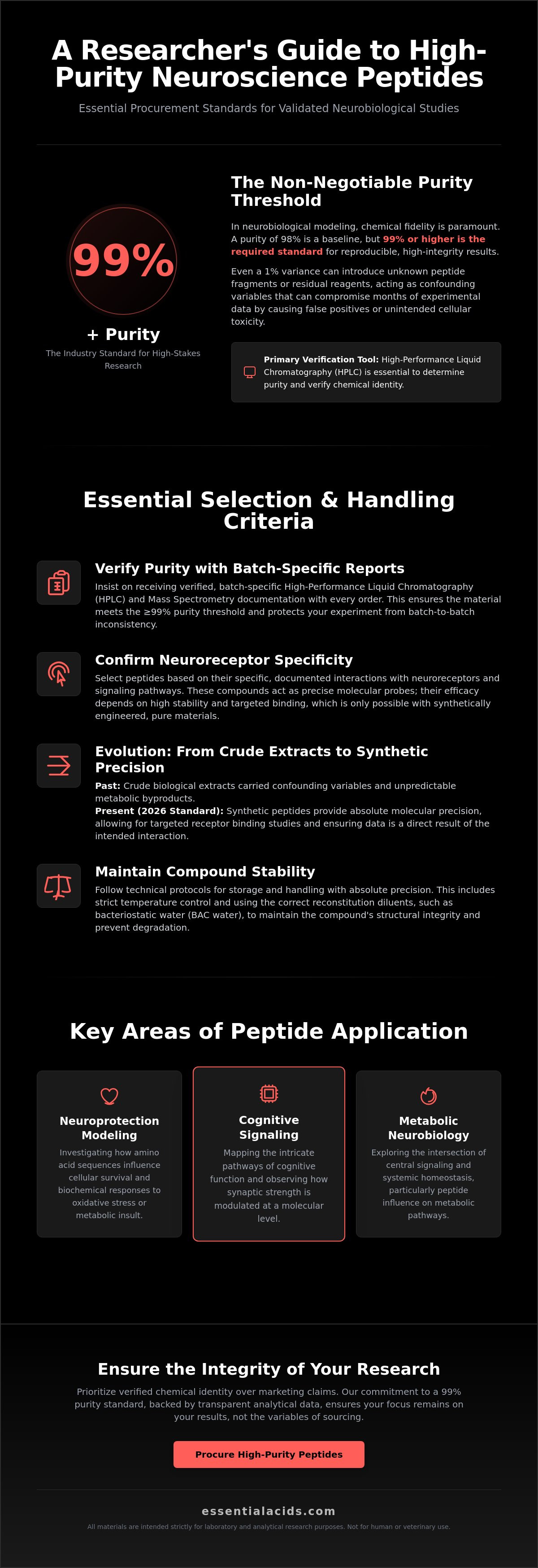
- Cellular Response and Neuroprotection Modeling: Investigating how specific amino acid sequences influence cellular survival and the biochemical response to oxidative stress or metabolic insult.
- Synaptic Plasticity and Cognitive Signaling: Mapping the pathways of cognitive signaling and observing how synaptic strength is modulated at the molecular level through receptor agonism or antagonism.
- Metabolic Health and Neurobiology: Exploring the intersection of central signaling and systemic homeostasis, specifically how peptides influence the metabolic pathways governed by the brain.
These research areas rely on the predictable behavior of high-purity compounds. When the molecular structure is verified and the analytical documentation is transparent, the researcher can focus on the resulting biological data. This disciplined approach to procurement is the foundation of reliable neuroscience research.
Essential Selection Criteria for High-Purity Research Materials
Securing reliable data in neurobiological modeling depends entirely on the chemical fidelity of the analytes used. For neuroscience research peptides, a purity threshold of 98% is often cited as a baseline; however, 99% or higher is the actual industry standard for high-stakes laboratory research. Even a 1% variance can introduce unknown peptide fragments or residual reagents that might interfere with delicate Neuropeptide research applications. These impurities often act as confounding variables, potentially leading to false positives in receptor binding assays or unintended toxicity in cellular models.
High-Performance Liquid Chromatography (HPLC) is the primary tool used to determine this purity percentage. It measures the concentration of the target peptide relative to any impurities present in the sample. Simultaneously, Mass Spectrometry (MS) verifies the molecular identity by measuring the mass-to-charge ratio of the ions. Without both reports, a researcher cannot be certain of the compound's integrity. It's also vital to monitor residual salts like trifluoroacetic acid (TFA), which is used during the synthesis process. High TFA concentrations can alter the pH of the experimental environment, making it necessary to utilize peptides with minimized salt content for sensitive in vitro studies.
Interpreting HPLC and Mass Spectrometry Reports
Reading an HPLC report requires looking beyond the stated percentage. A single, sharp, symmetrical peak indicates a high-purity sample. Red flags include "shoulders" on the main peak or multiple smaller peaks, which suggest the presence of truncated sequences or isomers. In MS reports, the observed molecular mass must match the theoretical mass of the peptide sequence exactly. Any deviation, even by a few Daltons, suggests a synthesis error or degradation. Researchers should reject any documentation that lacks clear axis labeling or appears to be a generic report rather than one tied to the specific vial.
The Importance of Batch Consistency
Procuring materials based on a catalog number is insufficient for reproducible science. Every synthesis cycle carries unique risks of variation. Maintaining scientific integrity requires access to batch-specific analytical reports for every order. This transparency ensures that if an experimental result changes between phases, the researcher can rule out chemical variance as the cause. Consistency across different research phases is only possible when the supplier provides verified data for every lot of neuroscience research peptides. You can view our verified neuroscience collection to see how these standards are applied to each research compound.
Comparative Analysis of Key Neuroscience Research Peptides
Selection of neuroscience research peptides in 2026 requires a focus on specific ligand-receptor dynamics rather than broad disease categories. The Neuroscience collection is structured to support this biochemical precision, providing researchers with high-purity compounds designed for targeted pathway mapping. Choosing between these analytes depends on whether the experimental model targets neurotrophic support, inhibitory signaling, or homeostatic regulation. Each compound carries a distinct molecular profile that dictates its behavior in vitro and in vivo models.
Semax: Investigating Neurotrophic Signaling
Semax serves as a primary ligand for studying neurotrophic signaling. It's a synthetic heptapeptide based on the ACTH(4-10) sequence, but it lacks hormonal activity. Its primary application in 2026 focuses on the modulation of Brain-Derived Neurotrophic Factor (BDNF) expression and its subsequent influence on neurotrophic signaling pathways. Laboratory models utilize Semax to explore neuroprotective mechanisms against oxidative stress and metabolic insult. When compared to other melanocortin-derived research compounds, Semax shows a unique ability to influence mRNA expression for neurotrophins within the hippocampus and specialized cortical regions.
Selank: Mapping Neuroreceptor Binding Behaviour
Selank provides a distinct experimental model for investigating the GABAergic system. As a synthetic derivative of the immunomodulatory peptide tuftsin, it's used to observe signal transduction patterns and peptide-receptor binding stability. In contrast to Semax, Selank’s interaction with GABA receptors in vitro allows researchers to map inhibitory neurotransmission patterns. Its comparative stability in controlled experimental systems makes it a reliable tool for modeling signal transduction without the rapid degradation often seen in endogenous sequences. Researchers prioritize Selank when the focus is on the modulation of neurotransmitter balance and receptor affinity.
DSIP and Neurological Homeostasis Models
Delta Sleep-Inducing Peptide (DSIP) is a nonapeptide utilized for mechanistic pathway modeling of neurological homeostasis. It provides a technical framework for investigating the regulation of sleep-wake cycles and the accompanying neuro-endocrine response patterns. In 2026, DSIP remains a staple for researchers focusing on how central signaling influences systemic stability. Its role in modeling the brain's response to environmental stressors makes it essential for homeostasis research. Like all neuroscience research peptides, the utility of DSIP is contingent upon its analytical purity, as even minor contaminants can disrupt the delicate regulatory cycles being modeled.
Analytical modeling also extends to cellular aging through the use of Epithalon. This tetrapeptide is utilized in investigations into neuro-epigenetics and telomerase activity. By observing its influence on epigenetic regulation, researchers can model the biochemical markers of cellular senescence within neural tissues. These investigations rely on the high-integrity synthesis of the peptide to ensure that observations are a result of the specific amino acid sequence rather than synthesis byproducts.
Optimising Experimental Integrity: Storage and Reconstitution
The transition from procurement to laboratory application is the phase where the chemical integrity of neuroscience research peptides is most frequently compromised. While synthesis purity is verified through HPLC, the physical handling of the analyte determines its actual viability in an experimental model. Lyophilized powder remains stable at room temperature for short periods during transit, but 2026 protocols recommend storage at -20°C or, for extended preservation, -80°C. Once reconstituted with bacteriostatic water, the solution must be maintained at 2-8°C for short-term use or frozen immediately to prevent degradation and maintain activity.
Mechanical stress is a primary cause of peptide degradation. Researchers shouldn't subject a vial to vigorous agitation or vortexing, as the resulting shear forces can disrupt the secondary structure or lead to irreversible aggregation. A gentle swirling motion is required. This ensures the powder is fully dissolved without structural damage. To further protect the molecular structure, it's essential to use opaque storage containers or wrap vials in foil to mitigate light sensitivity. UV exposure can trigger the breakdown of sensitive amino acid residues, leading to unpredictable experimental variables.
Reconstitution Best Practices for Researchers
Precise micro-dosing in neurobiological models relies on accurate concentration calculations, typically measured in milligrams per milliliter. The selection of a diluent is equally critical. Utilizing bacteriostatic water is the standard protocol for preventing microbial contamination in multi-use vials, as the 0.9% benzyl alcohol content inhibits the growth of most laboratory contaminants. For optimal stability, peptides should be reconstituted in a buffer that maintains a pH range between 4.0 and 6.0. Following reconstitution, the solution should be aliquoted into single-use volumes to avoid the structural damage caused by multiple freeze-thaw cycles.
Common Mistakes in Peptide Handling
Contamination risks increase exponentially when handling occurs outside of controlled environments, such as a laminar flow hood. A common error involves the failure to allow vials to reach room temperature before opening. This leads to atmospheric moisture condensation on the lyophilized powder and subsequent degradation. Additionally, researchers often overlook the impact of the container material; hydrophobic peptides can adhere to the walls of standard plastic tubes, altering the final concentration of the solution. You can secure high-purity neuroscience research peptides to ensure your experimental data remains uncompromised by chemical variance.
Procurement Standards: Why Essential Acids Defines Research Excellence
The procurement of neuroscience research peptides in 2026 is a process that demands more than a simple transaction; it requires a partnership based on absolute transparency. Essential Acids operates under the philosophy of "Making better, normal," which, in a laboratory context, translates to the removal of chemical variables that hinder scientific progress. By maintaining a clinical, high-integrity professionalism, the brand ensures that every compound provided is a tool of precision rather than a source of experimental uncertainty. This disciplined approach is rooted in the gravity of laboratory research, where the quality of the analyte is the foundation of the resulting data.
National research institutions require streamlined procurement pathways that don't sacrifice quality for scale. Essential Acids facilitates this through a stable supply chain and rigorous quality control protocols. Every batch is subjected to independent verification, ensuring that the compounds meet the high-purity standards required for complex neurobiological investigations. This commitment to scientific integrity is reflected in the provision of batch-specific analytical documentation for every neuroscience compound, allowing researchers to proceed with the confidence that their materials are chemically identical to the theoretical model.
Verified Purity and Scientific Integrity
As a scientific gatekeeper, Essential Acids prioritizes the integrity of the research-use only market. Laboratory credibility is built on the ability to reproduce results, a feat only possible with transparent HPLC and Mass Spectrometry reporting. This level of documentation isn't just a policy; it's a protective measure for the researcher's time and resources. For a detailed example of these standards in practice, researchers may review the BPC-157 5mg: Molecular Profile and Laboratory Research Standards for 2026. This documentation serves as a technical benchmark for what constitutes an acceptable analytical report in the modern laboratory environment, ensuring that the identity and purity of the peptide are beyond question.
Securing Your 2026 Research Catalog
Navigating the Neuroscience collection allows researchers to align their specific experimental needs with verified chemical identities. Regulatory compliance is maintained through a firm adherence to research-only procurement policies, ensuring that these materials remain strictly within the appropriate analytical frameworks. By choosing a supplier that prioritizes the technical nature of the products over commercial trends, laboratories can protect their experimental integrity from the instabilities of the broader marketplace. Secure high-purity neuroscience research peptides for your laboratory today to ensure your 2026 research catalog meets the highest standards of scientific integrity.
Advancing Neurobiological Discovery with Analytical Precision
The validity of neurobiological experiments in 2026 depends on the absolute elimination of chemical variables through rigorous procurement standards. As this guide has outlined, maintaining a 99% purity threshold and utilizing batch-specific HPLC and Mass Spectrometry documentation are essential steps for any high-level laboratory. By prioritizing these professional analytical standards, researchers protect their data from the confounding effects of synthesis byproducts and inconsistent compound quality. It's also vital to adhere to strict storage and reconstitution protocols to ensure that the molecular identity of your neuroscience research peptides remains stable throughout the experimental lifecycle.
Essential Acids remains a committed partner to the scientific community, providing strictly high-purity, research-only laboratory materials that meet the gravity of modern research requirements. Scientific integrity isn't merely a value; it's the foundation of every compound we offer. We invite you to Browse the Neuroscience Collection for High-Purity Research Compounds and secure the analytical materials your research deserves. Your commitment to precision is the catalyst for the next generation of neurobiological insights.
Frequently Asked Questions
What is the standard purity level for neuroscience research peptides?
The industry standard for high-integrity laboratory studies is a purity level of 99% or higher. While some providers offer 98% purity, the remaining 2% can contain truncated sequences or residual reagents that interfere with delicate neuroreceptor assays. Achieving this threshold ensures that experimental observations result from the specific peptide ligand rather than synthesis byproducts.
How do I verify the authenticity of a peptide batch report?
Authenticity is verified by comparing the batch-specific HPLC and Mass Spectrometry reports against the theoretical molecular weight of the peptide. Researchers should examine the chromatography graph for a single, symmetrical peak and ensure the axes are clearly labeled. Discrepancies between the observed and theoretical mass indicate a synthesis error or degradation.
Can neuroscience peptides be stored at room temperature during shipping?
Lyophilized peptides are chemically stable at room temperature for the duration of standard shipping windows. The freeze-drying process removes moisture that would otherwise facilitate degradation. Upon delivery, the compounds must be transferred to a temperature-controlled environment at -20°C or -80°C to maintain long-term analytical stability.
What is the difference between Semax and Selank in a research context?
Semax and Selank serve distinct experimental roles based on their molecular targets within neuroscience research peptides. Semax is utilized to model neurotrophic signaling and Brain-Derived Neurotrophic Factor (BDNF) interactions. Selank is preferred for mapping inhibitory neurotransmission through its interaction with the GABAergic system. These compounds provide different frameworks for studying signal transduction.
Why is bacteriostatic water preferred for peptide reconstitution in labs?
Bacteriostatic water is the preferred diluent because its 0.9% benzyl alcohol content inhibits microbial proliferation. This is critical for maintaining the stability of the analyte when a vial is accessed multiple times. Without this preservative, the risk of biological contamination increases, which would compromise the validity of the research data.
Are these peptides intended for human consumption or clinical trials?
No, these peptides are not intended for human consumption, clinical trials, or any form of therapeutic use. They are strictly for laboratory and analytical research purposes within a controlled environment. Essential Acids operates as a scientific supplier, and all products are sold under a rigorous research-use only policy to ensure regulatory compliance.
How does TFA removal affect the quality of a research peptide?
Reducing TFA levels improves the quality of a research peptide by preventing unintended shifts in the pH of experimental buffers. Trifluoroacetic acid is a byproduct of the synthesis process that can be cytotoxic in high concentrations. Removing these residual salts is necessary for sensitive in vitro models where cellular homeostasis must be maintained.
What happens if a peptide is exposed to light for an extended period?
Extended exposure to light can lead to the photodegradation of specific amino acid residues within the peptide sequence. This structural breakdown alters the chemical identity of the compound and renders the experimental results unreliable. Researchers must use opaque vials or secondary light-shielding containers to protect the integrity of the analytes.
Legal Disclaimer
All products sold on this website are intended exclusively for laboratory research purposes and not for human or veterinary use, diagnosis, cure, treatment, or prevention of any disease or condition. None of the statements on this site have been reviewed or evaluated by the U.S. Food and Drug Administration (FDA) or comparable regulatory authorities. Purchasing or using these products for any unintended purpose, including human consumption, may violate federal or local laws and poses safety risks.