

Procuring high-purity compounds isn't a simple administrative task; it represents the critical first stage of the scientific method where analytical verification determines the validity of every subsequent data point. When you choose to order peptides online, the burden of integrity shifts from the manufacturer to the researcher, necessitating a rigorous vetting process that many suppliers fail to meet. You likely understand the frustration of receiving a batch without transparent documentation or worrying about the thermal stability of your compounds during transit across Australia. These variables introduce noise into cellular studies and compromise the precision required for metabolic research.
This guide provides a clinical framework to identify and verify lyophilised compounds with absolute certainty. We will examine how to interpret batch-specific Certificates of Analysis (COAs) according to USP standards and evaluate the logistics of reliable domestic shipping to prevent degradation. By adhering to these protocols, you ensure that your laboratory maintains the "Making better, normal" standard of scientific excellence. We will also address the May 2026 regulatory updates regarding reclassified research-use only compounds to keep your procurement compliant and objective.
Key Takeaways
- Master the technical analysis of HPLC and Mass Spectrometry reports to confirm the chemical identity and analytical purity of laboratory compounds.
- Identify critical supplier red flags to securely order peptides online while maintaining the scientific integrity of your cellular research.
- Apply rigorous storage protocols for lyophilised peptides to preserve the stability of peptide bonds against environmental stressors like light and moisture.
- Distinguish between research-grade procurement and commercial "lifestyle" offerings to ensure compliance with the 2026 regulatory landscape in Australia.
- Utilise a clinical framework for verifying batch-specific documentation for metabolic agonists to prevent the introduction of impurities into your data sets.
Essential Criteria for Ordering Peptides Online for Research
Research procurement requires a transition from consumer-based logic to analytical verification. When you order peptides online, the objective is to secure high-purity compounds that serve as reliable variables in laboratory settings. Research-grade peptides are defined by their intended use as reagents in controlled environments; they are not human-grade pharmaceuticals. This distinction is maintained through "Research-Use Only" (RUO) labeling, which is a mandatory requirement for regulatory compliance within the Australian scientific community. Professional suppliers prioritize clinical transparency over marketing flair, ensuring that every vial is backed by batch-specific documentation.
The synthesis method significantly impacts the final impurity profile of a compound. Solid Phase Peptide Synthesis (SPPS) is the standard for most research sequences, allowing for precise control over the amino acid chain. However, Liquid Phase Synthesis may be employed for shorter sequences. Understanding these methods is essential because the scientific definition of peptides involves specific amide bonds that must be formed without creating truncated sequences or persistent trifluoroacetic acid (TFA) salts. A disciplined supplier provides verifiable data to prove that these chemical boundaries have been respected during production.
The Role of Purity in Research Outcomes
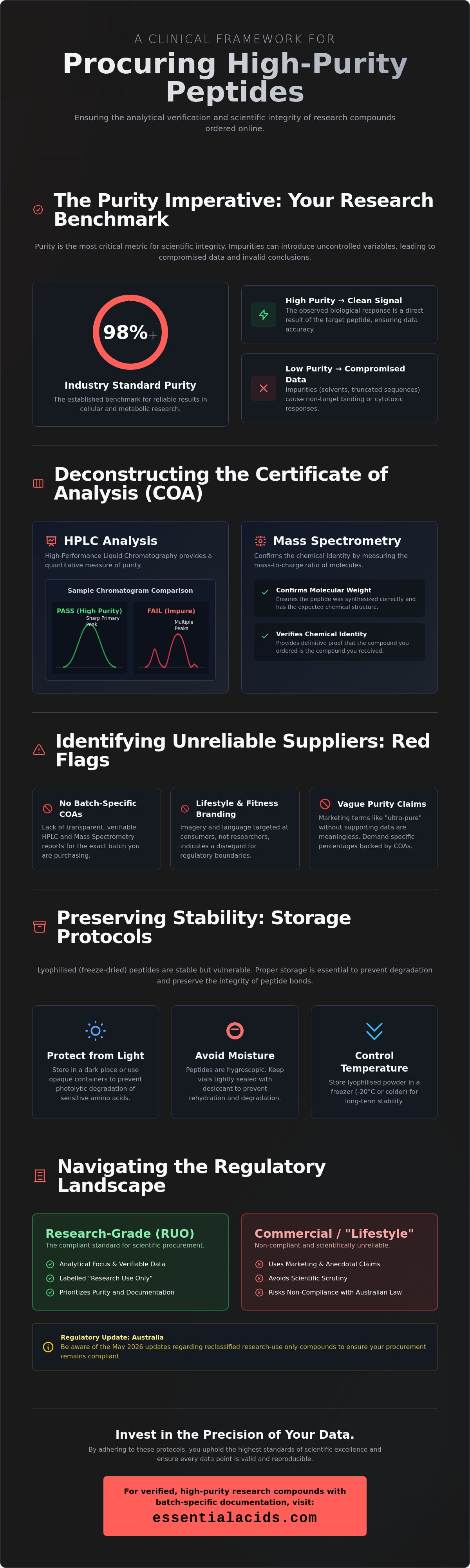
Purity is the most critical metric for scientific integrity. Trace impurities, such as residual solvents or misfolded sequences, can interfere with cellular signaling studies by binding to non-target receptors or inducing unexpected cytotoxic responses. While some commercial entities offer lower grades, 98% purity remains the industry benchmark for reliable results. Sequence length also dictates difficulty; longer chains like Tirzepatide 10mg or Retatrutide 10mg require more complex purification steps than shorter fragments like BPC-157 5mg. High-purity ensures that the biological response observed is a direct result of the peptide itself, not an artifact of contamination. For researchers focusing on specific sequences, the Nexa Peptide Store offers detailed scientific reviews that serve as essential guides for maintaining these standards in laboratory settings.
Regulatory Boundaries for Online Procurement
The procurement process must remain strictly detached from clinical or therapeutic applications. In Australia, laboratory reagents are categorized differently from therapeutic goods. Researchers should avoid suppliers who utilize lifestyle branding or fitness-related imagery. These markers often indicate a lack of analytical rigor and a disregard for regulatory boundaries. Professional procurement focuses on chemical specifications, such as the stability of lyophilised powders, rather than anecdotal performance. Maintaining this detached perspective ensures that the research remains objective and compliant with current legal standards. When you order peptides online through a reputable gatekeeper, you are investing in the precision of your data rather than a commercial trend.
Analytical Verification: Interpreting HPLC and Mass Spectrometry Reports
Research integrity depends on the ability to scrutinize raw laboratory data. When you order peptides online, the digital interface often masks the chemical reality of the compound. Analytical verification serves as the objective filter through which a researcher must pass every procurement decision. This involves a rigorous assessment of the Certificate of Analysis (COA), specifically focusing on interpreting HPLC and Mass Spectrometry reports to ensure the chemical profile aligns with the theoretical sequence. Without these documents, the researcher is essentially introducing an unverified variable into their laboratory environment.
Reading an HPLC Chromatogram
HPLC provides a quantitative measure of purity by separating the target peptide from synthesis by-products. High-Performance Liquid Chromatography (HPLC) is the gold standard for peptide purity verification. When reviewing a chromatogram, the researcher identifies the retention time and the area under the curve (AUC). A high-purity compound will display a single, sharp primary peak. Secondary peaks or significant baseline noise indicate the presence of impurities such as residual solvents or protecting groups. Peak tailing often suggests the presence of truncated sequences or isomers that elute at nearly the same time as the target, which can compromise the metabolic data of a study.
Confirming Molecular Identity via Mass Spec
While HPLC measures purity, Mass Spectrometry (MS) confirms the identity of the molecule. By measuring the mass-to-charge (m/z) ratio, researchers verify that the synthesized peptide matches the intended molecular weight. It's critical to account for the presence of counter-ions like trifluoroacetic acid (TFA), which are common in HPLC purification and can shift the observed mass. Since peptides are often synthesized as salts, the net peptide content (NPC) must be distinguished from the total mass of the lyophilised powder. Batch-specific documentation is non-negotiable for scientific integrity because it links a specific vial to a specific analytical event, preventing the use of generic or outdated reports.
Forged or generic COAs often lack batch-specific identifiers, such as a unique lot number or a specific date of analysis. If a supplier provides the same chromatogram for multiple orders across several months, the integrity of the research is compromised. Independent, third-party laboratory verification is the most reliable method to confirm that the compound in the vial matches the data on the screen. This level of transparency is what distinguishes a professional supplier from a commercial entity. Researchers seeking compounds with verified batch-specific documentation can view the Essential Acids catalog for detailed analytical profiles. Adhering to these verification standards ensures that your cellular studies remain objective and reproducible.
Identifying Reliable Suppliers: Red Flags in Online Peptide Distribution
Discernment in the procurement phase acts as a fundamental safeguard for research integrity. When you order peptides online, the digital storefront serves as the first point of analytical vetting. Serious researchers prioritize suppliers that maintain a professional distance from the consumer marketplace. High-integrity distribution is marked by a refusal to engage in aggressive sales tactics or hyperbolic marketing. Instead, the focus remains on the chemical specifications and the analytical purity of the compounds. Choosing a supplier is not merely a transaction; it's the selection of a partner in the scientific process.
One primary red flag is the presence of "lifestyle" branding. Websites featuring fitness imagery, athletic testimonials, or bodybuilders are generally avoided by the scientific community. These elements signal that the vendor is targeting the general public rather than institutional researchers. Such branding often correlates with a lack of regulatory compliance and a disregard for the "Research-Use Only" mandate. There's also a significant risk of "under-dosing" in unverified vials of compounds like Tirzepatide 10mg or BPC-157 5mg. Without batch-specific verification, the actual mass of the peptide may not match the label, which introduces a hidden variable that invalidates metabolic data and compromises cellular studies.
To learn more about the specific role of compounds like GHK-Cu in cellular research, EuroLab Peptides provides detailed technical primers that align with high-integrity analytical standards.
Professionalism also extends to payment security and data privacy. In the research chemical industry, secure transactions and the protection of institutional data are non-negotiable. A supplier's technical support should demonstrate a deep understanding of biochemistry and neuroscience. If scientific communication is replaced by vague marketing responses, the supplier likely lacks the expertise to guarantee compound integrity. A reliable gatekeeper provides direct answers regarding synthesis methods and purity levels without relying on emotional appeals.
Commercial vs. Scientific Marketing
Claims of "medical benefits" or "therapeutic effects" are immediate indicators of non-compliance. A laboratory reagent distributor maintains a strictly objective atmosphere, focusing on the biological classifications of the products. Verifying a supplier's focus on metabolic, neurological, or cellular research requires looking past the product list to the technical data provided. A supplement shop prioritizes "results," while a scientific gatekeeper prioritizes "reproducibility" and the "Making better, normal" standard of excellence.
Supply Chain Transparency
Transparency regarding the synthesis site and the quality of lyophilisation is essential for maintaining scientific integrity. Freeze-drying is a delicate process that determines the long-term stability of the peptide. Poor lyophilisation can lead to moisture retention, which accelerates peptide bond degradation. Adhering to established Handling and Storage Protocols is ineffective if the product was compromised during the final manufacturing stages. Low-cost peptides often indicate a lack of rigorous analytical testing. If the price is significantly lower than the market average for high-purity synthesis, the analytical integrity of the compound is likely compromised.
Handling and Storage Protocols for Lyophilised Research Peptides
The maintenance of chemical stability is an extension of the analytical verification process. Once you order peptides online and the compounds arrive at your facility, the environmental variables must be strictly controlled to prevent proteolysis or oxidation. Lyophilised peptides are generally stable, but the integrity of the peptide bond remains sensitive to thermal fluctuations, ultraviolet exposure, and moisture ingress. Protecting these compounds ensures that the metabolic data derived from your research remains accurate and reproducible. Scientific integrity demands that the storage environment reflects the same rigor as the synthesis laboratory.
Long-term storage requires temperatures of -20°C or -80°C to minimize kinetic energy and enzymatic activity. For short-term use, 2-8°C is acceptable, provided the vials remain sealed in a desiccant-rich environment. Moisture is the primary catalyst for degradation in the lyophilised state. Even trace amounts of humidity can lead to the collapse of the "cake" and subsequent hydrolysis of the peptide sequence. Researchers must ensure that vials reach room temperature before opening to prevent atmospheric condensation from contaminating the powder.
Temperature-Controlled Logistics
Sensitive neuropeptides, such as Selank 5mg or Semax 5mg, often require more stringent thermal monitoring during transit. Lyophilisation is the process that ensures shelf-stability at room temperature during transit by removing moisture through sublimation. Upon arrival, vials should be inspected for signs of moisture ingress or cake collapse, which indicate a breach in the vacuum seal. In the Australian climate, domestic transit times must be minimized to reduce the cumulative thermal load on the compounds. A collapsed cake often suggests that the peptide has been exposed to temperatures above its glass transition point, potentially compromising its structural integrity.
Laboratory Best Practices for Reconstitution
Reconstitution must be performed with precision to maintain protein stability. Bacteriostatic water or sterile saline are the standard solvents for research-use only compounds. Researchers must calculate concentration ratios carefully to ensure precise experimental dosing across multiple cellular studies. When you order peptides online for complex research, the following protocols should be observed:
- Introduce the solvent slowly along the side of the vial using a sterile syringe.
- Avoid direct stream impact on the lyophilised cake to prevent mechanical stress.
- Utilize gentle swirling rather than vigorous shaking to dissolve the powder.
- Aliquot the solution into single-use vials to avoid repeated freeze-thaw cycles.
Vigorous agitation can lead to the denaturation of complex sequences, particularly larger molecules like Tirzepatide 10mg or Retatrutide 10mg. Once reconstituted, the solution should be stored at 2-8°C and used within a defined window, typically 7 to 14 days, depending on the specific sequence's stability profile. Repeated freeze-thaw cycles must be avoided as they cause ice crystal formation that can physically shear the peptide chains. For researchers who require compounds synthesized with high-integrity protocols, you can browse the Essential Acids research catalog to secure verified materials for your next study. This disciplined approach to handling is essential for achieving the "Making better, normal" standard in every laboratory session.
Essential Acids: A Commitment to High-Purity Research Compounds
Essential Acids functions as a specialized gatekeeper for the Australian scientific community, providing access to a catalog defined by chemical integrity. Our selection ranges from foundational repair sequences like BPC-157 5mg and TB-500 5mg to sophisticated metabolic agonists such as Tirzepatide 10mg and Retatrutide 10mg. Every compound in our inventory is strictly for research-use only. We recognize that the ability to order peptides online in Australia must be supported by a robust analytical framework. This is why we provide batch-specific HPLC and Mass Spectrometry documentation for every item we distribute. By maintaining this level of transparency, we ensure that your laboratory data remains unpolluted by unverified variables.
Our commitment to scientific integrity extends to our logistics and storage protocols. We utilize a national Australian distribution network to ensure that lyophilised compounds reach your facility with minimal thermal exposure. Speed and reliability are essential when handling sensitive sequences like Selank 5mg or Semax 5mg. By focusing on the technical requirements of the research community, we provide a stable supply of reagents that meet the 98% purity benchmark required for cellular studies. This disciplined approach is the foundation of our operations.
Why Essential Acids is the Preferred Research Partner
Our operations are built on the principles of cellular health, metabolic regulation, and neuroscience. We don't operate as a standard e-commerce entity; rather, we function as a high-integrity fulfillment partner for institutional and independent researchers. Our direct fulfillment model ensures that every vial is handled with the necessary caution to preserve its structural stability. We provide the analytical tools required for researchers to verify the molecular identity of their reagents independently. This clinical approach eliminates the ambiguity often found in the research chemical industry. Integrity is our core value, and it dictates every aspect of our supply chain.
Initiating Your Research Procurement
Navigating our digital storefront requires a technical mindset. Our product categories are organized by biological processes, such as metabolic signaling and cellular ageing, rather than consumer-facing descriptors. This classification acts as a filter, ensuring that our audience understands the biochemical nature of the materials. Researchers can access batch-specific certificates of analysis for current inventories, including AOD-9604 5mg and Ipamorelin 5mg, prior to finalising procurement. This ensures that the purity levels match the data provided in the HPLC reports.
Our philosophical signature, "Making better, normal," reflects a visionary outlook on human potential, yet our daily practice remains strictly objective and cautious. We invite you to Explore our high-purity research compounds to experience a procurement process defined by expertise and adherence to rules. When you order peptides online through Essential Acids, you're securing more than just a reagent; you're ensuring the stability and validity of your entire research project. We remain committed to the precision of the laboratory and the gravity of scientific discovery.
Advancing Scientific Integrity in Laboratory Procurement
Scientific progress in 2026 demands a shift from passive procurement to active analytical verification. Ensuring the stability of your research variables requires a commitment to batch-specific HPLC and Mass Spectrometry documentation. As we've discussed, the integrity of the peptide bond is fragile, necessitating strict adherence to cold-chain logistics and precise reconstitution protocols. When you order peptides online, the objective remains the elimination of unverified variables to protect the validity of your cellular studies. This disciplined approach ensures that your data is a reflection of the compound's potential rather than an artifact of degradation.
Essential Acids remains a dedicated gatekeeper for the Australian research community, offering strictly research-grade compounds backed by rigorous verification. Our infrastructure is designed for secure domestic shipping, ensuring that your materials arrive with their structural integrity intact. By prioritizing clinical transparency over commercial trends, we help you maintain the "Making better, normal" standard in every experiment. We invite you to Order high-purity research peptides from Essential Acids to secure the analytical precision your work requires. Your commitment to high-integrity research is the primary driver of scientific advancement.
Frequently Asked Questions
Is it legal to order peptides online for research purposes in Australia?
It's legal to procure peptides for laboratory and research use provided they're explicitly labeled as research-use only. These compounds are classified as laboratory reagents rather than therapeutic goods under Australian regulations. Researchers must ensure they don't intend these materials for human consumption, as that would trigger different requirements under the Therapeutic Goods Administration. Maintaining strict adherence to the research-only mandate is essential for regulatory compliance.
How do I know if the peptides I ordered online are actually pure?
Purity is verified through batch-specific High-Performance Liquid Chromatography (HPLC) and Mass Spectrometry (MS) reports. When you order peptides online, a reputable supplier will provide these documents to confirm the chemical identity and the percentage of the target peptide. You should look for a primary peak on the HPLC chromatogram that represents at least 98% of the total area under the curve to ensure scientific integrity.
What is the difference between research-grade and pharmaceutical-grade peptides?
Research-grade peptides are synthesized specifically for in vitro or laboratory studies and aren't intended for human use. Pharmaceutical-grade peptides undergo extensive clinical trials and are manufactured in facilities that meet Good Manufacturing Practice (GMP) standards for human administration. Research-use only compounds prioritize analytical purity for experimental consistency rather than clinical safety profiles for human patients, serving as a linguistic filter for serious researchers.
How should I store my peptides once they arrive via mail?
Lyophilised peptides should be stored in a temperature-controlled environment, ideally at -20°C for long-term stability. Upon arrival, vials should be kept in a desiccated container to prevent moisture ingress, which can lead to peptide bond hydrolysis. Short-term storage at 2-8°C is acceptable for compounds currently being used in active laboratory sessions, provided they aren't subjected to light exposure or frequent temperature fluctuations.
Do I need a prescription to order research peptides online?
No, a prescription isn't required for the procurement of laboratory reagents intended for research-use only. Prescriptions are legal instruments used for the dispensing of therapeutic drugs to humans by licensed pharmacists. Because these compounds are strictly for scientific study and not for human consumption, they fall outside the clinical prescription framework in Australia. Suppliers like Essential Acids maintain this boundary to uphold the integrity of the scientific process.
What is the typical shelf life of a lyophilised peptide vial?
The shelf life of lyophilised peptides is approximately 24 months when stored at -20°C in a desiccated environment. At room temperature, most freeze-dried peptides remain stable for several weeks during transit, but structural degradation accelerates if they're exposed to high humidity. Once reconstituted into a liquid solution, the stability window narrows significantly. Most reconstituted peptides require use within 7 to 14 days when kept at 2-8°C.
Why do some peptides require cold-chain shipping while others do not?
Cold-chain shipping is necessary for peptides that exhibit high thermal instability even in a lyophilised state. While many freeze-dried compounds are shelf-stable at room temperature for short durations, certain neuropeptides may degrade if exposed to extreme Australian temperatures. Professional suppliers evaluate the sequence length and chemical structure to determine if refrigerated transit is required to maintain the "Making better, normal" standard of compound integrity during domestic shipping.
Can I use research peptides for my own personal health experiments?
No, research-use only peptides aren't for human consumption or personal health experiments under any circumstances. These compounds are sold strictly for laboratory research and in vitro studies where biological responses are monitored in a controlled environment. Essential Acids maintains a professional distance from any lifestyle use. Human administration of unverified research chemicals carries significant health and regulatory risks that are incompatible with the gravity of laboratory research.
Legal Disclaimer
All products sold on this website are intended exclusively for laboratory research purposes and not for human or veterinary use, diagnosis, cure, treatment, or prevention of any disease or condition. None of the statements on this site have been reviewed or evaluated by the U.S. Food and Drug Administration (FDA) or comparable regulatory authorities. Purchasing or using these products for any unintended purpose, including human consumption, may violate federal or local laws and poses safety risks.