

What if the primary source of variability in your longitudinal study isn't the biological model, but the manual mixing of your compounds? For many laboratories, the risk of cross-contamination and inconsistent purity levels in blended vials remains a persistent threat to scientific integrity. Selecting high-quality peptide blends for research requires more than just a surface-level scan of a digital storefront. It demands a rigorous commitment to verifying molecular compatibility and ensuring that every batch meets the highest analytical standards.
Key Takeaways
- Learn to interpret complex HPLC and Mass Spectrometry reports for multi-compound vials to ensure each constituent meets 99%+ purity standards.
- Understand the biochemical rationale behind pre-formulated peptide blends for research and how they eliminate the risks of cross-contamination inherent in manual mixing.
- Master the technical nuances of verifying specific concentration ratios to maintain precise dosing and data integrity in longitudinal studies.
- Navigate the shifting 2026 regulatory environment, including the impact of upcoming PCAC reviews on the procurement of high-stability research compounds.
- Identify the critical markers of a professional, research-only supplier to avoid common procurement errors and ensure batch-specific documentation.
Understanding Peptide Blends for Analytical Research
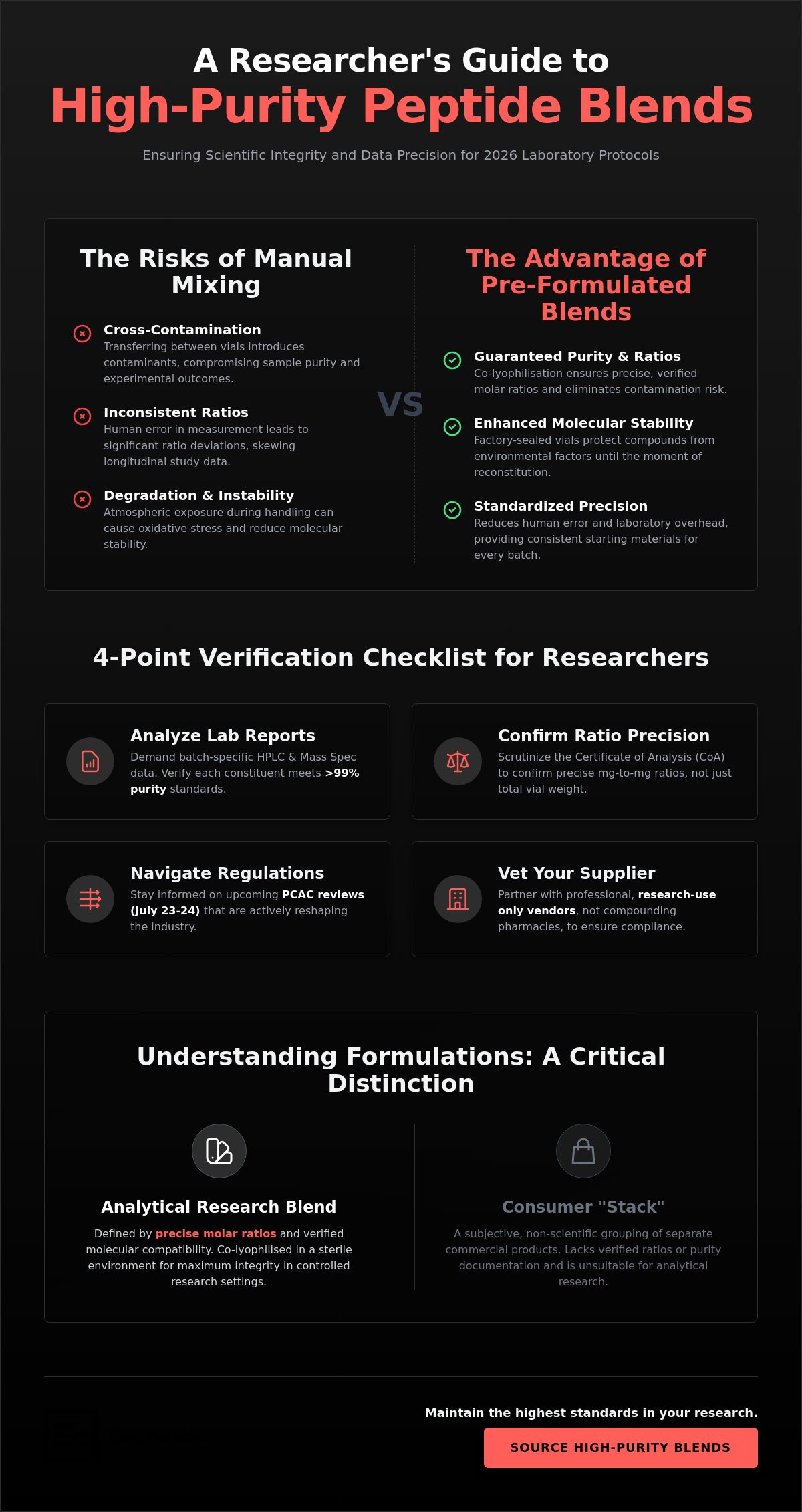
In a laboratory environment, multi-compound peptide formulations represent the co-lyophilisation of two or more distinct amino acid chains within a single sterile vial. This process is strictly distinct from the consumer-centric "stacks" found in the commercial marketplace. While a stack often implies a subjective grouping of products for varied end-goals, an analytical research blend is defined by precise molar ratios and verified molecular compatibility. Scientific integrity requires a baseline Understanding Peptides and their structural classifications to ensure that these combinations don't result in unintended degradation or precipitation during reconstitution. For researchers, the transition to pre-formulated blends in 2026 protocols reflects a move toward standardized analytical precision.
Molecular Synergy vs. Manual Compound Mixing
Manual reconstitution of individual compounds introduces several variables that can compromise data accuracy. The risk of cross-contamination during the transfer between vials is a significant concern in high-throughput environments. By utilizing peptide blends for research, laboratories can eliminate the procedural step of manual mixing, thereby reducing the margin for human error. Pre-formulated blends ensure that every research batch maintains a consistent concentration ratio. This consistency is vital for longitudinal stability profiling, where even a minor deviation in the molarity of one component can skew the results of a multi-vial study. Standardized blends also mitigate the risk of oxidative stress that can occur when compounds are exposed to the atmosphere during repeated manual handling. When high-purity integrity is required, the use of factory-sealed blends is preferred over manual laboratory manipulation.
The Role of Multi-Compounds in Pathway Interaction Modelling
The biochemical rationale for utilizing multi-compound formulations lies in the observation of molecular synergy within specific biological pathways. Researchers often investigate how dual-agonist peptides, such as a blend of BPC-157 and TB-500, interact at the cellular level to influence tissue repair mechanisms. These interactions are complex and require high-purity materials to isolate specific cellular responses. Utilizing peptide blends for research allows for the documentation of molecular compatibility within a single lyophilised state, ensuring that the compounds remain stable until the moment of activation. This is particularly relevant in metabolic and neuroscience research frameworks where pathway interaction modelling requires the simultaneous presence of multiple ligands to activate disparate but related receptor sites. The use of pre-formulated blends ensures that these interactions are studied under controlled, reproducible conditions, which is essential for the validation of experimental data in 2026 laboratory standards.
Key Evaluation Factors for Multi-Compound Formulations
Validating the integrity of multi-compound formulations requires a more sophisticated analytical approach than single-peptide assessments. While the therapeutic pathways for individual amino acid chains are often documented in literature regarding FDA Peptide Approvals, the evaluation of peptide blends for research demands batch-specific verification. A standard HPLC report for a blend will show multiple primary peaks. It's essential that the source laboratory provides documentation that identifies each peak and confirms that no degradation occurred during the co-lyophilisation process. Mass Spectrometry (MS) is equally vital, as it confirms the precise molecular weight of each constituent, ensuring the identity of the compounds matches the intended formulation. Adherence to GMP-compliant standards ensures that environmental controls are strictly maintained, preventing cross-contamination that would compromise experimental results.
Ratio Precision and Concentration Accuracy
Precision in milligram-to-milligram ratios is fundamental for reproducible data. A common error in procurement involves misinterpreting total vial weight versus individual compound mass. For example, a vial labeled as 10mg might contain a 5mg/5mg split, but without verified concentration data, the actual ratio may deviate. This deviation can introduce significant variables into metabolic or neuroscience research. Researchers should scrutinize the Certificate of Analysis to ensure the peak area integration reflects the intended concentration. Identifying under-dosed blends is a necessary step in maintaining scientific integrity. Some vendors use proprietary labeling to obscure exact ratios, which is a significant red flag for analytical research. Laboratories requiring verified, high-stability compounds can examine the multi-compound collection to review batch-specific analytical data.
Compatibility of Lyophilisation Parameters
Lyophilisation is a delicate thermodynamic process. Peptides don't always share the same stability requirements. Some require specific temperature ramps to avoid molecular cleavage, while others are sensitive to vacuum pressure levels. If compounds with conflicting requirements are processed together, one may suffer from aggregation or reduced bioactivity. When sourcing peptide blends for research, understanding the compatibility of these lyophilisation parameters is essential for ensuring that the final product remains viable for the duration of the study. Vacuum-sealed vials are the standard for preventing hydrolysis and ensuring long-term stability. The presence of a consistent, uniform cake within the vial is a visual indicator of a successful freeze-drying cycle, though it doesn't replace the need for mass spectrometry verification. Proper sealing also protects the compounds from atmospheric moisture, which is the primary driver of peptide degradation once the vacuum is breached.
Featured Formulations in the Multi-Compound Collection
The Multi-Compound collection is engineered for advanced molecular interaction studies, focusing on high-purity formulations that target metabolic and cellular health pathways. Every vial is accompanied by batch-specific HPLC reports to confirm the analytical integrity of each constituent. This commitment to transparency and quality assurance reflects the Essential Acids philosophy of "Making better, normal," providing researchers with the precision required for high-stakes laboratory work. Scientific integrity is the primary metric for these formulations, which are strictly for research-use only.
Tissue Repair Modelling: BPC-157 and TB-500 Formulations
BPC-157 and TB-500 are frequently paired to model complex tissue repair mechanisms. While BPC-157 5mg is often studied for its cytoprotective properties, its integration with TB-500 allows for the evaluation of synergistic effects on cellular response and extracellular matrix dynamics. Researchers utilize these peptide blends for research to observe how dual-compound presence influences angiogenesis and fibroblast migration. Standard concentration ratios, typically 5mg of each compound per vial, ensure that protocol consistency is maintained throughout longitudinal studies. The co-lyophilisation of these peptides prevents the variability often introduced during manual mixing in the laboratory.
Growth Hormone Secretagogue Synergy: CJC-1295 and Ipamorelin
The combination of CJC-1295 (No DAC) and Ipamorelin represents a sophisticated model for dual-pathway activation. This blend targets both the growth hormone-releasing hormone (GHRH) receptor and the ghrelin receptor simultaneously. This approach differs significantly from single-compound growth hormone research, as it allows for the observation of amplified signaling pathways. In 2026, stability considerations for secretagogue blends have become increasingly technical. Precise molar ratios are required to ensure that neither compound interferes with the receptor binding affinity of the other. High-purity secretagogue blends are essential for metabolic research frameworks where precise endocrine signaling data is required.
Advanced Analytical Blends: GHK-Cu and BPC-157
Advanced research models in dermatological and regenerative medicine often investigate the interaction between copper peptides and gastric-derived cytoprotective chains. Blends of GHK-Cu and BPC-157 are utilized to study complex cellular ageing processes and tissue regeneration. These peptide blends for research provide a stable environment for analyzing how copper ions interact with peptide structures in a lyophilised state. Identifying the molecular compatibility of these compounds is vital for ensuring that the GHK-Cu does not catalyze the oxidation of the BPC-157 chain. You may explore the full Multi-Compound collection for detailed specifications regarding the batch-specific analytical data for these advanced formulations.
Avoiding Common Procurement Errors in Research Peptides
Procurement errors in the research sector often stem from a lack of technical literacy regarding multi-component analytical reports. A primary error involves the failure to distinguish between research-grade materials and human-grade pharmaceuticals. Essential Acids maintains a strict "research-use only" policy, ensuring that all compounds are evaluated solely for their laboratory utility. Confusing these categories leads to significant regulatory and safety oversights. When sourcing peptide blends for research, the focus must remain on batch-specific data and molecular integrity rather than commercial marketing claims. Assuming all blends are created with equal molecular stability is a mistake that can compromise months of laboratory data.
Interpreting HPLC Reports for Multi-Compound Vials
A standard High-Performance Liquid Chromatography (HPLC) report for a single peptide displays one primary peak. In contrast, multi-compound vials will display distinct peaks for each constituent. A common error is assuming a single purity percentage covers the entire vial. Each component must be individually verified to meet the 99% purity threshold. If a report displays only one peak for a blend, it's a definitive red flag indicating either a mislabeled product or a failure in the testing protocol. Peak area integration must match the intended molar ratio of the formulation. Without a corresponding Mass Spectrometry (MS) report to confirm the molecular weight for each peak, the identity of the compounds remains unverified. Precision-minded researchers should verify the analytical integrity of multi-compound formulations before integrating them into longitudinal studies.
Storage and Reconstitution Risks for Complex Formulations
Molecular stability is not uniform across all compounds within a blend. It's a critical oversight to assume a blend shares the stability profile of its most resilient component. Temperature fluctuations during transit or storage can cause disparate degradation rates. For instance, one peptide in a blend might remain stable at room temperature while the other undergoes rapid hydrolysis. Best practices for reconstitution are vital to prevent molecular shearing. This occurs when a solvent is added too forcefully, physically damaging the delicate peptide chains. Research-grade solvents, such as sterile Bacteriostatic Water, are required to maintain the stability of lyophilised powders once they're activated. Using improper solvents can alter the pH of the solution, potentially causing precipitation or immediate degradation of the blended compounds. Maintaining a stable, cold-chain environment for lyophilised powders is the only way to ensure that the analytical profile remains consistent from procurement to application.
Strategic Sourcing of Peptide Blends for National Research
Strategic procurement of peptide blends for research requires a disciplined evaluation of supplier ethics and technical transparency. In 2026, the distinction between professional chemical suppliers and commercial vendors has become a primary determinant of data reliability. Scientific integrity is maintained through the exclusion of marketing hyperbole and a strict adherence to the "research-use only" designation. This professional distance ensures that the focus remains on the biochemical properties of the compounds rather than consumer trends. Selecting a supplier that prioritises clinical accuracy over traditional marketing flair is essential for maintaining the gravity of laboratory research.
The 2026 regulatory environment is characterized by increased scrutiny of peptide classifications. While the Pharmacy Compounding Advisory Committee (PCAC) reviews scheduled for July 23-24, 2026, primarily impact the compounding sector, they signal a broader shift in how high-purity peptides are perceived by regulatory bodies. National research institutions must partner with suppliers who provide immediate access to batch-specific analytical data to mitigate risks associated with shifting compliance standards. Transparent communication and data access are the foundations of a stable research supply chain.
Verifying Supplier Integrity and Scientific Standards
A supplier's "quiet authority" is demonstrated through the availability of comprehensive HPLC and Mass Spec documentation rather than aggressive sales tactics. Essential Acids prioritises clinical accuracy, ensuring that every multi-compound formulation is backed by verified data points. It's vital to partner with an entity that understands the rigid boundaries of the research-only policy. This commitment to transparency acts as a linguistic filter, ensuring that the audience understands the technical nature of the products. When a supplier avoids the casual or overly friendly tone common in modern e-commerce, it reinforces their reliability as a stable and well-regulated operation.
Optimising Laboratory Supply Chains for 2026
Streamlining procurement through pre-formulated multi-compound collections reduces the procedural burden on laboratory staff. By sourcing stable, high-purity formulations, laboratories can reduce long-term research costs associated with manual mixing and potential batch failure. This efficiency allows researchers to focus on pathway interaction modelling and longitudinal stability profiling without the overhead of manual compound preparation. You can secure high-purity peptide blends for your next research phase here.
Before finalizing any procurement, utilize this final checklist for acquiring high-purity multi-compounds:
- Confirm the availability of batch-specific HPLC and Mass Spectrometry reports for the current lot.
- Verify that a 99%+ purity rating applies to each individual component within the blend.
- Ensure the vials are vacuum-sealed and display a uniform lyophilised cake.
- Validate that the supplier maintains a strict "research-use only" policy with no references to human consumption.
- Confirm that the concentration ratios are clearly defined (e.g., 5mg/5mg) to ensure precise dosing in protocols.
Advancing Analytical Precision in Laboratory Protocols
The procurement of high-purity compounds is the foundation of reproducible scientific data. Maintaining rigorous standards in 2026 requires a technical understanding of how multi-compound vials are tested and documented. You've learned how to interpret complex analytical reports and why batch-specific verification is non-negotiable for every constituent within a blend. By prioritizing molecular stability and factory-standardized ratios, researchers can eliminate the variables introduced by manual mixing and environmental exposure. This disciplined approach to sourcing is what ensures the long-term viability of your research data.
Sourcing peptide blends for research from a partner committed to scientific integrity ensures your laboratory remains compliant with shifting regulatory frameworks while maintaining the highest levels of purity. Every vial in our collection is manufactured specifically for high-integrity research environments and is accompanied by batch-specific HPLC and Mass Spectrometry reports. We utilize temperature-controlled logistics for national shipping to guarantee that the analytical profile of your materials remains uncompromised upon arrival. This level of transparency reflects our dedication to the "research-use only" policy and the precision of your laboratory work.
Browse the Multi-Compound Collection for High-Purity Research Blends to ensure the analytical precision of your next study. We look forward to supporting your commitment to rigorous scientific discovery.
Frequently Asked Questions
Are peptide blends as stable as single-compound vials for long-term research?
Stability is maintained through precise co-lyophilisation. Blends are as stable as single-compound vials if the vacuum-sealed integrity is preserved. Pre-formulated options often surpass manual mixtures in stability because they are processed in a controlled, oxygen-free environment. This significantly reduces the risk of oxidative degradation that occurs during manual handling in the laboratory.
How do I interpret the HPLC report for a vial containing two different peptides?
Interpretation requires identifying separate primary peaks on the chromatogram. Each peak represents a distinct amino acid chain. You must ensure the area under each peak integrates to the specified concentration ratio. A valid report will provide a purity percentage for each compound individually. It shouldn't provide an averaged total for the entire vial.
What is the standard ratio for a BPC-157 and TB-500 research blend?
Laboratory protocols frequently utilize a 1:1 ratio by mass. For instance, a 10mg vial typically contains 5mg of BPC-157 and 5mg of TB-500. This standardized ratio is critical for investigating synergistic effects in cellular repair models. It ensures that results can be replicated across different research phases without concentration variables.
Can I reconstitute a multi-compound vial using standard bacteriostatic water?
Reconstitution with sterile bacteriostatic water is the standard protocol for most lyophilised peptide blends for research. The solvent should be introduced via the vial wall to minimize turbulence. This protects the delicate molecular structure from shearing. Shearing is a common risk when activating multi-compound formulations for analytical use in high-pressure environments.
Why is it preferable to purchase pre-formulated blends over manual mixing?
Pre-formulated peptide blends for research eliminate the variability and contamination risks associated with manual mixing. Factory-controlled environments ensure precise molar ratios that are difficult to replicate in a standard laboratory setting. This consistency is vital for maintaining data integrity in complex metabolic and neuroscience research frameworks where precision is mandatory.
Is there a risk of molecular interaction during the lyophilisation of a blend?
Molecular interaction is prevented by selecting peptides with compatible thermodynamic requirements. Professional laboratories calibrate freeze-drying cycles to accommodate the stability needs of all constituents. Mass Spectrometry is then employed to verify that no unintended chemical bonding or degradation occurred. This confirms the identity and integrity of each chain remains intact throughout the process.
How should multi-compound research peptides be stored to maintain integrity?
Integrity is preserved through strict temperature control. Lyophilised powders should be kept at 2°C to 8°C for immediate research or -20°C for extended storage. Post-reconstitution, the vials must be refrigerated. The stability of the entire blend is limited by the stability profile of its most sensitive component, requiring careful monitoring of the activation date.
Are these peptide blends intended for human or veterinary diagnostic use?
These compounds are strictly for research-use only. They are not manufactured for human or veterinary use. They aren't intended for diagnostic or therapeutic applications. Essential Acids maintains a disciplined focus on laboratory research, prioritizing scientific integrity and regulatory transparency. We strictly adhere to these boundaries to ensure the quality of our analytical materials.
Legal Disclaimer
All products sold on this website are intended exclusively for laboratory research purposes and not for human or veterinary use, diagnosis, cure, treatment, or prevention of any disease or condition. None of the statements on this site have been reviewed or evaluated by the U.S. Food and Drug Administration (FDA) or comparable regulatory authorities. Purchasing or using these products for any unintended purpose, including human consumption, may violate federal or local laws and poses safety risks.