

The classification of BPC-157 as a Schedule 4 Prescription Only Medicine by the Therapeutic Goods Administration (TGA) has effectively ended the era of informal peptide procurement. For scientific professionals, this shift necessitates a transition from trust-based sourcing to a rigorous adherence to Australian BPC-157 research standards. You understand that in a high-stakes laboratory environment, the difference between a breakthrough and a failed study often rests on the precise molecular sequence of your starting material. High-purity compounds are no longer a preference; they're a technical requirement for valid data.
This technical review establishes a standardized framework for verifying molecular integrity in 2026. We provide a comprehensive analysis of analytical verification standards, including the critical interpretation of batch-specific HPLC and Mass Spectrometry reports. By examining these protocols, you'll gain the clarity needed to ensure regulatory compliance and scientific integrity within your research facility. We'll preview the specific analytical benchmarks required to navigate the current Australian regulatory landscape while Essential Acids upholds its "making better, normal" philosophy through disciplined laboratory practice. This guide serves as a technical resource for those prioritizing research-use only materials of the highest verifiable grade.
Key Takeaways
- Identify the precise 15-amino acid sequence and molecular formula of BPC-157 to ensure experimental reproducibility in cellular models.
- Learn to interpret batch-specific HPLC and Mass Spectrometry reports to uphold bpc-157 research standards australia and verify analytical purity levels exceeding 99%.
- Review technical protocols for investigating BPC-157 within angiogenesis and nitric oxide pathways for musculoskeletal research applications.
- Navigate the 2026 Australian regulatory landscape by understanding the Schedule 4 classification and the ethical necessity of "research-only" procurement for laboratory use.
Molecular Profile of BPC-157: The Gastric Pentadecapeptide
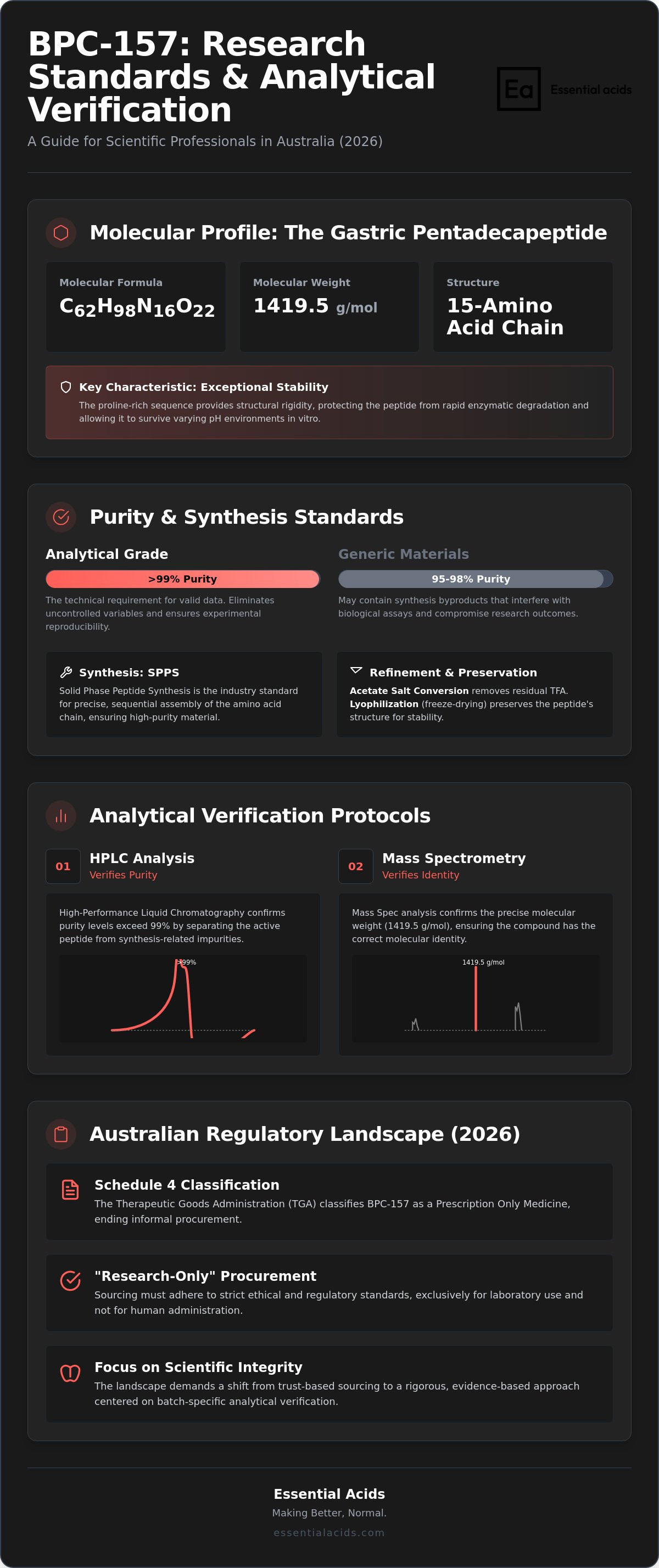
BPC-157 is defined by a precise 15-amino acid sequence: L-Valine, L-glycyl-L-prolyl-L-prolyl-L-glycyl-L-lysyl-L-prolyl-L-alanyl-L-aspartyl-L-aspartyl-L-alanyl-L-glycyl-L-leucyl-L-valyl-. This synthetic pentadecapeptide has a molecular formula of C62H98N16O22 and a precise molecular weight of 1419.5 g/mol. Historically, the compound is derived from human gastric juice. It was discovered during investigations into the body's natural defense mechanisms within the digestive tract. This BPC-157 Overview highlights its unique origin as a protective agent. Unlike many therapeutic proteins that are fragile, this sequence demonstrates exceptional stability across varying pH environments. It survives acidic conditions that would typically denature smaller peptides. This resilience is what initially drew researchers to its potential for systemic stability in controlled laboratory environments.
Amino Acid Sequence and Structural Integrity
The structural resilience of BPC-157 is largely attributed to its proline-rich sequence. Proline residues introduce structural rigidity. This rigidity protects the peptide from rapid enzymatic degradation in vitro. It's this metabolic stability that makes the compound a focus for research into cellular repair. Scientific professionals must ensure their materials meet the specific BPC-157 5mg: Molecular Profile benchmarks for 2026. Adhering to these standards is vital for maintaining experimental consistency. The sequence resists breakdown by proteases, allowing for longer interaction periods in cellular models. This characteristic is fundamental for observing long-term biological effects in musculoskeletal and gastrointestinal studies.
Synthesis Standards for Laboratory Research
Achieving the purity required by bpc-157 research standards australia requires sophisticated manufacturing. Solid Phase Peptide Synthesis (SPPS) remains the industry standard for producing high-purity research materials. This method allows for the precise, sequential assembly of the amino acid chain. A critical refinement step involves the removal of residual Trifluoroacetic acid (TFA). TFA is often used during the cleavage phase of synthesis but can interfere with biological assays. High-integrity suppliers perform an acetate salt conversion to mitigate this risk. This process replaces the TFA ions with acetate, which is significantly more biocompatible for laboratory use. It enhances the reliability of research data. Maintaining these synthesis standards ensures that the observed results reflect the activity of the peptide rather than the presence of synthetic contaminants. It's this rigorous approach that aligns with the philosophy of making better, normal, where the quality of the compound is the foundation of the research itself. For researchers in Australia, verifying these technical details is a non-negotiable step in procurement. Scientific integrity demands that every batch is accounted for with analytical precision.
Evaluating Quality Standards: Peptide Sciences and Industry Benchmarks
"Analytical grade" compounds are distinguished from generic research materials by their rigorous verification protocols. Generic materials frequently lack the batch-specific documentation required to confirm molecular identity. For researchers adhering to Molecular Data for BPC-157, the standard for a pentadecapeptide must exceed 99% purity. Generic alternatives often hover between 95% and 98%, leaving a significant margin for synthesis byproducts. These impurities don't just reduce the concentration of the active peptide; they introduce uncontrolled variables into the experimental environment. High-integrity research demands that these confounding factors are eliminated before the first assay begins.
Peptide Sciences maintains benchmarks that exceed these common industry averages. Achieving >99% purity requires multiple purification cycles through High-Performance Liquid Chromatography (HPLC). This level of precision is essential when maintaining bpc-157 research standards australia. Beyond the chemical purity, the physical state of the peptide is critical. Lyophilization, or freeze-drying, is the preferred method for preserving the secondary structure of the peptide. This process removes moisture under vacuum, creating a stable "cake" that resists degradation during transport. When housed in vacuum-sealed, sterile vials, the integrity of the compound is protected from oxidation and atmospheric moisture for long-term storage.
Purity Thresholds and Research Reproducibility
Reproducibility in cellular models is impossible without high-purity materials. Even trace amounts of residual solvents like acetonitrile or synthesis salts can trigger unintended metabolic responses. These confounding variables mask the true biological activity of the BPC-157 sequence. Standardized methods for identifying synthesis impurities, such as checking for truncated sequences or deprotected amino acids, are mandatory. Researchers should prioritize materials that provide clear evidence of these purification steps. You can review these laboratory research standards to ensure your experimental work remains grounded in empirical accuracy.
Comparative Analysis of High-Purity Suppliers
Market leaders distinguish themselves by ensuring batch-to-batch consistency in molecular weight and sequence integrity. This consistency is verified through independent third-party laboratories. Relying on a manufacturer's internal data alone creates a risk for research integrity. Essential Acids acts as a disciplined gatekeeper in the Australian market, ensuring that only materials meeting these rigorous bpc-157 research standards australia reach the laboratory. This protective approach reflects a commitment to scientific transparency. It ensures that the quality of the compounds speaks for itself, allowing researchers to focus on data collection rather than troubleshooting material quality. By maintaining a professional distance from market trends, the focus remains strictly on the precision of the laboratory.
Analytical Verification: Interpreting HPLC and Mass Spectrometry
High-Performance Liquid Chromatography (HPLC) serves as the primary analytical tool for determining the purity of research compounds. It separates the components of a sample based on their interaction with a stationary phase and a liquid mobile phase. In a high-purity environment, the goal is to achieve a "single peak" chromatogram. This indicates that the sample contains only one major substance. Any additional peaks, no matter how small, represent impurities or synthesis byproducts that could compromise bpc-157 research standards australia. It's not enough to rely on brand reputation; empirical data must drive the selection process for laboratory materials.
While HPLC measures purity, Mass Spectrometry (MS) is required to confirm the precise molecular identity of the compound. HPLC alone can't distinguish between two different molecules that happen to elute at the same time. MS works by ionizing the sample and measuring the mass-to-charge ratio of the resulting ions. For BPC-157, the analyst must identify the 1419.5 Da parent peak in the MS report. This value corresponds to the calculated molecular weight of the 15-amino acid sequence. If the report shows a different primary mass, the peptide is either incorrectly synthesized or significantly degraded. This verification ensures that the material in the vial matches the sequence on the label.
Reading the HPLC Chromatogram for Purity
Retention time is the specific duration it takes for a compound to travel through the column. This metric is used for initial identification against a known standard. The purity percentage itself is calculated using the Area Under the Curve (AUC). By comparing the area of the main peak to the total area of all detected peaks, the analyst determines the relative concentration of the target peptide. Warning signs in an HPLC report include baseline noise, shoulder peaks, or multiple elution points. These indicators suggest the presence of residual solvents or deprotected amino acids. High-integrity laboratories don't accept batches where these anomalies are present.
Mass Spectrometry: Confirming Molecular Identity
MS analysis is critical for differentiating BPC-157 from truncated sequences. These are chains where one or more amino acids failed to attach during synthesis. A truncated sequence might still show a clean HPLC peak, but it will fail MS verification because its mass will be lower than 1419.5 Da. Batch-specific documentation is essential for full laboratory transparency. It provides an empirical trail that supports the scientific integrity of your study. For detailed procurement protocols, researchers should consult the Buy Research Peptides Australia guide. This document outlines the necessary steps for ensuring that materials meet the required bpc-157 research standards australia for 2026. Maintaining these standards is the only way to ensure that research outcomes are reproducible and valid.
Laboratory Research Applications and Stability Protocols
Current investigations into BPC-157 prioritize its role in angiogenesis and the modulation of nitric oxide pathways. In musculoskeletal research, these pathways are examined for their influence on cellular proliferation and the acceleration of tissue repair models. Gastrointestinal cellular models provide a separate framework for observing fibroblast migration, specifically how the peptide interacts with the extracellular matrix. Adhering to bpc-157 research standards australia ensures that these observations are not skewed by degraded materials or microbial interference. The inclusion of BAC Water during reconstitution is a technical requirement to maintain a sterile environment throughout the duration of multi-day protocols.
Reconstitution and Storage in the Laboratory
Standardized reconstitution volumes for 5mg BPC-157 vials are typically determined by the desired concentration for micro-dosing in cellular assays. Lyophilized powder maintains high stability when stored at -20°C, often remaining viable for several years if the vacuum seal remains intact. Upon reconstitution, the peptide enters a more fragile state. It must be stored at 4°C and protected from thermal fluctuations. Mechanical agitation, such as vortexing, is discouraged because the physical stress can shear the delicate peptide bonds. UV light exposure is another critical variable; vials should be stored in dark environments to prevent photochemical degradation. These storage protocols are essential for maintaining the scientific integrity of the compound over the course of an active study.
Mechanistic Pathways in Cellular Research
Mechanistic research often focuses on the upregulation of VEGFR2 expression in endothelial cell models. VEGFR2 is a primary mediator of the effects of vascular endothelial growth factor, and its expression is a key marker in angiogenesis studies. Fibroblast migration is another area of interest, specifically the modulation of the FAK-paxillin pathway. This pathway is integral to the formation and turnover of focal adhesions, which are necessary for cell movement. Researchers also utilize BPC-157 to investigate its protective influence against NSAID-induced damage in in vitro models, particularly within gastric mucosal cell lines. These studies help define the peptide's utility in counteracting metabolic stressors while maintaining the highest bpc-157 research standards australia. Researchers requiring high-purity materials for these complex protocols can source analytically verified compounds from Essential Acids to ensure experimental reliability and reproducibility.
Procurement Compliance and Scientific Integrity in 2026
BPC-157 remains strictly classified as a Schedule 4 (Prescription Only) substance in Australia. This regulatory status, which was fully implemented on June 1, 2024, establishes a firm legal boundary between therapeutic application and laboratory investigation. For scientific professionals, this classification necessitates a disciplined approach to procurement. Researchers have an ethical responsibility to ensure that their materials are sourced exclusively for "research-use only" applications. Sourcing compounds that lack batch-specific analytical verification introduces both legal and scientific risks. In the 2026 landscape, high-purity materials are the only acceptable standard for organizations prioritizing scientific integrity and regulatory compliance.
The gravity of laboratory research requires a supplier that prioritizes accuracy over marketing flair. Essential Acids maintains a clinical, high-integrity professionalism that reflects the serious nature of biochemical study. This commitment is evidenced by the provision of detailed HPLC and Mass Spectrometry reports for every batch. By maintaining a professional distance from consumer trends, the focus remains on the precision of the laboratory. This "quiet authority" ensures that the quality of the compounds speaks for itself, allowing researchers to adhere to the most rigorous bpc-157 research standards australia without compromise.
Identifying Reliable Research Partners in Australia
Selecting a supplier in the Australian market requires a focus on analytical transparency and specialized expertise. A reliable partner should offer a specialized biochemistry catalog that includes high-purity compounds like 5-Amino-1MQ and various metabolic research agents. Criteria for selection must include the availability of clear disclaimers regarding the prohibition of human and veterinary consumption. These disclaimers aren't merely legal formalities; they are indicators of a supplier’s commitment to the rules of the scientific community. Essential Acids maintains its status as a disciplined scientific gatekeeper by using highly specific biological classifications for its materials. This acts as a linguistic filter to ensure the audience understands the technical and restricted nature of the products.
Trends in Peptide Innovation for 2026
Emerging research in 2026 is increasingly focused on the intersections of metabolic health and neuroscience. Pentadecapeptides like BPC-157 are being utilized in complex in vitro models to study cellular ageing and metabolic signaling. There is a growing trend toward multivariate studies where BPC-157 is integrated with other compounds, such as TB-500, to observe synergistic biological effects in tissue models. These advanced protocols require materials that meet the highest bpc-157 research standards australia to ensure experimental reproducibility. The future of peptide research lies in this intersection of precision and innovation. By adhering to these rigorous standards, the scientific community continues the pursuit of "making better, normal" through objective and cautious exploration. Explore the Essential Acids research catalog for high-purity BPC-157.
Standardizing Analytical Integrity for Future Peptide Investigations
The establishment of rigorous bpc-157 research standards australia marks a necessary shift toward empirical transparency in the laboratory. Maintaining the molecular integrity of the 15-amino acid sequence requires consistent verification through batch-specific HPLC and Mass Spectrometry. You've identified that >99% purity and the 1419.5 Da parent peak are the only acceptable benchmarks for reproducible research in cellular models. As the 2026 regulatory landscape evolves, the commitment to research-only compliance ensures that your data remains untainted by synthetic impurities or legal ambiguity.
You can secure high-purity BPC-157 for your laboratory research at Essential Acids. Our specialized catalog is curated by biochemists and includes batch-specific HPLC/MS reports as a standard requirement. We don't compromise on scientific integrity; we provide the disciplined gatekeeping necessary for high-level Australian facilities. By prioritizing these analytical standards, you ensure that the quality of your compounds supports the gravity of your research goals. Your work continues the essential pursuit of making better, normal through precise scientific discovery.
Frequently Asked Questions
Is BPC-157 from Peptide Sciences intended for human consumption?
No, BPC-157 is strictly classified for laboratory research use only and isn't intended for human or veterinary consumption. This adherence to legal boundaries is a core component of scientific integrity. Any deviation from this research-only policy contradicts the intended application of the compound within a controlled laboratory environment and violates regulatory standards.
What is the required purity level for BPC-157 in laboratory research?
Analytical grade BPC-157 requires a purity level exceeding 99% as verified by High-Performance Liquid Chromatography (HPLC). This threshold's essential for eliminating confounding variables like residual synthesis salts or truncated sequences. High-purity materials ensure that observed biological responses in cellular models are attributable solely to the target pentadecapeptide rather than contaminants.
How should BPC-157 be stored in a research environment to prevent degradation?
Lyophilized BPC-157 should be stored at -20°C for long-term stability to maintain its secondary molecular structure. Once reconstituted, the solution must be kept at 4°C and protected from UV light and mechanical agitation. These protocols prevent the shearing of peptide bonds and photochemical degradation during active research protocols in the laboratory.
What is the molecular weight and formula of BPC-157?
The molecular weight of BPC-157 is precisely 1419.5 g/mol with a molecular formula of C62H98N16O22. These technical specifications allow researchers to verify the compound's identity using Mass Spectrometry. Confirming the 1419.5 Da parent peak is a fundamental step in upholding bpc-157 research standards australia and ensuring batch-specific accuracy.
Can BPC-157 be reconstituted with sterile water instead of bacteriostatic water?
Sterile water is an option for immediate single-use applications, but bacteriostatic water (BAC Water) is the standard for research requiring multi-dose vials. The inclusion of 0.9% benzyl alcohol in BAC Water inhibits microbial growth. This is critical for maintaining a sterile environment in longitudinal in vitro studies where vials are accessed multiple times.
What does a single peak on an HPLC chromatogram indicate for BPC-157?
A single peak on an HPLC chromatogram indicates that the sample contains one primary substance with negligible impurities. In the context of BPC-157, this "single peak" requirement signifies that synthesis byproducts have been successfully removed through multiple purification cycles. Multiple peaks or baseline noise suggest the presence of contaminants that could compromise the reliability of experimental data.
Are high-purity research peptides available for laboratory use in Australia?
High-purity research peptides are available to Australian laboratories through specialized suppliers that provide batch-specific analytical documentation. These materials must be handled in accordance with the TGA Schedule 4 classification implemented on June 1, 2024. Adhering to bpc-157 research standards australia ensures that procurement remains compliant with local regulations for research-only materials.
How does BPC-157 maintain molecular stability in research models?
BPC-157 maintains molecular stability through its proline-rich 15-amino acid sequence, which provides structural rigidity. This configuration allows the peptide to resist enzymatic degradation by proteases in varying pH environments. This inherent resilience makes it a stable tool for investigating metabolic pathways and cellular repair mechanisms in various laboratory-controlled models.
Legal Disclaimer
All products sold on this website are intended exclusively for laboratory research purposes and not for human or veterinary use, diagnosis, cure, treatment, or prevention of any disease or condition. None of the statements on this site have been reviewed or evaluated by the U.S. Food and Drug Administration (FDA) or comparable regulatory authorities. Purchasing or using these products for any unintended purpose, including human consumption, may violate federal or local laws and poses safety risks.