

In the Australian research landscape, the value of a peptide isn't found in its promise, but in its proven molecular integrity. With the Therapeutic Goods Administration (TGA) designating unapproved peptides as a primary compliance priority for 2026, the margin for analytical error has effectively disappeared. Researchers frequently encounter the frustration of inconsistent batch quality and the technical burden of interpreting complex HPLC or Mass Spectrometry reports. When sourcing peptides australia, the distinction between a commercial grade product and a verified research compound is defined strictly by its chemical data.
You likely recognize that the validity of any laboratory outcome depends entirely on the purity of your reagents. This article provides a clinical and comprehensive overview of the Australian peptide research landscape, focusing on molecular verification and regulatory compliance. We will analyze the specific frameworks required to verify peptide purity, clarify the current legal standing of research-only materials, and outline the protocols for procuring locally stocked, analytical-grade compounds. By prioritizing scientific integrity over market trends, we aim to support the research community in making better, normal through rigorous standards.
Key Takeaways
- Define the role of short-chain amino acids as essential mediators in cellular signaling within the current 2026 Australian laboratory context.
- Learn to interpret HPLC and Mass Spectrometry data to confirm the molecular purity and identity of peptides australia before beginning laboratory trials.
- Clarify the regulatory distinction between therapeutic goods and unapproved compounds intended for non-clinical, analytical applications under TGA guidelines.
- Analyze the specific metabolic and regenerative mechanisms of leading research compounds such as 5-Amino-1MQ and BPC-157.
- Establish a rigorous procurement standard that prioritizes batch-specific verification and scientific integrity in every laboratory acquisition.
The Landscape of Peptide Research in Australia (2026)
The current state of peptides australia is defined by a rigorous return to analytical fundamentals. In 2026, the Australian laboratory landscape has moved beyond the broad exploration of basic amino acid sequences into highly specialized molecular signaling research. Peptides are short-chain amino acids that function as the fundamental building blocks of protein, acting as precise chemical messengers within biological systems. Their role in contemporary research is expansive; they drive investigations into neuroscience, cellular ageing, and metabolic regulation. This shift reflects a broader global trend where the precision of the compound determines the validity of the discovery.
Scientific validity in these studies depends entirely on molecular precision. In-vitro laboratory research allows for the isolated observation of cellular responses, a process that requires reagents of absolute purity. This is distinct from in-vivo therapeutic applications, which fall under different regulatory jurisdictions. For a researcher, even a minor variance in peptide sequence or the presence of an unverified byproduct can invalidate months of data. Integrity is the primary currency of the laboratory. Without it, the pursuit of scientific advancement is compromised by uncontrolled variables.
Molecular Diversity in Research Compounds
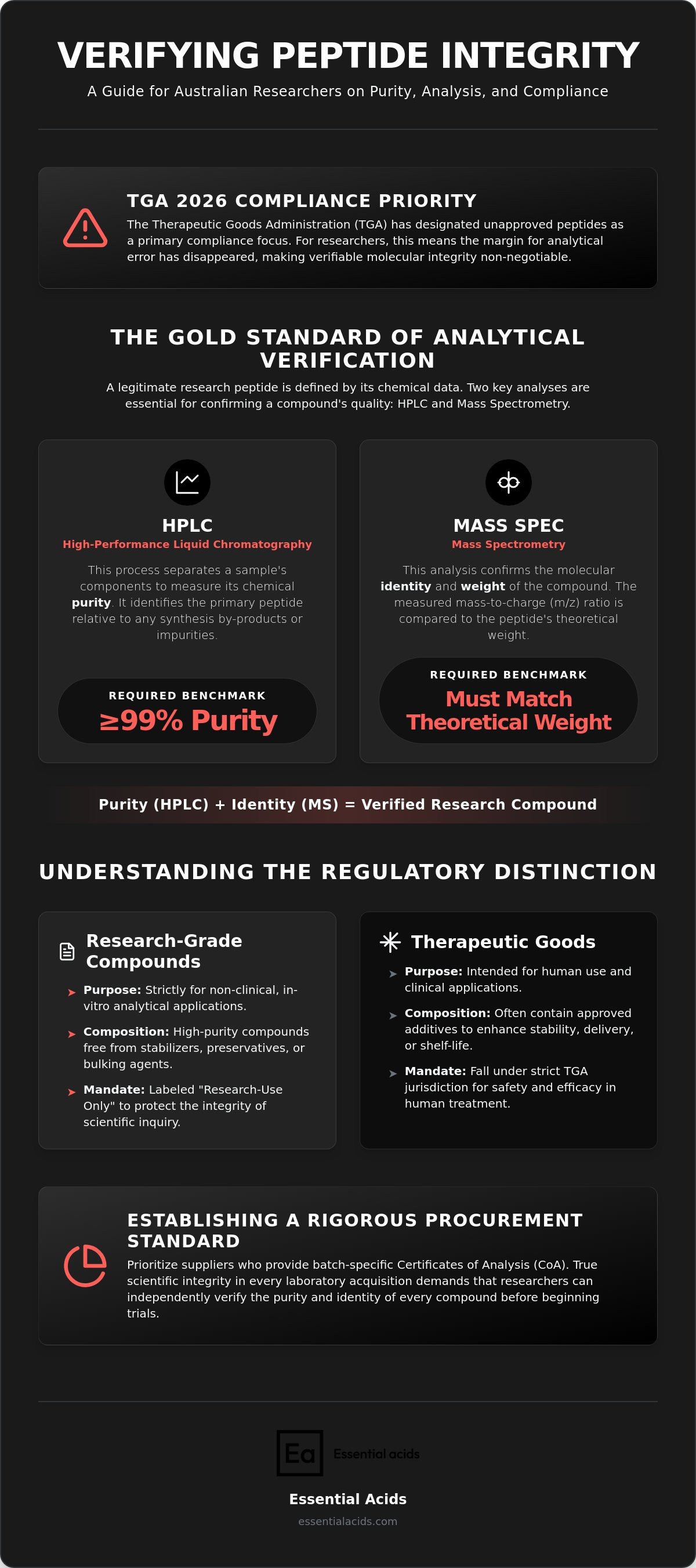
Modern research focuses on compounds with high specificity. For example, Ipamorelin remains a staple in GH-axis studies due to its selective binding properties. We also see the emergence of complex triple-agonist peptides in metabolic research, which aim to target multiple receptor pathways simultaneously. Unlike clinical formulations intended for human use, research-grade materials must be free from stabilizers, preservatives, or bulking agents. These additives are often introduced in pharmaceutical contexts but act as uncontrolled variables in a controlled laboratory environment. High-purity compounds ensure that the observed biological response is caused solely by the peptide itself.
The "Research-Only" Mandate
The "research-use only" designation is a declarative boundary that protects the integrity of scientific inquiry. It ensures that compounds are utilized strictly within controlled environments for analytical purposes. Adhering to this mandate is an ethical and legal necessity in the Australian landscape. Sourcing from suppliers who strictly enforce non-human use policies is essential for maintaining the professional distance required between the laboratory and the marketplace. This disciplined approach reflects a commitment to scientific integrity, ensuring that the focus remains on the data itself. Making better, normal starts with the precision of the tools used to explore human potential.
Analytical Verification: Interpreting HPLC and Mass Spectrometry Reports
The procurement of peptides australia requires a disciplined approach to analytical data. For the 2026 researcher, a supplier's claim of quality is secondary to the evidence provided in the Certificate of Analysis (CoA). High-Performance Liquid Chromatography (HPLC) remains the gold standard for determining chemical purity. This process separates the components of a sample, allowing for the identification of the primary peptide peak relative to any secondary peaks. A purity level of 99% or higher is generally the required benchmark for ensuring that experimental results are not skewed by synthesis by-products or residual reagents.
While HPLC confirms purity, Mass Spectrometry (MS) is utilized to confirm the molecular weight and identity of the compound. The mass-to-charge (m/z) ratio must align with the theoretical molecular weight of the specific sequence. Without this verification, a high purity reading on an HPLC report only indicates that the sample is clean, not necessarily that it is the correct peptide. Rigorous verification protocols are central to advancing Australian peptide and protein science research, where molecular accuracy is the foundation of all valid data. Researchers seeking verified compounds can review batch-specific analytical reports to ensure total consistency across laboratory trials.
Identifying Impurities in Synthetic Peptides
Impurities in synthetic peptides often arise from incomplete amino acid coupling or deprotection during the solid-phase peptide synthesis (SPPS) process. These contaminants can interfere with receptor binding studies or metabolic assays, leading to unreliable data. It is essential to cross-reference batch numbers on physical vials with the provided documentation. Reliable peptides australia suppliers provide batch-specific reports rather than generic, outdated templates. This transparency allows researchers to verify that the specific materials used in their current study meet the necessary analytical thresholds.
Stability and Storage Standards
Molecular integrity is highly dependent on stabilization through lyophilization, a freeze-drying process that removes moisture while preserving the peptide's primary structure. For laboratory storage, compounds should be kept in a desiccated environment at temperatures between -20°C and -80°C to prevent hydrolysis. When moving to the analytical phase, the selection of solvent is critical, often utilizing bacteriostatic water for laboratory reconstitution to inhibit microbial growth. Non-lyophilized peptides in an aqueous environment typically undergo significant molecular degradation within 48 hours when exposed to ambient room temperature. Maintaining these strict storage and handling protocols ensures the compound remains viable for the duration of the research period.
Regulatory Framework for Research Peptides in Australia
The regulatory environment for peptides australia is governed by the Therapeutic Goods Administration (TGA). Under the Therapeutic Goods Act 1989, any substance intended for therapeutic use must be registered on the Australian Register of Therapeutic Goods (ARTG). However, a critical distinction exists for compounds utilized strictly in non-clinical, laboratory settings. These "unapproved" peptides are not intended for human administration and therefore fall outside the ARTG registration requirement, provided they are maintained within a research-use only framework. This regulatory nuance is foundational for legitimate analytical inquiry, yet it requires strict adherence to institutional protocols.
Importation protocols have become increasingly stringent in 2026. The TGA 2026 peptide compliance priorities highlight a heightened focus on the illegal importation and supply of substances marketed for wellness or performance. For researchers, this means that sourcing must be conducted through established distributors who provide clear documentation of chemical identity. There is a sharp division between compounding pharmacies, which prepare prescription medications for patients, and research chemical distributors, who supply high-purity reagents for in-vitro studies. Conflating these two sectors introduces significant regulatory risk and compromises the formal distance required for scientific inquiry.
Compliance for Laboratory Procurement
Institutional research requires a verifiable paper trail. When professionals seek to buy research peptides Australia, the procurement process must include the acquisition of batch-specific analytical data. This documentation is essential for internal audits and ensuring that the laboratory remains compliant with workplace safety standards. Recent safety alerts regarding specific molecular variants, such as those involving the Tirzepatide structure, underscore the need for precise chemical identification. Only through rigorous documentation can the scientific community distance its work from the unregulated "grey market" and maintain its standing with regulatory bodies.
The Ethics of Scientific Integrity
Scientific integrity requires a formal, detached perspective on chemical supply. Transparent advertising that clarifies the non-human use status of these compounds is a regulatory necessity. The TGA has expressed significant concern regarding the promotion of peptides on social media platforms, where the line between research data and consumer marketing is frequently blurred. A disciplined supplier avoids these tactics, focusing instead on the technical specifications of the compounds. By maintaining these boundaries, the research community protects the long-term viability of molecular exploration. Making better, normal is a pursuit of data, not a response to market trends; therefore, the refusal to engage in aggressive marketing is a hallmark of a reliable partner.
Technical Profile: Leading Compounds in Australian Research
The selection of peptides australia for laboratory use is increasingly driven by specific molecular targets rather than broad biological observations. In 2026, research focus has narrowed toward compounds that exhibit high receptor affinity and predictable signaling pathways. 5-Amino-1MQ is a primary example, currently utilized in metabolic studies for its role as a small molecule inhibitor of nicotinamide N-methyltransferase (NNMT). By inhibiting this enzyme, researchers can observe changes in cellular energy metabolism and adipose tissue function. This precision allows for the isolation of metabolic variables that were previously difficult to quantify in in-vitro models.
Regenerative biology research continues to prioritize BPC-157 and TB-500 due to their influence on cellular response and tissue repair mechanisms. BPC-157, a pentadecapeptide, is frequently analyzed for its potential to modulate growth factor expression and nitric oxide signaling. Similarly, TB-500 acts as a synthetic analog of the naturally occurring protein Thymosin Beta-4, facilitating scientific inquiry into cellular migration and actin sequestration. For researchers conducting complex dermatological assays, GHK-Cu provides a technical framework for investigating copper peptide interactions in skin research. Researchers can access these analytical-grade compounds through our verified laboratory inventory.
Metabolic and Cellular Research
Metabolic research in 2026 demands compounds with verifiable molecular structures. 5-Amino-1MQ is valued for its ability to penetrate cellular membranes without the need for complex delivery systems, making it an efficient tool for NNMT inhibition studies. Investigating cellular aging often involves the use of Semax peptide to observe its impact on metabolic markers. Standardizing dosage for in-vitro analytical experiments is a critical step; it requires a precise understanding of the compound's concentration and purity to ensure that the resulting data is reproducible across different laboratory environments.
Neuroscience and Cognitive Studies
Neuropeptides such as Semax and Selank are central to modern neurological research models. These compounds are utilized to investigate neuroprotective pathways and the modulation of brain-derived neurotrophic factor (BDNF). Maintaining molecular stability during laboratory manipulation is a significant challenge, particularly with sensitive neuropeptide sequences that are prone to enzymatic degradation. The molecular weight of BPC-157 is calculated at 1419.45 grams per mole. By strictly controlling the analytical environment, researchers can ensure that these neuropeptides maintain their structural integrity throughout the duration of the study, leading to more accurate observations of neural signaling processes.
Essential Acids: Advancing Scientific Inquiry in Australia
Essential Acids operates as a rigorous scientific partner for the Australian research community. Our commitment is rooted in the provision of high-purity compounds that meet the exacting standards required for 2026 laboratory trials. In an industry where quality variance can invalidate months of data, we prioritize scientific integrity over commercial trends. This approach ensures that every compound in our inventory is accompanied by batch-specific analytical documentation, establishing a non-negotiable standard for laboratory procurement. By maintaining this disciplined focus, we provide the stability necessary for complex molecular exploration.
The philosophy of "Making better, normal" serves as our primary aspirational statement. It reflects a vision where scientific discovery is supported by reagents of absolute precision. We maintain a professional distance from consumer marketing to ensure that our focus remains strictly on the technical requirements of the researcher. This disciplined stance is essential for navigating the complex regulatory landscape of peptides australia, where the distinction between research materials and therapeutic goods must be clearly defined and strictly enforced. We don't engage in aggressive sales tactics; instead, the quality of our compounds is expected to speak for itself through consistent laboratory results.
The Essential Acids Standard
Scientific integrity is maintained through a policy of total transparency regarding compound purity. High-integrity professionalism is required to support the peptides australia research landscape effectively. We address the frequent pain point of supply chain instability by providing locally stocked, analytical-grade materials. This logistical advantage reduces transit-related degradation risks and ensures that researchers have consistent access to the compounds required for metabolic, neurological, and cellular ageing studies. Every compound is verified through independent third-party analysis to confirm that the molecular identity aligns with the provided specifications. This level of verification is critical for studies involving NNMT inhibition or cellular migration, where reagent purity is a primary variable.
Getting Started with Procurement
The procurement process is designed to be utilitarian and efficient, respecting the professional focus of the analytical researcher. Our digital interface allows for the seamless navigation of broad scientific categories to specific product data. Researchers can review our analytical catalog for 2026 to identify the specific sequences required for their current protocols. Accessing Certificates of Analysis for specific batches is a standard component of our service, allowing for the cross-verification of purity peaks and molecular weights before any laboratory work begins. This structured approach to chemical supply reinforces the reliability of the research environment and ensures that all materials are handled according to strict research-use only policies.
Review the Essential Acids Research Catalog to evaluate our current inventory of high-purity laboratory reagents and access batch-specific analytical data.
Standardizing Analytical Excellence for 2026
The 2026 landscape for peptides australia is defined by a necessary shift toward absolute analytical transparency and regulatory discipline. As the TGA continues to prioritize compliance for unapproved compounds, the responsibility falls on the researcher to verify every reagent through rigorous HPLC and Mass Spectrometry protocols. Valid scientific data cannot exist without molecular certainty; therefore, batch-specific documentation is the only acceptable standard for laboratory procurement. By maintaining a strict research-use only policy, the scientific community protects the integrity of its inquiry and ensures the long-term viability of molecular exploration.
Essential Acids remains a committed partner in this pursuit, providing the specialized compounds required to advance our collective understanding of metabolic regulation and cellular ageing. We support your laboratory requirements with Australia-wide shipping and verified, high-purity materials that align with institutional safety standards. We invite you to explore high-purity research compounds at Essential Acids and access the analytical data necessary for your next discovery. We look forward to supporting your contribution to making better, normal through disciplined scientific research.
Frequently Asked Questions
Are peptides legal for research purposes in Australia?
Peptides are legal for research in Australia when they are utilized strictly for laboratory and analytical purposes within a non-clinical framework. These materials are not registered on the Australian Register of Therapeutic Goods (ARTG) because they are not intended for human administration. Researchers must ensure that procurement and use align with institutional safety protocols and the mandatory "research-use only" designation.
How do I verify the purity of a peptide batch in 2026?
Purity verification is achieved by analyzing the batch-specific High-Performance Liquid Chromatography (HPLC) and Mass Spectrometry (MS) reports provided by the supplier. The HPLC report should demonstrate a primary peak representing a purity level of 99% or higher. The Mass Spectrometry data must confirm that the observed molecular weight matches the theoretical weight of the peptide sequence to ensure identity.
What is the difference between research-grade and pharmaceutical-grade peptides?
Research-grade peptides are high-purity reagents intended for in-vitro analysis, whereas pharmaceutical-grade peptides are formulated with stabilizers and preservatives for clinical use. In a laboratory setting, the presence of these additives can act as uncontrolled variables. High-purity research compounds ensure that observed biological responses are caused solely by the peptide itself without interference from pharmaceutical excipients.
Can I buy BPC-157 for personal use in Australia?
No, it's not legal to purchase BPC-157 for personal use in Australia. These compounds are strictly restricted to laboratory and analytical research environments. The Therapeutic Goods Administration (TGA) has prioritized compliance regarding unapproved peptides to prevent illegal human use. Essential Acids maintains a firm "research-use only" policy and doesn't supply materials for non-scientific or personal applications.
How should research peptides be stored to prevent molecular degradation?
To prevent molecular degradation, lyophilized peptides should be stored in a desiccated state at temperatures of -20°C or lower. Once reconstituted, the compounds become significantly more susceptible to hydrolysis and should be kept refrigerated at 2°C to 8°C. Protecting vials from light exposure and minimizing freeze-thaw cycles is also essential for maintaining the structural integrity of the amino acid chain.
What documentation should I expect when ordering from a reputable Australian supplier?
You should expect a comprehensive Certificate of Analysis (CoA) that includes batch-specific HPLC and Mass Spectrometry data. This documentation serves as the primary verification of chemical purity and molecular identity. Reputable suppliers of peptides australia provide these reports to ensure transparency and to support the scientific integrity of the research being conducted in institutional settings.
Is a prescription required for purchasing peptides for laboratory research?
A medical prescription is not required for purchasing peptides when they are intended strictly for laboratory and analytical research. Because these compounds are not for human use, they're procured through research chemical distributors rather than clinical pharmacy channels. Researchers must provide evidence of their institutional or analytical intent to remain compliant with the peptides australia research-only designation.
What are the most common impurities found in synthetic peptides?
The most frequent impurities in synthetic peptides include truncated sequences and deletion peptides resulting from incomplete amino acid coupling. Residual trifluoroacetic acid (TFA) and other synthesis solvents can also remain if the purification process is insufficient. These contaminants can interfere with receptor binding assays, making the use of verified, high-purity compounds a requirement for reliable laboratory data.
Legal Disclaimer
All products sold on this website are intended exclusively for laboratory research purposes and not for human or veterinary use, diagnosis, cure, treatment, or prevention of any disease or condition. None of the statements on this site have been reviewed or evaluated by the U.S. Food and Drug Administration (FDA) or comparable regulatory authorities. Purchasing or using these products for any unintended purpose, including human consumption, may violate federal or local laws and poses safety risks.