

Most researchers treat compliance as a final hurdle before submission, a stack of forms to sign off before the real work begins. That framing is costly. A research compliance framework is not a legal checklist. It is an institution-wide system of policies, roles, procedures, and oversight mechanisms that governs every stage of a study, from the first line of a grant proposal through to project closeout. Understanding compliance frameworks properly means recognising them as the operational backbone of ethical, reproducible science. This guide breaks down what these frameworks contain, how they function across specialised research areas, and how you can apply them in practice.
Table of Contents
- Key takeaways
- What is a research compliance framework?
- Core elements of effective compliance programmes
- Specialised compliance areas: IRB, biosafety, and research security
- Navigating foreign components and evolving regulations
- Implementing compliance in daily research practice
- My perspective on compliance as a research culture problem
- Research peptides for compliant laboratory studies
- Common questions
Key takeaways
| Point | Details |
|---|---|
| Frameworks span the full lifecycle | Compliance obligations begin at proposal stage and continue through project closeout, not just during data collection. |
| Seven core elements apply broadly | The OIG model of written policies, oversight, training, communication, enforcement, risk assessment, and corrective action underpins most effective programmes. |
| Specialised areas need tailored controls | Human-subject research, biosafety, and research security each require dedicated committees, approval workflows, and documentation standards. |
| Foreign collaborations carry hidden risk | NIH-funded projects with overseas components require early disclosure and consultation to avoid misclassification and audit exposure. |
| Compliance is a culture, not a process | Sustainable adherence depends on leadership engagement, continuous training, and proactive communication across research teams. |
What is a research compliance framework?
A research compliance framework is an institution-wide structure integrating policies, defined roles, and documented procedures that together govern how research is conducted, monitored, and reported. The word “framework” matters here. It is not a single policy document or a departmental checklist. It is the architecture that connects your institution’s obligations under federal regulations, sponsor requirements, ethical standards, and internal governance into a coherent, navigable system.
The scope is broader than most researchers assume. Compliance obligations attach to every stage of the research lifecycle. At the proposal stage, your framework governs how you disclose conflicts of interest, identify foreign collaborators, and confirm that proposed methods meet regulatory requirements. During award management, it dictates how funds are tracked, how personnel changes are reported, and how protocol amendments are handled. At data collection, it controls how human subjects are protected, how biosafety procedures are followed, and how data is stored and accessed. At closeout, it determines how final reports are filed and how records are retained.
The importance of research compliance at each of these stages is not abstract. Failures at any point can trigger audit findings, funding suspensions, or reputational damage that affects future grant competitiveness. The USC Research Compliance policy is a useful reference point here: it frames compliance as lifecycle-based, explicitly rejecting the idea that compliance is a one-time event.
Institutions typically organise their frameworks around several key components:
- Written policies and procedures that translate regulatory requirements into operational instructions
- Designated roles including a Compliance Officer, department administrators, and specialised committee members
- Oversight committees such as the Institutional Review Board (IRB), Institutional Biosafety Committee (IBC), and research security working groups
- Training programmes that build compliance knowledge across research staff at all levels
- Monitoring and reporting mechanisms that generate evidence of adherence and flag potential issues early
Understanding compliance frameworks at this structural level changes how you interact with them. You stop seeing compliance as something done to your research and start seeing it as something built into your research.
Core elements of effective compliance programmes
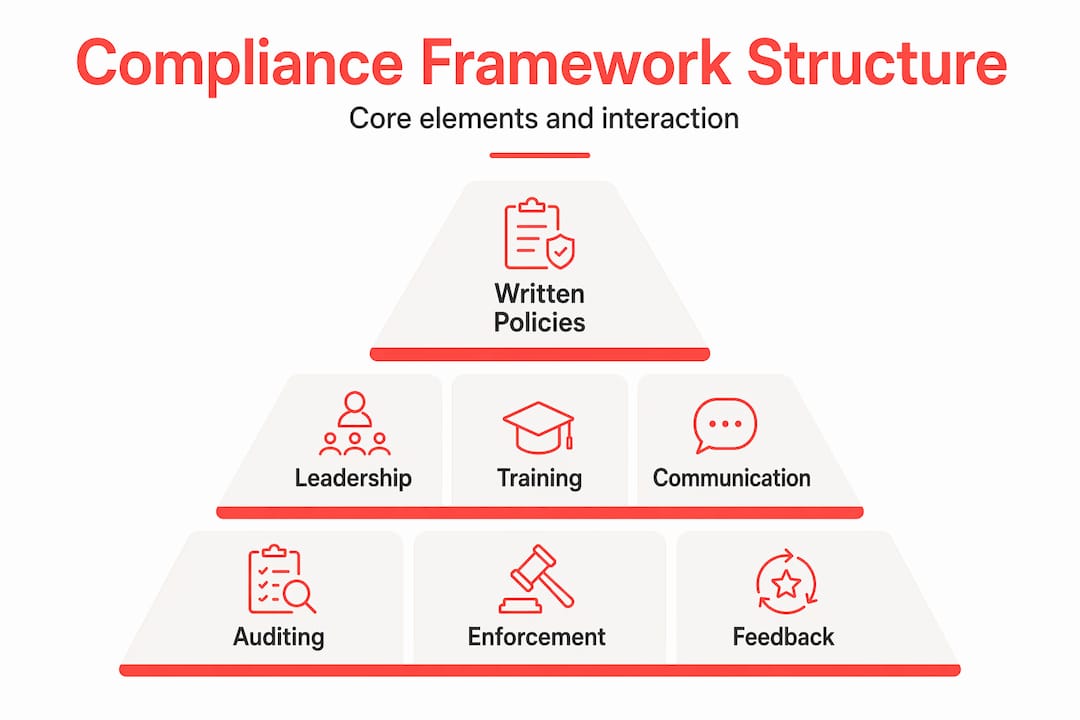
The most widely referenced model for structuring a research compliance programme comes from the Office of Inspector General. The OIG Seven Basic Elements provide a practical blueprint that most research institutions adapt to their own context. Each element addresses a distinct operational need.
-
Written policies and procedures. These are the foundation. Every compliance obligation, whether it relates to human subjects, financial management, or export controls, needs to be translated into a documented procedure that researchers and staff can actually follow.
-
Designated compliance leadership and oversight. A Compliance Officer and supporting committee structure provide the governance layer. Without named accountability, compliance responsibilities diffuse across departments and nothing gets enforced consistently.
-
Training and education. Compliance knowledge does not transfer by osmosis. Structured training, delivered at onboarding and refreshed regularly, is what converts written policy into researcher behaviour.
-
Open lines of communication. Researchers need clear channels to ask questions, report concerns, and receive guidance without fear of reprisal. Anonymous reporting mechanisms are a standard feature of mature frameworks.
-
Enforcement and disciplinary guidelines. Frameworks without consequences are suggestions. Defined responses to non-compliance, proportionate to severity, signal that the institution takes its obligations seriously.
-
Risk assessment and monitoring. Risk-based auditing shifts the focus from reactive rule-checking to proactive problem identification. Institutions that audit by risk profile catch issues before they become findings.
-
Response and corrective action. When problems are identified, the framework must specify how they are investigated, remediated, and documented. This is what turns a compliance incident into a learning event rather than a recurring failure.
Pro Tip: When reviewing your institution’s compliance programme, map each of these seven elements against your current documentation. Gaps in any single element tend to create cascading vulnerabilities across the others.
The key components of a compliance framework are not independent modules. They interact. Strong written policies mean nothing if training does not reach the researchers who need it. Enforcement mechanisms only work if communication channels allow issues to surface in the first place. Treat the seven elements as an integrated system, not a checklist.

Specialised compliance areas: IRB, biosafety, and research security
General compliance principles apply everywhere, but three specialised areas require their own dedicated frameworks within the broader institutional structure. Each has distinct regulatory drivers, committee structures, and documentation requirements.
Human-subject research and IRB oversight
The IRB sits at the centre of human-subject research compliance. Under standard operating procedures at institutions like UWM, investigators must receive written IRB approval before commencing any research involving human participants. This is not a formality. It is a governance control that prevents premature study commencement and protects both participants and the institution.
Protocol changes during an active study require prior IRB review, with a narrow exception for urgent modifications needed to eliminate immediate hazard to participants. This feedback loop between approvals and research activity creates an auditable, defensible compliance record. If your study deviates from the approved protocol without prior review, you have a compliance breach regardless of whether any harm occurred.
Biosafety committee requirements
Biosafety compliance is governed by the Institutional Biosafety Committee and draws on NIH guidelines and the Biosafety in Microbiological and Biomedical Laboratories (BMBL) standards. Investigators working with biological materials must meet criteria that include complete, consistent documentation and ongoing risk monitoring, with findings reported to the IBC.
The practical implication is that biosafety compliance is not a pre-study approval and nothing more. It requires continuous monitoring, updated risk assessments as experimental conditions change, and documented corrective action when deviations occur.
Research security programmes
Research security is the newest of the three specialised areas and the one most institutions are still building out. The UT System research security policy mandates a programme that includes communication protocols, training, risk assessment, incident reporting, and compliance reviews led by designated officers.
The table below summarises the key features of each specialised compliance area:
| Compliance area | Governing body | Key requirement | Ongoing obligation |
|---|---|---|---|
| Human-subject research | IRB | Written approval before commencement | Prior review of all protocol changes |
| Biosafety | IBC | Risk assessment and documentation | Continuous monitoring and incident reporting |
| Research security | Designated officer/committee | Incident response and disclosure | Training, risk reviews, and communication protocols |
Each of these areas feeds into the broader institutional framework. Institutions that structure compliance around specialised committees plus a central guide mapping obligations by research stage avoid treating these areas as siloed or ad hoc responsibilities.
Navigating foreign components and evolving regulations
One of the most underestimated compliance risks in federally funded research involves foreign collaborations. Under NIH policy, foreign components are defined as significant scientific activities conducted outside the United States. The NIH enforces disclosure and approval requirements for any such components in funded projects, and nondisclosure triggers compliance reviews that can affect the entire award.
The boundary between incidental foreign travel and a reportable foreign component is not always obvious. Early consultation with your sponsored programmes office is the most reliable way to avoid misclassification. Waiting until a compliance review to clarify the distinction is a poor strategy.
Research compliance guidelines in this area are also evolving rapidly. Federal agencies have tightened disclosure requirements in recent years, and institutions are updating their research compliance policies accordingly. Staying current requires more than reading policy updates when they arrive. It requires building a process for regular policy review into your compliance programme.
Common pitfalls in this space include:
- Failing to disclose foreign collaborators at the time of application because the collaboration seems minor
- Assuming that a foreign co-investigator’s activities are covered by the domestic award without checking the definition of “significant scientific activity”
- Not updating the sponsoring agency when a foreign component is added after award
Pro Tip: If you are unsure whether an overseas collaboration qualifies as a foreign component under your NIH award, consult your Office of Sponsored Programmes before the work begins. Retroactive disclosure is significantly more complicated than proactive notification.
Frameworks that handle these complexities well share a common feature: they build early consultation into the workflow rather than treating compliance review as a final gate.
Implementing compliance in daily research practice
Knowing how to ensure research compliance at the institutional level is one thing. Translating that into daily research practice is where most teams struggle. The gap between policy and practice is usually a training and communication problem, not a policy problem.
Practical steps for researchers and institutional professionals include:
- Map your compliance obligations by project stage. Before a project begins, identify every regulatory, ethical, and sponsor requirement that applies at each stage. Your sponsored programmes or research compliance office should have a lifecycle guide that makes this mapping straightforward.
- Assign clear compliance roles within your team. The principal investigator holds ultimate responsibility, but day-to-day compliance tasks need named owners. Ambiguity about who submits IRB amendments or who tracks biosafety documentation creates gaps.
- Build training into your onboarding process. Every new team member working on a regulated project should complete relevant compliance training before they begin work, not after their first protocol deviation.
- Use your reporting channels. If you identify a potential compliance issue, report it through the designated channel immediately. Self-reporting before an audit finding is treated very differently from a problem discovered during external review.
- Schedule compliance check-ins throughout the project. Compliance is not front-loaded. A mid-project review of your protocol adherence, data management practices, and financial reporting is standard practice in well-run research programmes.
The continuous nature of compliance across the research lifecycle is what makes it operationally demanding. It also makes it genuinely protective. Institutions that treat compliance as a living practice rather than a pre-study formality generate better audit outcomes, stronger data integrity, and more defensible research records.
My perspective on compliance as a research culture problem
I have watched researchers treat compliance frameworks as bureaucratic overhead for years, and I understand the frustration. The paperwork is real. The approval timelines are real. But in my experience, the institutions that struggle most with compliance are not the ones with bad policies. They are the ones where leadership has never made compliance feel like a shared professional value.
The lifecycle approach changes this. When researchers understand that compliance obligations attach to every stage of their work, not just the ethics approval at the start, they stop treating it as someone else’s problem. The risk-based auditing model reinforces this shift. When your institution audits by risk profile rather than by calendar, researchers learn that their compliance behaviour has direct consequences for how closely their work is scrutinised.
What I have found actually works is early education combined with visible leadership engagement. When a department head treats a compliance training session as worth their time, their team notices. When a Compliance Officer is accessible for early consultation rather than only appearing when something goes wrong, researchers use them. The frameworks are largely sound. The cultural embedding is where most institutions have room to improve.
— Michael
Research peptides for compliant laboratory studies
Compliance frameworks set the standard for how research is conducted. The compounds you use in that research need to meet the same standard.
Essentialacids supplies high-purity research peptides specifically for laboratory use, with batch-specific Certificates of Analysis provided for every product. If your work involves peptide-based studies, their catalogue includes Kisspeptin-10 for research, Ipamorelin for laboratory use, and BPC-157 research peptide, each analytically tested and supplied with full documentation to support reproducible, audit-ready results. For projects requiring combination compounds, their multi-compound research formulations offer a broader set of options. All products are strictly for research use, consistent with the compliance and safety standards your framework demands.
Common questions
What is a research compliance framework?
A research compliance framework is an institution-wide system of policies, roles, procedures, and oversight mechanisms that governs research from proposal through project closeout, covering ethical, regulatory, and operational obligations.
What are the key components of a compliance framework?
The OIG model identifies seven core elements: written policies, designated leadership, training, open communication channels, enforcement mechanisms, risk-based monitoring, and corrective action processes.
Why does IRB approval matter before a study begins?
Investigators must receive written IRB approval before commencing human-subject research. Protocol changes during a study also require prior IRB review, except in urgent situations involving immediate participant hazard.
How do foreign components affect research compliance?
NIH-funded projects must disclose significant scientific activities conducted outside the United States. Nondisclosure triggers compliance reviews, making early consultation with your sponsored programmes office critical.
How does a risk-based approach improve compliance?
Risk-based auditing shifts compliance monitoring from routine calendar reviews to targeted scrutiny of higher-risk activities, allowing institutions to identify and address problems before they escalate into formal findings.