

A certificate of analysis without raw HPLC data is an unsubstantiated claim that risks the entire foundation of a laboratory protocol. You likely understand the frustration of receiving inconsistent batch results or documentation that fails to account for molecular degradation during transit. It's difficult to maintain scientific integrity when the primary materials lack transparent verification. This technical overview clarifies the standards required for procuring high-purity research grade peptides in 2026, focusing on data-driven procurement and analytical precision.
We'll analyze the nuances of HPLC and MS reports, evaluate stability protocols for sensitive compounds, and establish a framework for securing a reliable supply chain. By prioritizing objective data over marketing assertions, researchers can ensure their work remains grounded in verifiable molecular integrity. This guide serves as a utilitarian roadmap for navigating the complexities of modern laboratory standards for research-use only compounds. Our objective is to facilitate the transition from procurement uncertainty to a disciplined, data-first methodology for all laboratory applications.
Key Takeaways
- Establish the 98% purity threshold as the mandatory baseline for maintaining scientific integrity in all laboratory settings.
- Master the interpretation of HPLC and Mass Spectrometry reports to verify the exact molecular identity and sequence purity of each compound.
- Implement standardized reconstitution protocols to preserve the stability of lyophilised research grade peptides during extended metabolic studies.
- Analyze the molecular mechanisms of 5-Amino-1MQ, specifically its role as a targeted NNMT inhibitor in cellular energy expenditure research.
- Secure a reliable laboratory supply chain by prioritizing providers who offer batch-specific analytical documentation and transparent verification.
Defining Research Grade Peptides: Standards and Purity Tiers
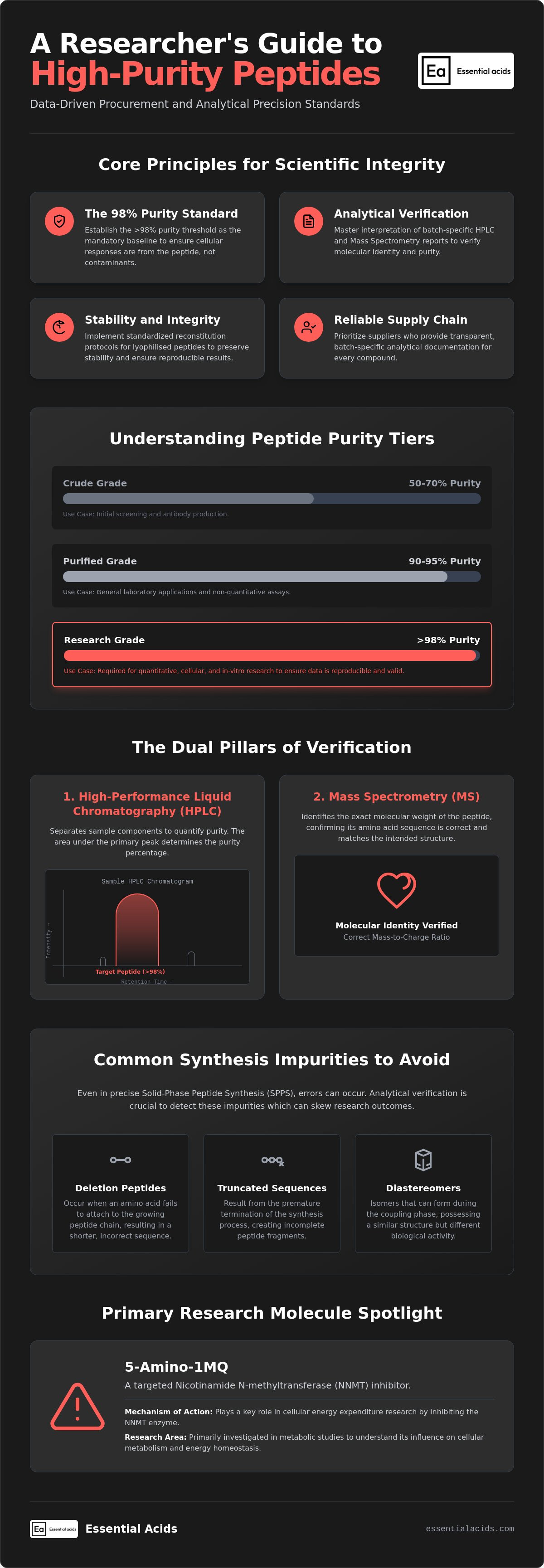
Research grade peptides represent a specific category of biochemical sequences synthesized for rigorous laboratory investigation. These compounds are strictly intended for in vitro research and are not classified as human grade pharmaceuticals or medical treatments. In the professional laboratory environment, the term "purity" isn't a subjective marketing adjective; it's a quantifiable metric. While some suppliers use "high purity" as a vague catch-all, scientific integrity requires a distinction between crude, purified, and analytical grades. Crude peptides, often used for initial screening, typically range from 50% to 70% purity. Purified grades reach 90% to 95%. However, true research grade peptides must meet a threshold of 98% or higher to ensure that cellular responses are the result of the peptide itself, not contaminating byproducts. This distinction is critical in an Australian regulatory context, where research chemicals are strictly excluded from therapeutic or veterinary use.
The Molecular Anatomy of Synthetic Peptides
Most research compounds are produced via Solid-Phase Peptide synthesis (SPPS). This process involves the sequential addition of protected amino acids to a resin-bound chain. Despite the precision of modern automated synthesizers, the process isn't infallible. Common impurities include:
- Deletion peptides: These occur when an amino acid fails to attach to the growing chain.
- Truncated sequences: These result from premature termination of the synthesis process.
- Diastereomers: These are isomers that can form during the coupling phase.
Maintaining sequence accuracy is vital for ensuring that data collected during neurological or metabolic research is reproducible. These impurities can mimic the target peptide's structure, potentially interfering with binding assays or receptor interactions. Accurate research grade peptides must be verified to ensure the amino acid sequence matches the intended molecular design without structural deviation.
Purity Thresholds and Laboratory Accuracy
The 98% benchmark isn't arbitrary. It's the industry standard for minimizing the influence of residual solvents and salts. During the purification process, trifluoroacetic acid (TFA) is frequently used as a counter-ion. If not properly removed or documented, residual TFA can exhibit cytotoxic effects in cell cultures, skewing research outcomes. Beyond chemical purity, molecular stability is maintained through lyophilisation. This freeze-drying process removes moisture while preserving the peptide's structural integrity. It's the most reliable method for long-term storage, preventing the hydrolysis and oxidation that often plague liquid formulations. Scientific gatekeepers prioritize these technical details because a single failed batch can invalidate months of laboratory work.
Analytical Verification: Interpreting HPLC and Mass Spectrometry Reports
Scientific integrity in metabolic or neuroscience research relies on the absolute verification of the compounds used. Relying on a "representative" Certificate of Analysis (COA) is a procedural failure that introduces unnecessary variables into a study. It's a risk that most disciplined researchers are unwilling to take. Every batch of research grade peptides must be accompanied by its own specific data set to ensure consistency across trials. High-Performance Liquid Chromatography (HPLC) and Mass Spectrometry (MS) are the dual pillars of this verification process. Together, they define both the purity and the identity of the molecule, providing a high-resolution view of the sample's chemical composition and ensuring that the laboratory standards are met with precision.
Reading the HPLC Chromatogram
HPLC separates a sample into its individual chemical components. The resulting chromatogram displays these as peaks over a timeline known as retention time. Purity is calculated by the "Area Under the Curve" (AUC) of the primary peak relative to any secondary peaks. If a report shows multiple significant spikes, it indicates the presence of synthesis byproducts or degradation. Analytical HPLC is used for these precise measurements, whereas preparative HPLC is the process used to purify the compound during manufacturing. Adherence to Regulatory Guidelines for Peptide Analysis ensures that baseline noise is correctly distinguished from actual contaminants. Researchers should scrutinize the baseline for drift or excessive noise when evaluating research grade peptides, as this may suggest poor equipment calibration.
Verifying Molecular Weight with Mass Spectrometry
While HPLC determines purity, Mass Spectrometry confirms identity. It measures the mass-to-charge ratio of the ionized peptide. Electrospray ionisation (ESI) is typically used to gently ionise the sample without causing fragmentation. The observed mass on the MS report must align with the theoretical mass based on the amino acid sequence. MS data prevents the misidentification of isomeric sequences that might otherwise appear identical on an HPLC chromatogram. Discrepancies as small as one Dalton can signal an incorrect amino acid substitution or a missing protective group. For those requiring verified compounds, reviewing batch-specific analytical data is a necessary step before beginning any laboratory protocol. This level of technical scrutiny is essential for maintaining the quiet authority of well-documented research results.
Stability and Reconstitution: Maintaining Research Integrity
Analytical verification establishes the identity of a compound at the point of manufacture, but the preservation of that data depends on the researcher's handling protocols. Once research grade peptides reach the laboratory, their molecular integrity is subject to environmental stressors. Lyophilisation, or freeze-drying, serves as the primary defense against degradation by removing the moisture required for hydrolysis. This state offers the highest level of long-term stability, provided that cold-chain logistics are strictly observed. Exposure to ambient temperatures during transit or storage can compromise the secondary structure of sensitive sequences, rendering the analytical data from the manufacturer irrelevant. It's vital to maintain a disciplined approach to storage to ensure that experimental results remain reproducible.
The Chemistry of Reconstitution
The choice of diluent is a critical variable in experimental design. While sterile saline is often used for immediate applications, BAC Water is preferred for multi-use research vials due to the presence of 0.9% benzyl alcohol, which inhibits microbial growth. Adhering to best practices for peptide reference standards involves monitoring the pH of the final solution. Extreme pH levels can lead to rapid deamidation or precipitation, effectively destroying the sample's utility. Handling delicate sequences requires a cautious approach; mechanical shear stress from aggressive shaking can denature the peptide. Instead, a gentle swirling motion is used to achieve a homogenous solution without disrupting the molecular bonds. Precision at this stage is just as important as the initial purity of the research grade peptides themselves.
Storage Life Cycles for Research Materials
Lyophilised vials are stable for several years when stored at -20°C or -80°C in a deep-freeze environment. Once reconstituted, however, the stability window narrows significantly. Liquid state peptides are highly vulnerable to oxidation and deamidation. To mitigate this risk, researchers should employ aliquotting. This involves dividing the solution into smaller, single-use volumes to avoid repeated freeze-thaw cycles. Each cycle of temperature fluctuation can degrade the molecular structure, leading to inconsistent data in metabolic or cellular studies. Systematic documentation of storage durations and temperatures is a hallmark of scientific integrity. A well-regulated laboratory ensures that no compound is used beyond its verified stability window, protecting the validity of the research outcomes.
Primary Research Molecules: 5-Amino-1MQ and Cellular Metabolism
The transition from establishing analytical standards to specific application requires a deep understanding of molecular mechanisms. While purity remains the baseline, the selection of research grade peptides depends on the specific biological pathways under investigation. In 2026, metabolic and neurological research has become increasingly focused on targeted enzymatic inhibition and growth factor signaling. These focused areas of study demand molecules that interact with cellular processes with high specificity and predictable binding affinities.
5-Amino-1MQ: Molecular Profile and Research Potential
5-Amino-1MQ (1-Methylquinoline) is a prominent molecule in adipose tissue research. It targets Nicotinamide N-methyltransferase (NNMT), an enzyme that's often overexpressed in metabolic dysfunction. By inhibiting NNMT, researchers observe an increase in intracellular NAD+ levels and a subsequent boost in mitochondrial biogenesis. This pathway is critical for understanding how cellular energy can be modulated without systemic hormonal interference. 5-Amino-1MQ acts as a small molecule inhibitor of Nicotinamide N-methyltransferase (NNMT), an enzyme involved in the regulation of cellular energy expenditure and NAD+ metabolism in laboratory models. High-quality research grade peptides and small molecules like 5-Amino-1MQ provide the necessary baseline for investigating these complex metabolic shifts.
Neuro-Research and Growth Factors
Cognitive studies frequently utilize the Semax Peptide to investigate neuro-regulation and protective pathways. Its role in modulating brain-derived neurotrophic factor (BDNF) makes it a staple in neurological research. Similarly, Ipamorelin is studied as a selective growth hormone secretagogue that doesn't trigger the secondary release of cortisol or prolactin. This selectivity is vital for maintaining the integrity of growth-related data. Researchers also examine the synergy between BPC-157 5mg and other compounds to map repair-focused signaling. BPC-157’s molecular profile suggests potential in angiogenic and tissue-healing research. Newer compounds like Retatrutide and Tesamorelin are expanding the landscape, offering more complex interactions with metabolic and growth pathways. You can explore the full technical specifications for these molecules at Essential Acids.
Procurement Excellence: The Essential Acids Standard
Scientific discovery doesn't happen in a vacuum. It relies on a consistent supply of materials that meet the exact specifications defined in the initial protocol. When procurement fails, the research fails. Essential Acids operates as a rigorous gatekeeper for the scientific community, prioritizing analytical accuracy over commercial volume. Our approach to research grade peptides is rooted in the belief that the quality of the compound must be verifiable and transparent. We don't rely on the "quiet authority" of our brand alone; we let the batch-specific data speak for itself. This disciplined methodology ensures that every vial delivered to a laboratory is an asset to the research, not a variable to be managed.
The Essential Acids Quality Framework
Internal verification is the cornerstone of our operation. We don't simply pass through materials from manufacturers. Every batch undergoes a secondary review to confirm that the purity and identity meet our strict internal benchmarks. By providing the necessary HPLC and MS reports with every order, we empower researchers to validate their own protocols without the need for redundant third-party testing. Transparency in sourcing is a non-negotiable standard. We maintain detailed records of manufacturing conditions and storage history, ensuring that the molecular integrity of the compounds is documented from synthesis to delivery. This framework supports the scientific integrity of every study that utilizes our materials.
Supporting the National Research Community
Logistics in Australia present unique challenges for sensitive biochemicals. High ambient temperatures and long transit distances can compromise molecular stability if not managed with technical precision. Essential Acids utilizes stabilized shipping protocols to protect the structural integrity of research grade peptides during transit. Our "Making better, normal" philosophy reflects a commitment to the long-term success of the Australian research community. We strictly adhere to research-only policies, ensuring full regulatory compliance and a professional distance from the consumer marketplace. This focus allows us to provide specialized technical support that's centered on molecular data and specific laboratory applications. To begin your next study with verified materials, explore our catalog of high-purity research grade peptides and secure the data your research deserves.
Advancing Scientific Integrity through Analytical Precision
Validating laboratory protocols in 2026 requires more than a reliance on supplier reputation. It demands a disciplined adherence to the 98% purity benchmark and the rigorous interpretation of batch-specific HPLC and MS reports. You've seen how molecular stability depends on both cold-chain logistics and precise reconstitution techniques. By prioritizing these technical standards, researchers ensure that their metabolic or neurological studies remain grounded in verifiable data rather than commercial assertions. This commitment to transparency is what separates rigorous investigation from speculative screening.
Essential Acids remains committed to this level of transparency, providing the high-integrity materials required to support the national research community. Our philosophy of "Making better, normal" is reflected in every batch-specific document and high-purity vial we offer. You're invited to Secure High-Purity Research Compounds for Your Laboratory to ensure your work meets the highest analytical standards. Maintaining the integrity of research grade peptides is a continuous process that begins with disciplined procurement. We look forward to supporting your next breakthrough with the precision your laboratory requires.
Frequently Asked Questions
What exactly defines a peptide as 'research grade'?
Research grade peptides are defined by their 98% or higher purity threshold and their strict classification for laboratory use. These molecules aren't intended for human consumption or veterinary applications. Instead, they serve as high-purity tools for in vitro assays and metabolic research. This classification ensures that any observed cellular response is attributable to the compound itself rather than contaminating impurities.
How do I read a Certificate of Analysis (COA) for a peptide batch?
Reading a COA involves analyzing the primary peak on the HPLC chromatogram to calculate the total purity percentage. You must also verify that the observed mass on the mass spectrometry report matches the theoretical mass of the peptide sequence. Discrepancies in these data points indicate a compromised or incorrectly synthesized batch that doesn't meet laboratory standards.
Why is HPLC testing more reliable than other analytical methods?
HPLC is the gold standard because it offers the highest resolution for separating a peptide from its synthesis byproducts. It identifies secondary peaks that other methods might miss, such as truncated sequences or isomers. This precision is essential for maintaining the scientific integrity of a laboratory's data and ensuring reproducible results.
Can research grade peptides be used for human trials without further processing?
No, research grade peptides cannot be used for human trials or any form of clinical application. These compounds are synthesized strictly for research-use only and haven't undergone the regulatory oversight required for pharmaceutical-grade materials. Using them outside of a laboratory setting violates safety protocols and strict regulatory boundaries.
How should research peptides be stored to ensure molecular stability?
Long-term stability is best maintained by storing lyophilised vials in a deep-freeze environment at -20°C or -80°C. The storage area must be dry and shielded from light to prevent premature degradation. Proper aliquotting after reconstitution is also necessary to avoid the structural damage caused by repeated freeze-thaw cycles.
What is the difference between lyophilised and reconstituted peptides?
Lyophilised peptides are freeze-dried solids that offer maximum shelf life and resistance to hydrolysis. Reconstituted peptides are those that have been dissolved in a diluent, such as BAC water, making them significantly more vulnerable to oxidation. Once in a liquid state, the molecular integrity of the compound begins to decline more rapidly than in its solid form.
Does Essential Acids provide batch-specific HPLC and MS reports?
Yes, Essential Acids provides batch-specific HPLC and MS reports for every compound in our catalog. We don't use "representative" data because we believe every batch must be independently verified for its own purity and identity. This level of transparency is a core part of our commitment to the research community's standards.
How does temperature during shipping affect peptide integrity?
Temperature fluctuations during shipping can lead to the unfolding or degradation of the peptide's molecular structure. High heat is particularly damaging to sensitive sequences, which is why stabilized shipping protocols are mandatory. Maintaining a consistent temperature range is vital for ensuring the compound arrives with its analytical integrity intact and ready for use.
Legal Disclaimer
All products sold on this website are intended exclusively for laboratory research purposes and not for human or veterinary use, diagnosis, cure, treatment, or prevention of any disease or condition. None of the statements on this site have been reviewed or evaluated by the U.S. Food and Drug Administration (FDA) or comparable regulatory authorities. Purchasing or using these products for any unintended purpose, including human consumption, may violate federal or local laws and poses safety risks.