

Can a single molecule effectively engage GLP-1, GIP, and glucagon receptors simultaneously without compromising the integrity of your metabolic data? With TRIUMPH-1 Phase 3 trials demonstrating weight reductions of up to 28.3 percent, the demand for high-purity materials in laboratory settings has reached a critical peak. Finding reliable retatrutide for sale often forces researchers to navigate a marketplace filled with inconsistent purity levels and missing documentation. You likely recognize that the success of your signaling models depends entirely on the analytical integrity of your starting compounds. Inconsistent batches don't just delay timelines; they fundamentally jeopardize the validity of your research outcomes.
This clinical guide establishes the 2026 standards for procuring research-grade peptides that maintain structural stability from the synthesis lab to your bench. It's our mission to assist in making better, normal through the provision of precise, verified materials. We'll outline how to verify batch-specific Certificates of Analysis and ensure your lyophilized materials survive transit without degradation. By focusing on the technical requirements of triple-receptor agonism, you can secure the precise tools needed to replicate complex metabolic outcomes with absolute confidence. This professional overview ensures your procurement process reflects the gravity of high-level biochemical inquiry.
Key Takeaways
- Understand the "Triple G" designation of Retatrutide and how its simultaneous engagement of GLP-1, GIP, and glucagon receptors creates a unique metabolic signaling model.
- Identify legitimate sources of retatrutide for sale by prioritizing suppliers that provide batch-specific analytical documentation to ensure research-grade purity.
- Utilize High-Performance Liquid Chromatography (HPLC) and Mass Spectrometry data to verify the structural integrity and identity of triple-agonist compounds before beginning laboratory protocols.
- Maintain the stability of lyophilized peptides through precise reconstitution using bacteriostatic water and strict adherence to standardized storage temperatures.
- Ensure scientific integrity by sourcing materials backed by transparent reporting, allowing for the successful replication of complex metabolic pathway simulations.
What is Retatrutide? Defining the Triple-Agonist Profile
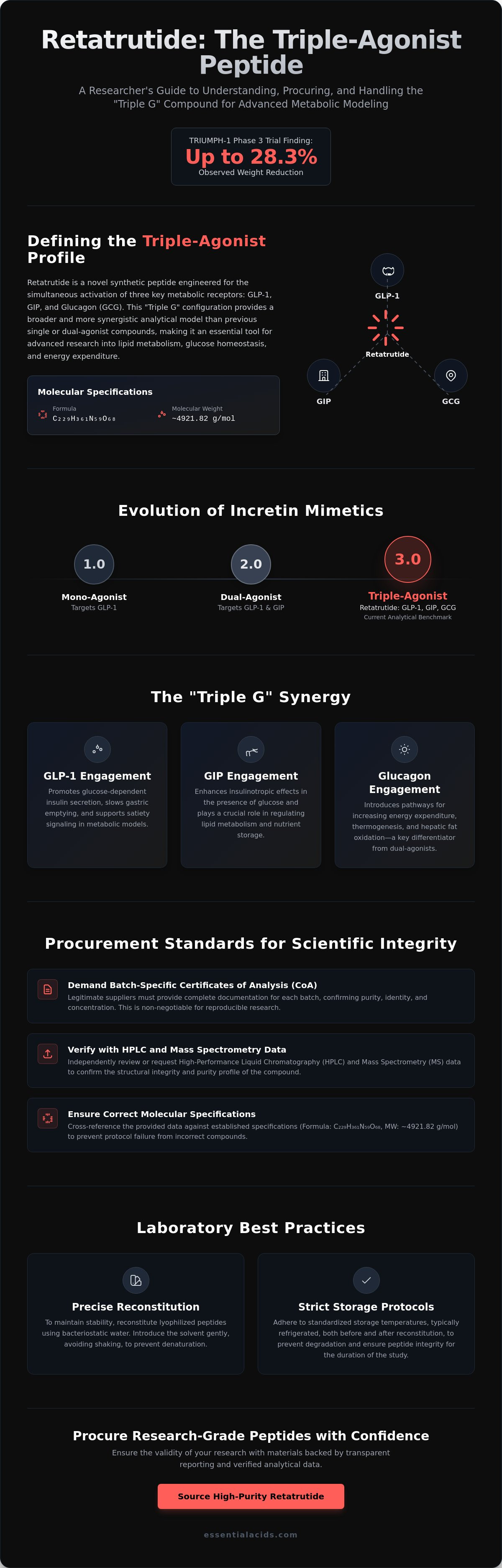
Retatrutide is a synthetic peptide engineered for the simultaneous activation of the glucagon-like peptide-1 (GLP-1), glucose-dependent insulinotropic polypeptide (GIP), and glucagon (GCG) receptors. This structural configuration is frequently referred to as the "Triple G" designation within contemporary biochemistry. By engaging three distinct metabolic pathways, the molecule provides a broader analytical scope than previous generations of incretin mimetics. Researchers investigating What is Retatrutide? will find that its primary utility lies in studying the synergistic effects of multi-receptor signaling on lipid metabolism and glucose homeostasis. The addition of the glucagon receptor specifically allows for the exploration of thermogenesis and nutrient utilization in ways that dual-agonists cannot facilitate.
Unlike single-agonist compounds or dual-pathway agents such as Tirzepatide, which only targets GLP-1 and GIP, Retatrutide introduces glucagon receptor agonism into the experimental model. This third pathway is critical for research focusing on energy expenditure and hepatic fat oxidation. When evaluating sources of retatrutide for sale, it's essential to recognize that this compound is strictly classified as a research-only material. It is intended for laboratory use to advance scientific understanding of metabolic disorders and isn't approved for human consumption or clinical application outside of authorized trials. Maintaining this distinction is vital for regulatory compliance and the preservation of scientific integrity.
The Evolution of Incretin Mimetics in Research
The trajectory of incretin research has moved from the simple replication of natural hormone action to the creation of optimized synthetic analogues. This evolution from GLP-1 mono-agonism to the complex triple-receptor targeting of Retatrutide reflects a deeper understanding of endocrine synergy. Synthetic peptides like these are indispensable for advancing endocrine research models because they offer a level of stability and specificity not found in endogenous hormones. Retatrutide currently stands as the analytical benchmark for researchers exploring the limits of multi-pathway metabolic regulation.
Molecular Specifications for Analytical Identification
For a researcher, the verification of molecular specifications is the first step in ensuring scientific integrity. Retatrutide is characterized by a molecular weight of approximately 4921.82 g/mol and the molecular formula C229H361N59O68. The amino acid sequence is specifically tailored to maintain high binding affinity at the GLP-1, GIP, and GCG receptors simultaneously. Structural precision is critical because even a single amino acid substitution can disrupt the delicate balance of triple-receptor agonism. When procuring materials, laboratory professionals must insist on analytical data that confirms these exact parameters to ensure the successful replication of metabolic signaling models. High-purity retatrutide for sale must be accompanied by batch-specific documentation to confirm these molecular specifications before any laboratory protocols begin.
Mechanisms of Action: GLP-1, GIP, and Glucagon Synergy
The metabolic efficacy of Retatrutide in experimental modeling is derived from its balanced affinity for three distinct hormone receptors. While traditional research has often relied on isolated receptor activation, this triple-agonist approach focuses on the coordinated signaling of GLP-1, GIP, and glucagon receptors. This synergy creates a more complex and biologically representative model of metabolic homeostasis. When procuring retatrutide for sale, researchers must prioritize materials that maintain the precise ligand-receptor affinity ratios required for these integrated responses. Coordinated signaling allows for the simultaneous observation of glucose disposal and lipid-related metabolic processes, which is essential for mapping multi-organ crosstalk in metabolic signaling models.
GLP-1 and GIP Receptor Engagement
In laboratory environments, GLP-1 and GIP activation provides a framework for observing nutrient-response behavior and insulin-linked pathways. GLP-1 receptor engagement is typically associated with insulin secretion and gastric motility signaling. The GIP component modifies these responses by influencing lipid sequestration and enhancing insulin sensitivity in cellular models. This dual activity is critical for studying the foundational aspects of homeostatic regulation. Researchers use these models to observe changes in appetite-related signaling, providing data that single-agonist compounds simply cannot generate. The stability of these interactions depends heavily on the analytical integrity of the peptide used.
Glucagon Receptor Interaction and Energy Homeostasis
The glucagon receptor (GCGR) interaction is what differentiates Retatrutide from dual-agonist models. Glucagon signaling acts as a primary driver for energy expenditure and hepatic fat oxidation. By activating the GCGR in tandem with incretin pathways, researchers can model increased thermogenesis and mitochondrial signaling activity. This interaction is frequently examined alongside MOTS-c peptide research, which centers on mitochondrial-derived energy regulation. Mapping these fat-burning mechanisms requires compounds that exhibit consistent receptor binding across all three targets. If the glucagon component is compromised, the experimental model fails to reflect the true synergistic potential of triple-agonism. Accessing reliable retatrutide for sale ensures that these mitochondrial signaling pathways are accurately represented in your data.
Procurement Standards: How to Evaluate Retatrutide for Sale
Evaluating the marketplace for research compounds requires a disciplined approach to analytical verification. When a laboratory identifies retatrutide for sale, the procurement process must transition from simple discovery to rigorous validation. The distinction between research-grade materials and pharmaceutical-grade products is fundamental. Research-grade peptides are intended for in vitro or animal models and must meet specific purity thresholds, typically exceeding 98 percent. Red flags in procurement include the absence of batch-specific data, generic representative reports, or pricing that significantly deviates from the established costs of high-purity synthesis. These inconsistencies often signal a lack of oversight that can jeopardize the validity of metabolic research.
High-Performance Liquid Chromatography (HPLC) and Mass Spectrometry (MS) are the essential tools for identifying compound integrity. While MS confirms the molecular weight and identity of the peptide, HPLC determines the purity level by separating the target molecule from synthesis byproducts. Without these dual data points, the structural integrity of the triple-agonist remains unverified. This increases the risk of experimental variability and compromises the reliability of signaling data. Accessing reliable retatrutide for sale requires a commitment to these analytical standards to ensure that every vial meets the requirements for professional laboratory use.
Verifying Peptide Purity and Batch Integrity
A Certificate of Analysis (COA) serves as the primary document for assessing the quality of a specific batch. Researchers should examine the chromatogram for clean peaks and minimal baseline noise, as this indicates a high-purity sample. Generic COAs that aren't linked to a specific lot number are insufficient for professional research. High-Performance Liquid Chromatography is the gold standard for peptide purity verification. By insisting on batch-specific documentation, laboratory managers can ensure that the materials meet the analytical standards required for complex metabolic simulations. Scientific integrity is maintained only when the material's identity is confirmed through independent testing.
Lyophilization and Stability Standards
Lyophilization, or freeze-drying, is the essential process for preserving the molecular structure of synthetic peptides. This method removes moisture through sublimation, resulting in a stable powder that resists degradation. Stability during transit is a critical concern, as temperature fluctuations can impact the peptide's binding affinity. Lyophilized powder offers superior resistance to thermal stress compared to liquid formulations. High-quality lyophilization also ensures that the material is easily reconstituted without clumping or precipitation. Proper handling from the synthesis lab to the research bench is necessary to maintain the compound's triple-receptor agonism throughout the duration of the study.
Laboratory Handling: Reconstitution and Storage Protocols
Reconstitution is a critical phase where the physical integrity of the triple-agonist peptide is most vulnerable. Once you have secured retatrutide for sale, the transition from lyophilized powder to an aqueous solution must be managed with clinical precision. Bacteriostatic water, containing 0.9 percent benzyl alcohol, is the recommended diluent for most research environments. This additive inhibits microbial growth, ensuring the solution remains stable during the course of the study. Sterile water for injection is an alternative but lacks the preservative properties required for multi-use vials in extended laboratory protocols. It's essential to allow the diluent to flow gently down the side of the vial rather than spraying it directly onto the powder to avoid mechanical denaturation.
Storage conditions are equally vital for maintaining the peptide's binding affinity. Retatrutide should be stored at 2–8°C in a temperature-controlled environment. Protection from light is mandatory; UV exposure can trigger photo-oxidation, leading to the degradation of the amino acid sequence. Researchers must avoid repeated freeze-thaw cycles. Each cycle subjects the peptide to mechanical stress that can cause molecular shearing, effectively rendering the compound useless for high-fidelity metabolic modeling. Stability is best preserved by aliquoting the reconstituted solution into single-use volumes if the study period extends beyond several days.
Calculating Concentration Ratios for Analytical Use
Precision in volumetric measurements is the foundation of research validity. When establishing concentration ratios, a mathematical framework is used to achieve specific mcg/mL concentrations. For instance, adding 2 mL of diluent to a 10 mg vial results in a concentration of 5 mg/mL or 5000 mcg/mL. These calculations follow the same baseline laboratory procedures used for BPC-157 5mg handling. Even minor discrepancies in volume can skew signaling data, leading to inaccurate conclusions regarding receptor-binding potency. Accurate pipetting and calibrated glassware are necessary to maintain these standards.
Contamination Prevention in Controlled Environments
Maintaining aseptic technique is non-negotiable during the reconstitution process. All surfaces should be sanitized, and the use of a laminar flow hood is advised to minimize the risk of airborne particulates. Environmental contaminants don't just compromise the purity of the sample; they can actively interfere with receptor-binding studies by introducing competitive ligands or enzymatic degraders. Disposal protocols for all materials, including syringes and vials used in signaling experiments, must adhere to institutional biohazard guidelines. To ensure your laboratory is equipped with high-purity materials, you can procure verified retatrutide for sale through our clinical catalog.
Procuring Retatrutide through Essential Acids
Essential Acids serves as a disciplined intermediary between biochemical synthesis and experimental application. When laboratory managers evaluate retatrutide for sale, they aren't merely purchasing a compound; they're securing the foundational data for their metabolic research. Our commitment to scientific integrity ensures that every material provided meets the rigorous standards required for high-fidelity modeling. We operate with a "quiet authority," prioritizing the technical requirements of the scientific community over traditional marketing flair. This approach reflects our core mission of making better, normal through the provision of precise, verified biochemicals.
Adherence to regulatory standards is a fundamental component of our operational framework. Every vial of Retatrutide is strictly classified for research-use only. This mandate is not a mere legal disclaimer; it's a boundary that protects the integrity of both the supplier and the research institution. By maintaining a professional distance from consumer trends, we ensure that our resources remain focused on the analytical needs of laboratory professionals. Scientific advancement depends on the availability of stable, high-purity materials that behave predictably within established metabolic signaling models.
Scientific Integrity and Quality Assurance
Our quality assurance process is designed to eliminate the ambiguity often found in third-party material procurement. Essential Acids prioritizes scientific accuracy by providing detailed HPLC and MS reports for every batch. These documents aren't generic templates; they're batch-specific records that verify the purity and molecular identity of the triple-agonist. This transparency allows researchers to account for every variable in their experimental design. As a disciplined partner for metabolic and cellular research, we provide the technical documentation necessary to support peer-reviewed outcomes and successful replication studies.
Ordering Materials for National Research Applications
The procurement process is streamlined to facilitate physical product fulfillment without unnecessary delays. We understand that research timelines are often sensitive to material availability. Our logistics network is optimized for secure handling and rapid national distribution, ensuring that lyophilized peptides reach your facility in peak condition. Institutions seeking to integrate Retatrutide into their metabolic models can rely on a procurement system built for professional scale. To begin the integration of high-purity materials into your laboratory workflow, you may view the analytical specifications for retatrutide for sale within our research catalog. This ensures your procurement process aligns with the highest standards of contemporary biochemistry.
Advancing Metabolic Modeling with Triple-Agonist Precision
The integration of triple-agonist signaling into laboratory models represents a significant shift in contemporary biochemistry. By engaging GLP-1, GIP, and glucagon receptors simultaneously, researchers can simulate complex endocrine interactions with a level of detail previously unavailable. Success in these studies depends entirely on the analytical integrity of the starting materials. It's vital to prioritize compounds verified through batch-specific HPLC and MS documentation to ensure that every experiment is built on a stable, high-purity foundation. Without these standards, the synergistic effects of the "Triple G" designation cannot be accurately mapped.
Securing reliable retatrutide for sale requires a disciplined commitment to these professional standards. Maintaining scientific integrity through rigorous procurement and proper storage protocols allows for the successful replication of metabolic signaling data. Essential Acids supports your efforts by providing high-purity lyophilized peptides backed by transparent reporting and a strict adherence to research-use only mandates. You can procure Retatrutide for laboratory research today to begin your next phase of biochemical inquiry. We look forward to supporting your progress in mapping the future of metabolic pathways.
Frequently Asked Questions
What is the specific purity standard for Retatrutide at Essential Acids?
Essential Acids maintains a minimum purity threshold of 98 percent for all research-grade peptides. This standard is verified through independent analytical testing to ensure the compound meets the requirements for high-fidelity metabolic modeling. Maintaining this level of purity is fundamental to our commitment to scientific integrity and the replication of complex signaling data.
Is Retatrutide intended for human or veterinary consumption?
No, Retatrutide is strictly classified for research-use only and is not intended for human or veterinary consumption. The materials provided are designated exclusively for laboratory experimentation and in vitro or animal modeling. Essential Acids maintains a professional distance from clinical or consumer applications to uphold regulatory compliance and safety standards.
How should Retatrutide be stored to maintain its molecular integrity?
Lyophilized Retatrutide must be stored at 2–8°C in a temperature-controlled environment to preserve its molecular stability. Once the peptide is reconstituted, the solution should be kept refrigerated and utilized within a timeframe that prevents enzymatic degradation. Avoiding repeated freeze-thaw cycles is mandatory for preserving the ligand-receptor binding affinity required for valid research outcomes.
What is the significance of Retatrutide being a triple-agonist?
The triple-agonist profile signifies the simultaneous engagement of the GLP-1, GIP, and glucagon receptors. This "Triple G" designation allows researchers to model integrated metabolic responses that single or dual-agonist compounds cannot facilitate. By including glucagon receptor agonism, the molecule provides a broader analytical scope for studying energy expenditure and hepatic lipid metabolism.
Does Essential Acids provide batch-specific HPLC reports?
Yes, Essential Acids provides batch-specific HPLC and Mass Spectrometry documentation for every procurement. These reports verify the purity and molecular identity of the specific lot number assigned to your laboratory materials. Accessing verified retatrutide for sale with this level of transparency ensures that your experimental data is built on a foundation of analytical accuracy.
Can Retatrutide be reconstituted with standard sterile water for research?
Bacteriostatic water is the recommended diluent for research applications because its 0.9 percent benzyl alcohol content inhibits microbial growth. While standard sterile water is suitable for immediate, single-use applications, it lacks the preservative properties needed for multi-use vials. Selecting the correct diluent is a critical step in maintaining the stability of the peptide during extended laboratory protocols.
What is the typical lead time for national procurement of research peptides?
The procurement process is optimized for physical product fulfillment with a standard lead time of 3 to 5 business days for national distribution. This streamlined timeline ensures that research institutions can maintain their experimental schedules without unnecessary delays. Secure handling protocols are utilized throughout the shipping process to protect the structural integrity of the lyophilized materials.
What happens if Retatrutide is exposed to light during storage?
Exposure to light can trigger photo-oxidation, leading to the degradation of the peptide's amino acid sequence. This structural damage effectively reduces the compound's binding potency and can skew the results of metabolic signaling studies. Retatrutide must be stored in an opaque container or a dark environment to prevent this degradation and ensure the preservation of its analytical integrity.
Legal Disclaimer
All products sold on this website are intended exclusively for laboratory research purposes and not for human or veterinary use, diagnosis, cure, treatment, or prevention of any disease or condition. None of the statements on this site have been reviewed or evaluated by the U.S. Food and Drug Administration (FDA) or comparable regulatory authorities. Purchasing or using these products for any unintended purpose, including human consumption, may violate federal or local laws and poses safety risks.