

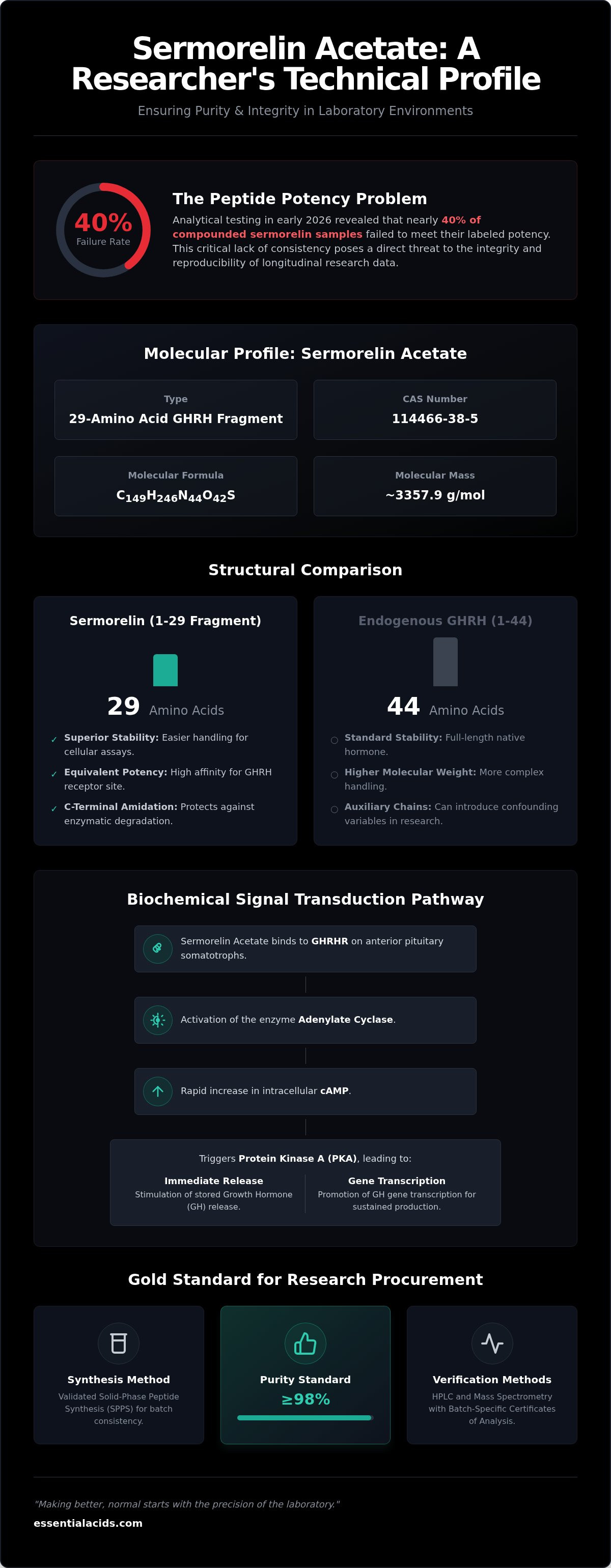
In early 2026, analytical testing revealed that nearly 40% of compounded sermorelin samples failed to meet their labeled potency, a statistic that underscores the volatility of the current global peptide market. For researchers, this lack of consistency isn't just a logistical hurdle; it's a direct threat to the integrity of longitudinal data. You likely understand that sourcing Sermorelin Acetate Australia requires a level of scrutiny that goes beyond standard procurement. In an environment where the TGA has made unapproved peptides a primary compliance priority for 2026, the need for verifiable, research-grade materials has never been more critical.
This technical profile provides the rigorous framework necessary to navigate the procurement of high-purity compounds for laboratory environments, ensuring your materials meet the highest analytical standards. We'll examine the molecular structure of this 29-amino acid GHRH analogue (CAS 114466-38-5) and establish protocols for verifying batch-specific purity via HPLC and Mass Spectrometry. We also address the specific storage requirements needed to prevent degradation in the Australian climate, maintaining our commitment to scientific integrity. Making better, normal starts with the precision of the laboratory.
Key Takeaways
- Define the precise molecular profile and mass of the 29-amino acid GHRH active fragment used in pituitary research.
- Examine the biochemical signal transduction pathways activated by GHRHR binding and the subsequent increase in intracellular cAMP.
- Establish rigorous procurement standards for Sermorelin Acetate Australia by prioritizing analytical verification through HPLC and Mass Spectrometry.
- Implement laboratory handling protocols to mitigate the risks of peptide denaturation and maintain stability in the Australian climate.
- Verify the integrity of research materials using batch-specific Certificates of Analysis to ensure data consistency and regulatory alignment.
Sermorelin Acetate: A Molecular Profile for Australian Research in 2026
Sermorelin Acetate is a synthetic 29-amino acid peptide that functions as the truncated, active fragment of endogenous Growth Hormone-Releasing Hormone (GHRH). In the context of Sermorelin Acetate Australia research, the compound is identified by the CAS number 114466-38-5. It possesses a molecular formula of C149H246N44O42S and a calculated molecular mass of approximately 3357.9 g/mol. This peptide is intended strictly for in vitro and laboratory-based analytical studies within Australian research environments. It's essential that researchers distinguish this specific fragment from the full-length hormone to ensure experimental accuracy and data reproducibility.
The primary structure of the peptide is defined by a precise sequence: Tyr-Ala-Asp-Ala-Ile-Phe-Thr-Asn-Ser-Tyr-Arg-Lys-Val-Leu-Gly-Gln-Leu-Ser-Ala-Arg-Lys-Leu-Leu-Gln-Asp-Ile-Met-Ser-Arg-NH2. This specific arrangement preserves the biological activity required for receptor binding while minimizing the molecular complexity found in the native 44-amino acid hormone. By focusing on this active core, scientists can isolate the specific signaling pathways associated with pituitary stimulation without the confounding variables of the larger protein's auxiliary chains.
Chemical Structure and Synthesis Standards
High-integrity laboratory research requires compounds produced via validated solid-phase peptide synthesis (SPPS) methods. This technique allows for precise control over the amino acid sequence, ensuring that the resulting Sermorelin Acetate: A Molecular Profile remains consistent across different batches. The acetate salt form is utilized specifically to enhance the peptide's solubility in aqueous buffers, a critical factor for successful in vitro modeling. For reliable analytical research, the compound must maintain a purity threshold of at least 98% as verified by HPLC.
Sermorelin vs. Full-Length GHRH 1-44
While endogenous GHRH consists of 44 amino acids, the 1-29 fragment is widely preferred in laboratory settings due to its superior stability and equivalent potency at the receptor site. The lower molecular weight of Sermorelin Acetate Australia facilitates easier handling and more predictable diffusion rates in cellular assays compared to the full 1-44 sequence. A key structural feature is the C-terminal amidation, which protects the peptide against enzymatic degradation, thereby extending its half-life during experimental procedures. This amidation is a prerequisite for maintaining structural integrity when studying the compound's interaction with the Growth Hormone Releasing Hormone Receptor (GHRHR). Providing these high-purity materials is central to our mission of making better, normal through rigorous scientific transparency.
Biochemical Mechanisms: Sermorelin Acetate in Pituitary Research
Sermorelin Acetate functions as a direct agonist at the Growth Hormone Releasing Hormone Receptor (GHRHR). These receptors are predominantly located on the somatotroph cells of the anterior pituitary gland. Upon binding, the peptide initiates a cascade that mimics the physiological signaling of the native 44-amino acid hormone. For researchers utilizing the Biochemical Profile of Sermorelin Acetate, understanding this interaction is fundamental to modeling neuroendocrine responses. The primary signal transduction pathway involves the activation of the enzyme adenylate cyclase. This activation leads to a rapid increase in intracellular cyclic adenosine monophosphate (cAMP), which subsequently triggers protein kinase A (PKA).
This intracellular signaling pathway doesn't just stimulate the immediate release of stored growth hormone. It also promotes the transcription of the GH gene and stimulates somatotroph proliferation in animal models. In neuroendocrine research, this makes the peptide a valuable tool for investigating the GHRH-IGF-1 axis. By observing how somatotrophs respond to varying concentrations of the peptide, scientists can gain insights into metabolic regulation and cellular ageing. Laboratory studies involving Sermorelin Acetate Australia often focus on these secondary metabolic shifts and the long-term viability of somatotroph populations.
Receptor Affinity and Specificity
The 1-29 sequence of Sermorelin demonstrates high affinity for the pituitary GHRHR. Unlike other growth hormone secretagogues, such as ghrelin mimetics, Sermorelin maintains a high degree of specificity for this specific receptor site. This specificity allows for a cleaner analytical environment when studying somatotroph behavior. Researchers can isolate the effects of GHRH-like stimulation without the cross-reactivity often seen with broader-spectrum peptides. When conducting Sermorelin Acetate Australia research, scientists often observe the specific binding kinetics to determine the peptide's efficacy in different cellular environments. High-purity compounds are essential for these kinetic studies, and you can explore verified research materials to ensure experimental consistency.
Feedback Inhibition and Regulatory Loops
A critical aspect of laboratory modeling is accounting for endogenous regulatory mechanisms. Somatostatin acts as the primary inhibitory counterpart to GHRH, and IGF-1 provides negative feedback at both the hypothalamic and pituitary levels. In controlled environments, researchers must design protocols that account for these inhibitory loops to accurately measure the pulsatile release of GH. Unlike exogenous growth hormone administration, Sermorelin application respects these feedback loops, allowing for a more nuanced study of the body's natural regulatory thresholds. This preservation of the GHRH-IGF-1 axis is vital for studies focused on metabolic health and neuroendocrine stability.
Laboratory Procurement: Standards for Australian Researchers
Procurement of Sermorelin Acetate Australia in 2026 demands a shift from commercial convenience to analytical rigor. High-Performance Liquid Chromatography (HPLC) remains the non-negotiable standard for determining peptide purity. Without a batch-specific chromatogram, researchers can't verify if the compound contains residual reagents or synthesis by-products. These impurities often skew in vitro data, leading to irreproducible results. Mass Spectrometry (MS) serves as the secondary, equally vital pillar by confirming the molecular weight. It's the only way to ensure the peptide sequence synthesized matches the intended 1-29 fragment exactly.
Maintaining high standards in the laboratory starts with the selection of a supplier that prioritizes transparency over marketing claims. In an environment where 40% of tested samples have historically failed potency requirements, the burden of proof lies in the documentation. Every research-grade vial should be accompanied by analytical reports that link directly to the specific batch in use. This level of detail is a prerequisite for any study aiming for publication or clinical translation.
Interpreting HPLC and Mass Spec Reports
A reliable HPLC report should display a single, sharp peak with minimal baseline noise. Broad peaks or multiple distinct signals indicate the presence of truncated sequences or chemical contaminants that could interfere with receptor binding studies. For molecular weight confirmation, Electrospray Ionization Mass Spectrometry (ESI-MS) should reflect the expected mass of approximately 3357.9 g/mol. Discrepancies in these values suggest improper synthesis or significant degradation. For a deeper analysis of these procurement standards, you can consult our technical guide on how to Buy Research Peptides Australia: A Technical Guide to Laboratory Procurement in 2026.
Regulatory Context in Australia for 2026
The Australian regulatory landscape has tightened significantly as of early 2026. Recent updates regarding TGA Compliance on Unapproved Peptides highlight a strategic shift toward increased scrutiny of peptide importation and supply. Researchers must ensure their procurement channels strictly adhere to AICIS and TGA guidelines for research-only chemicals. This distinction is critical; materials intended for laboratory use are governed by different frameworks than therapeutic goods. Institutional compliance requires that every vial is clearly labeled for "Research Use Only." This transparency protects the researcher while upholding the principles of scientific integrity. Making better, normal requires this level of discipline in every facet of the procurement process.
Stability and Handling: Maintaining Integrity in the Australian Climate
Maintaining the molecular integrity of Sermorelin Acetate Australia requires strict adherence to thermal and environmental protocols. Because the peptide consists of a specific 29-amino acid sequence, it's inherently susceptible to denaturation if exposed to temperatures exceeding 25°C for extended periods. Lyophilization, or freeze-drying, serves as the primary method for mitigating this risk. This process removes moisture from the peptide, resulting in a stable solid cake that significantly extends shelf life by reducing the kinetic energy available for chemical degradation. Without this stabilization, the delicate peptide bonds would be vulnerable to hydrolysis and oxidation.
Proper storage is a non-negotiable requirement for longitudinal research. For long-term preservation, lyophilized vials must be kept at -20°C. This temperature range effectively halts most metabolic and chemical activity within the vial. For immediate laboratory use, the compound can be stored at 4°C for a limited duration, typically not exceeding four weeks. It's critical to avoid repeated freeze-thaw cycles, as the resulting ice crystal formation can cause mechanical stress and micro-fractures in the peptide structure, leading to a loss of potency. Protection from light is equally vital; UV radiation can catalyze the breakdown of sensitive amino acid residues like methionine and tryptophan.
Shipping and Transit Protocols
Shipping in the Australian climate presents unique challenges for peptide stability. High ambient temperatures during transit can compromise a compound before it even reaches the laboratory bench. Cold-chain logistics, utilizing insulated packaging and specialized cooling agents, are necessary to maintain a stable environment. Mechanical agitation during transport also poses a risk to molecular integrity. Lyophilized peptides should be stored in a cool, dark, and dry environment to ensure maximum molecular stability. We prioritize these rigorous standards to ensure that every compound arrives with its analytical profile intact.
Reconstitution and Solution Stability
Reconstitution is a critical phase where the risk of peptide shear is highest. Researchers should use sterile bacteriostatic water or 0.9% sodium chloride saline as the diluent. The liquid should be introduced slowly down the side of the vial to avoid direct impact on the lyophilized cake. Shaking the vial can lead to denaturation; instead, a gentle swirling motion should be used until the solution is clear. Once in solution, Sermorelin becomes significantly more unstable. Reconstituted solutions should be used promptly or stored at 4°C for no longer than 7 to 10 days to ensure experimental accuracy. Similar handling protocols are detailed in our analysis of BPC-157 5mg: Molecular Profile and Laboratory Research Standards for 2026. Denaturation is irreversible. To secure high-purity compounds that have been handled with these rigorous standards, you can source research-grade Sermorelin Acetate for your laboratory.
Scientific Integrity: The Essential Acids Approach to Research Supply
The pursuit of scientific advancement in Australia relies on the absolute reliability of the compounds used in the laboratory. Essential Acids operates as a disciplined gatekeeper in this space, prioritizing analytical precision over traditional marketing flair. Our philosophical signature, "Making better, normal," reflects a commitment to providing the high-purity materials necessary for groundbreaking studies in neuroscience and metabolic health. When sourcing Sermorelin Acetate Australia, researchers require a partner that understands the gravity of longitudinal data and the necessity of regulatory compliance. This is especially true in the context of 2026, where TGA scrutiny of peptide compounds has reached a peak, demanding higher standards of transparency from suppliers.
Every vial of Sermorelin Acetate is accompanied by a batch-specific Certificate of Analysis (COA). This documentation includes the HPLC and Mass Spectrometry reports discussed in previous sections, providing a transparent record of the compound's purity and molecular weight. Our strict adherence to a "Research Use Only" policy is not merely a legal requirement; it's a core value that ensures our materials are used within the appropriate scientific frameworks. This policy maintains a clear boundary between laboratory-grade materials and therapeutic goods, supporting institutional transparency across the national research landscape. We don't compromise on these boundaries, as they're essential for maintaining the quiet authority of the research community.
Transparency in Chemical Analysis
Analytical data serves as the only valid measure of a compound's quality in a professional setting. We prioritize this data because marketing claims can't account for the subtle impurities that derail complex in vitro models. Our verification process involves rigorous testing before any batch is cleared for national distribution, ensuring that the CAS 114466-38-5 compound meets the 98% purity threshold. By providing these verified materials, we support the Australian scientific community in maintaining the integrity of their experimental outcomes and the reproducibility of their published data. Integrity isn't a marketing slogan; it's a measurable chemical reality.
Next Steps for Laboratory Procurement
Integrating our high-purity compounds into your 2026 research protocols is a straightforward process designed for professional efficiency. We provide comprehensive technical support for peptide handling, ensuring that your team has access to the molecular data required for precise experimental design. This includes detailed information on solubility, stability, and sequence verification as outlined in our technical profiles. To advance your laboratory's objectives, you can explore our high-purity Sermorelin Acetate for research and review the analytical documentation associated with our current inventory. Scientific integrity remains the non-negotiable foundation of every successful discovery.
Advancing Analytical Precision in 2026
The successful modeling of neuroendocrine pathways requires an uncompromising approach to chemical purity. Researchers must prioritize the 1-29 active fragment and its specific amidation to ensure receptor affinity and experimental reproducibility. As regulatory oversight from the TGA intensifies in 2026, the shift toward batch-specific verification becomes the only viable path for institutional transparency. Sourcing Sermorelin Acetate Australia through channels that provide comprehensive HPLC and Mass Spectrometry documentation is no longer optional for high-integrity studies. It's the necessary baseline for data that withstands peer review.
By adhering to strict cold-chain logistics and proper reconstitution protocols, laboratories can mitigate the risks of peptide denaturation in the Australian climate. This disciplined handling preserves the molecular profile and ensures that analytical results reflect the compound's true biochemical potential. We remain committed to supporting the scientific community with materials that meet these rigorous standards. Discovery begins with the precision of your starting materials.
Secure high-purity Sermorelin Acetate for your 2026 research projects at Essential Acids. We provide batch-specific HPLC/MS documentation for all strictly research-grade materials, supported by reliable national shipping across Australia.
Frequently Asked Questions
Is Sermorelin Acetate available for human consumption in Australia?
No, Sermorelin Acetate is not supplied for human consumption or therapeutic use through this storefront. It's strictly intended for research-use only within controlled laboratory environments. This policy adheres to the Therapeutic Goods Act 1989 and ensures that all materials are handled according to rigorous scientific standards.
What is the purity level of Essential Acids Sermorelin Acetate?
Every batch is verified at a purity threshold of >98% through HPLC analysis. This high-purity standard for Sermorelin Acetate Australia is necessary to ensure experimental results aren't compromised by synthesis by-products. Batch-specific documentation is provided to verify these analytical metrics for every order.
How should Sermorelin Acetate be stored upon arrival at the laboratory?
Lyophilized peptides must be stored at -20°C for long-term preservation to maintain molecular stability. For immediate research use, the compound may be kept at 4°C for a duration not exceeding four weeks. It's essential that the vials are kept in a dark, dry environment to prevent degradation from UV exposure.
Can Sermorelin Acetate be used for veterinary diagnostics?
No, these materials are not intended for veterinary diagnostics or any clinical applications in animals. The compounds are produced and labeled strictly for in vitro laboratory studies. Using these research-grade materials for diagnostic purposes outside of a laboratory setting is a violation of our research-only policy.
Does Sermorelin Acetate require cold-chain shipping within Australia?
Yes, cold-chain logistics are employed to protect the peptide from high ambient temperatures during transit. The Australian climate presents a significant risk of thermal denaturation for sensitive amino acid sequences. Insulated packaging and cooling agents are utilized to ensure the compound's integrity is preserved from our facility to your laboratory.
What documentation is provided with research-grade Sermorelin Acetate?
Every order includes batch-specific analytical documentation, specifically HPLC chromatograms and Mass Spectrometry reports. These documents provide the molecular weight confirmation and purity verification required for institutional compliance. This transparency is a core component of our commitment to scientific integrity.
What is the difference between Sermorelin and Ipamorelin in research?
Sermorelin is a 29-amino acid fragment of GHRH that binds to the GHRH receptor, while Ipamorelin is a pentapeptide that functions as a selective ghrelin receptor agonist. They stimulate growth hormone release through distinct biochemical pathways. Researchers select between them based on whether the study focus is on pituitary somatotroph signaling or ghrelin-mediated pathways.
How do I reconstitute Sermorelin Acetate for in vitro studies?
Reconstitution is performed by slowly introducing sterile bacteriostatic water or 0.9% saline down the internal wall of the vial. It's critical that the vial is not shaken, as mechanical stress can lead to peptide shear and denaturation. A gentle swirling motion should be used until the lyophilized cake is completely dissolved into a clear solution.
Legal Disclaimer
All products sold on this website are intended exclusively for laboratory research purposes and not for human or veterinary use, diagnosis, cure, treatment, or prevention of any disease or condition. None of the statements on this site have been reviewed or evaluated by the U.S. Food and Drug Administration (FDA) or comparable regulatory authorities. Purchasing or using these products for any unintended purpose, including human consumption, may violate federal or local laws and poses safety risks.