

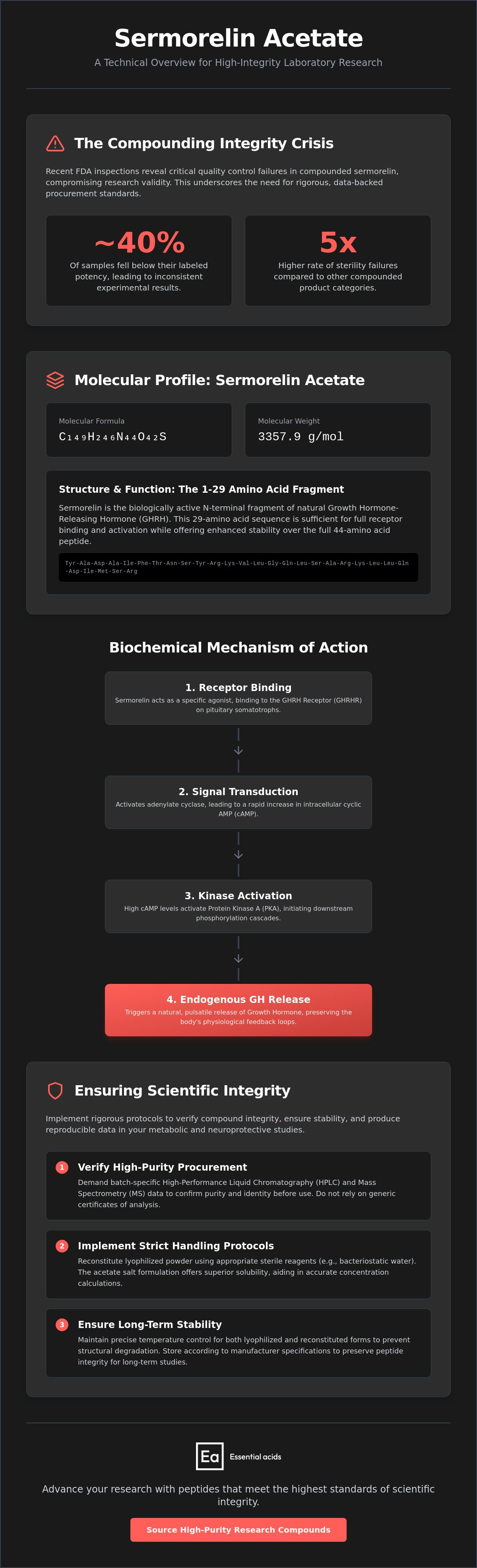
Recent FDA inspections through 2025 revealed that nearly 40% of compounded sermorelin samples fell below their labeled potency; sterility failures were five times higher than in other compounding categories. This data underscores the critical need for rigorous standards in sermorelin acetate research as we move into 2026. You're likely aware that the discontinuation of brand-name Geref has left a void in the market, forcing laboratories to rely on compounded variants that often lack batch-specific transparency. It's a challenging environment where scientific integrity is frequently compromised by inconsistent analytical data and ambiguous purity standards.
This article provides a comprehensive molecular profile designed to resolve these technical uncertainties. We'll deliver protocol-ready storage information and a detailed breakdown of the peptide’s biochemical mechanisms. By the end of this overview, you'll have a clear framework for verifying high-purity procurement and maintaining stability in long-term metabolic studies. We explore the necessary transition from observational data to the high-precision analytical protocols required for modern research-use only applications. Our focus remains on the objective data needed to maintain a disciplined laboratory environment.
Key Takeaways
- Identify the precise biochemical properties of the 1-29 amino acid fragment and its interaction with pituitary somatotrophs via cAMP signaling pathways.
- Analyze emerging 2026 frontiers in sermorelin acetate research, focusing on metabolic rate modulation and neuroprotective applications in controlled environments.
- Implement rigorous laboratory protocols for reconstitution and temperature control to ensure long-term peptide stability and prevent structural degradation.
- Verify compound integrity through high-purity procurement standards, including the use of batch-specific HPLC and Mass Spectrometry analytical data.
What is Sermorelin Acetate? A Molecular Definition
Sermorelin Acetate is a synthetic peptide consisting of the first 29 amino acids of the naturally occurring 44-amino acid growth hormone-releasing hormone (GHRH). Within the context of sermorelin acetate research, this molecule is classified as a growth hormone secretagogue (GHS) rather than a direct growth hormone replacement. Its molecular formula is C149H246N44O42S, with a molecular weight of approximately 3357.9 g/mol. Precise laboratory measurement depends on understanding this specific molecular weight to calculate molarity and concentration for in vitro and in vivo models. The compound is typically provided as a lyophilized powder, where the acetate salt plays a fundamental role in maintaining the structural integrity of the peptide bonds during long-term storage and subsequent reconstitution.
The 1-29 Amino Acid Sequence: Structure and Function
The primary structure of the peptide is defined by the sequence Tyr-Ala-Asp-Ala-Ile-Phe-Thr-Asn-Ser-Tyr-Arg-Lys-Val-Leu-Gly-Gln-Leu-Ser-Ala-Arg-Lys-Leu-Leu-Gln-Asp-Ile-Met-Ser-Arg. While endogenous GHRH contains 44 residues, structural biology has confirmed that the first 29 amino acids are entirely sufficient for receptor binding and biological activation of the pituitary somatotrophs. This truncation enhances the molecule's stability while retaining full potency. In 2026, high-purity synthesis is achieved through advanced Solid-Phase Peptide Synthesis (SPPS). This method allows for the precise assembly of the amino acid chain, ensuring that the resulting compound meets the strict analytical requirements of the scientific community.
Acetate Salt vs. Other Formulations
The choice of the acetate salt formulation is not arbitrary. It provides a specific biochemical rationale centered on solubility and stability. Acetate salts generally offer superior solubility in aqueous reagents, such as bacteriostatic water, compared to other salt forms like trifluoroacetate (TFA), which can be more cytotoxic in certain research applications. The acetate salt also exhibits a more favorable stability profile under various pH conditions, which is crucial for maintaining the peptide's secondary structure. This stability is vital for ensuring that the results of sermorelin acetate research remain consistent across different batches and laboratory environments, upholding the core value of scientific integrity.
The Somatotropic Axis: Biochemical Mechanism of Action
Sermorelin acts as a specific agonist for the Growth Hormone Releasing Hormone Receptor (GHRHR), located on the surface of somatotroph cells in the anterior pituitary. Unlike the administration of exogenous growth hormone, sermorelin acetate research focuses on the peptide's ability to trigger endogenous production. This distinction is vital for maintaining the integrity of the somatotropic axis. By stimulating the pituitary directly, the molecule preserves the natural regulatory mechanisms, including the inhibitory influence of somatostatin. It doesn't bypass the body's control systems; instead, it works within them to facilitate a more physiological hormonal response.
GHRH Receptor Binding Affinity
Technical analysis of binding kinetics in in-vitro models demonstrates that sermorelin exhibits a high affinity for the GHRHR. It effectively mimics the amino-terminal fragment of endogenous GHRH to initiate hormonal signaling. This binding triggers a pulsatile release of growth hormone, which contrasts with the static elevations seen in direct replacement therapies. While Ipamorelin and other GHSR agonists target the ghrelin receptor pathway, sermorelin operates through the canonical GHRH signaling route. This specificity allows researchers to isolate the effects of GHRH stimulation without the secondary metabolic interference often associated with broader secretagogue profiles. For laboratories requiring high-purity analytical research compounds, maintaining this receptor specificity is a core requirement for valid data collection.
Downstream Cellular Signaling
The biochemical cascade begins once the peptide occupies the receptor, activating the enzyme adenylate cyclase. This process leads to a rapid increase in intracellular cyclic adenosine monophosphate (cAMP). High cAMP levels subsequently activate protein kinase A (PKA), which promotes the opening of L-type calcium channels. The resulting calcium ion influx is the primary driver for the exocytosis of pre-stored growth hormone vesicles. Beyond immediate release, this pathway influences the management of adult-onset growth hormone insufficiency research by modulating long-term gene expression. The synthesis of new growth hormone mRNA is upregulated, ensuring the somatotroph maintains a ready supply for subsequent secretory pulses. This entire process remains subject to negative feedback from Insulin-like Growth Factor 1 (IGF-1), providing a self-regulating loop that prevents the supra-physiological peaks often encountered with synthetic growth hormone. In a disciplined research environment, this feedback loop is essential for observing natural metabolic limits and cellular responses.
Current Frontiers in Sermorelin Acetate Research (2026)
The landscape of sermorelin acetate research in 2026 is characterized by a significant transition from endocrinology-focused studies to broader applications in cellular biology. While historical data centered on pituitary provocative testing, modern investigations prioritize the systemic implications of GHRH receptor activation. This includes evaluating how synthetic analogues influence neuroprotective pathways and cognitive resilience in ageing models. Researchers are currently examining the relationship between pulsatile growth hormone secretion and the maintenance of neural plasticity; this suggests that the peptide's influence extends far beyond the somatotropic axis. Strict adherence to regulatory standards is paramount, especially as the World Anti-Doping Agency (WADA) has maintained sermorelin on the 2026 Prohibited List under section S2.2.4. This classification reinforces the compound's status as a research-use only molecule, demanding a disciplined approach to laboratory documentation.
Protein synthesis and musculoskeletal tissue repair remain central to current experimental designs. The ability to upregulate IGF-1 locally within specific tissue environments, without the systemic metabolic instability often seen with synthetic growth hormone, offers a significant research advantage. These studies utilize controlled models to observe cellular repair mechanisms, ensuring that every data point contributes to a clearer understanding of regenerative biology. Scientific integrity is maintained through the use of batch-specific verified compounds, ensuring that researchers aren't dealing with the potency inconsistencies reported in recent FDA inspections where nearly 40% of samples fell below labeled standards.
Metabolic and Adipose Tissue Research
Current investigations into lipolysis and lipid oxidation highlight the peptide's role in modulating adipose tissue metabolism. By increasing the expression of hormone-sensitive lipase, sermorelin facilitates the breakdown of triglycerides into free fatty acids. Research also monitors glucose metabolism and insulin sensitivity. These parameters are critical for understanding the long-term metabolic safety profile of GHRH analogues. Studies in 2026 are specifically focusing on how these metabolic shifts impact body composition in specialized metabolic models, providing a foundation for future biological inquiries into energy homeostasis.
Cellular Longevity and Senescence
The philosophical signature of "Making better, normal" is reflected in research targeting mitochondrial function and the reduction of oxidative stress. 2026 studies are increasingly focused on cellular senescence, exploring how GHRH receptor agonists might delay the onset of the senescent phenotype in diverse cell lines. By stabilizing mitochondrial membrane potential and reducing reactive oxygen species, researchers aim to clarify the pathways through which growth factors influence cellular ageing. This work is essential for developing a strictly objective understanding of how GHRH analogues interact with the fundamental processes of biological decline and cellular integrity.
Laboratory Procurement: Handling and Storage Protocols
The maintenance of structural integrity is a fundamental prerequisite for valid sermorelin acetate research. In its lyophilized state, the peptide exhibits significant stability; however, it remains sensitive to thermal fluctuations and ultraviolet exposure. Standard laboratory protocols dictate that unconstituted vials should be stored at -20°C for long-term preservation, which can maintain the compound’s viability for up to 24 months. For short-term experimental windows, storage at 2-8°C is acceptable, provided the duration doesn't exceed 90 days. Light sensitivity must be addressed by using amber glass vials or storing the compounds in complete darkness, as UV radiation can catalyze the cleavage of peptide bonds and lead to inaccurate analytical results.
Once the peptide is transitioned from a lyophilized powder to a liquid state, its vulnerability to degradation increases exponentially. Reconstituted solutions are highly labile and must be handled with extreme caution to prevent the loss of biological activity. It's essential that researchers document every stage of the procurement and handling process to ensure that the data collected reflects the properties of the molecule rather than the artifacts of degradation.
Reconstitution and Dilution Standards
Reconstitution must be performed using a methodical approach to avoid mechanical stress. The choice of solvent is determined by the intended duration of the study. Bacteriostatic water, containing 0.9% benzyl alcohol, is typically utilized for research requiring multi-day stability, as it inhibits bacterial growth. Conversely, sterile 0.9% sodium chloride is preferred for immediate analytical applications where alcohol interference must be avoided. The following steps should be followed:
- The vial septum is sanitized using a 70% isopropyl alcohol swab.
- The solvent is introduced slowly, allowing the liquid to flow down the interior wall of the glass vial.
- The vial is gently swirled until the powder is completely dissolved; shaking is strictly prohibited.
The introduction of mechanical energy through vigorous shaking can lead to the denaturation of the peptide's delicate secondary structure. This results in a loss of receptor binding affinity, effectively rendering the sample useless for precise sermorelin acetate research.
Long-term Stability and Integrity
Adhering to established BPC-157 research standards for peptide longevity provides a reliable framework for managing sermorelin. Reconstituted sermorelin should be used within 7 to 14 days when stored at 2-8°C. To extend this window, the solution can be divided into single-use aliquots and frozen at -20°C. This practice prevents the damage caused by repeated freeze-thaw cycles, which can fracture the peptide chain. Researchers should monitor for signs of degradation, such as visible precipitation, cloudiness, or distinct color changes. To maintain the highest levels of scientific integrity, it's recommended to procure verified research compounds that include batch-specific certificates of analysis, ensuring that the starting material meets the necessary purity thresholds before the study begins.
Scientific Integrity: Sourcing High-Purity Peptides in Australia
The procurement of chemical compounds for sermorelin acetate research within Australia requires a rigorous adherence to analytical standards. In 2026, the Therapeutic Goods Administration (TGA) has made unapproved peptide products a compliance priority, emphasizing the legal distinction between therapeutic goods and research-only compounds. For the independent researcher, this regulatory environment necessitates a shift away from commercial suppliers toward entities that provide transparent, batch-specific data. Scientific integrity isn't a marketing claim; it's a measurable metric verified through High-Performance Liquid Chromatography (HPLC) and Mass Spectrometry (MS). Essential Acids maintains a disciplined commitment to these standards, ensuring that the compounds provided are intended strictly for laboratory-use only to maintain the gravity of the research process.
Verification protocols must be exhaustive to prevent the introduction of experimental bias. When sourcing compounds, the quality of the material is expected to speak for itself through the provided analytical documentation. A refusal to accept anything less than verified, batch-specific data is the primary defense against the potency inconsistencies and sterility failures documented in recent regulatory inspections. This cautious approach ensures that the metabolic or cellular data generated in your laboratory remains both accurate and reproducible.
Interpreting Analytical Documentation
Reading a Certificate of Analysis (CoA) requires a specialized understanding of chromatograms and mass spectra. The HPLC chromatogram provides a visual representation of the peptide’s purity by measuring the area under the primary peak relative to any secondary peaks. A purity level exceeding 98% is the standard for high-level sermorelin acetate research. Mass Spectrometry (MS) serves as the identity confirmation, verifying the molecular weight of the peptide to ensure the correct amino acid sequence was synthesized. Researchers must identify potential impurities, such as residual solvents or truncated sequences, as these contaminants can significantly alter cellular response data or interfere with the cAMP signaling pathways discussed in previous sections.
Ethical and Regulatory Compliance
Strict adherence to a "research-use only" policy is the hallmark of a reliable scientific gatekeeper. This professional distance avoids the casual tone common in e-commerce and reinforces the boundary between clinical application and laboratory inquiry. When buying research peptides in Australia, transparency regarding the supplier's testing protocols is non-negotiable. Essential Acids operates with a level-headed pace that respects the researcher's time and professional focus, providing the high-purity compounds necessary for the pursuit of "Making better, normal." By maintaining these rigorous standards, the integrity of the Australian scientific community is preserved, ensuring that research into growth hormone secretagogues continues within a stable and well-regulated framework.
Advancing Laboratory Standards for Growth Hormone Secretagogues
The successful execution of sermorelin acetate research in 2026 depends entirely on the precision of the starting materials and the discipline of the handling protocols. We've established that the peptide's structural integrity is highly sensitive to mechanical stress and thermal fluctuations, requiring a methodical approach to reconstitution and storage. It's essential that researchers prioritize high-purity compounds verified through batch-specific HPLC and Mass Spectrometry to avoid the pitfalls of potency inconsistencies that often compromise metabolic data. Maintaining a professional distance from commercial trends ensures that the focus remains strictly on the biochemical mechanisms of the somatotropic axis.
Scientific integrity is the core value that distinguishes a reliable laboratory environment. Essential Acids remains committed to providing the analytical grade compounds necessary for rigorous inquiry into cellular health and aging. Every compound is backed by verified analytical reports to ensure your results are both accurate and reproducible. We invite you to View Analytical Grade Sermorelin Acetate for Research, featuring high-purity laboratory grade compounds and secure national delivery across Australia. Maintaining these high standards is the first step toward achieving reliable, evidence-based outcomes in your next study.
Frequently Asked Questions
What is the molecular weight of Sermorelin Acetate?
The molecular weight of Sermorelin Acetate is approximately 3357.9 g/mol. This precise value is calculated based on its 29-amino acid primary structure and is a fundamental constant for researchers when determining molar concentrations for in-vitro assays. Accurate measurement is necessary to ensure that experimental dosages remain consistent across different batches and study phases. Any deviation in this measurement can compromise the validity of the laboratory data.
How should Sermorelin Acetate be stored for long-term research?
Storage of the lyophilized powder at -20°C is required for long-term preservation of the peptide's structural integrity. This temperature prevents the hydrolysis of peptide bonds, maintaining stability for up to 24 months. For reconstituted solutions, researchers must maintain a temperature of 2-8°C and use the aliquot within 14 days. These strict conditions are necessary for preventing the rapid degradation that occurs in aqueous environments.
Can Sermorelin Acetate be used for human or veterinary consumption?
No, Sermorelin Acetate is strictly prohibited for human or veterinary consumption and is designated for research-use only. The compounds are intended solely for laboratory evaluation and analytical testing within professional settings. Essential Acids enforces this policy to maintain the highest levels of regulatory compliance and to ensure that the materials are utilized for their intended scientific purpose. Any other use is strictly forbidden.
What is the difference between Sermorelin and Ipamorelin in a research setting?
Sermorelin is a GHRH receptor agonist, while Ipamorelin is a ghrelin receptor agonist. This difference in receptor specificity means they activate the somatotropic axis through distinct biochemical pathways. Researchers use sermorelin to specifically study the effects of GHRH-mediated pituitary stimulation. This allows for an isolated analysis of the endogenous feedback loops that regulate growth hormone secretion without the broader effects associated with ghrelin mimetics.
How do I verify the purity of a Sermorelin Acetate batch?
Purity is verified through the examination of High-Performance Liquid Chromatography (HPLC) and Mass Spectrometry (MS) data. HPLC confirms the purity percentage by identifying any secondary peaks that indicate contaminants or degradation products. Mass Spectrometry ensures the molecular identity of the compound by matching the observed mass to the theoretical molecular weight. Both reports are necessary to maintain the scientific integrity required for high-level sermorelin acetate research.
What is the typical shelf life of lyophilised Sermorelin Acetate?
The typical shelf life for lyophilized Sermorelin Acetate is 24 months when stored at -20°C in a moisture-controlled environment. If the compound is stored at 2-8°C, the stability period is reduced to approximately 90 days. Protection of the vials from light exposure is required during these periods. UV radiation can lead to the cleavage of amino acid chains, which compromises the analytical results of the study.
Why is Sermorelin Acetate preferred over direct GH in certain research models?
Sermorelin is preferred because it stimulates a pulsatile release of growth hormone that respects endogenous feedback mechanisms. Direct administration of growth hormone can bypass the regulatory influence of somatostatin and IGF-1, potentially leading to supra-physiological levels. In sermorelin acetate research, the preservation of these natural loops allows for a more accurate observation of physiological responses and cellular interactions within the somatotropic axis.
Is a certificate of analysis (CoA) provided with Sermorelin research materials?
A batch-specific Certificate of Analysis (CoA) is provided with all research materials to ensure laboratory transparency. This documentation contains the primary analytical data, including HPLC chromatograms and Mass Spectrometry results. These reports allow researchers to verify the purity and identity of the specific batch they've procured. Access to this data is a core requirement for maintaining the rigorous standards expected in modern biochemical investigation.
Legal Disclaimer
All products sold on this website are intended exclusively for laboratory research purposes and not for human or veterinary use, diagnosis, cure, treatment, or prevention of any disease or condition. None of the statements on this site have been reviewed or evaluated by the U.S. Food and Drug Administration (FDA) or comparable regulatory authorities. Purchasing or using these products for any unintended purpose, including human consumption, may violate federal or local laws and poses safety risks.