

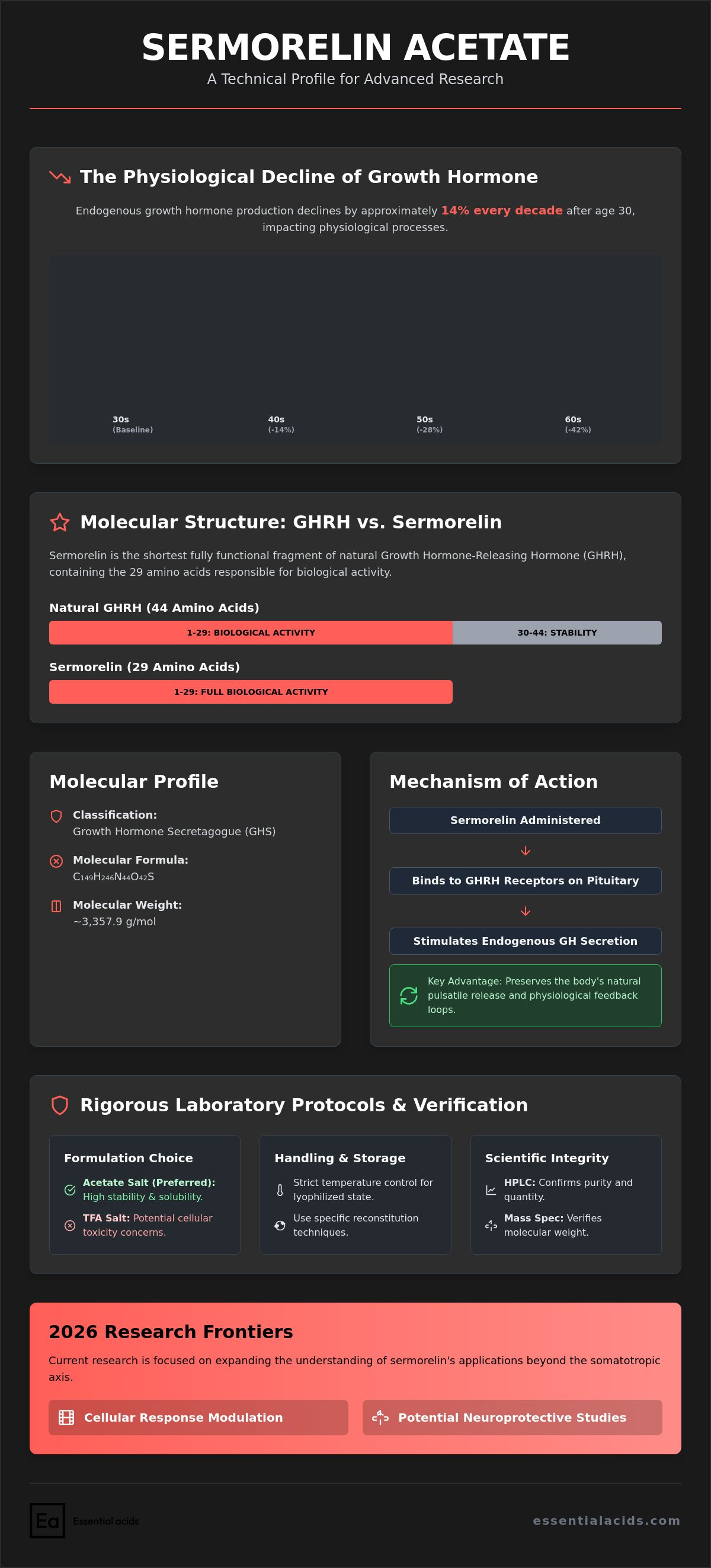
Did you know that endogenous growth hormone production typically declines by approximately 14% every decade after the age of 30? This steady physiological shift drives the critical necessity for rigorous sermorelin acetate research to understand how GHRH analogs interface with the pituitary gland's natural feedback loops. For the modern researcher, the challenge isn't just understanding the peptide's 29-amino acid sequence. It's navigating a landscape where batch-specific analytical data and precise stability protocols are often difficult to secure.
You likely recognize that maintaining scientific integrity requires more than just a basic certificate of analysis. You need absolute certainty regarding molecular purity and long-term storage stability. This article provides a comprehensive technical profile of Sermorelin Acetate, detailing its biochemical properties and the rigorous laboratory standards required for 2026. We'll examine the specific molecular mechanisms of action, establish protocol-ready handling instructions for lyophilized compounds, and outline the verification standards necessary for high-purity procurement in a regulated research environment.
Key Takeaways
- Identify the molecular structure of Sermorelin as a 29-amino acid fragment of GHRH and its precise interaction with the somatotropic axis via the cAMP pathway.
- Analyze the latest 2026 frontiers in sermorelin acetate research, focusing on cellular response modulation and potential applications in neuroprotective studies.
- Establish rigorous laboratory protocols for peptide stability by maintaining strict temperature controls and utilizing specific reconstitution techniques to prevent molecular degradation.
- Ensure scientific integrity by prioritizing batch-specific analytical verification, including HPLC and Mass Spectrometry, to confirm compound identity and purity levels.
What is Sermorelin Acetate? A Molecular Definition
Sermorelin acetate is a synthetic polypeptide that functions as a growth hormone-releasing hormone (GHRH) analogue. In the field of sermorelin acetate research, the compound is identified as the amino-terminal fragment of the naturally occurring 44-amino acid endogenous GHRH. Specifically, it consists of the first 29 amino acids. This truncated sequence is the shortest functional fragment that retains the full biological potency of the parent hormone. Within laboratory classifications, it's categorized as a growth hormone secretagogue (GHS) because it acts directly on the pituitary gland to stimulate the production and secretion of growth hormone.
The molecular profile of the peptide is defined by high precision to ensure analytical accuracy in research settings. The following specifications are standard for laboratory measurement:
- Molecular Formula: C149H246N44O42S
- Molecular Weight: Approximately 3,357.9 g/mol
- Chemical Name: L-Tyrosyl-L-alanyl-L-aspartyl-L-alanyl-L-isoleucyl-L-phenylalanyl-L-threonyl-L-asparaginyl-L-seryl-L-tyrosyl-L-arginyl-L-lysyl-L-valyl-L-leucyl-L-glycyl-L-glutaminyl-L-leucyl-L-seryl-L-alanyl-L-arginyl-L-lysyl-L-leucyl-L-leucyl-L-glutaminyl-L-aspartyl-L-isoleucyl-L-methionyl-L-seryl-L-argininamide acetate
The 1-29 Amino Acid Sequence: Structure and Function
The primary structure of Sermorelin is essential for its receptor binding affinity. While endogenous GHRH contains 44 amino acids, the first 29 residues are sufficient for stimulating the pituitary somatotrophs. The remaining 15 amino acids in the native hormone primarily serve to provide stability against enzymatic degradation in the bloodstream rather than contributing to the signal transduction itself. In 2026, sermorelin acetate research continues to utilize Solid-Phase Peptide Synthesis (SPPS) as the gold standard for production. This method allows for the precise assembly of the peptide chain, ensuring that the final compound meets the high-purity requirements necessary for metabolic and cellular studies.
Acetate Salt vs. Other Formulations
The formulation of the peptide as an acetate salt is a deliberate biochemical choice. Acetate is a common counter-ion used to enhance the hydrophilicity and overall solubility of synthetic peptides. This salt form is particularly advantageous when the compound must be reconstituted in bacteriostatic water or other laboratory reagents. Unlike trifluoroacetate (TFA) salts, which are sometimes used in initial synthesis but can exhibit cellular toxicity, the acetate salt is generally preferred for long-term research due to its superior stability profile and reduced interference with biological assays. This stability is critical for maintaining the integrity of the peptide during the lyophilisation process and subsequent storage in a laboratory environment.
The Somatotropic Axis: Biochemical Mechanism of Action
Sermorelin acts as a specific ligand for the growth hormone-releasing hormone receptor (GHRHR) located on the membrane of pituitary somatotrophs. Unlike direct human growth hormone (hGH) administration, which bypasses the body's regulatory systems, sermorelin functions as an integral component of the somatotropic axis. This preservation of the physiological feedback loop is a primary focus in sermorelin acetate research. The compound stimulates the endogenous release of growth hormone in a manner that mimics natural pulsatile secretion. This process is strictly governed by the reciprocal relationship between GHRH stimulation and somatostatin inhibition, ensuring that growth hormone levels do not exceed homeostatic thresholds.
GHRH Receptor Binding Affinity
Technical analysis of binding kinetics reveals that the 1-29 amino acid fragment possesses high specificity for the GHRHR. This receptor belongs to the G-protein coupled receptor (GPCR) superfamily. Upon binding, the peptide initiates a conformational change that activates the stimulatory G-protein (Gs). Detailed chemical interactions and structural data are available in the Sermorelin Acetate Molecular Profile. It's vital to distinguish this pathway from those utilized by other secretagogues. For example, while Ipamorelin functions as an agonist for the ghrelin receptor (GHS-R), sermorelin targets the GHRH pathway exclusively. This specificity allows researchers to isolate the effects of GHRH-mediated stimulation without the secondary metabolic influences often associated with ghrelin-mimetic compounds.
Downstream Cellular Signaling
The activation of the GHRH receptor triggers the adenylate cyclase pathway, which serves as the primary secondary messenger system. Adenylate cyclase catalyzes the conversion of adenosine triphosphate (ATP) into cyclic adenosine monophosphate (cAMP). This increase in intracellular cAMP activates protein kinase A (PKA). This kinase subsequently facilitates the opening of L-type calcium channels. The resulting influx of calcium ions is the immediate biochemical trigger for the exocytosis of pre-stored growth hormone vesicles into the bloodstream.
Beyond the immediate release of stored hormone, sermorelin acetate research suggests that sustained GHRHR activation influences the transcription of the GH1 gene. This action supports the de novo synthesis of growth hormone within the somatotroph. This entire signaling cascade is naturally modulated by Insulin-like Growth Factor 1 (IGF-1) and somatostatin. These regulatory elements provide a robust negative feedback system that maintains hormonal equilibrium. For laboratory studies requiring high-purity compounds to observe these delicate signaling pathways, sourcing Sermorelin Acetate with verified analytical data is essential for ensuring experimental repeatability.
Current Frontiers in Sermorelin Acetate Research (2026)
Contemporary sermorelin acetate research in 2026 has moved beyond simple diagnostic applications, focusing instead on systemic metabolic modulation and cellular senescence. While earlier studies prioritized the confirmation of pituitary function, current laboratory models investigate the peptide's broader influence on tissue repair and protein synthesis. These investigations typically examine how the upregulation of anabolic pathways affects musculoskeletal and connective tissue regeneration in controlled environments. Researchers utilize high-purity GHRH analogues to observe changes in nitrogen retention and cellular recovery following induced physiological stress.
Another significant frontier involves the neuroprotective potential of GHRH-mediated signaling. Investigations into cognitive function suggest that growth hormone secretagogues may assist in maintaining neuronal integrity. This research often monitors the expression of brain-derived neurotrophic factor (BDNF) and other markers of synaptic plasticity. Although human applications remain outside the scope of current laboratory mandates, these findings provide a critical foundation for understanding how hormonal signaling interfaces with neurobiology. For precise experimental design, researchers often refer to established Sermorelin administration protocols to ensure consistent delivery and measurable outcomes in animal models.
Metabolic and Adipose Tissue Research
Laboratory investigations into metabolic rate modulation focus heavily on the mechanisms of lipolysis and lipid oxidation. Sermorelin acetate research demonstrates that GHRH-induced growth hormone release promotes the breakdown of triglycerides in adipose tissue through the activation of hormone-sensitive lipase. Studies in metabolic models also assess the peptide’s impact on glucose metabolism and insulin sensitivity. Because the secretagogue preserves the pulsatile nature of hormone release, it's a valuable tool for researching body composition changes without the metabolic disruptions often associated with exogenous hormone flooding. This allows for a more nuanced understanding of lipid metabolism in various research-use only contexts.
Cellular Longevity and Senescence
The 2026 research landscape is increasingly defined by the study of cellular ageing and the "Making better, normal" philosophy. This approach prioritizes the maintenance of physiological function at optimal levels through rigorous scientific intervention. Current studies explore how GHRH analogues affect mitochondrial function and the reduction of oxidative stress. By stimulating endogenous pathways, researchers observe a decrease in markers associated with cellular senescence, such as p16INK4a. Future directions in this field aim to quantify the long-term impact of GHRH signaling on the preservation of cellular integrity across multiple organ systems, reinforcing the commitment to scientific integrity in age-related research.
Laboratory Procurement: Handling and Storage Protocols
The precision of sermorelin acetate research is intrinsically linked to the chemical stability of the peptide during its lifecycle in the laboratory. As a synthetic 29-amino acid fragment, the compound is susceptible to primary and secondary structure degradation if environmental variables are not strictly controlled. Maintaining the molecular integrity of the peptide requires a disciplined approach to temperature management and light exposure. In its lyophilised state, the compound remains stable at room temperature for brief periods, but long-term storage necessitates a temperature of -20°C to prevent deamidation or oxidation of the methionine residue at position 27.
Light sensitivity represents another critical risk factor for peptide longevity. UV radiation can induce cleavage of the peptide backbone, leading to the formation of impurities that skew analytical results. Vials should be stored in opaque containers or dark environments to preserve the signal-to-noise ratio in subsequent assays. Once the seal is compromised for reconstitution, the stability window narrows significantly. Laboratory protocols must prioritise the use of batch-specific data to verify that the compound has not undergone significant degradation before the commencement of a study.
Reconstitution and Dilution Standards
The process of transitioning the peptide from a freeze-dried cake to a solution requires adherence to specific dilution standards. Researchers must choose an appropriate solvent based on the intended duration of the study. While sterile saline is suitable for immediate use, BAC Water is the preferred reagent for multi-use vials due to its antimicrobial properties. The solvent should be introduced slowly, allowing it to run down the side of the glass vial to avoid mechanical stress. Shaking the vial can lead to the formation of air-liquid interfaces that denature the peptide; gentle swirling is the only acceptable method for achieving a homogenous solution.
Long-term Stability and Integrity
Identifying the signs of degradation is paramount for ensuring the validity of research outcomes. Visible precipitation or a shift from a clear to a cloudy appearance indicates that the peptide has aggregated or precipitated out of solution. To maintain BPC-157 research standards for longevity, it's recommended to aliquot the reconstituted solution into single-use micro-tubes. This practice prevents the damage caused by repeated freeze-thaw cycles, which can shear the delicate amino acid chain and alter the binding affinity. By following these rigorous handling protocols, researchers can ensure that the compound retains its full biological potency throughout the experimental timeline.
Scientific Integrity: Sourcing High-Purity Peptides in Australia
The validity of sermorelin acetate research is entirely dependent on the analytical precision of the compounds utilized. In a landscape where molecular identity can be obscured by sub-standard synthesis or inadequate purification, the burden of verification rests with the researcher. Scientific integrity isn't a passive attribute; it's a rigorous process of confirmation. High-Performance Liquid Chromatography (HPLC) and Mass Spectrometry (MS) are the non-negotiable pillars of this process. These analytical techniques ensure that the peptide sequence is correct and that the purity levels meet the stringent requirements of metabolic and cellular studies in 2026.
Essential Acids maintains a disciplined commitment to these analytical standards. Every batch is subjected to independent testing to confirm that the compound's molecular signature aligns with the theoretical profile of the 1-29 GHRH fragment. This level of transparency is essential for maintaining a stable research environment. When procurement is handled with this degree of caution, the risks of experimental variance due to impurities or incorrect peptide concentrations are significantly mitigated. It's the quality of the compound that speaks for its efficacy, requiring no secondary marketing claims to establish its value in the laboratory.
Interpreting Analytical Documentation
Understanding a Certificate of Analysis (CoA) is a fundamental skill for the modern researcher. The HPLC chromatogram provides a visual representation of purity; a single, sharp peak indicates a high-purity compound, while secondary peaks suggest the presence of truncated sequences or residual solvents. Purity percentages should ideally exceed 98% for sensitive biochemical assays. Mass Spectrometry complements this by verifying the molecular weight. For sermorelin acetate, the MS peak should align closely with the calculated mass of 3,357.9 g/mol. Identifying even trace impurities is vital, as foreign molecules can interfere with GHRH receptor binding kinetics and compromise the accuracy of the resulting data.
Ethical and Regulatory Compliance
Navigating the Australian national landscape for research compounds requires a strict adherence to regulatory frameworks. All peptides provided are intended for laboratory research purposes only and are not for human consumption. This "research-use only" policy is a core tenet of our operation, serving as a linguistic and ethical filter to ensure that these compounds remain in the hands of qualified professionals. When buying research peptides in Australia, supplier transparency becomes the primary metric for reliability. Essential Acids acts as a scientific gatekeeper, prioritizing the precision of the laboratory over the trends of the marketplace. This professional distance ensures that the focus remains on the "Making better, normal" philosophy through the lens of objective, high-integrity science.
Advancing Analytical Standards in GHRH Research
Successful sermorelin acetate research in 2026 depends on the convergence of molecular precision and disciplined laboratory management. It's clear that understanding the 1-29 amino acid sequence's role in the somatotropic axis is only the first step. Researchers must also adhere to strict thermal and light-protection protocols to ensure data reproducibility across long-term studies. The current shift toward investigating cellular senescence and metabolic rate modulation requires compounds that are verified through independent, batch-specific analytical data. Scientific integrity isn't just a value; it's a procedural requirement for uncovering reliable metabolic insights.
Essential Acids supports this commitment by providing high-purity, laboratory-grade compounds. Every batch is accompanied by specific HPLC and Mass Spectrometry reports to confirm identity and purity levels. We ensure secure national delivery across Australia, maintaining the professional distance and expert caution required for high-level research. View Analytical Grade Sermorelin Acetate for Research. Maintaining these rigorous standards is the primary pathway to advancing our collective understanding of GHRH analogues and their systemic biological impacts.
Frequently Asked Questions
What is the molecular weight of Sermorelin Acetate?
The molecular weight of Sermorelin Acetate is approximately 3,357.9 g/mol. This figure represents the 29-amino acid fragment that constitutes the functional amino-terminal of endogenous growth hormone-releasing hormone. Accurate molecular weight verification is a fundamental requirement for calculating precise molar concentrations during in-vitro and in-vivo analytical procedures.
How should Sermorelin Acetate be stored for long-term research?
Lyophilised powder should be stored at -20°C for long-term stability in a laboratory setting. This temperature prevents molecular degradation and maintains the peptide's primary structure. Once the compound is reconstituted into a solution, it must be kept refrigerated at 2-8°C and protected from light to minimize the risk of deamidation or oxidation over time.
Can Sermorelin Acetate be used for human or veterinary consumption?
No, this compound is strictly prohibited for human or veterinary consumption. It's supplied for laboratory research-use only and must be handled within controlled experimental environments. Any application outside of these specified parameters violates the terms of procurement and the foundational principles of scientific integrity established for these materials.
What is the difference between Sermorelin and Ipamorelin in a research setting?
Sermorelin is a specific agonist for the growth hormone-releasing hormone receptor (GHRHR), whereas Ipamorelin targets the ghrelin receptor (GHS-R). In sermorelin acetate research, this distinction allows for the isolated study of the somatotropic axis. Unlike ghrelin mimetics, sermorelin doesn't typically induce secondary gastric or appetite-related signaling, providing a more targeted model for pituitary research.
How do I verify the purity of a Sermorelin Acetate batch?
Verification is achieved through High-Performance Liquid Chromatography (HPLC) and Mass Spectrometry (MS) analysis. A high-purity batch will display a single, sharp peak on the HPLC chromatogram, indicating the absence of truncated peptide sequences. The MS report must confirm that the observed mass matches the theoretical molecular weight of the 1-29 fragment to ensure chemical identity.
What is the typical shelf life of lyophilised Sermorelin Acetate?
The typical shelf life for the lyophilised form is 24 months when maintained at -20°C in a moisture-controlled environment. Stability decreases significantly if the compound is exposed to room temperature for extended periods. Researchers should always refer to the batch-specific data provided to determine the exact stability window for their specific laboratory materials.
Why is Sermorelin Acetate preferred over direct GH in certain research models?
It's often preferred because it preserves the natural negative feedback loops and pulsatile release patterns of the somatotropic axis. Direct growth hormone administration bypasses these regulatory systems, which can lead to supra-physiological levels and the suppression of endogenous production. Sermorelin acetate research focuses on stimulating the pituitary gland, offering a more physiological approach to studying hormone secretion.
Is a certificate of analysis (CoA) provided with Sermorelin research materials?
Yes, a batch-specific certificate of analysis is provided with all procurement. This documentation is essential for verifying the analytical standards of the compound before experimental use. The CoA includes the purity percentage determined by HPLC and the molecular weight confirmation from MS, ensuring that the researcher has full transparency regarding the compound's chemical integrity.
Legal Disclaimer
All products sold on this website are intended exclusively for laboratory research purposes and not for human or veterinary use, diagnosis, cure, treatment, or prevention of any disease or condition. None of the statements on this site have been reviewed or evaluated by the U.S. Food and Drug Administration (FDA) or comparable regulatory authorities. Purchasing or using these products for any unintended purpose, including human consumption, may violate federal or local laws and poses safety risks.