

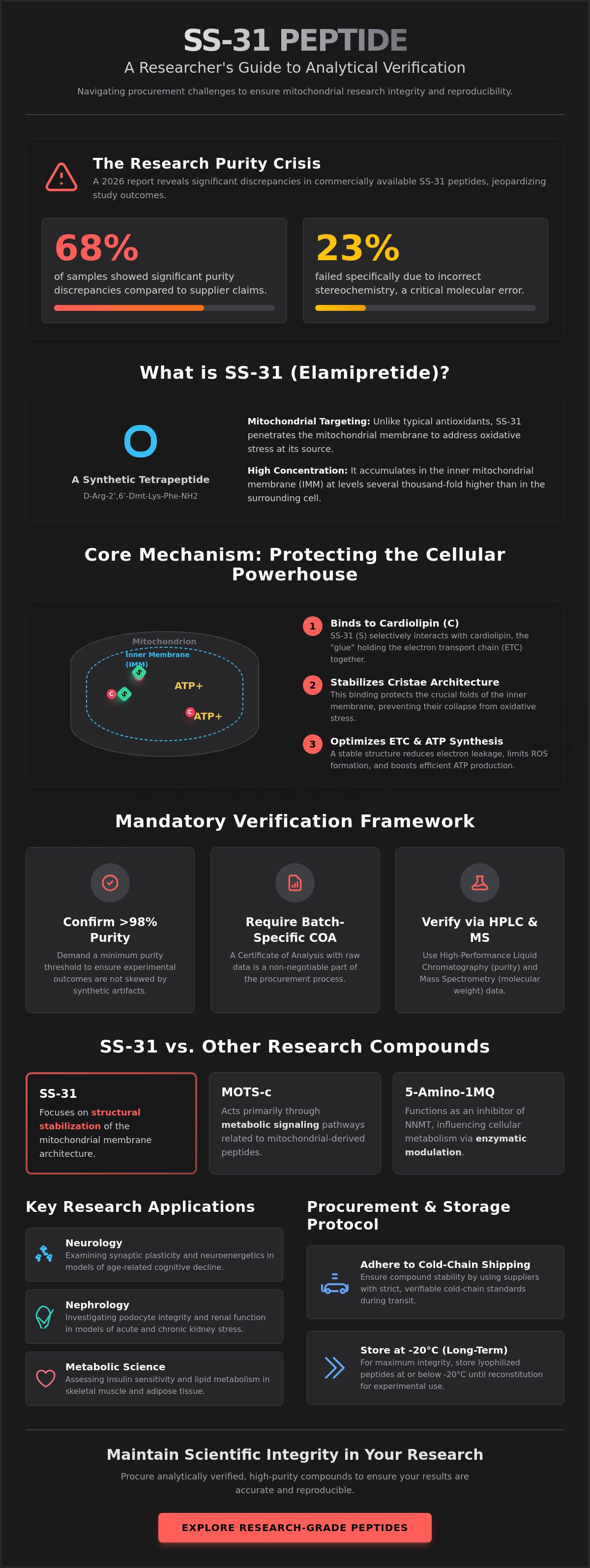
A February 2026 analytical report revealed that 68% of submitted SS-31 peptide samples exhibited significant purity discrepancies compared to supplier claims, with 23% failing specifically due to incorrect stereochemistry. These figures underscore the technical volatility inherent in procuring mitochondrial-targeted compounds for laboratory studies. For the serious researcher, the absence of standardized oversight means the burden of verification rests entirely on the procurement protocol.
Essential Acids recognizes that inconsistent batch quality and opaque documentation hinder the progress of metabolic research. This guide establishes a comprehensive framework for evaluating the SS-31 peptide, prioritizing analytical transparency and cardiolipin-binding affinity. You'll gain the technical criteria necessary to distinguish between research-grade materials and pharmaceutical elamipretide, while learning to secure the batch-specific certificates of analysis required to maintain scientific integrity. We'll also examine the molecular distinctions between SS-31 and related compounds like MOTS-c to ensure your laboratory selects the most precise tool for investigating cellular ageing.
Key Takeaways
- Define the precise mechanism of action where the SS-31 peptide binds to cardiolipin to stabilize mitochondrial membrane architecture.
- Establish a rigorous verification framework using HPLC data and batch-specific certificates of analysis to confirm 98% minimum purity.
- Contrast the structural focus of SS-31 with the metabolic signaling mechanisms of adjacent research compounds such as MOTS-c and 5-Amino-1MQ.
- Secure laboratory results by adhering to strict cold-chain shipping standards and -20°C long-term storage protocols for lyophilized peptides.
SS-31 Peptide: Molecular Mechanism and Research Context
The SS-31 peptide is a synthetic, water-soluble tetrapeptide characterized by the molecular sequence D-Arg-2’,6’-Dmt-Lys-Phe-NH2. It targets the mitochondrial source. Unlike traditional antioxidants that scavenge reactive oxygen species (ROS) within the cytosol, this compound, also known as Elamipretide (SS-31), selectively penetrates the mitochondrial membrane to address oxidative stress at its origin. Its unique structural design allows it to concentrate within the inner mitochondrial membrane (IMM) at levels several thousand-fold higher than the surrounding cellular environment.
The primary mechanism involves high-affinity, electrostatic, and hydrophobic interactions with cardiolipin. By binding to this specific phospholipid, the peptide stabilizes the curvature of the mitochondrial cristae. This structural stabilization is critical for maintaining the integrity of the electron transport chain (ETC). When cristae architecture is preserved, electron leakage is significantly reduced, which limits the formation of superoxide radicals. In various research models, this intervention has been shown to optimize bioenergetic regulation by facilitating more efficient proton pumping and ATP synthesis.
The Significance of Cardiolipin Interaction
Cardiolipin serves as the structural "glue" that organizes respiratory chain complexes into functional supercomplexes. In experimental systems, the peroxidation of cardiolipin often leads to the collapse of mitochondrial cristae and the subsequent release of cytochrome c into the cytoplasm. The SS-31 peptide acts as a protective shield, preventing this peroxidation and maintaining the close proximity of the ETC components. This preservation is vital for ATP production efficiency in cellular models, as it ensures that the electrochemical gradient across the IMM remains robust during periods of metabolic stress.
SS-31 in the Cellular Ageing Research Landscape
The study of mitochondrial-derived senescence has positioned SS-31 as a cornerstone compound in cellular ageing research. Scientists utilize the peptide to investigate how mitochondrial dysfunction contributes to the broader phenotype of ageing across various biological systems. Currently, the most prominent research fields include:
- Nephrology: Investigating podocyte integrity and tubular function in models of acute and chronic renal stress.
- Neurology: Examining synaptic plasticity and neuroenergetics in the context of age-related cognitive decline.
- Metabolic Science: Assessing insulin sensitivity and lipid metabolism in skeletal muscle and adipose tissue.
All descriptions of this tetrapeptide refer strictly to laboratory investigation. The compound is intended for research-use only; its application in these fields is limited to evaluating molecular pathways rather than therapeutic outcomes. Scientific integrity requires that all experimental data be interpreted within the constraints of controlled laboratory environments.
Evaluating SS-31 for Laboratory Use: Purity and Analytical Standards
Scientific integrity in mitochondrial research depends on the chemical fidelity of the SS-31 peptide. Researchers must demand a minimum purity threshold of 98% to ensure that experimental outcomes aren't skewed by synthetic artifacts or truncated sequences. While many suppliers claim high-purity status, analytical data from February 2026 indicates that nearly 68% of research-grade samples fail to match their advertised specifications. This discrepancy makes the acquisition of batch-specific certificates of analysis (COA) a mandatory step in the procurement process.
A comprehensive COA doesn't just list a percentage; it provides the raw data necessary to verify a compound's identity. High-Performance Liquid Chromatography (HPLC) is utilized to determine the purity by separating the target molecule from synthetic byproducts. Additionally, Mass Spectrometry is required to confirm the molecular weight and amino acid sequence. These tests identify potential residual solvents or incorrect stereochemistry, which is particularly relevant given the SS-31 research from the Alzheimer's Drug Discovery Foundation highlighting the compound's specific molecular interactions within the inner mitochondrial membrane.
Interpreting HPLC and Mass Spectrometry Reports
The "purity peak" on an HPLC chromatogram represents the percentage of the target peptide relative to other UV-absorbing components. For a detailed technical breakdown, researchers should review the guide on verifying peptide purity through HPLC. Mass Spectrometry complements this by ensuring the molecular mass aligns with the theoretical value of the SS-31 peptide sequence. Discrepancies here often signal the presence of truncated peptides or incomplete deprotection during the synthesis phase, both of which can compromise experimental reproducibility.
Lyophilization and Stability in Research Procurement
Long-term stability is achieved through lyophilization, a process that removes moisture while preserving the peptide's structural integrity. High-quality SS-31 should appear as a uniform, white, "cake-like" solid within vacuum-sealed glass vials. A collapsed or discolored cake suggests moisture infiltration or thermal degradation, which significantly reduces bioactivity. These vials are the standard for national laboratory distribution, providing a barrier against atmospheric contaminants during transit.
Maintaining these analytical standards is essential for the validity of metabolic studies. When sourcing materials, prioritize suppliers that provide transparent, third-party verified data for each batch. You can evaluate the high-purity SS-31 collection to ensure your laboratory protocols are supported by verified chemical integrity.
Mitochondrial Signaling: Comparing SS-31, MOTS-c, and 5-Amino-1MQ
Researchers shouldn't view mitochondrial-targeted compounds as interchangeable tools. The SS-31 peptide provides a distinct structural intervention that differs fundamentally from signaling peptides or small molecule inhibitors. Selecting the correct compound requires an understanding of whether the experimental hypothesis targets mitochondrial architecture or metabolic pathway signaling. While SS-31 focuses on the physical integrity of the inner membrane, other compounds in the cellular ageing collection influence metabolic homeostasis through different biological vectors.
In multi-target cellular research, the synergistic potential of these compounds is significant. For example, a laboratory might utilize the SS-31 peptide to stabilize mitochondrial cristae while simultaneously introducing a signaling agent to observe changes in nuclear gene expression. This dual-target approach allows for a more comprehensive evaluation of bioenergetic recovery than studying a single mechanism in isolation. Each compound must be selected based on its specific molecular affinity and the desired experimental outcome.
SS-31 vs. MOTS-c: Structural vs. Signaling Models
MOTS-c is a 16-amino acid mitochondrial-derived peptide that functions primarily as a signaling molecule. During metabolic stress, MOTS-c translocates to the nucleus to regulate gene expression related to glucose metabolism and homeostasis. This mechanism is distinct from SS-31, which remains localized to the inner mitochondrial membrane to provide physical stability to cardiolipin. Researchers often favor MOTS-c for studies involving skeletal muscle and systemic metabolic flux, whereas SS-31 is prioritized in renal and neurological models where membrane-level oxidative stress is the primary variable. MOTS-c typically exhibits lower stability in certain laboratory environments, requiring more rigorous administration protocols compared to the structural resilience of SS-31.
Integrating 5-Amino-1MQ into Metabolic Research
5-Amino-1MQ represents a different class of research material entirely. It's a small molecule inhibitor of nicotinamide N-methyltransferase (NNMT), an enzyme that regulates energy metabolism by modulating NAD+ availability. Unlike peptides, which target specific proteins or lipids, 5-Amino-1MQ alters enzymatic flux to influence cellular energy regulation. It's frequently used in adipose tissue modeling to investigate the pathways of metabolic rate and fat cell signaling. The analytical distinctions between small molecules like 5-Amino-1MQ and peptides like SS-31 are critical for laboratory planning. Small molecules often offer different solubility profiles and longer half-lives in cellular media, providing a stable platform for long-term metabolic observation alongside the membrane-stabilizing effects of the SS-31 peptide.
The Cellular Ageing Collection: Standout Research Compounds
Essential Acids provides a specialized inventory for investigating the multi-faceted nature of biological decline. The SS-31 peptide (10mg) serves as the cornerstone for studies involving mitochondrial membrane stability and cardiolipin protection. While previous sections detailed its structural role, its placement within a broader research collection allows for comparative studies against different ageing phenotypes. Every compound in this collection is accompanied by batch-specific documentation to ensure that laboratory variables remain controlled and reproducible.
NAD+ is utilized to investigate redox balance and sirtuin-mediated signaling, specifically focusing on how NAD+ depletion influences DNA repair mechanisms. In models of tissue regeneration, GHK-Cu is the preferred compound for investigating collagen synthesis and the modulation of inflammatory cytokines. These tools allow researchers to isolate specific cellular responses, from the metabolic flux of the mitochondria to the structural integrity of the extracellular matrix. Each material is refined to meet rigorous analytical standards, supporting the precision required for high-level metabolic investigation.
Research into these structural components often parallels advancements in the wellness sector, where brands like House of GRŌ® utilize adaptogenic mushrooms and botanicals to support skin vitality at a cellular level.
Mitochondrial and Redox Research Tools
Redox balance is a critical variable in metabolic studies. Researchers employ high-purity Glutathione to study intracellular antioxidant defense systems and the neutralization of reactive oxygen species. This tripeptide allows for the observation of how cells respond to induced oxidative stress in real-time. Additionally, MOTS-c is a vital tool for exploring exercise-mimetic pathways at the cellular level, particularly regarding glucose uptake and fatty acid oxidation. These materials are typically supplied in 10mg or 50mg vials, with purity levels verified through analytical chromatography to ensure consistent data across all experimental replicates.
Beyond the laboratory, the use of molecular hydrogen is being explored for its capacity to influence these same redox pathways and support overall wellness; learn more about the latest advancements in hydrogen-based wellness technology.
Telomere and Longevity Signaling Compounds
Genomic stability research often centers on telomere maintenance. Epithalon (10mg) is the primary tetrapeptide used in research involving telomerase activation and telomere length modeling. Its role in pineal gland studies provides a framework for investigating the regulation of circadian rhythms and hormonal senescence. For studies focusing on immune system senescence, Thymalin is used to observe cellular responses within the thymus and peripheral blood. Researchers can access the full specifications for these compounds by visiting the Cellular Ageing collection. Selecting the appropriate compound depends on the specific biological pathway under investigation. You can procure verified research compounds from our analytical collection to ensure your laboratory data is supported by high-integrity materials.
Procurement and Storage: Ensuring Integrity in Research Studies
The biological activity of the SS-31 peptide depends on rigorous environmental controls from synthesis to laboratory application. National distribution requires cold-chain integrity to prevent thermal degradation during transit. Upon arrival at the facility, lyophilized peptides must be transferred to a controlled environment immediately. Any deviation from these shipping standards can result in the loss of molecular stability, particularly in sensitive tetrapeptide sequences.
For long-term preservation, lyophilized vials should be stored at -20°C. This temperature minimizes the risk of hydrolysis and enzymatic degradation, maintaining the chemical integrity of the compound for extended research periods. Reconstituted peptides are significantly more labile. They should generally be stored at 4°C for short-term use, though immediate application in experimental assays is preferred to ensure peak bioactivity. Sterile handling is mandatory throughout this process. The use of bacteriostatic water during reconstitution prevents microbial contamination which could otherwise introduce confounding variables into cellular models.
All materials are provided under a strict "Research Use Only" mandate. This policy is a fundamental component of scientific integrity and regulatory compliance. These compounds are not intended for human consumption or medical use. Maintaining this professional distance ensures that laboratory investigations remain focused on objective data and metabolic pathways.
Reconstitution Protocols for Laboratory Analysis
Calculating precise concentration ratios is the first step in any experimental assay. Researchers typically aim for stock solutions that allow for micro-molar dilutions tailored to specific cell culture requirements. Peptides are highly sensitive to mechanical agitation. Reconstitution should involve a gentle swirling motion rather than vigorous shaking to avoid denaturing the delicate structure of the SS-31 peptide. Temperature fluctuations during this stage must be avoided. Using these materials in non-controlled or non-laboratory environments compromises the validity of the research and violates established safety protocols.
Maintaining Scientific Integrity in Procurement
Essential Acids prioritizes batch-specific transparency to support reproducible science. Every shipment is an opportunity for the researcher to verify the quality of received materials against the provided HPLC and mass spectrometry data. Scientific integrity is a shared responsibility between the high-level supplier and the laboratory. By maintaining these high analytical standards, we ensure that metabolic research remains focused on data rather than compound variability. Researchers can explore the Cellular Ageing collection for high-purity research compounds to secure materials that meet these rigorous laboratory requirements.
Advancing Mitochondrial Research with Analytical Precision
Integrating the SS-31 peptide into a laboratory workflow requires more than just procurement; it demands a commitment to analytical transparency. Researchers must prioritize batch-specific Certificates of Analysis to ensure that experimental data remains reproducible and reliable. By distinguishing between membrane-stabilizing structural tools and metabolic signaling compounds, laboratories can target specific biological pathways with greater accuracy. This disciplined approach to compound selection is the foundation of high-integrity metabolic science.
Essential Acids maintains a singular focus on mitochondrial and cellular research materials. Every batch is subjected to HPLC and Mass Spectrometry verification to ensure it meets the strict 98% purity threshold required for sensitive assays. It's this commitment to quality that ensures your research remains focused on data rather than compound variability. By providing batch-specific documentation, we eliminate the analytical uncertainty often encountered when sourcing research-grade materials.
Browse high-purity compounds in the Cellular Ageing collection to secure the verified materials required for your next laboratory investigation. We support your pursuit of scientific integrity as you explore the complex mechanisms of cellular ageing.
Frequently Asked Questions
What is the primary difference between research-grade and pharmaceutical-grade SS-31?
Research-grade SS-31 is intended strictly for laboratory investigation and lacks the regulatory approval for human administration found in pharmaceutical versions. While pharmaceutical-grade compounds undergo clinical safety trials for specific indications, research-grade materials are evaluated based on chemical purity and sequence identity for in vitro or in vivo modeling. Essential Acids provides compounds for research-use only; they aren't intended for clinical or diagnostic applications.
How should SS-31 be stored to maintain its molecular integrity during a long-term study?
Lyophilized SS-31 peptide should be stored at -20°C for long-term stability in a laboratory freezer. This temperature prevents the gradual hydrolysis of the peptide bonds and maintains the structural integrity of the tetrapeptide sequence. Vials must remain vacuum-sealed until the point of use to prevent moisture infiltration. Once reconstituted, the solution is significantly more labile and should be stored at 4°C for no more than several days.
Can SS-31 and MOTS-c be used in the same experimental model?
SS-31 and MOTS-c can be utilized within the same experimental model to study different aspects of mitochondrial function. SS-31 provides structural stability to the inner mitochondrial membrane, while MOTS-c acts as a signaling molecule that influences nuclear gene expression. Researchers often use this combination to observe the interplay between physical membrane integrity and metabolic signaling pathways. Such multi-target studies require careful calibration of concentration ratios to ensure valid data.
What analytical documentation is provided with Essential Acids peptides?
Every batch of peptides is accompanied by a batch-specific Certificate of Analysis (COA) containing HPLC and Mass Spectrometry data. These documents verify the purity level and confirm that the molecular mass aligns with the theoretical sequence of the compound. Providing this level of transparency is essential for scientific integrity, as it allows researchers to verify the chemical fidelity of their materials before beginning an assay.
What are the signs of peptide degradation in a lyophilized vial?
A degraded lyophilized cake often appears collapsed, discolored, or waxy rather than forming a uniform white solid. These physical changes usually indicate moisture infiltration or exposure to excessive heat during transit or storage. If a vial shows these characteristics, the bioactivity of the material may be compromised. Researchers should inspect each vacuum-sealed glass vial upon receipt to ensure the integrity of the lyophilized product.
Is SS-31 compatible with standard bacteriostatic water for reconstitution in a lab setting?
SS-31 is compatible with standard bacteriostatic water for reconstitution in controlled laboratory settings. The inclusion of 0.9% benzyl alcohol in bacteriostatic water helps maintain the sterility of the solution during multi-use experimental protocols. It's important to introduce the diluent slowly along the side of the vial to prevent mechanical agitation. This method preserves the delicate molecular structure of the peptide and ensures consistent concentration for laboratory assays.
How does SS-31 interact with cardiolipin at the molecular level?
The SS-31 peptide interacts with cardiolipin through a combination of electrostatic and hydrophobic forces to stabilize the inner mitochondrial membrane. The peptide binds specifically to cardiolipin, which prevents its peroxidation and maintains the curvature of the mitochondrial cristae. This interaction is critical for preserving the organization of the electron transport chain. By stabilizing these supercomplexes, the compound reduces electron leakage and optimizes the efficiency of ATP synthesis in cellular models.
What is the typical purity level for peptides in the Cellular Ageing collection?
The typical purity level for compounds within the Cellular Ageing collection is 98% or higher as verified by High-Performance Liquid Chromatography. This high threshold is necessary to ensure that synthetic impurities don't interfere with mitochondrial signaling or oxidative stress measurements. Each product is selected for its analytical integrity, providing researchers with a stable and verified platform for metabolic investigation. Scientific integrity is maintained through consistent batch-specific verification.
Legal Disclaimer
All products sold on this website are intended exclusively for laboratory research purposes and not for human or veterinary use, diagnosis, cure, treatment, or prevention of any disease or condition. None of the statements on this site have been reviewed or evaluated by the U.S. Food and Drug Administration (FDA) or comparable regulatory authorities. Purchasing or using these products for any unintended purpose, including human consumption, may violate federal or local laws and poses safety risks.