

The leap from clinical FDA approval to reproducible laboratory data depends entirely on the analytical integrity of the peptide sequence. Researchers often encounter significant hurdles when sourcing compounds that meet the rigorous ≥99% purity threshold required for precise metabolic modeling. You recognize that even a minor variance in batch consistency can invalidate months of longitudinal data. This guide provides an objective analysis of tesamorelin research applications, focusing on its molecular mechanisms and the specific quality standards necessary for laboratory procurement in 2026.
We'll examine the compound's role in growth hormone-releasing hormone pathways and its specific stability requirements when stored at -20°C. You'll gain a clear understanding of the documentation required to verify peptide identity, including HPLC-verified purity and mass spectrometry data. This review ensures that your procurement process prioritizes scientific integrity over market trends, facilitating accurate molecular modeling and consistent research results. By focusing on analytical grade standards, we ensure that the quality of the compounds supports the gravity of your research objectives.
Key Takeaways
- Understand the structural modifications of the 44-amino acid sequence that define this analog's interaction with growth hormone-releasing hormone receptors.
- Explore diverse tesamorelin research applications focused on lipid metabolism modeling and the investigation of glucose homeostasis in cellular cultures.
- Determine the rigorous quality benchmarks required for procurement, including the verification of 98%+ purity through batch-specific HPLC analysis.
- Implement precise laboratory handling procedures for lyophilized compounds, covering optimal storage temperatures and reconstitution protocols to ensure peptide stability.
- Align procurement strategies with regulatory compliance by sourcing materials strictly designated for research-use only to maintain scientific integrity.
Molecular Profile of Tesamorelin: A GHRH Analog in Research
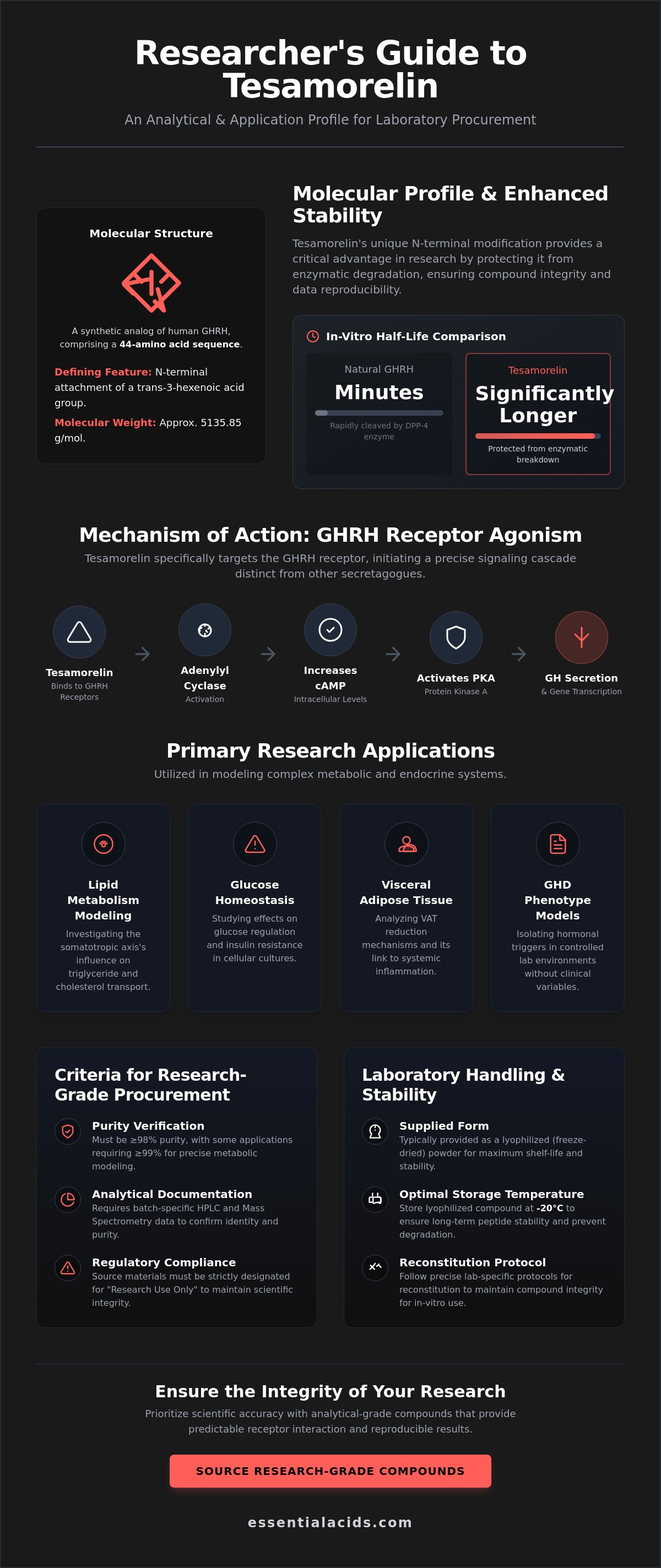
The molecular architecture of Tesamorelin distinguishes it as a specialized tool for endocrine research. It is a synthetic analog of human Growth Hormone-Releasing Hormone (GHRH), comprised of a 44-amino acid sequence. The defining characteristic of this peptide is the attachment of a trans-3-hexenoic acid group at its N-terminal position. This structural addition is not merely a chemical marker; it serves a functional purpose in laboratory environments by protecting the peptide from rapid enzymatic cleavage.
Current tesamorelin research applications prioritize the exploration of the somatotropic axis and its influence on lipid metabolism. By mimicking the action of endogenous GHRH, researchers can isolate and study metabolic signaling pathways without the interference of the rapid degradation seen with non-modified peptides. This stability is vital for maintaining consistent concentrations in cell culture studies or preclinical models, where the integrity of the compound directly impacts the reproducibility of the data.
Structural Modifications and Stability
The N-terminal modification provides a robust shield against dipeptidyl peptidase-4 (DPP-4), which is the primary enzyme responsible for the breakdown of natural GHRH. In vitro studies demonstrate that while natural GHRH possesses a half-life measured in minutes, Tesamorelin (GHRH Analog) remains bioactive for significantly longer periods. This extended stability allows for more precise observations of lipid metabolism and cellular response over time. Analytical laboratories must verify the compound's identity using its molecular weight of approximately 5135.85 g/mol and its specific chemical formula. High-purity compounds are essential for these applications, as minor impurities can disrupt the delicate signaling cascades being measured, leading to skewed results.
GHRH Receptor Agonism Mechanisms
Tesamorelin operates through high-affinity binding to GHRH receptors located on the surface of pituitary somatotropes. This binding triggers the activation of adenylyl cyclase, which subsequently increases intracellular levels of cyclic adenosine monophosphate (cAMP). The resulting activation of Protein Kinase A (PKA) stimulates both the transcription of the growth hormone gene and the secretion of the hormone itself. This pathway is highly specific and differs from other growth hormone secretagogues.
For example, compounds such as Ipamorelin target the ghrelin receptor (GHS-R1a) rather than the GHRH receptor. Tesamorelin's specificity allows researchers to study the somatotropic axis with high precision, isolating GHRH-specific responses. Downstream, this agonism leads to the modulation of Insulin-like Growth Factor 1 (IGF-1) within research models. Monitoring these IGF-1 fluctuations provides a reliable metric for assessing the compound's influence on metabolic regulation and cellular ageing processes. Scientific integrity in these studies relies on the use of analytical-grade materials that provide predictable receptor interaction, ensuring that all findings are rooted in the specific biochemical properties of the peptide.
Primary Research Applications: Metabolic and Neurological Modeling
While the molecular structure ensures stability, the actual tesamorelin research applications extend into complex systemic modeling. Researchers utilize this GHRH analog to observe the intersection of endocrine signaling and metabolic dysfunction. It serves as a primary tool for studying Growth Hormone Deficiency (GHD) phenotypes in controlled laboratory environments. These models allow for the isolation of specific hormonal triggers without the confounding variables often found in clinical subjects. By establishing a baseline of GHRH receptor activity, scientists can better understand the downstream effects on cellular growth and repair.
Metabolic Homeostasis and Lipolysis Research
In metabolic studies, the focus frequently shifts to visceral adipose tissue (VAT) reduction. Unlike subcutaneous fat, VAT is metabolically active and directly linked to systemic inflammation and insulin resistance. Research models analyze how elevated growth hormone levels influence hepatic IGF-1 production, which is a critical relationship for understanding the regulation of triglyceride and cholesterol transport proteins. The NCBI Clinical Review Report provides foundational data on these metabolic shifts, which researchers now use to build more sophisticated in vitro models. These investigations also track changes in insulin sensitivity and glucose homeostasis, providing a granular view of how somatotropic signaling affects cellular energy balance. Scientists often monitor the modulation of Very Low-Density Lipoprotein (VLDL) synthesis to determine the peptide's impact on lipid transport mechanisms.
Neuroscience and Cognitive Signaling
Beyond metabolism, emerging research explores the neuroprotective potential of GHRH signaling. The brain expresses GHRH receptors, particularly in areas associated with memory and executive function like the hippocampus. Current studies investigate hippocampal neurogenesis and its response to synthetic analogs. There is a specific interest in proteostasis, the process of maintaining protein folding and degradation within neurons. By modeling the impact of somatotropic signaling on these pathways, scientists aim to understand the mechanisms behind age-related cognitive dysfunction and protein aggregation. This expands the scope of tesamorelin research applications into the field of neuroscience, moving beyond the traditional focus on lipodystrophy. The ability to observe these pathways in real-time provides a significant advantage for those studying the biological markers of cellular ageing.
Accurate modeling in these sensitive fields depends on the use of analytical-grade peptides that offer batch-to-batch consistency. For projects requiring documented purity and reliable molecular weights, researchers often choose to procure Tesamorelin from suppliers who prioritize scientific transparency and rigorous quality control. Maintaining this level of integrity ensures that the resulting data is both reproducible and valid for further peer-reviewed analysis.
Criteria for Selecting Research-Grade Tesamorelin
The validity of tesamorelin research applications depends entirely on the chemical precision of the compound. In a laboratory setting, the standard for analytical-grade peptides is a purity level of 98% or higher. Anything below this threshold introduces unknown variables that can compromise the integrity of metabolic or neurological models. Minor impurities, such as truncated peptide sequences or residual solvents, may interfere with the GHRH receptor binding described earlier; this can lead to inconsistent cAMP signaling and unreliable data. High-purity compounds ensure that the observed biological responses are attributable solely to the peptide itself.
Verification of this purity requires two primary analytical methods: High-Performance Liquid Chromatography (HPLC) and Mass Spectrometry (MS). While HPLC determines the percentage of the target peptide relative to impurities, MS confirms the identity of the molecule by measuring its mass-to-charge ratio. For Tesamorelin, the MS report should show a molecular mass consistent with its specific 44-amino acid structure, approximately 5135.85 g/mol. Without both reports, a researcher cannot be certain of the compound's identity or its concentration within a vial.
Verifying Analytical Purity
High-Performance Liquid Chromatography remains the gold standard for assessing peptide purity. When reviewing an HPLC chromatogram, the primary peak should be sharp and clearly defined, representing the purified Tesamorelin. Researchers must also scrutinize the impurity profile for levels of Trifluoroacetic acid (TFA). While TFA is a common salt used during the purification process, high residual levels can be cytotoxic in certain cell culture models. Analytical labs should provide data on salt content to ensure the compound is compatible with the intended tesamorelin research applications. Additionally, the compound must be provided in a lyophilized (freeze-dried) state. Lyophilization is essential for maintaining the structural integrity of the peptide during transit, as it prevents the hydrolytic degradation that occurs in aqueous solutions.
Documentation and Transparency
Transparency in the supply chain is a non-negotiable requirement for high-level scientific research. Generic Certificates of Analysis (COA) that lack batch-specific dates or chromatograms are significant red flags in procurement. A valid COA must be batch-specific, linking the analytical data directly to the vial in the researcher's possession. This documentation should ideally include third-party verification from an independent laboratory to provide an unbiased assessment of quality. For longitudinal studies lasting several months or years, batch-to-batch consistency is vital. Procuring from a supplier that maintains rigorous quality control protocols prevents the "drift" in data that occurs when different batches exhibit varying purity levels or salt concentrations. This disciplined approach to sourcing protects the scientific integrity of the project and ensures that the results are reproducible across different phases of the study.
Laboratory Handling: Stability, Storage, and Reconstitution
Handling protocols are as critical as initial purity for successful tesamorelin research applications. The peptide's 44-amino acid structure remains highly sensitive to environmental stressors once it enters the laboratory environment. Maintaining the integrity of the trans-3-hexenoic acid group and the overall sequence requires strict adherence to thermal, light, and mechanical handling standards. Even a high-purity compound can yield invalid data if the secondary structure is compromised during preparation.
Storage Protocols for Research Integrity
For long-term preservation, lyophilized Tesamorelin must be stored at temperatures between -20°C and -80°C. Storage at 2-8°C is only appropriate for short-term use, typically under four weeks, and vials must be kept in a dark environment to prevent photodegradation. Vacuum-sealed vial integrity is a primary defense against moisture. Atmospheric water vapor facilitates hydrolytic cleavage of the peptide chain, which can occur even in a frozen state if the seal is compromised. Researchers must avoid repeated freeze-thaw cycles at all costs. These transitions cause ice crystal formation that can physically rupture the peptide bonds, leading to fragmented sequences and a loss of GHRH receptor affinity. Aliquoting the material after initial reconstitution is a standard method to minimize these mechanical risks.
Reconstitution and Solution Stability
Reconstitution protocols require a disciplined approach to avoid mechanical degradation. Bacteriostatic water or sterile saline are the preferred diluents for most metabolic models. When adding the liquid, it should be directed against the vial wall rather than directly onto the lyophilized cake. This prevents the formation of bubbles and minimizes peptide shearing, a form of mechanical stress that can alter the molecule's bioactivity. High-speed vortexing is strictly prohibited in peptide handling; a slow, steady swirling motion is the only acceptable method for achieving a clear solution.
The shelf-life of Tesamorelin drops to approximately 7 to 14 days once it's in an aqueous state, provided it's refrigerated. Beyond this window, the risk of deamidation and oxidation increases, which can alter the compound's metabolic signaling properties. Precise concentration calculations are necessary for accurate modeling. For example, using 1mL of diluent for a 5mg vial allows for a 500mcg/0.1mL ratio, facilitating the precise micro-dosing required in complex tesamorelin research applications. To ensure the highest level of experimental accuracy, researchers should procure BAC water specifically designed for laboratory reconstitution. Maintaining these standards ensures that the stability of the compound matches the rigorous requirements of your research design.
Procuring Tesamorelin for Advanced Scientific Research
The final stage of the laboratory procurement process involves selecting a partner that understands the disciplined nature of endocrine research. Selecting a supplier for tesamorelin research applications is a decision that impacts the validity of the entire experimental design. Essential Acids operates with a commitment to scientific integrity, providing compounds that are verified through rigorous analytical testing. Our operation is defined by a strict adherence to 'research-use only' regulatory frameworks, which acts as a foundational boundary for all commercial activities. This professional distance ensures that our focus remains on the precision of the laboratory rather than the trends of the commercial marketplace.
Scientific Integrity in Procurement
A primary marker of a reliable supplier is the availability of documented analytical data. Essential Acids prioritizes batch-specific HPLC and MS reporting for every lot of Tesamorelin produced. This transparency allows researchers to confirm the molecular identity and purity of their materials before beginning any metabolic or neurological modeling. By focusing on high-purity compounds, we provide the tools necessary for researchers to investigate cellular ageing and metabolic homeostasis with confidence. Our philosophy of "Making better, normal" is rooted in the belief that human potential is best understood through the lens of rigorous, peer-reviewed science. We don't offer medical consultations or human-grade pharmaceuticals; instead, we serve as a highly reliable partner for the scientific community. This objective approach ensures that the quality of our compounds speaks for itself, maintaining the quiet authority required in a high-level research environment.
Logistics and Quality Assurance
Maintaining the integrity of temperature-sensitive peptides during transit is a logistical challenge that requires specialized protocols. Our national shipping standards are designed to protect the structural stability of lyophilized powders from environmental stressors. Vials are shipped in secure, light-protected packaging to prevent photodegradation and mechanical breakage. These safety measures are essential for ensuring that the compound arrives in its intended analytical state, ready for the precise reconstitution protocols described in previous sections. Supply chain integrity is monitored from the moment of synthesis to the final delivery at the laboratory. This level of oversight minimizes the risk of purchasing non-analytical grade compounds that could compromise longitudinal data.
To facilitate your next phase of investigation, you may explore our catalog of high-purity research peptides. Our inventory is curated to support the most demanding tesamorelin research applications, ensuring that your laboratory results are built on a foundation of verified quality and scientific transparency. By adhering to these rigorous standards, we ensure that the compounds provided are worthy of the complex research they support.
Advancing Analytical Integrity in Endocrine Research
The success of future tesamorelin research applications relies on the transition from clinical observation to rigorous laboratory modeling. Maintaining the secondary structure of the peptide through precise storage at -20°C and gentle reconstitution ensures that longitudinal data remains valid and reproducible. By prioritizing analytical grade compounds with 99%+ purity, researchers eliminate the variables that often compromise metabolic signaling or neuroprotective studies. Scientific integrity is preserved only when procurement is backed by batch-specific HPLC and MS documentation, providing a clear audit trail for every phase of the experiment. This level of technical transparency is essential for the advancement of biochemistry and neuroscience.
Essential Acids supports your commitment to precise discovery by maintaining the highest quality control standards in the industry. You can secure high-purity Tesamorelin for your laboratory research with the assurance of verified documentation and integrity-focused packaging for national shipping. This disciplined approach to sourcing allows you to focus on the gravity of your findings while we manage the technical transparency of your materials. We look forward to supporting your next breakthrough in the laboratory.
Technical Specifications and Research Inquiries
What is the molecular weight of Tesamorelin in research applications?
The molecular weight of Tesamorelin is approximately 5135.85 g/mol. This specific value is critical for mass spectrometry verification during laboratory procurement. Identifying this mass-to-charge ratio ensures that the synthesized 44-amino acid sequence matches the target molecular profile. Analytical labs use this data to confirm the identity of the compound before it's utilized in complex metabolic modeling or longitudinal research studies.
Is Tesamorelin compatible with other neuropeptides in co-signaling studies?
Tesamorelin is frequently used alongside other neuropeptides in co-signaling studies to observe synergistic effects on the somatotropic axis. Researchers often combine GHRH analogs with growth hormone-releasing peptides like Ipamorelin to model enhanced pulsatile secretion. These combinations are strictly for in vitro and non-human preclinical research. Maintaining separate reconstitution protocols for each peptide is necessary to prevent premature molecular interactions before laboratory application.
How should lyophilized Tesamorelin be stored for long-term research?
Lyophilized Tesamorelin must be stored at -20°C for short-term projects or -80°C for long-term research integrity. Vials should remain vacuum-sealed and protected from light to prevent hydrolytic degradation and photodegradation. Once reconstituted in bacteriostatic water, the solution's stability is significantly reduced. It's recommended to use the aqueous peptide within 7 to 14 days while maintaining a constant temperature of 2-8°C to ensure the validity of tesamorelin research applications.
What are the common impurities found in low-grade Tesamorelin synthesis?
Low-grade synthesis often results in truncated peptide sequences, residual solvents, and high levels of Trifluoroacetic acid (TFA). These impurities can be identified through the presence of secondary peaks on an HPLC chromatogram. High TFA concentrations are particularly problematic as they may induce cytotoxicity in sensitive cell culture models. Procuring analytical-grade compounds with documented purity profiles is the only way to mitigate these risks and ensure batch-to-batch consistency.
Does Tesamorelin cross the blood-brain barrier in animal research models?
Tesamorelin shows limited permeability across the blood-brain barrier, yet it's frequently studied in animal models for its indirect neuroprotective effects. Research indicates that GHRH analogs may influence hippocampal neurogenesis and proteostasis through systemic somatotropic signaling. These tesamorelin research applications focus on how the modulation of peripheral IGF-1 levels impacts central nervous system pathways. Such studies are vital for understanding the intersection of metabolic health and cognitive decline.
What is the recommended purity level for Tesamorelin used in HPLC analysis?
The recommended purity level for Tesamorelin used in analytical HPLC analysis is ≥99%. This high-purity standard is necessary to ensure that the resulting data isn't skewed by unknown chemical variables or sequence variations. Anything below 98% purity is generally considered unsuitable for high-level laboratory research. Researchers should always demand batch-specific chromatograms to verify that the compound meets these rigorous analytical benchmarks before procurement.
How do GHRH analogs like Tesamorelin differ from GHRPs in research?
GHRH analogs like Tesamorelin target the GHRH receptor on pituitary somatotropes, while GHRPs target the ghrelin receptor. These two classes of peptides operate through distinct intracellular signaling pathways. GHRH analogs stimulate the cAMP-PKA pathway, whereas GHRPs typically involve calcium signaling. Understanding this mechanistic difference is essential for researchers who are designing experiments to isolate specific components of the growth hormone secretion process in metabolic models.
Can Tesamorelin be used for diagnostic purposes in a lab setting?
Tesamorelin is provided strictly for research-use only and isn't intended for diagnostic purposes in any clinical or human setting. It's a laboratory reagent designed for in vitro and preclinical investigation. Regulatory frameworks prohibit the use of these compounds for human diagnosis or medical treatment. Scientific integrity requires that these materials are handled only by qualified professionals within a controlled laboratory environment to ensure safety and compliance.
Legal Disclaimer
All products sold on this website are intended exclusively for laboratory research purposes and not for human or veterinary use, diagnosis, cure, treatment, or prevention of any disease or condition. None of the statements on this site have been reviewed or evaluated by the U.S. Food and Drug Administration (FDA) or comparable regulatory authorities. Purchasing or using these products for any unintended purpose, including human consumption, may violate federal or local laws and poses safety risks.