

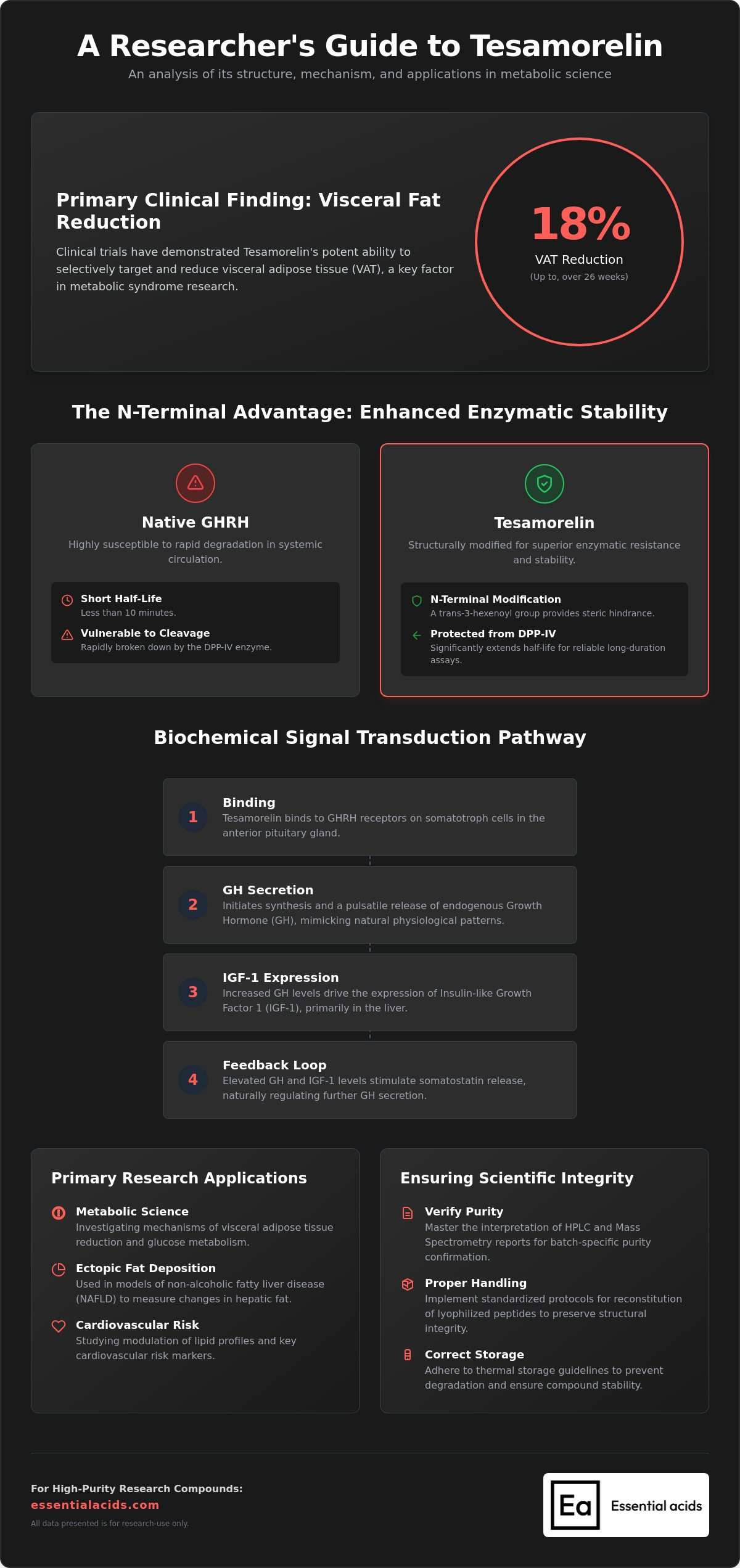
In clinical trials, Tesamorelin has demonstrated the capacity to reduce visceral adipose tissue by up to 18% over a 26-week period, a metric that underscores its unique potency among GHRH analogues. For investigators exploring tesamorelin research applications, the primary challenge isn't just observing these metabolic shifts but ensuring the chemical integrity of the compound used in the laboratory. You're likely aware that inconsistent peptide purity and a lack of batch-specific analytical documentation can compromise the validity of your data. This technical overview addresses those exact pain points by providing a rigorous analysis of the peptide's molecular structure and its performance in 2026 research models.
We'll examine how the specific N-terminal modification of this analogue provides superior enzymatic stability compared to other secretagogues. This article details the biochemical pathways involved in growth hormone stimulation and outlines the verification standards necessary for high-purity procurement. By examining the latest data on IGF-1 elevation and the F8 formulation's enhanced bioavailability, you'll gain the clarity needed to maintain scientific integrity in sophisticated metabolic or neuroendocrine studies. All data is presented strictly for research-use only.
Key Takeaways
- Analyze the stabilized molecular structure of Tesamorelin and the significance of the trans-3-hexenoyl group in maintaining enzymatic resistance.
- Evaluate primary tesamorelin research applications within metabolic science, specifically focusing on mechanisms of visceral adipose tissue reduction and glucose metabolism.
- Distinguish the biochemical profiles of GHRH analogues from GHRPs to identify the most appropriate secretagogue for specific laboratory models.
- Implement standardized protocols for reconstitution and thermal storage to preserve the structural integrity of lyophilized peptide sequences.
- Verify scientific integrity in procurement by mastering the interpretation of HPLC and Mass Spectrometry reports for batch-specific purity confirmation.
Molecular Structure and Mechanism of Action
Tesamorelin is a synthetic peptide consisting of 44 amino acids, designed as a stabilized analogue of the endogenous growth hormone-releasing hormone (GHRH). In tesamorelin research applications, the compound's primary value lies in its structural modification. Specifically, the attachment of a trans-3-hexenoyl group to the N-terminal tyrosine residue distinguishes it from the native GHRH (1-44) sequence. This biochemical profile is detailed further in the entry for Tesamorelin on Wikipedia, which serves as a foundational reference for its structural properties. By maintaining the full 44-amino acid chain, the peptide preserves high binding affinity for growth hormone-releasing hormone receptors (GHRHR) located on the somatotroph cells of the anterior pituitary gland.
The mechanism of action relies on the simulation of natural physiological processes. Upon binding to the GHRHR, the peptide initiates the synthesis and secretion of endogenous growth hormone (GH). Unlike direct GH administration, which can lead to supra-physiological peaks, this analogue promotes a pulsatile release pattern. This preservation of the GH axis is a critical variable in endocrine research. It allows investigators to observe metabolic changes while maintaining the natural feedback mechanisms of the hypothalamic-pituitary-somatotropic axis.
The Role of N-Terminal Modification in Enzymatic Stability
The addition of the hexenoyl group is the definitive factor in the peptide's laboratory utility. Native GHRH is highly susceptible to rapid cleavage by the enzyme dipeptidyl peptidase IV (DPP-IV), which targets the N-terminal. This degradation typically limits the half-life of native GHRH to less than ten minutes in systemic circulation. The hexenoyl modification creates steric hindrance that protects the peptide from this specific enzymatic attack. In vitro studies demonstrate that this protection extends the half-life significantly. For long-duration laboratory assays, this stability ensures that the compound remains active throughout the observation period, providing more reliable data on chronic metabolic shifts.
Signal Transduction Pathways in Research Models
Binding to the GHRHR activates a G-protein coupled receptor mechanism, specifically triggering the cAMP-dependent pathway. This activation increases intracellular cyclic adenosine monophosphate (cAMP) levels, which subsequently opens calcium channels and stimulates the release of GH vesicles. Downstream, the increased GH levels drive the expression of Insulin-like Growth Factor 1 (IGF-1) in cellular models, primarily within the liver. Researchers must account for the complex feedback inhibition loops inherent in this system. For instance, elevated GH and IGF-1 levels eventually stimulate the release of somatostatin, which acts as a natural brake on further GH secretion. Analyzing these loops is essential for understanding the long-term efficacy of tesamorelin research applications in metabolic syndrome models.
Primary Research Applications in Metabolic Science
The utility of tesamorelin research applications centers primarily on its ability to modulate adipose tissue distribution without the systemic instability associated with direct growth hormone administration. Phase 3 clinical data has established that this analogue can reduce visceral adipose tissue (VAT) by 15% to 18% over a 26-week duration. In laboratory models, this makes it an essential tool for investigating the physiological mechanisms of lipolysis. Researchers use these models to observe how GHRH analogues target deep abdominal fat while largely sparing subcutaneous fat layers. This specificity allows for the isolation of metabolic pathways that contribute to systemic inflammation and insulin resistance.
Recent studies have expanded into the investigation of ectopic fat deposition, particularly in models of non-alcoholic fatty liver disease (NAFLD). By stimulating the GHRH-GH-IGF-1 axis, investigators can measure changes in hepatic fat fraction and lipid oxidation rates. This research is critical for understanding metabolic syndrome, where lipid profile modulation and cardiovascular risk markers are primary endpoints. While the peptide promotes fat oxidation, research protocols must carefully monitor glucose metabolism. Data suggests a potential for hyperglycemia or altered insulin sensitivity, which serves as a vital variable in studies evaluating the safety and efficacy of metabolic interventions. For those procuring high-purity peptides for such sensitive assays, batch-specific analytical verification remains the standard for maintaining scientific integrity.
Adipocyte Differentiation and Lipolysis Studies
In cellular research, Tesamorelin is used to examine changes in adipocyte size and the activation of molecular markers like hormone-sensitive lipase (HSL) and adipose triglyceride lipase (ATGL). This provides a contrast to other secretagogues; for instance, comparing these results with the molecular profile of Ipamorelin allows researchers to differentiate between ghrelin-mimetic pathways and direct GHRH receptor activation. Such comparative data is essential for determining which analogue most effectively drives lipolytic signaling in specific tissue types.
Neuroendocrine and Cognitive Research Potential
Beyond metabolic science, the GHRH-Growth Hormone-IGF-1 axis is increasingly studied for its neuroprotective potential. Research into somatopause, the age-related decline in neuroendocrine function, investigates how sustained IGF-1 levels might influence cognitive markers and neuronal health. In certain laboratory environments, investigators explore the capacity of these analogues to influence the blood-brain barrier's permeability or function. These studies often measure mean IGF-1 score elevations, which clinical trials have placed at approximately 1.0 to 1.5 SD above baseline, to correlate systemic endocrine shifts with neurobiological outcomes.
Parallel to these clinical explorations, the role of targeted nutrition remains a key interest for those managing age-related physiological shifts, where brands like Nutrahara focus on providing high-quality supplement options for women's health.
Comparative Analysis: Tesamorelin vs. Other GHRH Analogues
Researchers must distinguish between direct growth hormone-releasing hormone (GHRH) analogues and growth hormone-releasing peptides (GHRPs) when designing endocrine studies. While both classes increase growth hormone (GH) output, they utilize distinct signaling pathways. Tesamorelin and CJC-1295 act directly on the GHRH receptor (GHRHR) in the pituitary; in contrast, GHRPs like Ipamorelin target the ghrelin receptor (GHS-R). For tesamorelin research applications, the primary advantage is the peptide's high specificity for visceral adipose tissue reduction. Unlike many GHRPs, it doesn't typically stimulate appetite or significantly elevate cortisol and prolactin levels, which are critical variables for metabolic research integrity.
The choice of analogue often depends on the desired GH release profile. CJC-1295 with DAC (Drug Affinity Complex) provides a non-physiological, sustained elevation of GH levels due to its binding with serum albumin. This contrasts sharply with Tesamorelin, which preserves the natural pulsatile secretion of GH. For investigators studying the hypothalamic-pituitary-somatotropic axis, the pulsatile nature of Tesamorelin offers a more accurate simulation of endogenous biological processes. This preservation of the GH axis allows for clearer data when observing long-term metabolic shifts in laboratory models.
Tesamorelin vs. CJC-1295 Structure
Molecular differences dictate stability and research utility. Tesamorelin maintains the full 44-amino acid sequence, stabilized by an N-terminal hexenoyl group. This differs from the CJC-1295 structure, which uses the truncated 29-amino acid fragment with four substitutions at positions 2, 8, 15, and 27. These substitutions prevent enzymatic degradation, but the resulting binding affinities differ. Tesamorelin is specifically optimized for metabolic assays where VAT reduction is the primary endpoint.
Selecting Compounds for Targeted Laboratory Research
Selection requires a framework based on specific study goals. Generalized growth or recovery studies might use a combination of GHRH and GHRP secretagogues for synergistic effects. However, for studies isolated to visceral adiposity, Tesamorelin is the primary candidate. Adhering to rigorous laboratory procurement standards ensures that analogues possess the necessary batch-specific documentation. Tesamorelin research applications continue to expand as investigators refine these comparative models.
Laboratory Handling, Reconstitution, and Storage
Maintaining the structural integrity of the 44-amino acid sequence is paramount for successful tesamorelin research applications. In its lyophilized state, the peptide is relatively stable, yet it remains sensitive to thermal fluctuations and light exposure. For long-term preservation exceeding 90 days, vials must be stored in a controlled freezer at -20°C. Short-term storage of the lyophilized powder at 2-8°C is acceptable for periods up to three months. Investigators should ensure that vials remain sealed in an environment with minimal humidity to prevent moisture ingress, which can lead to premature peptide degradation.
The reconstitution process requires precision to avoid mechanical denaturation of the peptide chain. Bacteriostatic water (0.9% benzyl alcohol) is the standard diluent for most laboratory assays, as it inhibits bacterial growth and allows for multiple withdrawals from a single vial. When introducing the diluent, the liquid should be aimed at the side of the glass vial rather than directly onto the lyophilized cake. This technique minimizes the risk of shear stress. Researchers must never shake the vial; instead, a gentle swirling motion should be used until the solution is clear and free of particulate matter. For those requiring the highest level of scientific integrity, sourcing verified bacteriostatic water alongside high-purity peptides is a fundamental requirement.
Reconstitution Calculations and Concentration Standards
Precise dosing in cellular or animal models depends on accurate mg/mL calculations. For instance, reconstituting a 2mg vial with 1mL of diluent yields a concentration of 2mg/mL, whereas using 2mL of diluent results in 1mg/mL. Using high-quality, sterile diluents is essential to prevent the introduction of contaminants that could alter the results of sensitive metabolic assays. Regarding chemical stability, Tesamorelin maintains its optimal structural integrity when the solution is held at a pH of approximately 5.0.
Long-term Storage and Stability Testing
Once reconstituted, the stability window of the peptide narrows significantly. The solution should be maintained at 2-8°C and used within 7 to 14 days. To avoid the degradation caused by repeated freeze-thaw cycles, investigators should aliquot the reconstituted solution into single-use plastic tubes for long-term storage at -80°C. While Tesamorelin is more robust than native GHRH due to its N-terminal modification, it is generally less stable than smaller, cyclic peptides. Researchers can refer to the BPC-157 molecular profile to compare the stability benchmarks of different peptide classes. Protecting the solution from direct light exposure during all phases of the assay is necessary to prevent photo-oxidation of the tyrosine residues.
Sourcing Tesamorelin for Scientific Integrity
High-Performance Liquid Chromatography (HPLC) is the definitive analytical method for establishing the purity of compounds used in tesamorelin research applications. This technique separates the peptide from any residual impurities by measuring retention times against a known standard. A purity level of 98% or higher is generally required for metabolic studies to ensure that observed biological responses are attributable to the peptide rather than contaminants. Mass Spectrometry (MS) serves as the secondary layer of verification. It confirms the molecular weight and sequence of the 44-amino acid chain by analyzing the mass-to-charge ratio of the ionized peptide. Together, these methods provide the raw data necessary to uphold scientific integrity in the laboratory.
Essential Acids operates with a commitment to "Making better, normal," a philosophy that prioritizes the availability of high-purity compounds for rigorous investigation. All products are provided strictly for research-use only. This boundary is maintained to ensure that laboratory chemicals remain within the hands of qualified investigators who understand the technical requirements for safe handling and disposal. By providing transparent analytical data, we support the stability and reproducibility of complex metabolic research. It's a standard that ensures the quality of the compounds speaks for itself without the need for traditional marketing flair.
Understanding Batch-Specific Analytical Documentation
A Certificate of Analysis (CoA) is only as reliable as the specific batch it represents; researchers must verify that the documentation matches the lot number on the vial. Third-party testing remains the industry standard for unbiased verification, providing an external audit of peptide purity and sequence identity. Essential Acids ensures consistency across all metabolic research compounds by mandating these rigorous testing protocols for every production cycle. This eliminates the ambiguity often found in the research chemical marketplace and provides investigators with the batch-specific documentation required for high-level study.
Procurement Standards for Australian Laboratories
Acquiring high-purity peptides for national research requires adherence to strict laboratory safety and handling regulations. Australian investigators must ensure that their procurement channels comply with local standards for the importation and storage of research-grade chemicals. Maintaining a clear audit trail from the point of synthesis to the laboratory bench is essential for regulatory compliance. For those ready to advance their investigations into GHRH analogues, you may view Tesamorelin for research to access batch-verified compounds designed for scientific precision. Tesamorelin research applications demand this level of transparency to ensure that every assay yields reliable and verifiable data.
Advancing Metabolic Research Standards in 2026
The structural modification of Tesamorelin ensures its role as a primary candidate for studying visceral adiposity in sophisticated laboratory models. By maintaining the natural GH axis, this analogue allows for nuanced data collection that other secretagogues might obfuscate. Precision in tesamorelin research applications depends entirely on the chemical integrity of the peptide sequence. We've established that the hexenoyl modification provides the stability required for long-duration assays, provided that the compound's purity is analytically verified. These standards prevent the ambiguity that often compromises metabolic research outcomes.
Scientific integrity remains the benchmark for procurement in high-level laboratories. Essential Acids provides high-integrity sourcing strictly for laboratory and analytical research use; this ensures that every vial meets the rigorous demands of the scientific community. By prioritizing transparency and verified quality, we assist investigators in "Making better, normal" through stable and reproducible experimental results. Explore our high-purity Tesamorelin for laboratory research to access the batch-specific HPLC and Mass Spectrometry documentation necessary for your next study. It's a commitment to ensuring that the compound's quality remains a reliable constant in your research environment.
Frequently Asked Questions
What is the primary difference between Tesamorelin and other GHRH analogues?
Tesamorelin is distinguished by its full 44-amino acid sequence and the specific addition of a trans-3-hexenoyl group at the N-terminal. This modification provides superior resistance to dipeptidyl peptidase IV (DPP-IV) degradation compared to native GHRH. Unlike analogues like CJC-1295 with DAC, which provide sustained growth hormone elevation, Tesamorelin is engineered to preserve the natural pulsatile release pattern of endogenous growth hormone.
Is Tesamorelin suitable for human consumption or clinical use?
No, these compounds are strictly intended for laboratory and analytical research-use only. Tesamorelin research chemicals are not for human consumption, therapeutic use, or clinical application. All materials must be handled by qualified investigators within a controlled laboratory environment to ensure safety and regulatory compliance. Any use outside of these parameters is strictly prohibited.
How should lyophilized Tesamorelin be stored for maximum shelf life?
For long-term stability, lyophilized vials must be stored at -20°C. While the peptide remains stable at refrigerated temperatures (2-8°C) for up to 90 days, the freezer environment is necessary to prevent the gradual degradation of the amino acid chain over extended periods. Vials should be kept in a dark environment and protected from moisture to maintain the structural integrity of the compound.
What is the mechanism by which Tesamorelin reduces visceral adipose tissue in research models?
In tesamorelin research applications, the peptide binds to growth hormone-releasing hormone receptors in the pituitary to stimulate the secretion of endogenous growth hormone. This increase in growth hormone subsequently activates lipolysis, specifically within visceral adipose tissue. The process involves the enzymatic breakdown of stored triglycerides into free fatty acids, a mechanism that researchers monitor to evaluate metabolic shifts in obesity models.
How is the purity of Tesamorelin research compounds verified?
Purity is verified using a combination of High-Performance Liquid Chromatography (HPLC) and Mass Spectrometry (MS). HPLC establishes the percentage of the target peptide relative to impurities, while MS confirms the precise molecular weight and amino acid sequence. Scientific integrity requires that investigators review batch-specific analytical reports to ensure the material meets the 98% purity threshold typically required for metabolic assays.
Can Tesamorelin be used in conjunction with other peptides like Ipamorelin in laboratory studies?
Yes, investigators frequently combine Tesamorelin with GHRPs like Ipamorelin to study the synergistic effects of dual-pathway stimulation. While Tesamorelin targets the GHRH receptor, Ipamorelin acts on the ghrelin receptor, leading to a more pronounced release of growth hormone in laboratory models. These studies are vital for mapping the complex feedback loops within the hypothalamic-pituitary-somatotropic axis.
What are the common reconstitution solvents used for Tesamorelin in research?
Bacteriostatic water and sterile 0.9% saline are the standard solvents used for reconstitution in a laboratory setting. Bacteriostatic water is often preferred for studies requiring multiple withdrawals from a single vial, as the benzyl alcohol content prevents microbial contamination. The choice of diluent should be consistent across all samples in an assay to avoid variables related to pH or solubility.
Does Tesamorelin affect insulin-like growth factor 1 (IGF-1) levels in cellular assays?
Tesamorelin consistently elevates IGF-1 levels by stimulating hepatic production in response to increased growth hormone. In tesamorelin research applications, researchers typically observe IGF-1 scores rising by 1.0 to 1.5 standard deviations above the baseline. Monitoring these levels is a standard procedure for verifying the biological activity of the GHRH analogue and its impact on downstream endocrine signaling.
Legal Disclaimer
All products sold on this website are intended exclusively for laboratory research purposes and not for human or veterinary use, diagnosis, cure, treatment, or prevention of any disease or condition. None of the statements on this site have been reviewed or evaluated by the U.S. Food and Drug Administration (FDA) or comparable regulatory authorities. Purchasing or using these products for any unintended purpose, including human consumption, may violate federal or local laws and poses safety risks.