

The exceptional metabolic influence of tirzepatide is not simply a function of its peptide sequence but is fundamentally anchored in its unique, site-directed fatty acid acylation. While many laboratory protocols focus on basic peptide synthesis, the specific tirzepatide structure incorporates a C20 fatty diacid moiety that dictates its dual-agonist profile. You likely recognize the difficulty in reconciling the overlapping sequences of GIP and GLP-1 analogs when attempting to verify batch-specific analytical standards for research-use only applications.
This article delivers an exhaustive technical profile of the 39-amino acid architecture, providing the clarity needed to understand how this compound achieves simultaneous receptor affinity. We will analyze the molecular modifications that extend its biological half-life and evaluate the chemical stability required for precise laboratory reconstitution. This data ensures that your experimental designs are supported by rigorous biochemical integrity and objective structural data. By examining the specific acylation patterns and sequence modifications, you will gain a comprehensive understanding of the mechanisms that define this dual-receptor agonist.
Key Takeaways
- Identify the specific 39-amino acid sequence and the clinical rationale behind its dual-agonist design for metabolic research.
- Examine the tirzepatide structure to understand how the C20 fatty diacid modification enhances binding affinity and chemical stability.
- Gain clarity on the structural differences between GLP-1 and GIP analogs to ensure accurate receptor targeting in laboratory environments.
- Determine precise protocols for reconstitution and storage using verified solubility data for common buffers like saline and BAC water.
- Establish rigorous quality benchmarks for research-use only compounds by utilizing HPLC and mass spectrometry data to verify molecular integrity.
What is Tirzepatide? Defining the Dual-Agonist Molecular Profile
Tirzepatide is a synthetic peptide comprising 39 amino acids, engineered specifically to activate both the glucose-dependent insulinotropic polypeptide (GIP) and glucagon-like peptide-1 (GLP-1) receptors. It's not a naturally occurring hormone; rather, it's a precisely calibrated compound designed for rigorous metabolic study. The tirzepatide structure functions as a dual agonist, often classified in contemporary biochemical literature as a "twincretin." This nomenclature reflects its capacity to simulate the physiological actions of two distinct endogenous hormones within a single molecular framework. While naturally occurring incretins possess extremely short half-lives due to rapid enzymatic degradation, this synthetic analog is modified to maintain structural integrity and prolonged receptor interaction in research-use only applications.
The Incretin Concept in Research Models
The incretin system remains a primary focus in metabolic regulation studies. GLP-1 primarily facilitates glucose-dependent insulin secretion and suppresses glucagon release. GIP plays a more complex role in lipid metabolism and energy balance. Traditional research models often relied on mono-agonists, which only address one side of the metabolic equation. Dual-agonism represents a significant technical advancement over these older models. It allows for the investigation of synergistic pathways that mono-agonists can't replicate. By targeting both receptors, researchers can observe integrated responses in insulin sensitivity and adipose tissue regulation. This integrated approach is essential for understanding the multi-pathway nature of metabolic homeostasis and cellular energy expenditure.
Molecular Evolution: From Fish Incretins to Synthetic Analogs
The architectural design of the tirzepatide structure finds its roots in evolutionary biology. Comparative studies of incretin sequences in primitive vertebrates, such as the lamprey and dogfish, revealed ancestral versions of these peptides that naturally exhibited dual-receptor affinity. Early synthetic research focused on exenatide-based structures, which were largely GLP-1 centric and derived from Gila monster saliva. The shift toward GIP-centric peptide scaffolds allowed for greater engineering flexibility. Modern structural engineering has successfully modified the peptide's binding kinetics, ensuring high affinity for both receptor pockets. These refinements aren't just about efficacy; they're about stability. The resulting synthetic analog exhibits superior resistance to proteolytic cleavage, which is a critical requirement for maintaining analytical integrity during laboratory storage and reconstitution.
- Synthetic 39-amino acid sequence.
- Dual-receptor affinity for GIP and GLP-1.
- Engineered for enhanced proteolytic stability.
- Classified as a "twincretin" in analytical biochemistry.
Detailed Molecular Architecture and Amino Acid Sequence
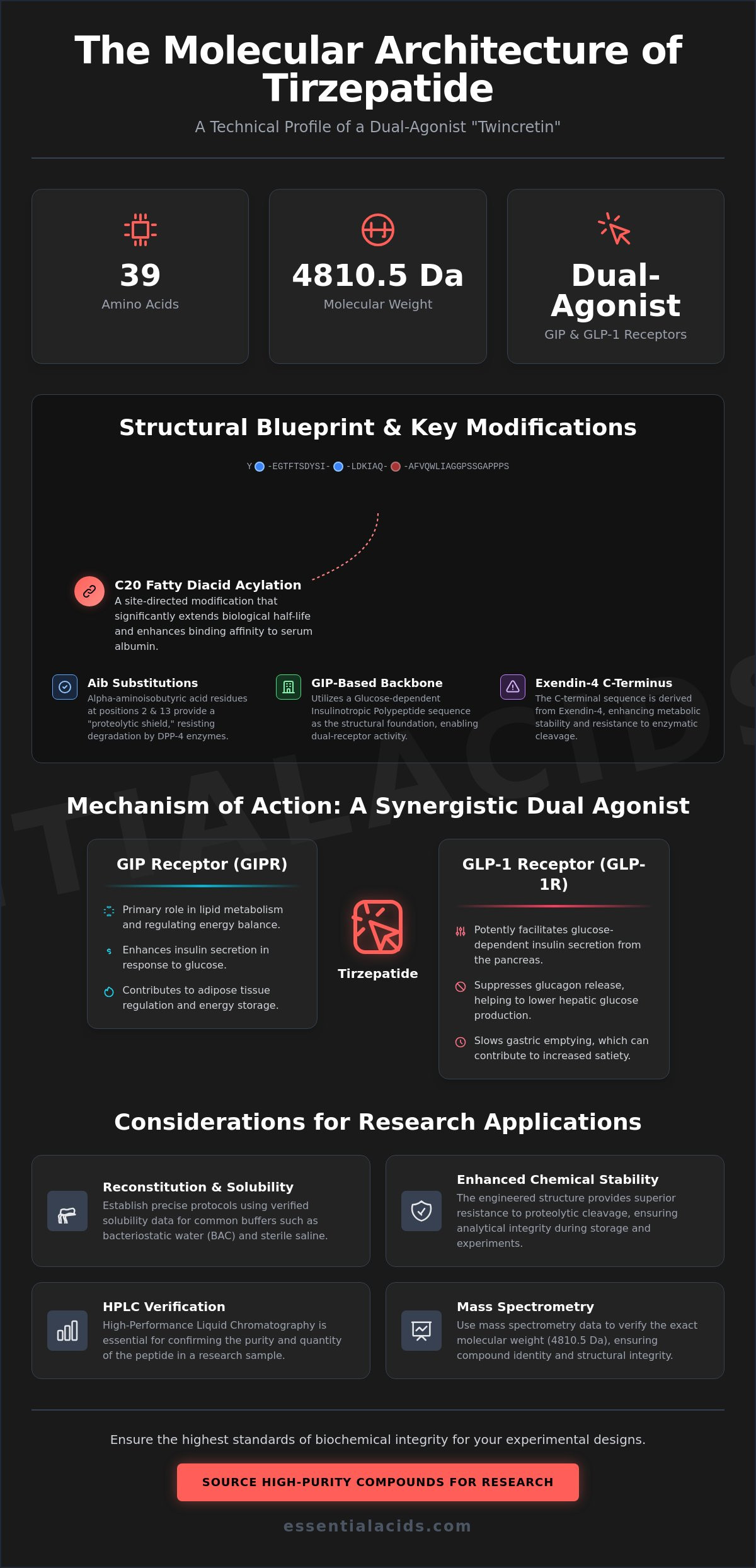
The tirzepatide structure is a sophisticated engineering feat that balances receptor affinity with biological durability. Its primary sequence consists of 39 amino acids: Y-Aib-EGTFTSDYSI-Aib-LDKIAQ-C20diacid-AFVQWLIAGGPSSGAPPPS. This specific arrangement is built upon a GIP-based backbone, which serves as the scaffold for the compound's dual-agonist properties. While the native GIP sequence provides the foundation, targeted substitutions enable the molecule to interact effectively with GLP-1 receptors. According to the Tirzepatide chemical structure data provided by PubChem, the molecule possesses a molecular weight of 4810.52 Da. This analytical value is essential for laboratory researchers who must ensure precise molarity during experimental preparation. The choice of a GIP-centric backbone is strategic; it allows for the integration of GLP-1 activity without compromising the inherent stability of the peptide chain.
Primary Sequence Modifications and Stability
Structural integrity is maintained through the substitution of specific residues that are otherwise vulnerable to proteolytic cleavage. The C-terminal region incorporates a sequence derived from exendin-4, which significantly improves metabolic stability in vitro compared to the native GLP-1 C-terminus. This modification prevents rapid enzymatic breakdown in diverse laboratory environments. Alpha-aminoisobutyric acid (Aib) is utilized at positions 2 and 13 to serve as a protective barrier. Specifically, the inclusion of Aib at the N-terminus effectively shields the peptide from dipeptidyl peptidase-4 (DPP-4) enzymatic degradation. These modifications don't just preserve the peptide; they ensure experimental results remain consistent by preventing premature breakdown of the compound during the research window.
The C20 Fatty Diacid Side Chain: Engineering Half-Life
The most defining feature of the tirzepatide structure is the attachment of a C20 fatty diacid (eicosanedioic acid) side chain. This moiety is linked to the Lysine residue at position 20 via a gamma-Glu linker. This specific side chain facilitates strong, non-covalent binding to serum albumin. By leveraging albumin as a carrier, the compound avoids rapid renal filtration and clearance. This engineering choice extends the research window significantly, allowing for longer observation periods in metabolic models without the need for frequent dosing. For scientists requiring high-purity compounds to validate these structural properties, sourcing from a supplier that prioritizes scientific integrity is vital for reproducible data.
- Total Amino Acids: 39.
- Molecular Weight: 4810.52 Da.
- DPP-4 Resistance: Mediated by Aib at positions 2 and 13.
- Side Chain: C20 eicosanedioic acid via gamma-Glu linker.
- Binding Mechanism: Non-covalent albumin association.
The Structural Basis for Dual Receptor Agonism (GLP-1R and GIPR)
The tirzepatide structure is uniquely configured to traverse the distinct geometric requirements of both the GLP-1 and GIP receptors. Unlike mono-agonists that target a single pocket, this molecule utilizes a chimeric design to achieve high affinity for both. The structural basis for dual agonism lies in the precise spatial orientation of its N-terminal and mid-sequence residues. This dual-receptor engagement triggers a synergistic increase in cyclic adenosine monophosphate (cAMP) production, which is a primary secondary messenger in metabolic signaling. Researchers often analyze this interaction through the lens of biased agonism, where the structural modifications favor specific intracellular pathways over others. This selectivity is vital for observing downstream effects without the noise of non-specific signaling.
GLP-1 Receptor Interaction and Signaling
GLP-1 receptor activation is primarily mediated by the N-terminal residues of the peptide. While the tirzepatide structure is heavily based on the GIP sequence, it retains key residues that ensure GLP-1R potency. In comparative cellular models, tirzepatide typically demonstrates lower GLP-1R potency than native GLP-1, yet it maintains sufficient affinity to stimulate insulin secretion in pancreatic beta-cell research. This deliberate reduction in GLP-1R potency relative to the GIPR component is a defining characteristic of its pharmacological profile. It allows researchers to study the compound's effects without the rapid receptor internalisation often seen with high-potency GLP-1 mono-agonists.
GIP Receptor Synergy and Metabolic Homeostasis
The GIP backbone provides the primary structural framework for the molecule. GIPR activation plays a dominant role in modulating the systemic effects of GLP-1 signaling, particularly within adipose tissue. In research models, GIPR stimulation has been shown to influence lipid deposition and insulin sensitivity. This interaction is often studied alongside other mitochondrial-active compounds like the MOTS-c peptide to understand the broader landscape of mitochondrial and metabolic signaling. The synergy between these pathways allows for a more nuanced investigation of energy balance and metabolic homeostasis. This multi-receptor approach is essential for mapping the complex crosstalk between gut hormones and peripheral tissues.
- Dual activation of GLP-1 and GIP receptors within a single molecular scaffold.
- Biased agonism favoring G-protein signaling over β-arrestin recruitment.
- Synergistic cAMP production in diverse cellular models.
- Strategic potency imbalance to optimise receptor interaction and research longevity.
Stability, Solubility, and Degradation in Laboratory Environments
Maintaining the analytical integrity of the tirzepatide structure requires strict adherence to thermal and chemical stability protocols. In its lyophilized state, the peptide demonstrates optimal stability when stored at -20°C for long-term durations, while 4°C is generally acceptable for short-term research phases. Exposure to ambient temperatures can accelerate primary degradation pathways, specifically the oxidation of methionine and tryptophan residues. Deamidation of asparagine or glutamine residues also remains a significant risk, particularly in aqueous solutions where pH fluctuations occur. If the environment shifts toward extreme acidity or alkalinity, the peptide is prone to aggregation, which irreversibly alters its receptor binding integrity and renders experimental data unreliable.
The C20 fatty diacid side chain introduces specific challenges regarding chemical durability. Unlike simpler peptides, the hydrophobic nature of the eicosanedioic acid makes it sensitive to oxidative stress in poorly buffered environments. Researchers must monitor for the cleavage of the gamma-Glu linker, as any detachment of the fatty acid moiety eliminates the molecule's ability to associate with albumin. This loss of structural components directly impacts the compound's half-life in metabolic models, effectively reverting the dual-agonist to a short-acting peptide scaffold. Ensuring that the tirzepatide structure remains intact during the research window is a prerequisite for valid longitudinal studies.
Optimal Storage and Handling for Research Integrity
Research integrity depends on the preservation of the peptide's secondary and tertiary configurations. Lyophilized vials should be kept in a desiccated environment to prevent moisture-induced hydrolysis. Repeated freeze-thaw cycles must be avoided, as the resulting mechanical stress and ice crystal formation can lead to peptide denaturation and loss of potency. Low-binding polypropylene tubes are recommended to mitigate the risk of peptide adsorption to plastic laboratory surfaces, which can significantly reduce the effective concentration of the compound in dilute solutions. These precautions ensure that the analytical profile of the compound remains consistent from the first assay to the final data point.
Reconstitution and Buffer Compatibility
Reconstitution should be performed using sterile, laboratory-grade solvents such as PBS, physiological saline, or high-purity BAC water to ensure consistent solubility. The choice of buffer is critical for the C20 side chain's functionality. For studies involving serum-containing media, maintaining a physiological pH (7.4) is essential to ensure the gamma-Glu linker remains properly ionized. This ionization is necessary for the hydrophobic eicosanedioic acid to effectively engage with albumin binding sites. When determining molar concentrations for cellular response studies, researchers should account for the molecular weight of 4810.52 Da to ensure precise dosing across all experimental replicates.
- Long-term storage: -20°C in desiccated conditions.
- Avoid repeated freeze-thaw cycles to prevent denaturation.
- Recommended solvents: PBS, 0.9% Saline, or Bacteriostatic Water.
- Primary degradation risks: Oxidation, deamidation, and side-chain cleavage.
- Use low-protein binding plastics for all dilute solutions.
Scientific Integrity: Procuring Tirzepatide for Research Applications
High-purity standards are not merely a preference; they are a baseline requirement for analytical validity in any laboratory setting. For researchers investigating the tirzepatide structure, utilizing compounds with a purity level of ≥98% is critical to prevent interference from residual reagents or truncated peptide sequences. Impurities within a sample can lead to non-specific receptor binding or unexpected cellular toxicity, which ultimately compromises the integrity of the metabolic data. Verifying the molecular weight of 4810.52 Da and the specific amino acid arrangement requires sophisticated analytical techniques, primarily High-Performance Liquid Chromatography (HPLC) and Mass Spectrometry (MS). These methods ensure that the synthetic analog matches the intended chemical profile before it is introduced into an experimental model.
There is a fundamental distinction between research-grade compounds and clinical pharmaceuticals. Research-grade materials are designed for in vitro and laboratory animal studies, where the focus remains on biochemical interactions and signaling pathways. Essential Acids maintains a disciplined commitment to scientific transparency by providing batch-specific analytical documentation for every compound. This "quiet authority" ensures that the quality of the material is documented and verified, allowing the data to speak for itself. By prioritizing rigorous quality assurance over aggressive marketing, we provide a reliable foundation for researchers who require absolute precision in their metabolic studies.
Interpreting Certificates of Analysis (CoA)
A Certificate of Analysis is the primary tool for verifying the integrity of a peptide. When reviewing an HPLC chromatogram, a single, sharp peak indicates high purity and the absence of significant co-eluting impurities. Mass spectrometry fragmentation patterns further confirm the identity of the peptide by matching the observed mass-to-charge ratio with the theoretical tirzepatide structure. Ensuring batch consistency across longitudinal metabolic studies is a fundamental protocol, as demonstrated in our analysis of BPC-157 5mg research standards. This level of scrutiny prevents the introduction of variables that could skew results over extended observation periods.
Compliance and Research-Only Use Policies
The status of tirzepatide as a research-only compound is absolute and non-negotiable. These materials are intended strictly for controlled laboratory environments and must not be repurposed for human or clinical use. The ethical necessity of using verified, high-purity compounds cannot be overstated; it is the cornerstone of responsible scientific inquiry. Essential Acids supports the Australian scientific community by upholding these rigorous standards and ensuring that all materials are handled within a framework of regulatory compliance. Maintaining this professional distance protects the integrity of the research process and ensures that the focus remains entirely on the advancement of biochemical knowledge.
- Minimum purity benchmark: ≥98% as verified by HPLC.
- Molecular identity confirmed via Mass Spectrometry fragmentation.
- Batch-specific documentation provided for analytical transparency.
- Strict adherence to research-use only policies.
- Low-protein binding storage required for analytical consistency.
Advancing Metabolic Research through Structural Precision
Developing a comprehensive understanding of the tirzepatide structure is a prerequisite for any researcher aiming to map the synergies between GLP-1 and GIP signaling. The integration of the C20 fatty diacid side chain and specific amino acid substitutions provide the stability required for complex metabolic models. These modifications prevent rapid enzymatic degradation. By centering your research on verified molecular profiles, you eliminate the variables associated with low-purity analogs and inconsistent batch quality. Precision at the molecular level is the only way to ensure that downstream cellular responses are accurately attributed to dual-receptor activation.
Scientific integrity is maintained through high-purity standards (≥98%) verified by rigorous analytical testing. Essential Acids specializes in metabolic research compounds, providing batch-specific HPLC and Mass Spectrometry reports with every sample to ensure absolute transparency. View our high-purity Tirzepatide for research applications to support your next phase of laboratory inquiry. All compounds are provided for research-use only, ensuring the Australian scientific community has access to materials that meet the highest benchmarks of laboratory excellence. We provide the precise tools necessary to advance the boundaries of biochemical knowledge.
Frequently Asked Questions
Is tirzepatide a peptide or a small molecule drug?
Tirzepatide is classified as a synthetic 39-amino acid peptide, not a small molecule drug. Its architecture is based on the GIP (glucose-dependent insulinotropic polypeptide) sequence, modified to incorporate GLP-1 (glucagon-like peptide-1) receptor activity. This peptide structure requires specific handling and storage protocols, such as lyophilization, to maintain its biological activity in research-use only environments. Maintaining these conditions ensures that the compound remains analytically viable for the duration of the study.
What is the exact amino acid sequence of tirzepatide?
The exact amino acid sequence of tirzepatide is Y-Aib-EGTFTSDYSI-Aib-LDKIAQ-C20diacid-AFVQWLIAGGPSSGAPPPS. This sequence includes two alpha-aminoisobutyric acid (Aib) residues at positions 2 and 13 to provide resistance against DPP-4 enzymatic degradation. The specific tirzepatide structure also features a C20 fatty diacid moiety attached to a Lysine residue at position 20, which is fundamental to its prolonged half-life in laboratory models.
How does the C20 fatty acid side chain affect tirzepatide's half-life in research models?
The C20 fatty acid side chain extends the compound's half-life by facilitating strong, non-covalent binding to serum albumin. This association significantly reduces renal clearance and protects the peptide from rapid metabolic breakdown. In research applications, this modification allows for an extended observation window of approximately 5 days, which is a substantive increase compared to the minutes-long half-life of native incretin hormones.
Can tirzepatide be reconstituted in bacteriostatic water for laboratory use?
Tirzepatide can be reconstituted in bacteriostatic water (BAC water) for laboratory research applications. The inclusion of 0.9% benzyl alcohol in BAC water inhibits bacterial growth, which is useful for experiments spanning several days. However, researchers must ensure the solvent pH is compatible with the peptide's stability profile to prevent aggregation. Other common solvents include phosphate-buffered saline (PBS) or sterile 0.9% saline.
What is the molecular weight of the tirzepatide research compound?
The molecular weight of the tirzepatide research compound is 4810.52 Daltons. This value is calculated based on its 39-amino acid sequence and the addition of the C20 fatty diacid side chain. Precise molecular weight data is essential for calculating molar concentrations in analytical assays. Verification of this weight is typically achieved through mass spectrometry, ensuring the synthetic compound matches the theoretical molecular profile required for high-integrity research.
How does tirzepatide's structure differ from semaglutide?
Tirzepatide differs from semaglutide primarily through its dual-agonist architecture and backbone origin. While semaglutide is a mono-agonist targeting only the GLP-1 receptor with a modified GLP-1 backbone, tirzepatide is a "twincretin" based on the GIP backbone. The tirzepatide molecule incorporates specific substitutions that allow it to activate both GIP and GLP-1 receptors simultaneously, whereas semaglutide lacks significant GIP receptor affinity.
What are the common degradation pathways for tirzepatide in a lab setting?
Common degradation pathways for tirzepatide include the oxidation of methionine and tryptophan residues and the deamidation of asparagine. Exposure to light, moisture, or improper pH levels can trigger these chemical changes, leading to a loss of receptor binding potency. Hydrolysis of the peptide bonds or cleavage of the C20 side chain can also occur if the compound is stored outside of recommended temperature ranges.
Why is HPLC testing essential for tirzepatide research vials?
HPLC testing is essential to verify that the peptide purity meets the required benchmark of ≥98% for scientific integrity. This analytical method identifies and quantifies impurities, such as truncated sequences or residual solvents, that could skew experimental results. High-integrity research-use only compounds must be accompanied by batch-specific HPLC chromatograms to confirm that the tirzepatide structure is consistent and free from contaminants that might interfere with metabolic signaling studies.
Legal Disclaimer
All products sold on this website are intended exclusively for laboratory research purposes and not for human or veterinary use, diagnosis, cure, treatment, or prevention of any disease or condition. None of the statements on this site have been reviewed or evaluated by the U.S. Food and Drug Administration (FDA) or comparable regulatory authorities. Purchasing or using these products for any unintended purpose, including human consumption, may violate federal or local laws and poses safety risks.