

Standard bacteriostatic water is the default choice for reconstitution, yet it remains the primary cause of failed solubility in hydrophobic peptide sequences. Many researchers have experienced the frustration of a high-purity lyophilized sample turning into an unusable gel or a cloudy suspension. Understanding whats aa water and its function as a specialized co-solvent is essential for maintaining the scientific integrity of laboratory data.
Essential Acids provides the technical clarity required to navigate complex reconstitution protocols. This guide offers a clinical overview of Acetic Acid diluents, focusing on their chemical properties and the thermodynamic barriers they overcome. You'll learn which peptides require an acidic environment for stability, the significance of pH levels in 0.6% solutions, and the specific mixing protocols necessary to achieve complete dissolution. Making better, normal requires a disciplined approach to every reagent used in the laboratory. This article serves as a technical reference for research-use only applications.
Key Takeaways
- Identify AA water as a specialized aqueous diluent consisting of sterile water and low-concentration glacial acetic acid for precise laboratory applications.
- Learn whats aa water and how it adjusts pH levels to bypass the isoelectric points that often result in peptide gelling or precipitation.
- Determine when to utilize standard bacteriostatic water versus specialized acetic acid co-solvents based on the thermodynamic properties of the peptide.
- Follow a disciplined reconstitution protocol to ensure complete solubility while maintaining the chemical stability of your research samples.
- Recognize the necessity of high-purity reagents in preserving scientific integrity and ensuring the accuracy of analytical research data.
Understanding AA Water: Definition and Chemical Composition
AA Water, or Acetic Acid Water, represents a specialized aqueous diluent utilized within analytical laboratory settings. To understand whats aa water, one must view it as a precision reagent rather than a general solvent. It consists of high-purity sterile water and low-concentration glacial acetic acid. This specific formulation is engineered to maintain the stability of lyophilized compounds that fail to dissolve in neutral environments. It's strictly designated for Research Use Only (RUO) to ensure the integrity of in-vitro studies. Unlike standard solvents, it functions primarily as a pH modifier. This role is critical when dealing with complex amino acid chains that exhibit poor solubility at a neutral pH.
The Basic Components of AA Water
The formulation relies on a sterile, deionized water base to prevent mineral interference with sensitive peptide sequences. The active component is glacial acetic acid (CH3COOH). This high-purity form provides the necessary hydronium ions to alter the solution's acidity. Understanding the chemical composition of acetic acid is vital for researchers managing complex molecular structures. A critical distinction between AA water and Bacteriostatic (BAC) water is the total absence of antimicrobial agents. BAC water contains benzyl alcohol, which can cause immediate precipitation or degradation in certain hydrophobic peptides. AA water avoids these additives to prioritize chemical compatibility. It's a clean system designed for high-integrity research.
Concentration Standards in Research
Laboratory standards typically dictate a concentration between 0.5% and 0.6%. When researchers ask whats aa water, they are often seeking a solution for peptides that gel in standard BAC water. The 0.6% concentration has emerged as the industry benchmark because it provides a predictable pH shift without compromising the primary structure of the peptide. AA Water is a dilute acetic acid solution used to adjust pH for hydrophobic peptide research. Achieving this balance requires batch-specific analytical documentation to ensure the purity of the final product. High-purity reagents ensure that no contaminants disrupt the metabolic or cellular observations intended by the study. Precision in concentration is not a matter of preference; it's a requirement for scientific integrity. Using a verified, analytical-grade diluent prevents the inconsistent data often associated with improvised laboratory solutions. Each batch must meet rigorous standards to support reproducible results. This disciplined approach to reagent selection reflects the gravity of modern laboratory work. Without standardized concentrations, researchers risk the structural integrity of their samples. Essential Acids maintains these high-purity standards to support the precision of the scientific community.
The Science of Solubility: Why Acetic Acid is Required
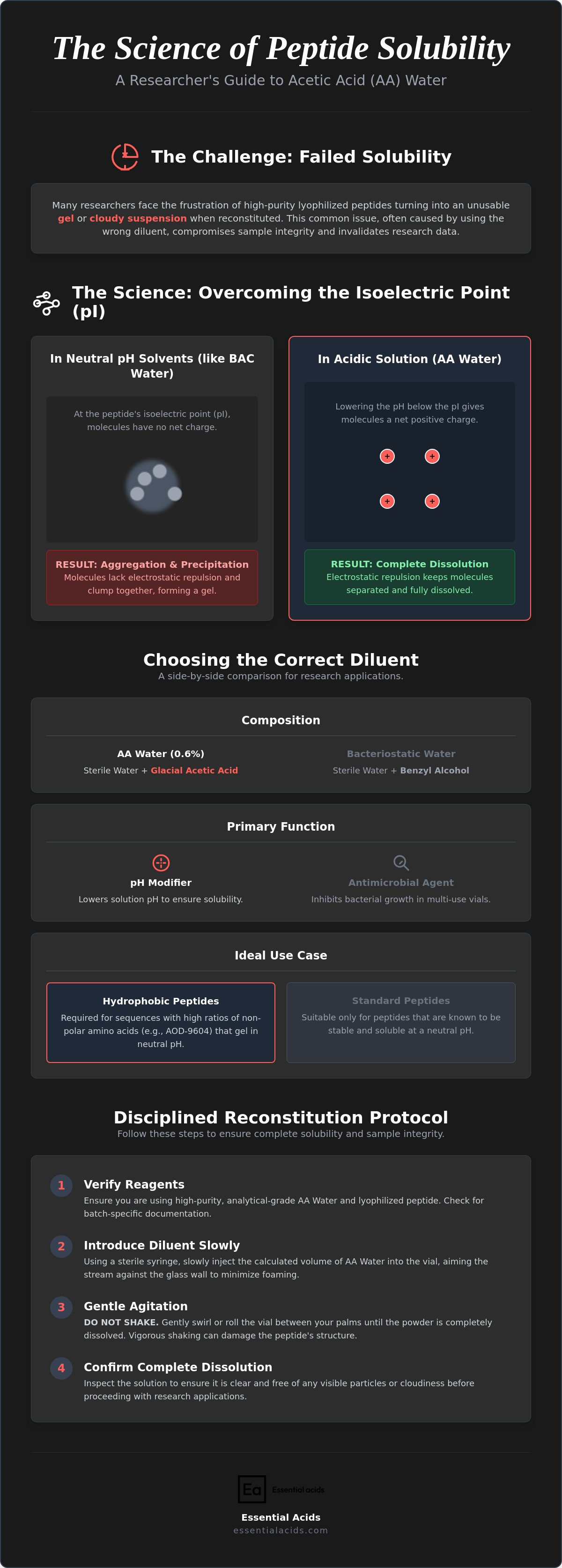
Peptides are complex polymers. Their solubility isn't just about mixing; it's about the isoelectric point (pI). This is the specific pH value at which a molecule carries no net electrical charge. When a solution's pH matches the peptide's pI, solubility drops to its absolute minimum. Without a net charge, molecules lack the repulsive forces needed to stay separated. They aggregate. They precipitate. They turn into a gel.
Understanding whats aa water requires a focus on pH manipulation. By introducing a 0.6% acetic acid solution, the researcher effectively lowers the pH of the environment below the peptide's pI. This acidification causes the amino acid residues to accept protons, resulting in a net positive charge. These like-charged molecules then experience electrostatic repulsion. They push away from one another, allowing the solvent to surround individual peptide chains and maintain a stable, dissolved state. Maintaining this state is a primary requirement for professional laboratory reagents used in high-precision research.
Hydrophobicity and Molecular Sequences
Specific sequences present unique thermodynamic challenges. For instance, AOD-9604 contains a high ratio of non-polar amino acids. These sequences are inherently hydrophobic. In neutral-pH solvents, these molecules tend to cluster together to minimize contact with water. Standard bacteriostatic water often fails to break these clusters because it cannot disrupt the strong intermolecular hydrogen bonding that holds the aggregate together. Technical resources regarding peptide reconstitution and solubility emphasize that acidic diluents are necessary for basic peptides containing residues like Arginine or Lysine. The acetic acid acts as a disruptor, breaking these bonds and facilitating a homogenous mixture.
The Gelling Phenomenon in Laboratory Samples
Visual confirmation of poor solubility is usually immediate. A researcher might observe persistent cloudiness or a thick, viscous texture within the vial. This gelling is a clear indicator of molecular aggregation. It's a significant barrier to scientific integrity. Gelled samples lead to inaccurate pipetting. They result in inconsistent concentrations during analytical testing. If the solution isn't homogenous, the data derived from the research is compromised. Utilizing high-purity diluents ensures a clear solution. This clarity is the hallmark of a successful reconstitution, allowing for the precise measurements required in high-level biochemistry. When you consider whats aa water, remember its primary function is the prevention of these physical obstructions to research accuracy.
AA Water vs. Bacteriostatic Water: Choosing the Correct Diluent
Selection of a diluent is a critical step in preserving the analytical integrity of a research sample. While Bacteriostatic (BAC) water is the standard for most hydrophilic compounds, it's often insufficient for sequences with high hydrophobicity. When evaluating whats aa water, researchers must view it as a precision-calibrated tool for pH management rather than a simple solvent. The divergence in their chemical composition translates directly to their performance in the laboratory. The wrong choice doesn't just result in poor solubility; it can cause immediate sample degradation or irreversible aggregation.
Key Differences in Formulation and Function
The primary distinction lies in the additives and resulting pH levels. BAC water contains 0.9% benzyl alcohol. This additive serves as a bacteriostatic agent, inhibiting the growth of most potentially contaminating bacteria. However, BAC water maintains a near-neutral pH, which is often the exact environment where basic peptides reach their isoelectric point and precipitate. In contrast, AA water is intentionally acidic. It lacks antimicrobial agents like benzyl alcohol, focusing entirely on providing the hydronium ions necessary for pH adjustment.
Storage requirements also differ. BAC water exhibits high stability at room temperature prior to opening. AA water requires more disciplined storage to prevent any shift in concentration that could affect its pH-modifying capabilities. If the wrong diluent is chosen, the peptide may undergo immediate degradation. This is especially true for sensitive sequences where the presence of benzyl alcohol in BAC water could trigger a negative reaction, leading to a loss of high-purity characteristics. Every laboratory decision should be rooted in the specific chemical requirements of the molecule under study.
The Co-Solvent Approach: Mixing AA and BAC Water
A common laboratory practice involves a co-solvent system to achieve both solubility and preservation. Many researchers adopt a ratio of 25% AA water and 75% BAC water. This specific mixture leverages the pH-lowering properties of the acetic acid to ensure the peptide dissolves, while the benzyl alcohol from the BAC water provides antimicrobial protection for long-term studies. This dual approach is often required for peptides like AOD-9604, which are notoriously difficult to reconstitute in neutral solvents alone.
When researchers look to buy research peptides Australia, they must also ensure their procurement protocols include these specialized reagents. Scientific integrity depends on the precision of every component in the vial. If you're still determining whats aa water and how it fits into your workflow, remember that its primary value is in its ability to prevent the aggregation that compromises analytical data. Precision in the laboratory isn't just about the compounds; it's about the environment in which they are studied.
Laboratory Application: Reconstitution Protocol for Research
Executing a successful reconstitution requires more than just mixing components. It's a disciplined procedure designed to protect the fragile molecular structure of the peptide. Understanding whats aa water in a practical context means recognizing its role as a precision tool for overcoming thermodynamic resistance. When the peptide sequence is hydrophobic, the introduction of the diluent must be executed with a focus on scientific integrity and sample stability. Failure to follow these steps often leads to irreversible gelling, which compromises the entire analytical study.
The following protocol is established for research-use only applications:
- Step 1: Calculate the total volume of diluent required based on the target concentration. Precision in these calculations ensures that the final molarity is consistent across all test batches.
- Step 2: If a co-solvent system is required, the AA water and BAC water must be combined in a separate sterile vial before being introduced to the peptide cake. A 25% AA to 75% BAC ratio is frequently utilized to balance solubility with antimicrobial protection.
- Step 3: Draw the prepared diluent into a sterile syringe and introduce it to the lyophilized peptide vial. The liquid should be aimed along the side wall of the glass to prevent direct impact on the delicate peptide powder.
- Step 4: Allow the vial to sit undisturbed at room temperature. The solution is complete only when the liquid is entirely clear. Shaking the vial is strictly prohibited, as mechanical agitation can lead to the shearing of peptide chains and a loss of bioactivity.
Specific Peptides Requiring AA Water
Certain compounds are notorious for their poor solubility in neutral environments. AOD-9604 is the primary example within the research community; it almost always requires an acidic environment to prevent aggregation. Emerging research into Cagrilintide suggests similar requirements for achieving a homogenous solution. IGF-1 variants also present technical challenges. While these variants are sensitive, maintaining a slightly acidic environment is often necessary to preserve their primary structure during the dissolution phase. Researchers seeking high-purity reagents can order analytical grade AA water to ensure these specific protocols remain consistent.
Storage and Handling of Reconstituted Samples
Once reconstituted, the stability of the sample depends heavily on environmental factors. Acidic solutions typically maintain their integrity best when stored at a constant temperature of 2-8°C. It's important to use Type 1 borosilicate glass vials for these samples. This high-integrity material resists the leaching that can occur when acidic solutions interact with lower-quality glass over time.
While whats aa water is a vital question for hydrophobic sequences, it's equally important to know when it's unnecessary. Peptides like Ipamorelin or Semax Peptide are inherently hydrophilic. These compounds typically dissolve readily in standard bacteriostatic water without the need for pH modification. Distinguishing between these requirements is a fundamental skill for any disciplined researcher committed to scientific accuracy. Making better, normal starts with the precision of the laboratory environment.
Sourcing High-Purity AA Water for Scientific Integrity
Scientific integrity in peptide research is contingent upon the purity of every component within the analytical system. A high-purity lyophilized peptide is only as reliable as the solvent used for its reconstitution. If a diluent contains trace contaminants, heavy metals, or microbial byproducts, the resulting data is fundamentally compromised. Essential Acids provides laboratory-grade reagents designed to meet rigorous analytical standards, ensuring that researchers can maintain a disciplined environment for their studies. When researchers evaluate whats aa water for their specific protocols, they must prioritize reagents that have undergone extensive quality assurance processes.
Every batch of AA water must be sterile-filtered using a 0.22 µm membrane to eliminate microbial life. This is followed by rigorous endotoxin screening to ensure the absence of pyrogens that could interfere with sensitive metabolic or cellular assays. Maintaining the brand philosophy of "Making better, normal" requires absolute scientific transparency. This is achieved through the provision of batch-specific Certificates of Analysis (COA), which verify the precision of the 0.6% acetic acid concentration and the absence of impurities. This level of detail is a primary requirement for any high-integrity laboratory operation.
Verifying Solvent Quality
A Certificate of Analysis serves as the definitive record of a solvent's purity. When examining a COA for AA water, researchers should look for verified pH levels and the results of sterility testing. Using non-laboratory grade acetic acid or standard tap water introduces unpredictable variables into the research environment. Tap water contains minerals and chlorine that can trigger immediate degradation of the peptide's primary structure. Even small deviations in solvent quality can jeopardize the integrity of BPC-157 5mg or other sensitive research materials. Proper solvent selection is not an optional step; it's a fundamental component of quality assurance in biochemistry.
Procurement for National Research Facilities
Modern scientific research depends on secure and compliant supply chains. Sourcing high-purity laboratory reagents across Australia requires a partner that understands the gravity of analytical work. Essential Acids provides a streamlined procurement process for national research facilities, ensuring that specialized diluents like AA water are available for high-level studies. A reliable supply chain prevents the delays that can occur when specialized reagents are backordered or fail to meet purity standards. When you understand whats aa water and its critical role in peptide solubility, the importance of sourcing from a verified supplier becomes clear. Explore our range of high-purity research materials at Essential Acids to ensure your laboratory maintains the highest standards of scientific integrity.
Advancing Analytical Accuracy through Reagent Precision
Reconstitution is a foundational step in laboratory research that demands strict adherence to chemical principles. Understanding whats aa water and its specific role in manipulating the isoelectric point ensures that hydrophobic sequences remain stable and homogenous throughout the study. This technical precision prevents the molecular aggregation and gelling that frequently compromise analytical results in less disciplined environments. By prioritizing pH management, researchers protect the primary structure of their compounds and ensure the reproducibility of their data.
Essential Acids maintains a steadfast commitment to scientific integrity by providing strictly research-use only (RUO) reagents. Every diluent is 0.22 µm sterile filtered and verified through batch-specific analytical documentation to ensure total compliance with rigorous laboratory standards. Secure High-Purity Research Reagents at Essential Acids to uphold the demanding requirements of modern biochemistry. We remain a dedicated partner for researchers focused on the precision of metabolic and cellular discovery. Your commitment to high-purity standards ensures the continued advancement of analytical research.
Frequently Asked Questions
Is AA water the same as vinegar?
No, AA water is not equivalent to household vinegar. Vinegar is a food-grade product containing fermentation byproducts and unpredictable concentrations of acetic acid. In contrast, AA water is an analytical-grade reagent consisting of 0.6% glacial acetic acid and sterile, deionized water. It's sterile-filtered to 0.22 µm to ensure the scientific integrity of laboratory samples. Using unverified food products in a research setting introduces contaminants that compromise molecular stability.
Can I use AA water for all types of research peptides?
AA water is not a universal solvent and should only be used for peptides that exhibit poor solubility in neutral environments. Most hydrophilic peptides are better suited for bacteriostatic water. Using an acidic diluent for peptides that don't require it can lead to unnecessary structural stress or degradation. Researchers must determine the isoelectric point of their specific compound before selecting a diluent. Understanding whats aa water and its acidic nature is key to this selection.
Why does my peptide vial turn into a gel when I use BAC water?
Gelling occurs when the pH of the bacteriostatic water matches the isoelectric point of the peptide, resulting in zero net charge. This lack of electrical repulsion causes the molecules to aggregate rather than dissolve. This phenomenon is common with hydrophobic sequences like AOD-9604. Introducing an acidic environment with AA water provides the necessary net positive charge to keep the molecules separated in a clear, homogenous solution.
What is the shelf life of AA water once the vial is punctured?
The recommended shelf life for punctured AA water vials is 30 days when stored under refrigeration at 2-8°C. While the acetic acid provides a slightly inhibitory environment for some microbes, the solution lacks a dedicated bacteriostatic agent like benzyl alcohol. To maintain scientific integrity, vials should be discarded after this period. Proper labeling and tracking of the puncture date are essential for maintaining rigorous laboratory standards.
Do I need to refrigerate AA water before it is mixed with a peptide?
Refrigeration is not strictly mandatory for unmixed AA water, provided it's stored in a cool, dark environment away from direct sunlight. However, maintaining the reagent at a consistent temperature prevents concentration shifts due to evaporation or degradation. Once the solvent is introduced to a lyophilized peptide, the resulting solution must be refrigerated immediately to preserve bioactivity. Disciplined storage is a fundamental requirement for all research-use only materials.
Can AA water be used as a standalone solvent for AOD-9604?
AA water can function as a standalone solvent for AOD-9604 to ensure initial solubility. However, many protocols suggest a co-solvent system to provide long-term antimicrobial protection. A standalone acidic diluent lacks the preservative qualities of benzyl alcohol found in BAC water. Researchers often use a small volume of AA water to dissolve the peptide cake before diluting to the final volume with bacteriostatic water.
Is AA water intended for human consumption or administration?
No, AA water is strictly for laboratory and in-vitro research use only. It is not manufactured for human consumption, therapeutic use, or clinical administration. Essential Acids maintains a firm policy regarding the research-use only nature of its products to ensure regulatory compliance and safety. Any use of these reagents outside of a controlled laboratory setting is strictly prohibited and violates the terms of procurement.
How do I calculate the 25% AA to 75% BAC water ratio for a 2ml vial?
To achieve a 25% to 75% ratio in a 2ml total volume, you must combine 0.5ml of AA water with 1.5ml of bacteriostatic water. These components should be mixed in a separate sterile vial before being introduced to the peptide sample. Precision in these measurements is vital for maintaining the intended pH and antimicrobial concentration. This calculation ensures the researcher understands whats aa water and its specific volume requirements for complex reconstitution tasks.
Legal Disclaimer
All products sold on this website are intended exclusively for laboratory research purposes and not for human or veterinary use, diagnosis, cure, treatment, or prevention of any disease or condition. None of the statements on this site have been reviewed or evaluated by the U.S. Food and Drug Administration (FDA) or comparable regulatory authorities. Purchasing or using these products for any unintended purpose, including human consumption, may violate federal or local laws and poses safety risks.