

The common classification of BPC-157 and TB-500 as interchangeable healing peptides ignores the fundamental divergence in their molecular signaling pathways. While both compounds are frequently investigated for tissue repair, the debate of bpc-157 vs tb-500 hinges on a distinction between localized gastric-derived signaling and systemic actin-sequestering. Researchers often encounter significant ambiguity when attempting to map these distinct pathways, especially when faced with inconsistent analytical data or conflicting reconstitution protocols from various suppliers. These research-use only substances require a level of precision that transcends anecdotal evidence.
It's understood that establishing a rigorous, high-purity baseline is essential for maintaining scientific integrity in any laboratory setting. This analysis provides a technical comparison of these peptides, moving beyond surface-level observations to examine their specific molecular mechanisms and potential synergistic applications in controlled environments. An objective breakdown of current FDA regulatory statuses as of June 2026 is included, covering the upcoming July PCAC review and the recent removal of these compounds from the Category 2 list. This report clarifies the differentiation between localized and systemic action, supporting the Essential Acids commitment to making better, normal through disciplined inquiry.
Key Takeaways
- Distinguish the 15-amino acid pentadecapeptide BPC-157 from the 43-amino acid TB-500 to understand their unique molecular footprints.
- Analyze the bpc-157 vs tb-500 debate through the lens of localized VEGF expression versus systemic G-actin sequestering.
- Explore the synergistic potential of multi-pathway research designs that integrate localized signaling with systemic cellular migration.
- Utilize HPLC and Mass Spectrometry data to verify batch-specific purity and ensure the scientific integrity of laboratory compounds.
- Determine the correct research application by matching BPC-157 to localized gastric studies and TB-500 to systemic actin-based motility research.
Molecular Profiles: Defining BPC-157 and TB-500
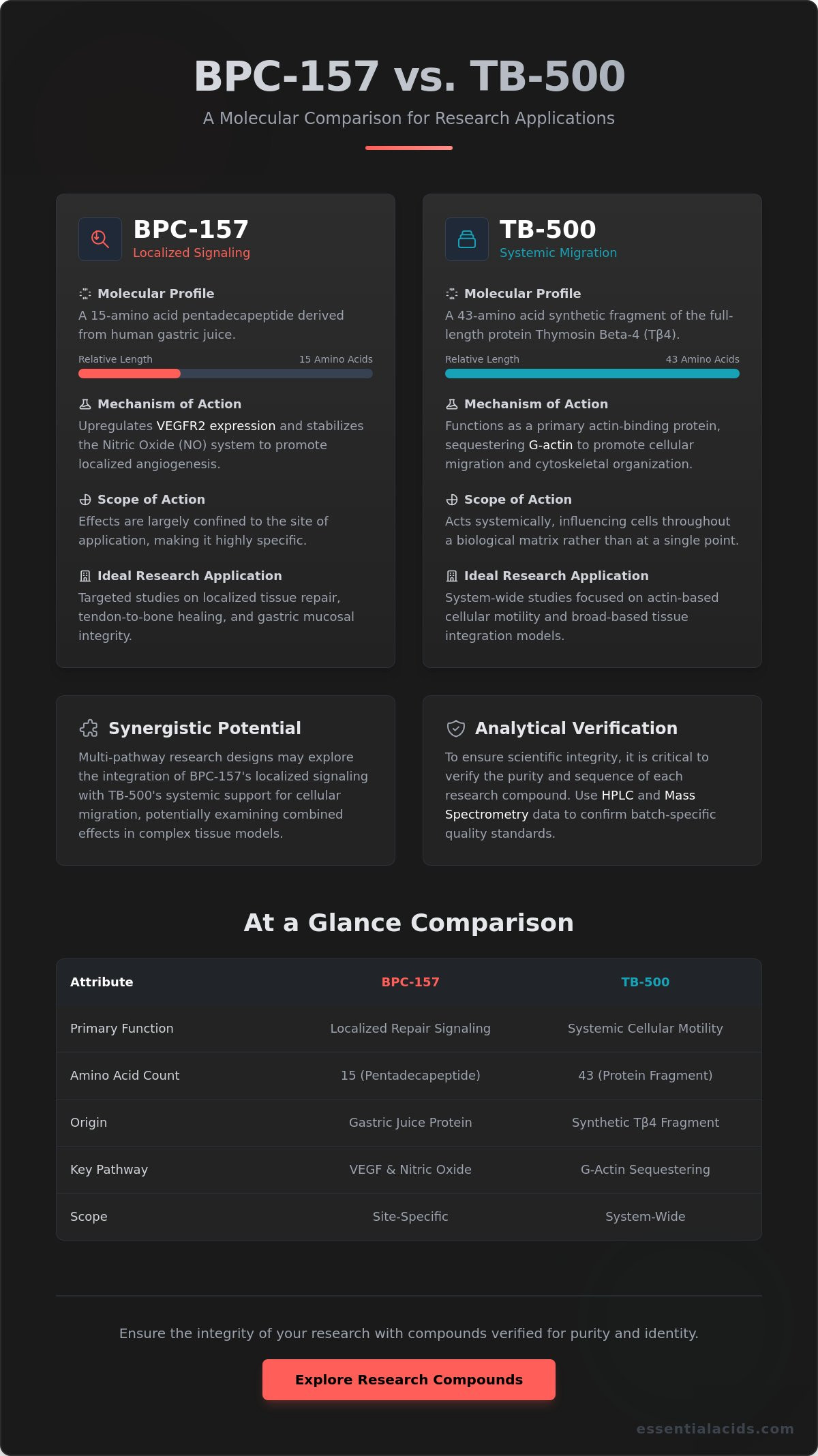
The molecular distinction between BPC-157 and TB-500 begins with their primary structures and biological origins. While often grouped in research literature, their chemical identities are fundamentally different. BPC-157 is a 15-amino acid pentadecapeptide, whereas TB-500 is a synthetic 43-amino acid peptide modeled after the full-length protein Thymosin Beta-4. This structural variance influences molecular weight, sequence stability, and the resulting biochemical interactions within a laboratory environment. Understanding the bpc-157 vs tb-500 comparison requires a granular look at these underlying sequences and their stability profiles. These differences dictate how each compound behaves under various thermal and chemical stressors during experimentation.
BPC-157: The Gastric-Derived Pentadecapeptide
BPC-157, or Body Protective Compound-157, is derived from a larger protein found in human gastric juice. Its primary sequence is Gly-Pro-Pro-Pro-Gly-Lys-Pro-Ala-Asp-Asp-Ala-Gly-Leu-Val. This specific arrangement grants the molecule a high degree of stability, particularly in acidic or proteolytic environments, which is a rare trait for peptides of this size. Researchers often consult the BPC-157 5mg: Molecular Profile to establish baseline analytical standards for purity and sequence verification. Because BPC-157 lacks a carrier protein, its research applications focus on its intrinsic ability to modulate biological signaling directly at the cellular level. This stability is a key factor when designing longitudinal studies where the compound must remain viable over extended periods.
TB-500: The Thymosin Beta-4 Fragment
TB-500 is a synthetic fragment of the endogenous protein Thymosin Beta-4 (Tβ4). While Tβ4 is a full-length 43-amino acid protein, TB-500 represents the active sequence responsible for cellular motility. Its sequence is extensive: Ac-Ser-Asp-Lys-Pro-Asp-Met-Ala-Glu-Ile-Glu-Lys-Phe-Asp-Lys-Ser-Lys-Leu-Lys-Lys-Thr-Glu-Thr-Gln-Glu-Lys-Asn-Pro-Leu-Pro-Ser-Lys-Glu-Thr-Ile-Glu-Gln-Glu-Lys-Gln-Ala-Gly-Glu-Ser. This long chain allows it to sequester G-actin, a critical process for cellular migration and cytoskeletal organization. In the context of bpc-157 vs tb-500, the latter is distinct from Thymosin Alpha-1, which is primarily associated with immune modulation rather than the actin-based motility observed with the Beta-4 fragment. The increased molecular weight of TB-500 compared to pentadecapeptides necessitates different handling and reconstitution protocols to maintain sequence integrity. Maintaining this integrity is paramount for ensuring that the G-actin binding domain remains functional throughout the duration of the research protocol.
Mechanistic Comparison: Localized Signaling vs. Systemic Migration
Distinguishing the biological pathways of these two compounds is critical for experimental accuracy. The comparison of bpc-157 vs tb-500 reveals a fundamental split between localized vasogenic signaling and systemic protein sequestering. While both facilitate tissue integration in laboratory models, they operate through disparate molecular switches. BPC-157 acts primarily as a modulator of the vascular endothelial growth factor (VEGF) system, whereas TB-500 functions as a primary actin-binding protein. This mechanical divergence dictates the spatial influence of each peptide within a biological matrix. Researchers must account for these differences when selecting a compound for specific metabolic or structural studies. The choice between them isn't merely about efficacy, but about the specific biological target and the desired range of action.
Angiogenesis and Nitric Oxide Pathways (BPC-157)
BPC-157 triggers the upregulation of VEGFR2 expression, facilitating localized angiogenesis. This pentadecapeptide interacts with the growth hormone receptor signaling pathway to stabilize the nitric oxide (NO) system. In tendon-to-bone healing models, this provides the vascular infrastructure necessary for tissue reattachment. Its influence is largely confined to the site of application, making it ideal for localized research designs involving specific tissue trauma or gastric mucosal integrity.
Actin-Sequestering and Cellular Motility (TB-500)
TB-500 sequesters globular actin (G-actin), preventing polymerization into F-actin. This maintains a pool of monomers available for cellular movement, promoting endothelial cell differentiation and migration across research substrates. Its influence extends to myofibrils, where it reorganizes the cytoskeleton. Unlike localized signaling, TB-500 exhibits a systemic migratory influence, affecting cells distant from the initial point of interaction. This makes it suitable for research exploring widespread cellular motility and systemic tissue repair.
The core angiogenic contrast is that BPC-157 triggers the creation of vascular networks through localized signaling, while TB-500 facilitates the physical migration of cells through systemic actin modulation. Selecting the appropriate compound depends on whether the research design requires localized growth factor upregulation or widespread cellular motility. For laboratories requiring high-purity analytical samples to test these pathways, maintaining scientific integrity through verified suppliers is paramount. This objective approach ensures that experimental outcomes aren't compromised by sequence degradation or analytical impurities. By understanding the distinct mechanisms of these peptides, researchers can design more precise protocols that target specific cellular behaviors without the interference of unintended systemic effects.
Synergistic Potential in Multi-Pathway Research Designs
The theoretical synergy between these peptides rests on the concurrent activation of non-overlapping biological pathways. In a multi-modal research design, the comparison of bpc-157 vs tb-500 shifts from a choice of one over the other to an investigation of their combined efficacy. While BPC-157 establishes the vascular signaling infrastructure through VEGF upregulation, TB-500 facilitates the physical migration of cells into that newly created matrix. This co-administration aims to address the inherent 'wait-and-see' periods often observed in single-peptide longitudinal studies. By activating both localized angiogenic stimuli and systemic cellular motility, researchers can observe complex tissue integration at an accelerated rate compared to isolated protocols. These research-use only compounds provide a unique opportunity to map how concurrent signaling influences long-term cellular outcomes.
Expanding the scope to triple-peptide research often involves the introduction of the ghk-cu peptide. This tripeptide modulates the extracellular matrix, potentially creating a more receptive environment for the signaling and migratory actions of the primary compounds. This multi-pathway approach allows for a more comprehensive observation of cellular behavior, especially in soft tissue research models where environmental receptivity is a limiting factor. By integrating these various mechanisms, the laboratory can generate multi-modal data that reflects the complexity of biological systems.
Complementary Biological Cascades
In this framework, BPC-157 acts as the 'architect' that provides the necessary signaling blueprints for vascularization. Conversely, TB-500 acts as the 'builder', utilizing its actin-sequestering properties to drive the physical migration of cells to the target site. When these pathways are activated simultaneously, the research model doesn't rely on a single biological switch. Soft tissue models involving ligament or tendon research show that this dual-pathway activation can provide more robust observational data than either compound used in isolation. This disciplined approach to multi-pathway research is central to the Essential Acids mission of making better, normal through scientific integrity.
Research Stability and Reconstitution
Technical precision is required when managing co-administration. Maintaining molecular integrity during co-reconstitution is paramount, as the sequence stability of the 43-amino acid TB-500 differs from the 15-amino acid BPC-157. For detailed protocols, researchers should consult the BPC-157 Reconstitution guide to ensure that baseline standards are met. Mixed-peptide research vials require specific storage temperatures, typically 2 to 8 degrees Celsius, to prevent sequence degradation. Integrity in the laboratory depends on these micro-adjustments in protocol, ensuring that every batch-specific variable is controlled for the duration of the study.
Analytical Verification: Quality Standards for Research Integrity
The validity of any study involving bpc-157 vs tb-500 depends entirely on the analytical integrity of the compounds used. High-Performance Liquid Chromatography (HPLC) is the critical standard for verifying peptide purity, while Mass Spectrometry (MS) confirms the molecular sequence and weight. Without these verification steps, researchers risk introducing unknown variables into their biological models. Essential Acids maintains a commitment to batch-specific analytical documentation, ensuring that every vial meets rigorous laboratory specifications. High-integrity research isn't possible when sequence identity or purity levels remain unverified.
Procuring materials from 'gray market' suppliers introduces significant risks, including elevated levels of Trifluoroacetic acid (TFA) and residual solvents. TFA is often used during the peptide synthesis process, but it must be properly removed to prevent cellular toxicity in research substrates. Residual solvents can similarly interfere with metabolic pathways, leading to skewed observational data. Maintaining scientific integrity requires a transition from anecdotal sourcing to verified, analytical-grade compounds. To ensure your laboratory protocols are supported by verified materials, you can source analytical-grade peptides directly from Essential Acids.
Interpreting HPLC and MS Reports
Purity percentages are the primary metric for quality, with 99% or higher serving as the laboratory gold standard. When reviewing an HPLC report, researchers should identify a single, dominant peak that represents the target peptide. Secondary peaks or 'shoulders' indicate the presence of impurities, truncated sequences, or degraded fragments. Mass Spectrometry provides the necessary confirmation that the molecular weight aligns with the theoretical value of the peptide sequence. Third-party verification acts as an essential safeguard, providing an unbiased assessment that protects the integrity of the research design.
Storage and Cold-Chain Logistics
Lyophilization, or freeze-drying, is utilized to ensure long-term molecular stability. This process removes moisture, which prevents the hydrolysis of peptide bonds. Temperature fluctuations during transit can cause rapid sequence degradation, particularly for the longer 43-amino acid chain of TB-500. Standardized laboratory storage protocols require unconstituted vials to be kept in a controlled environment, typically at -20 degrees Celsius for long-term preservation. Even minor deviations in cold-chain logistics can compromise the structural integrity of the compounds, leading to inconsistent results across different research batches. Maintaining these strict environmental controls is a prerequisite for reproducible scientific inquiry.
Conclusion: Selecting the Appropriate Research Compound
The choice within the bpc-157 vs tb-500 comparison is ultimately determined by the spatial and mechanistic requirements of the laboratory protocol. BPC-157 is prioritized in research models requiring localized angiogenic stimuli, particularly those investigating gastric mucosal integrity or specific ligamentous reattachment. Its pentadecapeptide structure is optimized for stability in localized environments where VEGF upregulation is the primary metric. Conversely, TB-500 is the appropriate selection for studies exploring systemic cellular migration and cytoskeletal reorganization. Its role in sequestering G-actin provides a broader migratory influence that is essential for modeling widespread tissue integration across various biological substrates.
Scientific integrity in the laboratory is inseparable from the quality of the compounds utilized. High-purity standards aren't a luxury but a requirement for achieving reproducible results that can withstand rigorous peer review. When sequence identity is verified through HPLC and Mass Spectrometry, the researcher eliminates the risk of data contamination by synthesis byproducts or residual solvents. It's through this rigorous analytical lens that the true potential of these peptides can be observed without the interference of unknown variables. Essential Acids remains dedicated to providing these batch-specific standards to ensure that every experimental outcome is a reflection of the biological design rather than material inconsistency.
A firm boundary is maintained regarding the application of these materials. All products, including BPC-157 and TB-500, are strictly for research-use only and aren't intended for human or veterinary use. This mandate is reinforced through every stage of the supply chain to ensure regulatory compliance and professional safety. The ongoing flux in the regulatory landscape, including the upcoming July 2026 PCAC reviews, underscores the importance of sourcing from suppliers who prioritize transparency and ethical standards. It's expected that researchers will adhere to these boundaries to preserve the gravity and legitimacy of their work within the scientific community.
Making Better, Normal: The Essential Acids Philosophy
Upholding scientific integrity requires more than just high-purity compounds; it necessitates a commitment to transparent sourcing and rigorous documentation. Essential Acids provides the necessary tools for visionary research into human potential, ensuring that the compounds used in the laboratory meet the highest possible analytical benchmarks. This disciplined approach to supply is what defines the brand’s mission. By providing a stable and reliable foundation for inquiry, the brand enables researchers to focus on the precision of their findings. To explore our full range of verified compounds, you can review our catalog of high-purity research peptides and select the materials that align with your specific research objectives.
Advancing Laboratory Precision through Molecular Differentiation
The technical divergence between these peptides defines their utility in controlled environments. While BPC-157 provides the localized angiogenic signaling necessary for site-specific tissue integration, TB-500 enables the systemic cellular migration required for broader structural modeling. Navigating the bpc-157 vs tb-500 comparison requires a commitment to analytical precision and an understanding of how these distinct pathways can be leveraged for synergistic outcomes. Integrating these compounds into a multi-pathway design allows researchers to observe complex biological interactions with greater resolution than single-peptide protocols.
Maintaining scientific integrity requires materials that meet the 99%+ purity gold standard. Essential Acids supports this disciplined inquiry by providing batch-specific HPLC and MS reports alongside research-dedicated cold-chain logistics to prevent sequence degradation. You can secure high-purity BPC-157 and TB-500 for your laboratory research to ensure your observational data remains reproducible and robust. These research-use only tools are fundamental for laboratories dedicated to making better, normal through visionary scientific progress. We look forward to supporting your next phase of discovery.
Frequently Asked Questions
What is the primary difference between BPC-157 and TB-500?
The primary difference between BPC-157 and TB-500 lies in their molecular structure and biological targets. BPC-157 is a 15-amino acid pentadecapeptide that primarily modulates localized vascular endothelial growth factor (VEGF) signaling. Conversely, TB-500 is a 43-amino acid synthetic fragment modeled after Thymosin Beta-4, focusing on systemic actin-sequestering. This distinction between localized signaling and systemic migration is the core consideration in any bpc-157 vs tb-500 research protocol.
Can BPC-157 and TB-500 be used together in a single research study?
Co-administration of these peptides is common in multi-pathway research designs. Researchers utilize both compounds to observe the interaction between localized angiogenic stimuli and systemic cellular motility. This approach allows for a comprehensive analysis of tissue integration within a single biological model. Technical precision during reconstitution is required to maintain the molecular integrity of both sequences when they're used in tandem.
How should BPC-157 and TB-500 be stored to ensure molecular stability?
Unconstituted, lyophilized peptides should be stored at -20°C to ensure long-term molecular stability. Reconstituted solutions require immediate refrigeration at temperatures between 2°C and 8°C. Exposure to thermal fluctuations or UV light can lead to rapid peptide degradation, particularly for the longer amino acid chain of TB-500. Standardized cold-chain logistics are essential for preserving the structural integrity of these compounds from synthesis to the laboratory.
What are the common purity standards for laboratory-grade TB-500?
The established gold standard for laboratory-grade TB-500 is a purity level of 99% or higher. This high-purity threshold is necessary to ensure that observational data isn't compromised by synthesis byproducts or residual solvents like TFA. Analytical verification through HPLC is the primary method used to confirm these standards. Maintaining these rigorous benchmarks is critical for achieving reproducible results in high-level biochemical research.
Is TB-500 the same as Thymosin Beta-4?
TB-500 is a synthetic fragment of Thymosin Beta-4, not the full protein itself. While it contains the active G-actin binding domain responsible for cellular migration, it's a specific sequence designed for targeted research applications. This distinction is important for researchers who require the precise migratory influence of the fragment without the broader biological interactions of the full-length endogenous protein. It's often selected for its specific focus on cytoskeletal reorganization.
Why is BPC-157 often referred to as a 'stable' peptide?
BPC-157 is considered stable due to its unique resistance to proteolytic and acidic degradation. Its 15-amino acid sequence is derived from human gastric juice, where it must maintain structural integrity despite harsh environmental stressors. This inherent stability makes it a reliable tool for research involving various pH levels or enzymatic environments. Unlike many other peptides, it doesn't require a carrier protein to remain functional during laboratory observations.
What analytical reports should I expect with a research peptide purchase?
Researchers should expect batch-specific HPLC and Mass Spectrometry (MS) reports with every analytical-grade purchase. The HPLC report provides a visual representation of purity levels, while the MS report confirms that the molecular weight matches the theoretical sequence. These documents serve as a verification of scientific integrity, ensuring that the materials used in the laboratory are exactly what they're claimed to be. Transparent analytical data is a prerequisite for professional research.
Can these compounds be used for human or veterinary applications?
No, these compounds are strictly for research-use only and aren't intended for human or veterinary applications. Essential Acids maintains a rigorous policy that limits the use of these peptides to laboratory environments. Any application outside of these controlled settings is prohibited and violates the intended use of the products. This boundary is essential for maintaining regulatory compliance and ensuring the safety and integrity of the scientific process.
Legal Disclaimer
All products sold on this website are intended exclusively for laboratory research purposes and not for human or veterinary use, diagnosis, cure, treatment, or prevention of any disease or condition. None of the statements on this site have been reviewed or evaluated by the U.S. Food and Drug Administration (FDA) or comparable regulatory authorities. Purchasing or using these products for any unintended purpose, including human consumption, may violate federal or local laws and poses safety risks.