

A 98% purity rating on a Certificate of Analysis is not a guarantee of scientific integrity; it's merely a starting point for rigorous verification. In the disciplined landscape of research-use only compounds, especially following the FDA reclassifications in April 2026, peptide purity testing serves as the final gatekeeper between reproducible data and contaminated models. You've likely encountered the frustration of inconsistent batch quality or the dense, opaque nature of mass spectrometry graphs provided by suppliers. These technical hurdles often obscure the presence of undisclosed impurities that can compromise metabolic or cellular research.
This guide provides the analytical framework necessary to independently audit a Certificate of Analysis, ensuring you can distinguish between acceptable deviations and critical failures. You'll gain the confidence to verify the molecular integrity of your materials and understand which purity grade is required for your specific research applications. We'll examine the nuances of HPLC and LC-MS analysis to ensure your research outcomes remain strictly objective and verified. By mastering these analytical standards, you ensure that the quality of your compounds speaks for itself through precise, repeatable results.
Key Takeaways
- Define peptide purity as the ratio of the target analyte to total detected substances to establish a baseline for scientific integrity in laboratory environments.
- Learn how to utilize peptide purity testing data, specifically HPLC for quantification and LC-MS for molecular weight confirmation, to verify compound identity.
- Determine the appropriate purity grade for your application by evaluating the sensitivity of your research model to minor contaminants and undisclosed impurities.
- Audit a Certificate of Analysis independently by cross-referencing batch numbers and verifying analysis dates against physical research materials to ensure data reproducibility.
The Significance of Peptide Purity Testing in Scientific Research
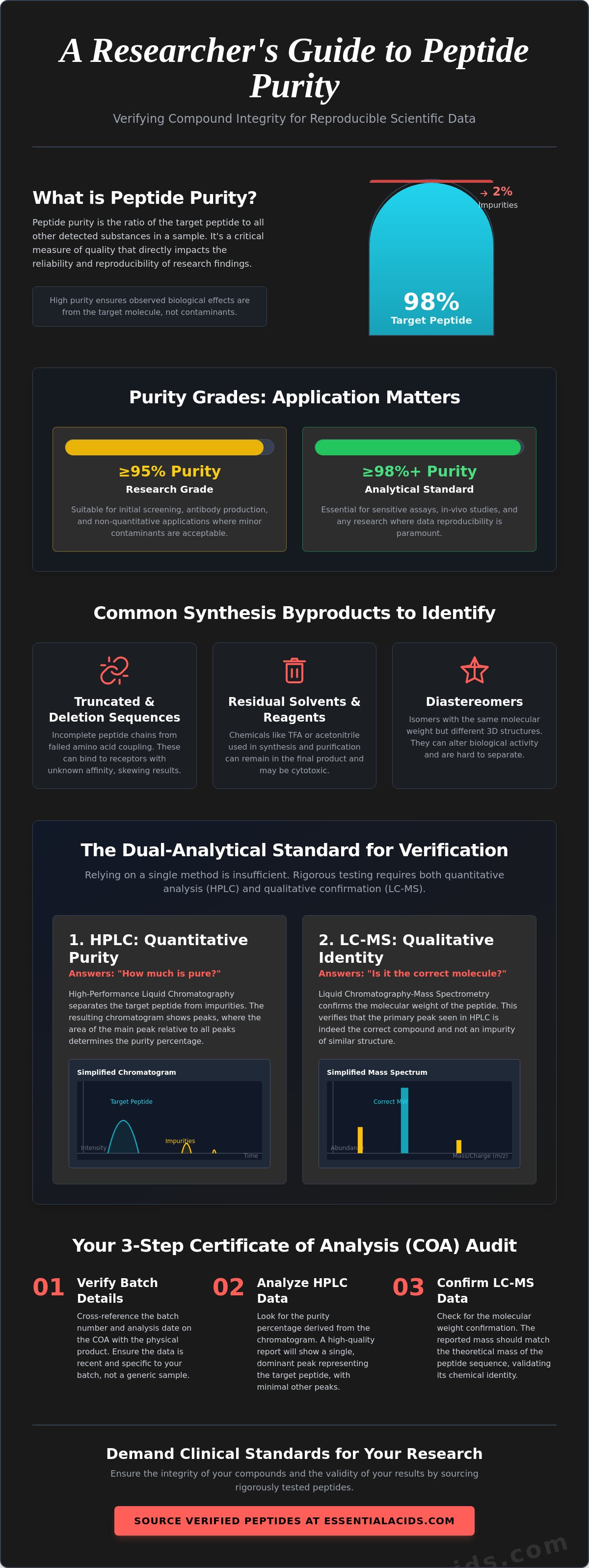
Peptide purity is defined as the mass fraction of the target peptide relative to the total mass of all detected analytes in a sample. It is not merely a quantitative metric; it's the fundamental prerequisite for scientific integrity. In laboratory environments, peptide purity testing ensures that observed biological effects are attributed solely to the molecule under investigation. Peptides are short chains of amino acids that function as precise signaling molecules. When these chains contain impurities, the risk of off-target cellular responses increases. These contaminants may lead to erroneous conclusions regarding metabolic or neurological pathways.
Distinguishing between research-grade and analytical-standard purity profiles is essential for high-fidelity modeling. While research-grade materials often target a 95% threshold, analytical-standard compounds typically exceed 98% or 99%. This distinction is critical because the remaining percentage is not inert. It consists of synthesis byproducts that can exhibit their own biological activity. These impurities can mask or amplify the effects of the primary compound, leading to skewed data sets and unreliable conclusions.
Common Contaminants in Synthetic Peptides
Synthetic byproducts often emerge during Solid Phase Peptide Synthesis (SPPS). Truncated sequences and deletion peptides are the most prevalent issues. These occur when the coupling of an amino acid fails, resulting in a shorter chain that may still bind to receptors with unpredictable affinity. Residual solvents like trifluoroacetic acid (TFA) or acetonitrile, used during cleavage and purification, can remain as trace contaminants. Diastereomers, which are stereoisomers with identical molecular weights but different spatial orientations, are also common. These isomers can alter molecular signaling and are often difficult to detect without advanced chromatography.
Impact of Impurities on Research Reproducibility
The presence of even 1% impurities can lead to false-positive results in sensitive metabolic studies. For instance, when researching 5-Amino-1MQ, the integrity of the molecule is paramount to ensure the observed inhibition of nicotinamide N-methyltransferase (NNMT) is accurate. Peptide degradation products or oxidation products can interfere with receptor-ligand interaction assays. This creates noise in the data that obscures legitimate biological signals. Establishing a baseline purity requirement is the only way to ensure that research data remains reproducible across different laboratories. Without rigorous verification, the validity of the entire research model is compromised.
Analytical Standards: HPLC and Mass Spectrometry Explained
Rigorous peptide purity testing requires a dual-analytical approach to ensure both quantitative purity and qualitative identity. High-Performance Liquid Chromatography (HPLC) serves as the primary tool for determining the percentage of the target peptide relative to total analytes. Liquid Chromatography-Mass Spectrometry (LC-MS) provides the definitive molecular weight confirmation required to verify that the synthesized chain matches the theoretical sequence. Relying on a single method is insufficient for high-integrity research. A batch-specific profile must include both to account for structural integrity and concentration accuracy. This methodology ensures that the compound's chemical signature is fully mapped before it enters a laboratory environment.
Detection during chromatography typically occurs via UV absorbance at 214nm. This specific wavelength is utilized because it corresponds to the absorption of peptide bonds. While 254nm is often used to detect aromatic rings, 214nm ensures that all peptide-based analytes are captured, regardless of their specific amino acid composition. This comprehensive detection is vital for identifying all potential synthesis byproducts within a sample.
The Mechanics of HPLC Analysis
HPLC separates molecules based on their hydrophobic properties through a process involving a stationary and a mobile phase. In reverse-phase HPLC, a non-polar stationary phase, typically C18 silica, interacts with the peptide. A polar mobile phase consisting of water and acetonitrile carries the sample through the column. As the concentration of the organic solvent increases, the peptide elutes. Interpreting the resulting chromatogram requires precise peak area integration. A stable baseline indicates a clean run, while "shoulder peaks" or small abnormalities attached to the main peak signal the presence of closely related impurities. These often include diastereomers or deletion sequences that share similar hydrophobic signatures. Advanced protocols, such as chiral high-performance liquid chromatography-electrospray ionization tandem mass spectrometry (HPLC-ESI-MS/MS), allow for the resolution of these complex stereoisomers.
Identity Verification via Mass Spectrometry
Mass spectrometry confirms the identity of the compound by measuring the mass-to-charge (m/z) ratio. The observed molecular weight must align with the theoretical mass calculated from the specific amino acid sequence. This step is vital for complex synthetic chains where a single amino acid error can occur during synthesis. MS also detects non-peptide contaminants. It effectively identifies residual salts and trifluoroacetic acid (TFA) residues that HPLC might miss. Accurate MS data ensures the compound in the vial is exactly what the research protocol requires. For researchers requiring verified materials, auditing the batch-specific analytical data provided with each compound is a standard protocol for maintaining laboratory integrity.
Selecting the Appropriate Purity Grade for Research Models
The selection of a purity grade isn't an arbitrary choice; it's a decision that dictates the reliability of every subsequent data point. Researchers must evaluate the sensitivity of their specific model to minor contaminants before procurement. While standard research grades of 95% to 97% might suffice for preliminary qualitative screening, quantitative assays require peptide purity testing to confirm levels of 98% or higher. Ultra-high purity, often exceeding 99%, is reserved for structural studies like NMR spectroscopy and crystallography. In these applications, trace impurities can cause significant signal interference or prevent the formation of clean crystals. Following USP Peptide Quality Standards provides a framework for these requirements, ensuring that the analytical profile aligns with the intended research application.
Purity Requirements for Cellular Signaling Studies
In cellular signaling research, particularly for receptor-ligand studies involving GHK-Cu or Ipamorelin, the threshold for purity is strictly set at 98% or above. Impurities such as truncated sequences can act as competitive inhibitors, binding to target receptors without triggering the intended biological response. This leads to skewed results that don't reflect the true potency of the compound. Minimizing cross-reactivity is vital in immunogenic identification models where even minute quantities of synthesis reagents can induce inflammation or off-target cellular stress. Batch-to-batch consistency is the only way to ensure that longitudinal data remains valid, as fluctuations in impurity profiles can introduce uncontrolled variables into the research environment.
Purity Standards for Metabolic and Endocrine Research
Metabolic research often utilizes complex molecules that require exceptional structural verification via peptide purity testing. Analyzing the tirzepatide structure in dual-agonist models highlights the necessity of high purity. Because these compounds interact with both GLP-1 and GIP receptors, any structural deviation caused by oxidation or deletion can shift the agonist's affinity, yielding unreliable metabolic data. This is equally true for 5-Amino-1MQ in NNMT inhibition research. If the compound contains residual solvents from the purification process, the enzymatic inhibition observed may be a byproduct of chemical interference rather than the peptide's primary mechanism. Quantitative assays demand this level of precision to ensure that findings are rooted in the compound’s verified molecular profile.
How to Audit a Peptide Certificate of Analysis (COA)
A Certificate of Analysis (COA) is a technical summary of a compound's molecular profile. It's not a marketing document; it's a formal record of peptide purity testing results. To perform a successful audit, you must first verify that the batch number on the report matches the identifier on the physical vial. If these numbers don't align, the documentation is irrelevant to your specific research material. You must also check the analysis date. Peptides are susceptible to degradation, so a report older than six to twelve months may no longer accurately reflect the purity or potency of the material.
Examination of the HPLC chromatogram is the next critical step. A high-integrity report displays a clean, sharp primary peak with minimal baseline noise. Significant noise or multiple smaller peaks indicate the presence of synthesis byproducts or degraded fragments. The mass spectrometry (MS) section must show a single dominant mass that corresponds precisely to the target peptide's theoretical weight. This confirmation ensures that the correct amino acid sequence was synthesized without significant deletions or errors in the chain.
Red Flags in Analytical Documentation
Generic reports are a major indicator of poor quality control in peptide purity testing. If a COA lacks specific batch identifiers, technician signatures, or laboratory contact information, it shouldn't be trusted. Another common tactic involves truncated X or Y axes on chromatograms. By zooming in on the primary peak and cutting off the baseline, a supplier can hide significant impurities that would otherwise be visible. Reports from third-party labs without verifiable credentials or contact details also pose a risk to scientific integrity. You can ensure the reliability of your research data by reviewing our batch-specific analytical documentation for every compound.
Verifying Sequence and Molecular Integrity
Confirming molecular integrity requires comparing the reported mass on the MS graph to the theoretical molecular weight of the peptide. You must also verify the counter-ion used during the final purification stage. While trifluoroacetic acid (TFA) is common, many research models require an acetate counter-ion to minimize potential cellular toxicity. Researchers can utilize online bioinformatics tools like the Expasy Molecular Weight calculator to cross-reference their specific peptide sequence against the theoretical mass reported on the COA. This independent verification step acts as a final safeguard before the material is introduced into a laboratory model.
Essential Acids: Clinical Standards in Peptide Procurement
Essential Acids operates with a disciplined focus on scientific accuracy and regulatory transparency. Our core philosophy, "Making better, normal," is realized through molecular precision and a commitment to data-driven transparency. We provide batch-specific analytical documentation for every compound in our catalog, ensuring that the results of peptide purity testing are accessible to every researcher. By maintaining a strict research-use only policy, our operational resources remain dedicated to laboratory advancements and the integrity of the scientific process. This professional distance prevents the casual tone common in commercialized health entities, positioning Essential Acids as a rigorous gatekeeper for high-purity compounds.
Our supply chain is specifically engineered to maintain the stability of lyophilized peptides for laboratory use. Lyophilization, or freeze-drying, is utilized to remove moisture while preserving the secondary structure of the molecule. This process is essential for preventing hydrolysis and other forms of chemical degradation during transport and storage. By controlling environmental variables from synthesis to delivery, we ensure that the molecular integrity of the compound remains intact. This stability is a prerequisite for reproducible research, particularly in studies involving metabolic pathways or cellular ageing where precise dosing is mandatory.
Transparent Sourcing for Laboratory Applications
We employ a rigorous vetting process for raw material synthesis and purification to eliminate synthesis byproducts before they reach the final stage. Each batch undergoes a series of internal and third-party audits to confirm that the analytical profile matches our high-integrity standards. This level of oversight allows researchers to order peptides online with confidence, knowing that the material has been verified through HPLC and LC-MS analysis. We recognize that high-integrity research chemicals are the bedrock of the scientific community. Our sourcing strategy prioritizes analytical verification over market trends, reinforcing our position as a reliable partner for complex biochemical modeling.
Standardizing Quality in Peptide Sciences
Maintaining the peptide integrity required for complex cellular modeling is our primary operational objective. Every item in our catalog, such as bpc 157 5mg, must meet stringent purity benchmarks before it is released for procurement. We don't rely on generic documentation; instead, we provide the specific data necessary for professional peptide purity testing audits. This standardized approach to quality control ensures that analytical verification remains a constant, predictable factor in your research design. We invite you to explore our catalog of verified research compounds and download batch-specific reports to confirm the analytical profile of your materials.
Advancing Research Integrity through Analytical Precision
Scientific integrity depends on the transition from passive procurement to active analytical verification. By mastering the interpretation of HPLC chromatograms and MS mass-to-charge ratios, researchers eliminate the variables introduced by synthesis byproducts. Selecting the correct purity grade ensures that cellular signaling and metabolic data remain reproducible and strictly objective. Comprehensive peptide purity testing serves as the final safeguard, ensuring that the molecular identity of a compound aligns perfectly with its theoretical sequence. This disciplined approach to verification is what allows for the advancement of complex laboratory models with absolute confidence.
Essential Acids remains committed to this level of transparency by providing batch-specific HPLC and MS reports for every compound we offer. Our specialized biochemistry expertise and rigorous research-only standards ensure that your materials meet the highest analytical benchmarks. We invite you to View Our Batch-Verified Research Catalog to access the documentation necessary for your next project. It's time to elevate your laboratory standards by prioritizing verified molecular integrity. We look forward to supporting your commitment to precise and reliable research outcomes.
Frequently Asked Questions
What is the minimum purity required for most laboratory research?
The generally accepted standard for quantitative biochemical assays is a purity level of 98% or higher. While 95% purity may be sufficient for initial qualitative screening, high-integrity research models require a more refined profile to minimize off-target cellular responses. Utilizing compounds that fall below these benchmarks can introduce uncontrolled variables that compromise the scientific integrity of the resulting data. For metabolic and neurological studies, the highest available analytical grade is always preferred to ensure reproducible results.
Can a peptide be 100% pure?
Absolute 100% purity is chemically unattainable in synthetic peptide production. Even the most rigorous purification processes leave trace amounts of moisture, atmospheric gases, or residual counter-ions like trifluoroacetic acid (TFA). Analytical standards prioritize reaching the highest possible threshold, typically exceeding 99%, which is considered ultra-high purity. Researchers should be cautious of any supplier claiming total 100% purity, as it is not an analytically sound metric in biochemistry.
What is the difference between purity and peptide content?
Purity refers to the ratio of the target peptide to total peptide-based impurities, while peptide content measures the actual weight of the peptide relative to the total powder weight. A vial might show 98% purity on a report, but the actual peptide content could be 80% due to the presence of salts, moisture, and counter-ions. This distinction is critical for accurate molar calculations. Failure to account for peptide content can lead to significant dosing errors in laboratory research models.
How does HPLC detect impurities in a peptide sample?
HPLC separates the sample into its individual components based on hydrophobicity as the analyte passes through a stationary phase column. As the mobile phase gradient changes, different molecules elute at specific times, creating distinct peaks on a chromatogram. This process is the gold standard in peptide purity testing because it allows for the precise quantification of the target molecule relative to any synthesis byproducts. Any peak outside the primary target area is identified as a contaminant or a closely related peptide impurity.
Why is mass spectrometry necessary if I already have an HPLC report?
Mass spectrometry is essential because it confirms the molecular weight and identity of the peptide, whereas HPLC only measures its quantity and purity. While HPLC can show that a sample is 99% pure, it cannot verify that the 99% is the correct amino acid sequence. MS provides the mass-to-charge ratio required to ensure the synthesized chain matches the theoretical weight. Integrating both methods into a peptide purity testing protocol is the only way to confirm both the concentration and the structural integrity of the material.
What happens if a research peptide is stored at the wrong temperature?
Incorrect storage leads to accelerated chemical degradation, specifically through processes like hydrolysis and deamidation. Lyophilized peptides are highly sensitive to moisture and thermal fluctuations; therefore, they must be stored at -20°C for long-term stability. Exposure to room temperature can alter the molecular structure, rendering the original analytical reports obsolete. Once degradation begins, the compound's biological activity becomes unpredictable, which fundamentally undermines the reliability of any research outcomes.
How often should a peptide batch be re-tested for purity?
A peptide batch should typically undergo re-verification every 12 to 24 months if stored under optimal, climate-controlled conditions. If the integrity of the vial's seal is compromised or if storage temperatures have fluctuated, immediate re-testing is required. Regular auditing ensures that the compound continues to meet the stringent purity benchmarks established during the initial synthesis. Maintaining a consistent testing schedule is a core component of preserving scientific integrity in longitudinal research environments.
Is "pharma-grade" the same as "research-grade" in terms of purity?
The terms are not technically interchangeable because pharma-grade implies production in a cGMP-compliant facility specifically for human clinical use. Essential Acids provides high-purity research chemicals that are intended strictly for laboratory research-use only. While our compounds often meet or exceed the 98% purity levels found in pharmaceutical standards, they are not produced for medical applications or human consumption. All materials are governed by a strict research-only policy to ensure they are utilized solely within a controlled laboratory setting.
Legal Disclaimer
All products sold on this website are intended exclusively for laboratory research purposes and not for human or veterinary use, diagnosis, cure, treatment, or prevention of any disease or condition. None of the statements on this site have been reviewed or evaluated by the U.S. Food and Drug Administration (FDA) or comparable regulatory authorities. Purchasing or using these products for any unintended purpose, including human consumption, may violate federal or local laws and poses safety risks.