

Why does a nonapeptide primarily categorized for its somnogenic properties demonstrate such significant regulatory influence over the endocrine stress response and antioxidant pathways? While the dsip peptide is often narrowly defined by its namesake delta sleep-inducing effects, its utility in a laboratory setting extends into complex neuromodulation and analgesic research. You likely recognize the frustration of navigating conflicting literature regarding its blood-brain barrier permeability and the persistent lack of batch-specific analytical data in the current market.
This technical reference provides a rigorous profile of Delta Sleep-Inducing Peptide to resolve these ambiguities for the 2026 scientific community. We provide a comprehensive analysis of the Trp-Ala-Gly-Gly-Asp-Ala-Ser-Gly-Glu sequence, alongside the precise storage protocols required to maintain molecular integrity. We also address critical regulatory shifts in Australia, where the TGA has designated unapproved peptides as a 2026 compliance priority. This guide serves as a foundational resource for upholding scientific integrity and understanding the legal requirements for research-use only compounds and Schedule 4 substances in a professional laboratory context.
Key Takeaways
- Analyze the Trp-Ala-Gly-Gly-Asp-Ala-Ser-Gly-Glu sequence to understand how its molecular architecture influences cellular absorption and research utility.
- Examine the biochemical pathways through which the dsip peptide modulates slow-wave sleep and regulates corticotropin levels within the HPA axis.
- Establish disciplined laboratory standards for the reconstitution and storage of lyophilized powders to ensure batch-specific analytical consistency.
- Identify the 2026 Australian regulatory requirements for research compounds to ensure compliant procurement through verified suppliers.
What is Delta Sleep-Inducing Peptide (DSIP)?
The Delta-sleep-inducing peptide (DSIP) is a naturally occurring nonapeptide that was first isolated in 1977 by the Swiss research team of Schoenenberger and Monnier. It was identified within the cerebral venous blood of rabbits that were kept in a state of sleep through electrical stimulation of the intralaminar thalamic area. This discovery marked a significant shift in sleep research; it provided evidence of a specific molecular messenger capable of inducing delta-wave, or slow-wave, sleep patterns. In contemporary laboratory settings, the dsip peptide is utilized as a high-purity research compound to investigate the biochemical regulation of circadian rhythms and homeostatic sleep pressure.
While its primary nomenclature suggests a singular function, the peptide exhibits a diverse range of physiological interactions. It's categorized strictly as a research-use only substance, maintaining scientific integrity through rigorous batch-specific documentation. Researchers prioritize this compound for its potential to modulate the endocrine system, particularly in how it influences the hypothalamic-pituitary-adrenal (HPA) axis during metabolic stress. The compound's stability and purity are critical for ensuring reproducible results in complex neurological assays.
Biological Origin and Distribution
Endogenous production of this nonapeptide occurs primarily within the hypothalamus and specific regions of the brainstem. It isn't confined to the central nervous system. Researchers have documented its presence in systemic circulation and various peripheral tissues. A critical factor in neurological research is its ability to cross the blood-brain barrier. Evidence suggests the dsip peptide utilizes a carrier-mediated transport system to traverse this barrier in both directions, though the rate of permeability can vary between mammalian models. Rat and rabbit models remain the primary standards for comparative analysis due to the well-documented baseline levels of the peptide in these species.
Endogenous Diurnal Variation
Plasma concentrations of DSIP follow a distinct circadian rhythm, showing significant fluctuations over a 24-hour cycle. Peak endogenous levels typically correlate with the onset and maintenance of slow-wave sleep cycles, where delta-wave activity is most pronounced. Understanding these fluctuations is essential for longitudinal neurological studies. If researchers don't account for natural diurnal variation, experimental data regarding exogenous administration can be easily misinterpreted. Precise timing in laboratory protocols ensures that metabolic observations reflect the compound's actual influence rather than inherent biological rhythms.
Molecular Architecture and Pharmacokinetics
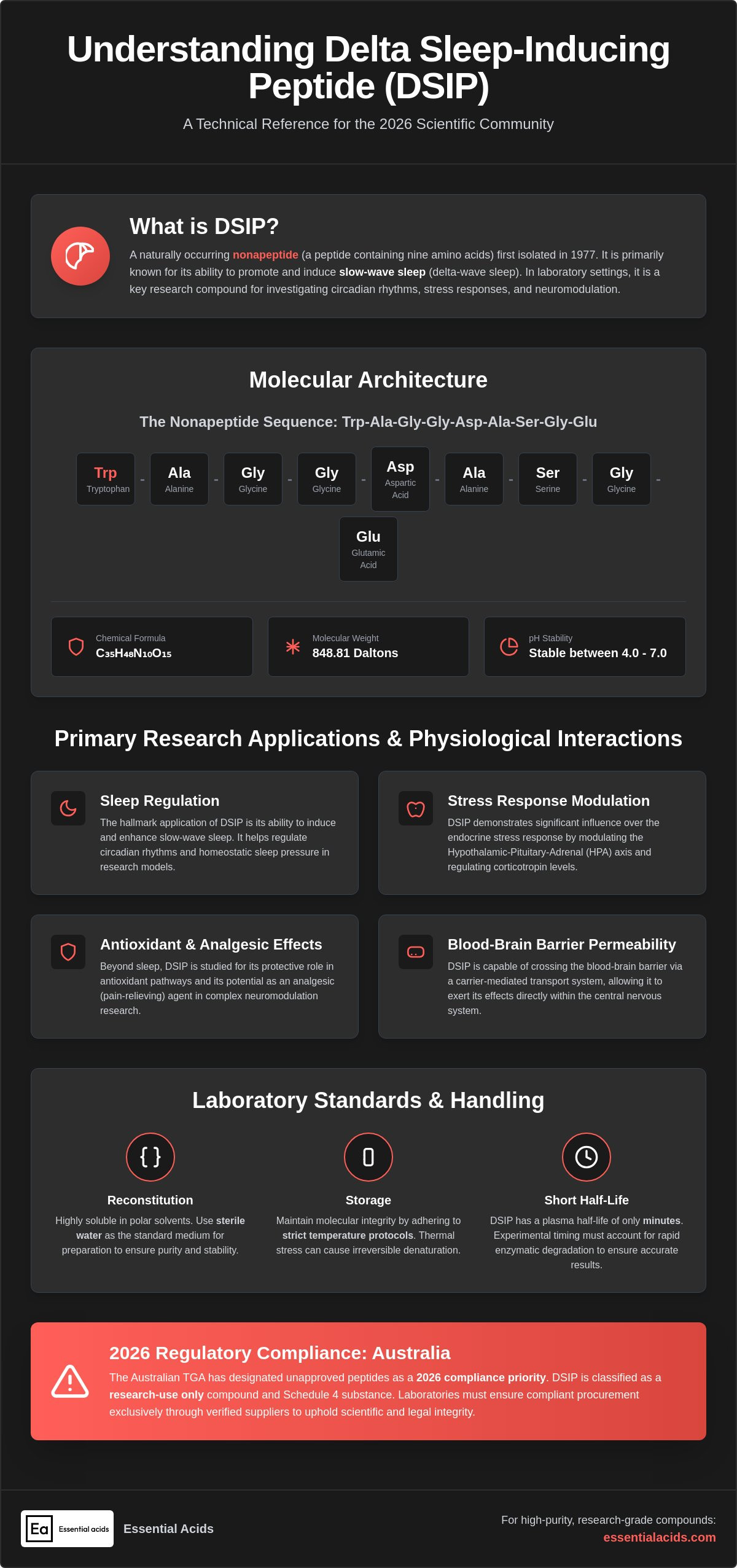
The chemical identity of the dsip peptide is defined by its specific nonapeptide sequence: Tryptophan-Alanine-Glycine-Glycine-Aspartic Acid-Alanine-Serine-Glycine-Glutamic Acid. This linear chain determines its primary biological activity and governs how the molecule interacts with cellular receptors. According to DSIP Molecular Data, the compound has a chemical formula of C35H48N10O15. Its relatively small size is a defining characteristic that influences its distribution throughout various biological compartments in laboratory models. Unlike more complex proteins, this nonapeptide maintains a streamlined structure that facilitates rapid systemic movement.
The pharmacokinetic profile of the compound is marked by a relatively short half-life in plasma, typically measured in minutes. It's subject to rapid hydrolysis by aminopeptidases; however, it demonstrates surprising resistance to enzymatic degradation in specific brain tissues. This suggests that the peptide might exist in a protected conformational state or bind to specific carrier proteins that shield it from common metabolic breakdown. Researchers prioritize high-purity batches to ensure that the degradation rates observed in vitro are representative of the compound's actual stability rather than a result of impurities.
Structural Stability and Solubility
Solubility is a critical factor for successful laboratory reconstitution. The peptide is highly soluble in polar solvents, making sterile water the standard medium for initial preparation. While it remains stable in neutral to slightly acidic environments, typically between pH 4.0 and 7.0, exposure to alkaline conditions can accelerate the breakdown of the peptide bonds. The molecular weight of DSIP is precisely 848.81 Daltons. Maintaining this molecular integrity requires strict adherence to temperature protocols, as thermal stress can lead to irreversible denaturation of the nonapeptide chain.
Blood-Brain Barrier (BBB) Permeability
A primary focus in neuroscience research is the peptide's ability to traverse the blood-brain barrier. Evidence indicates that the dsip peptide crosses the BBB primarily through passive diffusion, although carrier-mediated transport systems may also play a role in its bidirectional movement. This permeability is essential for studies targeting hypothalamic regulation. Researchers exploring these mechanisms often cross-reference data with other regulatory compounds, such as the semax peptide, to establish comparative benchmarks for transport efficiency and central nervous system activity. This comparative analysis helps define the unique pharmacokinetic advantages of DSIP in modulating deep sleep cycles and endocrine stress responses.
Primary Research Applications and Physiological Interactions
While the nomenclature of the dsip peptide emphasizes its somnogenic properties, its utility in laboratory research extends into a broad spectrum of regulatory functions. Its primary application involves the modulation of slow-wave sleep (SWS) patterns, specifically by influencing the power and frequency of delta waves in EEG readings. However, its physiological influence is not limited to sleep induction. A Scientific Review of DSIP highlights its role as a multifunctional regulatory messenger that maintains homeostatic balance across various biological systems. This includes a documented impact on thermoregulation, where the peptide appears to reduce basal body temperature in mammalian models, a physiological shift that typically precedes deep sleep states.
The peptide's interaction with neurotransmitter systems allows researchers to study the stability of circadian rhythms under metabolic stress. Unlike traditional sedatives, the dsip peptide acts as a modulator rather than a direct agonist, suggesting its role is to facilitate natural regulatory processes. This distinction is critical for longitudinal studies focusing on neurological health and the preservation of natural sleep architecture in controlled environments.
Modulation of Neuroendocrine Pathways
The dsip peptide demonstrates a significant capacity to interact with the hypothalamic-pituitary-adrenal (HPA) axis. Evidence suggests it can inhibit the release of corticotropin-releasing hormone (CRH) and subsequent corticotropin (ACTH) secretion, effectively dampening the systemic stress response. This regulatory influence extends to other hormonal pathways, including the secretion of growth hormone (GH) and luteinizing hormone (LH). Researchers frequently utilize the peptide to investigate metabolic disruptions characterized by hypercortisolism, such as Cushing’s syndrome, where stabilizing the pituitary-adrenal axis is a primary research objective.
Neuroprotective and Antioxidant Potential
In vitro investigations have identified the peptide's ability to reduce oxidative stress within neuronal cell cultures. This antioxidant potential makes it a subject of interest for research involving cellular ageing and neuroprotection. By mitigating free radical damage in stressed biological environments, the peptide provides a framework for studying cellular resilience. These neuroprotective effects are often explored through multi-compound protocols. For instance, analyzing the synergistic interactions of this nonapeptide alongside tesamorelin research applications provides researchers with a more comprehensive view of how growth hormone modulation and antioxidant pathways intersect to influence metabolic health. Such studies are essential for mapping the complex regulatory networks that govern cellular longevity in 2026 laboratory research.
Laboratory Standards for DSIP Research in 2026
Modern research protocols for the dsip peptide in 2026 demand a higher level of analytical rigor than previous decades. Scientific integrity is maintained through the strict application of batch-specific documentation and verified handling procedures. It's no longer sufficient to rely on generic molecular profiles; researchers must ensure that the compounds utilized in their assays meet precise purity and identity standards to ensure reproducible data. This section outlines the essential standards for maintaining the molecular stability of the nonapeptide within a controlled laboratory environment.
The transition from historical clinical observations to high-precision molecular biology requires a disciplined approach to compound management. Every research cycle should begin with a review of the analytical reports provided by the supplier. This practice ensures that the experimental variables are limited to the biological interactions under study rather than inconsistencies in the research material itself.
Storage and Reconstitution Protocols
Proper storage is the first line of defense against molecular degradation. Lyophilized dsip peptide should be stored in a temperature-controlled environment at -20°C for short-term preservation. For longitudinal studies extending beyond six months, storage at -80°C is required to maintain the integrity of the nonapeptide chain. Once the peptide is reconstituted, its stability decreases significantly. Researchers must use sterile water for initial solubilization, though saline or phosphate-buffered saline (PBS) may be preferred for specific in vitro assays depending on the required osmotic balance.
A critical rule in peptide handling is the absolute avoidance of repeated freeze-thaw cycles. These cycles induce mechanical stress that can lead to the cleavage of peptide bonds, rendering the batch useless for precise neurological research. The standard laboratory practice involves aliquoting the reconstituted solution into single-use vials immediately after preparation. This ensures that each experimental unit uses a fresh, non-degraded sample.
Analytical Verification (HPLC/MS)
Verification of purity is mandatory for any high-level research application. High-Performance Liquid Chromatography (HPLC) is the primary tool used to determine the purity of the sample. In 2026, a minimum purity threshold of 98% or higher is the expected standard for peer-reviewed research. Any deviation below this level introduces unknown contaminants that could interfere with HPA axis or circadian rhythm studies. Mass Spectrometry (MS) serves as a secondary, qualitative verification. It confirms the identity of the peptide by measuring its precise molecular mass, ensuring the sequence aligns with the Trp-Ala-Gly-Gly-Asp-Ala-Ser-Gly-Glu architecture without truncation or modification.
For laboratories seeking to maintain these rigorous standards with verified compounds, you can buy DSIP that includes comprehensive analytical documentation to support your research objectives.
Procurement and Compliance for Australian Laboratories
The procurement of research compounds in Australia has undergone significant scrutiny following the Therapeutic Goods Administration (TGA) announcement on June 10, 2026. The TGA officially designated unapproved peptide products as a compliance priority for the year, reflecting a coordinated effort to address the surge in unregulated online markets. For laboratories, this means navigating the landscape of peptides for sale requires a heightened focus on supplier transparency and regulatory alignment. Procuring the dsip peptide for legitimate in vitro or animal studies necessitates a partner that understands the gravity of these compliance shifts.
Scientific integrity depends on the precision of the starting material. Researchers must prioritize suppliers that provide batch-specific Certificates of Analysis (COAs), which serve as the only verifiable proof of purity and molecular identity. In a field where minor impurities can deviate metabolic results, the absence of analytical documentation is a significant research risk. Verified compounds ensure that the experimental outcomes are a result of the Trp-Ala-Gly-Gly-Asp-Ala-Ser-Gly-Glu sequence rather than unknown synthesis byproducts. This disciplined approach to sourcing is what distinguishes professional research from the unregulated grey market.
Sourcing High-Purity Research Compounds
Selecting a reliable Australian research chemical supplier involves evaluating their commitment to analytical transparency. A reputable partner doesn't just list a compound; they provide the HPLC and Mass Spectrometry data required to confirm the high-purity status of each batch. Essential Acids maintains a commitment to scientific integrity by ensuring all research materials meet a minimum 98% purity threshold. This rigorous standard is essential for 2026 laboratory protocols, where the precision of the dsip peptide is critical for mapping neuroendocrine and circadian pathways. Transparency in manufacturing and testing isn't a luxury. It's a foundational requirement for modern neuroscience.
Regulatory Framework for Research Materials
Understanding the legal boundaries in Australia is paramount for institutional compliance. While most injectable peptides are classified as Schedule 4 prescription-only medicines under the Poisons Standard for clinical use, the acquisition of these materials for laboratory research is governed by strict Research Use Only (RUO) designations. Laboratories must ensure their procurement channels don't intersect with the illegal importation routes currently being targeted by the TGA's 2026 crackdown. Compliance isn't optional. It's a protective measure that ensures the longevity of the research project. As we move through 2026, the dsip peptide remains a pivotal tool for investigating slow-wave sleep and HPA axis regulation, provided it's handled within a framework of absolute regulatory transparency and analytical rigor.
Advancing Neuroscience Research with Precision Nonapeptides
The dsip peptide remains a cornerstone for laboratories investigating the intersection of circadian rhythms and endocrine homeostasis. Its capacity to modulate the HPA axis and facilitate delta-wave sleep cycles provides a unique framework for studying metabolic resilience and neuroprotection. As regulatory scrutiny intensifies in 2026, the necessity for analytical transparency and batch-specific verification hasn't been more critical for maintaining scientific integrity.
It's essential that researchers prioritize high-purity compounds supported by rigorous documentation to ensure reproducible data in complex assays. Essential Acids provides specialized materials for neuroscience and metabolic studies, ensuring every batch meets the highest professional standards. We provide batch-specific HPLC and Mass Spectrometry reports to guarantee a minimum purity threshold of 98% or higher for all research compounds.
Secure High-Purity DSIP for Your 2026 Research at Essential Acids. By adhering to disciplined laboratory protocols and choosing verified suppliers, you ensure your research contributes meaningfully to the evolving understanding of regulatory peptides.
Frequently Asked Questions
What is the primary function of the DSIP peptide in research?
The primary function of the dsip peptide in research is the modulation of delta-wave sleep patterns and the regulation of the hypothalamic-pituitary-adrenal (HPA) axis. It acts as a regulatory messenger that allows researchers to study homeostatic sleep pressure and systemic stress responses. By influencing the power and frequency of delta waves in EEG readings, the compound provides a foundational tool for investigating circadian rhythm stability in various mammalian models.
How does DSIP cross the blood-brain barrier?
DSIP crosses the blood-brain barrier primarily through passive diffusion and carrier-mediated transport mechanisms. This bidirectional permeability is a critical feature for neuroscience research, as it allows the peptide to influence central nervous system activity while maintaining a presence in systemic circulation. The efficiency of this transport can vary between species, making it a focal point for comparative pharmacokinetic studies in laboratory environments.
What is the recommended storage temperature for lyophilized DSIP?
Lyophilized DSIP should be stored at -20°C for short-term research or -80°C for long-term preservation of molecular integrity. Maintaining these precise temperatures prevents the denaturation of the nonapeptide chain and ensures the reliability of experimental data. Once the peptide is reconstituted, its stability decreases significantly, requiring immediate aliquoting and storage in a refrigerated or frozen environment depending on the intended timeframe of the study.
Is DSIP intended for human consumption or clinical use?
No, DSIP is strictly prohibited from human consumption or clinical use and is designated for laboratory research only. There are no circumstances under which this compound should be administered to humans or used for therapeutic purposes. It is manufactured and supplied as a research-use only material, requiring strict adherence to institutional safety protocols and regulatory frameworks to ensure professional and ethical laboratory conduct.
How can researchers verify the purity of a DSIP batch?
Researchers verify the purity of a dsip peptide batch through High-Performance Liquid Chromatography (HPLC) and Mass Spectrometry (MS). A verified batch-specific report should demonstrate a minimum purity threshold of 98% to ensure the absence of interfering contaminants during assays. Mass Spectrometry is utilized to confirm the precise molecular weight of 848.81 Daltons, ensuring the nonapeptide sequence aligns with the required Trp-Ala-Gly-Gly-Asp-Ala-Ser-Gly-Glu architecture.
What are the common non-sleep effects observed in DSIP studies?
Non-sleep effects documented in research include the modulation of thermoregulation and the dampening of corticotropin (ACTH) secretion. Studies also indicate potential antioxidant properties and influence over growth hormone and luteinizing hormone release within neuroendocrine pathways. These interactions allow researchers to investigate the peptide's role in mitigating oxidative stress and stabilizing the pituitary-adrenal axis during metabolic disruptions or cellular ageing studies.
Which amino acids make up the DSIP nonapeptide sequence?
The DSIP nonapeptide sequence consists of nine amino acids: Tryptophan, Alanine, Glycine, Glycine, Aspartic Acid, Alanine, Serine, Glycine, and Glutamic Acid. This specific Trp-Ala-Gly-Gly-Asp-Ala-Ser-Gly-Glu architecture determines its unique biochemical interactions and regulatory functions. Maintaining the integrity of this sequence is vital for ensuring that the observed biological activity in research models is consistent with established molecular profiles.
Can DSIP be reconstituted in bacteriostatic water?
DSIP can be reconstituted in bacteriostatic water if the research protocol necessitates a preservative to prevent microbial growth over an extended period. While sterile water is the standard solvent for initial solubilization, the choice of medium often depends on the specific requirements of the assay. Researchers must ensure the chosen solvent doesn't introduce variables that could interfere with the peptide's molecular stability or its interaction with cellular receptors.
Legal Disclaimer
All products sold on this website are intended exclusively for laboratory research purposes and not for human or veterinary use, diagnosis, cure, treatment, or prevention of any disease or condition. None of the statements on this site have been reviewed or evaluated by the U.S. Food and Drug Administration (FDA) or comparable regulatory authorities. Purchasing or using these products for any unintended purpose, including human consumption, may violate federal or local laws and poses safety risks.