

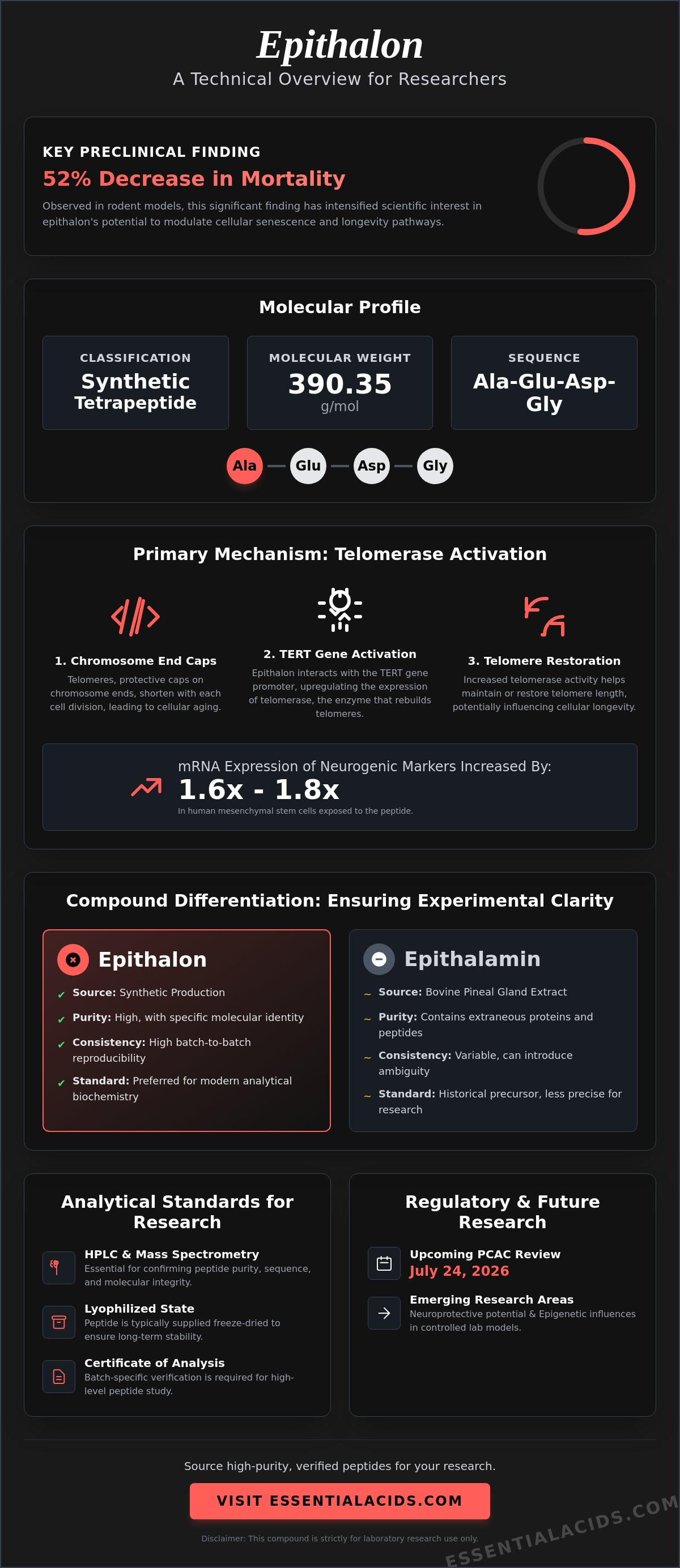
Could a 52% decrease in mortality observed in rodent models be replicated through the precise activation of the telomerase enzyme? Scientific interest in epithalon research has intensified as investigators seek to understand the molecular pathways of cellular senescence and the restoration of telomeric caps. You likely recognize the difficulty in sourcing analytical-grade compounds that maintain structural integrity across varied laboratory conditions, especially when the distinction between synthetic Epithalon and bovine-derived Epithalamin is often blurred by imprecise labeling. This technical guide provides a comprehensive overview of the biochemical mechanisms governing telomerase induction and the specific stability profiles essential for rigorous in vitro protocols.
We'll analyze the current regulatory landscape, including the scheduled July 24, 2026, PCAC review, and establish the high-purity standards necessary for reproducible data in the study of molecular aging. Our focus remains on the transition from observational gerontology to rigorous analytical biochemistry. Making better, normal requires a disciplined adherence to verified chemical properties over market trends, ensuring that your research-use only materials meet the highest threshold of scientific integrity. This objective assessment serves as a foundation for establishing reliable laboratory parameters and identifying the batch-specific verification required for high-level peptide study.
Key Takeaways
- Identify the specific biochemical pathways of the Ala-Glu-Asp-Gly tetrapeptide in facilitating telomerase induction and TERT gene expression.
- Differentiate between synthetic Epithalon and bovine-derived Epithalamin to ensure batch-specific consistency and prevent experimental ambiguity in your data.
- Establish rigorous analytical standards for epithalon research by utilizing HPLC and Mass Spectrometry to confirm peptide purity and molecular integrity.
- Examine the role of chromatin remodelling in regulating protein synthesis within the theoretical framework of molecular ageing.
- Assess emerging research into the neuroprotective potential and epigenetic influences of synthetic tetrapeptides in controlled laboratory models.
Epithalon Research: Molecular Profile and Theoretical Framework
Epithalon is a synthetic tetrapeptide comprised of four amino acids: L-alanyl-L-glutamyl-L-aspartyl-glycine. Its primary structural identity is defined by the sequence Ala-Glu-Asp-Gly. This compound possesses a precise molecular weight of 390.35 g/mol, a specification that serves as a critical benchmark for analytical verification in laboratory settings. Epithalon research focuses on the compound's capacity to modulate biological rhythms and cellular longevity, primarily by mimicking the activity of endogenous regulatory peptides. Within the mammalian endocrine system, the pineal gland produces these regulatory sequences to maintain metabolic homeostasis and circadian synchronization. Synthetic production ensures the removal of extraneous proteins often found in glandular derivatives, providing a high-purity compound for biochemical interrogation.
The Discovery and Synthesis of Epitalon
The origin of this peptide is rooted in the work of Professor Vladimir Khavinson at the St. Petersburg Institute of Bioregulation and Gerontology. Initial investigations utilized Epithalamin, a complex glandular extract derived from the bovine pineal gland. Through iterative analysis, researchers isolated the specific tetrapeptide sequence responsible for the extract's observed biological activity. Epithalon is a synthetic mimetic of the natural pineal peptide epithalamin. The transition from crude extracts to the synthetic Epitalon sequence allows for a level of batch-to-batch consistency that is unattainable with glandular materials. This precision is essential for modern biochemical assays where molecular integrity and scientific integrity are the primary variables.
Research Applications in Cellular Aging
The investigation of cellular senescence remains a cornerstone of epithalon research. Scientists utilize this tetrapeptide to explore the mechanisms underlying the Hayflick limit, which represents the finite number of times a normal somatic cell population will divide before cell division stops. Research models focus on in vitro applications to observe how telomerase induction might influence this threshold. It's strictly classified as a laboratory research compound. This status necessitates a clear distinction between experimental findings in controlled environments and therapeutic claims, which are not supported by regulatory approval. High-purity peptides are required to avoid confounding variables in these sensitive cellular models.
Maintaining the structural integrity of the Ala-Glu-Asp-Gly sequence is vital for laboratory planning. The peptide is typically provided in a lyophilized state to ensure long-term stability under varied storage conditions. Researchers must account for molecular weight confirmation through mass spectrometry to verify the identity of the compound before initiating protocols. The absence of hyperbolic marketing ensures that the focus remains on the quantifiable data provided by certificates of analysis. Making better, normal involves this level of technical transparency and adherence to established analytical standards. This disciplined approach ensures that epithalon research remains grounded in objective data rather than commercial trends.
Mechanisms of Action: Telomerase Activation and Gene Expression
The primary biochemical objective of epithalon research centers on the induction of telomerase activity. Telomerase is the ribonucleoprotein reverse transcriptase responsible for maintaining telomere length by adding repetitive DNA sequences to the ends of chromosomes. In most somatic cells, the gene encoding the catalytic subunit of this enzyme, telomerase reverse transcriptase (TERT), is transcriptionally repressed. Epithalon appears to bypass this repression by interacting directly with the TERT promoter region. Research has suggested that mRNA expression of neurogenic differentiation markers increased by 1.6 to 1.8 times in human mesenchymal stem cells exposed to the peptide. This upregulation suggests a fundamental shift in cellular programming toward a more proliferative state.
Beyond telomere maintenance, the peptide demonstrates a significant influence on the pineal-hypothalamic axis. It facilitates the restoration of melatonin secretion patterns, which are often disrupted during cellular ageing. This systemic interaction supports the regulation of metabolic rhythms and hormonal balance in research models. Additionally, the compound exhibits potent antioxidant properties in vitro. It neutralizes free radicals and enhances the activity of endogenous antioxidant enzymes like superoxide dismutase. An Epithalon research summary provides further context on these multifaceted interactions within the endocrine and central nervous systems. For investigators seeking to replicate these findings, utilizing analytical-grade Epithalon is necessary to ensure experimental accuracy.
Telomerase Induction in Senescent Cells
In senescent cell populations, the lack of active telomerase leads to the Hayflick limit, where cell division ceases. Epithalon research indicates that the peptide may reactivate the silenced TERT gene, allowing cells to overcome this replicative boundary. Observations in fibroblast cultures have shown measurable telomere elongation following exposure to the synthetic tetrapeptide. This capacity for rejuvenation in vitro offers a unique model for studying cellular immortality and the potential for extended replicative lifespans in controlled environments.
Epigenetic Regulation and DNA Interaction
The peptide functions as an epigenetic modulator by influencing the accessibility of genetic information. It interacts with DNA promoter regions to regulate the cell cycle and modulate apoptosis pathways. Epithalon facilitates gene transcription by promoting the acetylation of histones, which transitions chromatin from a condensed state to a more accessible, transcriptionally active form. This direct interaction with the epigenetic landscape allows the peptide to influence protein synthesis at a fundamental level. By altering the chromatin environment, the compound ensures that regulatory genes remain active, supporting the integrity of the cellular transcriptome during prolonged research periods.
Comparative Analysis: Epithalon vs. Epithalamin in Research
Distinguishing between these two terms is vital for accurate laboratory documentation and experimental design. Epithalamin is a complex of polypeptides extracted from the bovine pineal gland, whereas Epithalon is a synthetic tetrapeptide mirroring the primary active sequence. While initial epithalon research began with these glandular extracts, modern biochemistry has moved toward synthetic sequences to eliminate the variables inherent in biological materials. Glandular extracts often contain a spectrum of proteins and peptides that can interfere with specific signaling assays, making it difficult to isolate the exact mechanism of telomerase induction. This complexity often leads to inconsistent results that can't be easily replicated in high-integrity studies.
Synthetic Precision vs. Glandular Complexity
The preference for the synthetic tetrapeptide Ala-Glu-Asp-Gly stems from the need for absolute control over experimental variables. Epithalamin, being a bovine derivative, carries a risk profile that includes potential biological contaminants such as prions or extraneous animal proteins. These impurities can trigger unintended immunological responses in cellular cultures, confounding the data and compromising the integrity of the study. By utilizing a synthetic mimetic, researchers ensure that the observed effects on TERT gene expression are directly attributable to the specific amino acid sequence rather than unknown components of a glandular matrix. This evolution from crude extracts to precise synthesis represents a standard shift toward higher scientific integrity in gerontology.
Reproducibility in Scientific Trials
Achieving consistent results across different laboratory environments requires a compound with a verified molecular weight and purity profile. Synthetic peptides offer a level of batch-to-batch consistency that glandular extracts simply can't match. In epithalon research, the use of High-Performance Liquid Chromatography (HPLC) allows for the verification of purity levels often exceeding 98%, ensuring that each vial contains the exact molar concentration required for the protocol. This level of analytical precision is non-negotiable for peer-reviewed studies where reproducibility is the ultimate benchmark of validity. It's a fundamental requirement for any project aiming to contribute to the collective understanding of molecular ageing.
Stability and bioavailability also differ significantly between these forms. Synthetic Epithalon is typically provided in a stable, lyophilized state, allowing for precise reconstitution in sterile media. This controlled preparation is essential for maintaining the peptide's integrity during long-term incubation periods. For those establishing new experimental frameworks, understanding the criteria for selecting high-purity materials is a critical first step. Detailed guidance on these standards can be found in our resource on Where to Buy Peptides: A Researcher’s Guide to Analytical Integrity. Choosing synthetic compounds over glandular alternatives effectively minimizes the risk of experimental drift and ensures that the focus remains on the specific molecular pathways of cellular senescence. Making better, normal requires this level of dedication to analytical transparency.
Analytical Standards: Verifying Epithalon Purity and Integrity
High-Performance Liquid Chromatography (HPLC) remains the gold standard for assessing peptide quality in a laboratory environment. This analytical technique separates individual components within a sample based on their interaction with a stationary phase, producing a visual representation of purity. Mass Spectrometry (MS) complements this by confirming the molecular mass of the tetrapeptide, ensuring the sequence matches the expected 390.35 g/mol. For epithalon research, the presence of a single, sharp peak at the expected retention time indicates a high-purity compound. Low-grade synthesis often results in secondary peaks representing truncated sequences or residual solvents, which can compromise the accuracy of cellular assays.
Identifying common impurities is a critical step in maintaining experimental control. Residual chemicals from the solid-phase peptide synthesis process, such as unreacted amino acids or coupling reagents, can introduce unintended variables. These contaminants may interfere with telomerase induction or trigger inflammatory responses in in vitro models. High-integrity laboratories prioritize materials that have undergone rigorous purification to remove these by-products. Ensuring the quality of the starting material is the only way to guarantee that the observed biological effects are solely attributable to the Ala-Glu-Asp-Gly sequence.
Reading a Certificate of Analysis (COA)
A COA provides the necessary data to verify scientific integrity before initiating a protocol. Researchers must evaluate the purity percentage, moisture content, and residual Trifluoroacetic acid (TFA) levels. TFA is frequently used as a counter-ion during purification, but high concentrations can shift the pH of the final solution and affect cell viability. The area under the primary chromatogram peak determines the final purity percentage relative to any detectable impurities. Batch-specific documentation is non-negotiable for researchers because it ensures that the physical material used in the laboratory matches the analytical data provided by the manufacturer.
Stability and Reconstitution Protocols
Maintaining the stability of the tetrapeptide sequence requires strict adherence to temperature and pH parameters. Lyophilized powder is most stable when stored at -20°C or -80°C, minimizing the risk of peptide degradation over time. Once reconstituted, the peptide's shelf life decreases significantly; it's sensitive to light and temperature fluctuations. Reconstitution should occur in a sterile, buffered environment, typically utilizing bacteriostatic water or phosphate-buffered saline. For broader insights into maintaining peptide integrity and storage best practices, consult our guide on BPC-157 5mg: Molecular Profile and Laboratory Research Standards for 2026.
Reliable epithalon research is impossible without verified materials that meet these rigorous standards. To support your laboratory objectives, you can buy analytical-grade Epithalon that has been verified via HPLC and MS. Ensuring that each batch is documented protects the validity of your data and the reproducibility of your findings. Making better, normal involves this level of dedication to analytical transparency and laboratory precision.
The Future of Epithalon in Gerontology Research
The trajectory of epithalon research is expanding beyond basic telomere biology to investigate broader neuroprotective pathways and epigenetic modulation. Investigators are increasingly focused on how the Ala-Glu-Asp-Gly sequence interacts with the suprachiasmatic nucleus to influence systemic regulatory functions. This area of study examines the restoration of rhythmic hormonal patterns that typically degrade with cellular ageing. While the primary mechanism remains telomerase induction, the intersection of peptide science and epigenetics suggests a more complex regulatory role involving chromatin remodeling. Essential Acids maintains a disciplined commitment to providing high-purity analytical standards to support these evolving investigations into molecular longevity.
The upcoming Pharmacy Compounding Advisory Committee (PCAC) meeting scheduled for July 24, 2026, reflects the shifting regulatory landscape for synthetic peptides. This review may influence the availability of research materials, making the procurement of verified, high-purity compounds even more critical for laboratory planning. Scientific integrity requires that investigators utilize materials with batch-specific documentation to avoid the confounding variables associated with low-grade synthesis. Our role is to act as a rigorous gatekeeper, ensuring that the compounds provided for epithalon research meet the stringent requirements of modern gerontology.
Neuroprotection and Circadian Rhythms
Research models often utilize Epithalon to observe changes in melatonin synthesis within the pineal gland. This is particularly relevant for studying age-related cognitive decline in controlled laboratory environments where circadian synchronization is a primary variable. Data suggests that the peptide may influence the expression of genes involved in neuronal plasticity and antioxidant defense mechanisms. It is vital to maintain strict research-use only boundaries when discussing these findings. The objective is to establish reproducible data within in vitro or animal models rather than extrapolating to clinical applications. These studies rely on the peptide's ability to cross biological membranes and interact with nuclear DNA to facilitate gene transcription.
Conclusion: Prioritising Scientific Integrity
Epithalon remains a vital tool for molecular biology, offering a unique mechanism for investigating the Hayflick limit and cellular senescence. The necessity of high-purity compounds cannot be overstated; valid scientific discovery depends entirely on the quality of the starting material. Using peptides verified through HPLC and Mass Spectrometry ensures that experimental outcomes are not skewed by synthetic by-products or residual solvents. This objective approach allows researchers to focus on the quantifiable data provided by the St. Petersburg Institute of Bioregulation and Gerontology and other global research entities.
Scientific integrity is the core value that drives our operations. By prioritizing batch-specific verification and objective data, we provide researchers with the tools needed to advance the understanding of molecular aging. Making better, normal requires a disciplined focus on the precision of the laboratory. Explore our high-purity Epithalon for your next research project. Each vial is prepared to meet the rigorous standards required for high-level biochemical interrogation, ensuring that your data remains stable and reproducible.
Advancing Gerontology Through Analytical Precision
The transition from observational gerontology to rigorous molecular interrogation requires a compound that meets the highest analytical standards. Valid epithalon research depends on the ability to replicate telomerase induction and TERT gene expression within controlled in vitro models. By prioritizing synthetic tetrapeptides over glandular complexities, you eliminate biological variables that often confound long-term data. It's essential that scientific integrity is maintained through the strict application of HPLC and Mass Spectrometry to verify each batch's molecular weight and purity profile.
Essential Acids remains a reliable partner in your pursuit of understanding cellular ageing. Every order includes a batch-specific COA to ensure your laboratory documentation remains complete and compliant with research-only protocols. We understand that your next discovery relies on the stability and integrity of the compounds you select. Making better, normal involves this level of technical transparency and adherence to established analytical benchmarks.
Secure High-Purity Epithalon for Laboratory Research and ensure your data remains reproducible and accurate. We look forward to supporting your contribution to the field of molecular bioregulation.
Frequently Asked Questions
Is Epithalon approved for human consumption?
No, Epithalon is not approved for human consumption. It is strictly classified as a research chemical intended for laboratory use only. Regulatory bodies, including the FDA, haven't approved this compound for any therapeutic or diagnostic indication in humans. All scientific integrity protocols must adhere to these boundaries to ensure regulatory compliance and safety within the research environment.
What is the primary mechanism of Epithalon in research?
The primary mechanism involves the induction of telomerase reverse transcriptase (TERT) gene expression. This process facilitates the activation of the telomerase enzyme, which is responsible for maintaining telomere length at the ends of chromosomes. In epithalon research, scientists investigate how this molecular pathway influences cellular senescence and the Hayflick limit in varied in vitro models.
How should Epithalon be stored in a laboratory setting?
Epithalon should be stored as a lyophilized powder at temperatures of -20°C or -80°C to ensure long-term stability. Once reconstituted in a sterile buffer like bacteriostatic water, the solution is significantly more sensitive to degradation. It must be kept refrigerated at 2-8°C and protected from light, though immediate use is recommended to maintain the integrity of the peptide sequence.
What is the difference between Epithalon and Epithalamin?
Epithalamin is a complex mixture of polypeptides extracted from the bovine pineal gland, while Epithalon is a synthetic tetrapeptide mirroring the active sequence Ala-Glu-Asp-Gly. Synthetic production provides a high-purity compound with a specific molecular weight of 390.35 g/mol. This eliminates the risk of biological contaminants and batch-to-batch variability often associated with glandular extracts.
How can I verify the purity of Epithalon peptides?
Purity is verified using High-Performance Liquid Chromatography (HPLC) and Mass Spectrometry (MS). HPLC determines the purity percentage by measuring the area under the primary chromatogram peak, while MS confirms the molecular mass matches the theoretical value. A batch-specific Certificate of Analysis (COA) is required to document these findings and ensure the compound meets high analytical standards.
Does Epithalon research involve telomerase activation?
Yes, telomerase activation is the central focus of current epithalon research. Scientific interest centers on the peptide's ability to reactivate the catalytic subunit of telomerase in senescent cells. This mechanism is studied to understand its impact on chromosomal stability and cellular longevity in controlled laboratory settings, moving beyond observational gerontology to precise molecular analysis.
What are the typical concentrations used in in vitro Epithalon studies?
Typical concentrations in cell culture models range from 0.01 µg/mL to 10 µg/mL. Some studies investigating mRNA expression of neurogenic markers have utilized specific ranges to observe 1.6 to 1.8 fold increases in differentiation. Researchers must determine the optimal molarity based on the specific cell line and the desired metabolic or epigenetic endpoint of the laboratory protocol.
Can Epithalon be used in veterinary research?
Epithalon may be used in veterinary research models, including rodent and insect studies, to investigate biological age and mortality rates. Research in rats has suggested a 52% decrease in mortality under specific experimental conditions. However, the compound remains for research-use only and isn't intended for use in domestic animals or livestock outside of a regulated laboratory setting.
Legal Disclaimer
All products sold on this website are intended exclusively for laboratory research purposes and not for human or veterinary use, diagnosis, cure, treatment, or prevention of any disease or condition. None of the statements on this site have been reviewed or evaluated by the U.S. Food and Drug Administration (FDA) or comparable regulatory authorities. Purchasing or using these products for any unintended purpose, including human consumption, may violate federal or local laws and poses safety risks.