

What if the most studied tripeptide in regenerative biochemistry functions as a massive-scale genetic regulator rather than a simple copper transporter? For decades, GHK-Cu research has focused on its role in skin regeneration and wound healing, yet the true complexity of its molecular profile often remains obscured by inconsistent purity and conflicting stability data. You've likely encountered the frustration of batch-to-batch variability or the absence of rigorous analytical documentation when sourcing compounds for laboratory use. We understand that scientific integrity depends on the precision of your materials and the clarity of your data.
This comprehensive 2026 literature review provides a disciplined examination of the GHK-Cu tripeptide, exploring its intricate molecular mechanisms and gene expression pathways. We'll establish a clear framework for laboratory handling while detailing the high-purity standards required for reliable experimental results. By the end of this profile, you'll have a thorough understanding of how this peptide influences cellular ageing and metabolic processes at a genomic level. Our analysis prioritizes objective facts over market trends, ensuring your research is supported by verified biochemistry and batch-specific integrity.
Key Takeaways
- Review the 1973 discovery by Dr. Loren Pickart and the subsequent characterization of GHK-Cu as a vital age-dependent tripeptide.
- Examine the high-affinity binding mechanisms of Copper(II) and the specific pathways involved in peptide-mediated cellular transport.
- Gain insights into gene expression profiling through the Broad Institute Connectivity Map, highlighting the upregulation of DNA repair genes during GHK-Cu research.
- Define strict laboratory benchmarks for analytical verification, focusing on the use of HPLC and Mass Spectrometry for purity confirmation.
- Access a framework for maintaining scientific integrity by prioritizing batch-specific documentation and verified molecular standards in research settings.
The Molecular Characterization and Discovery of GHK-Cu
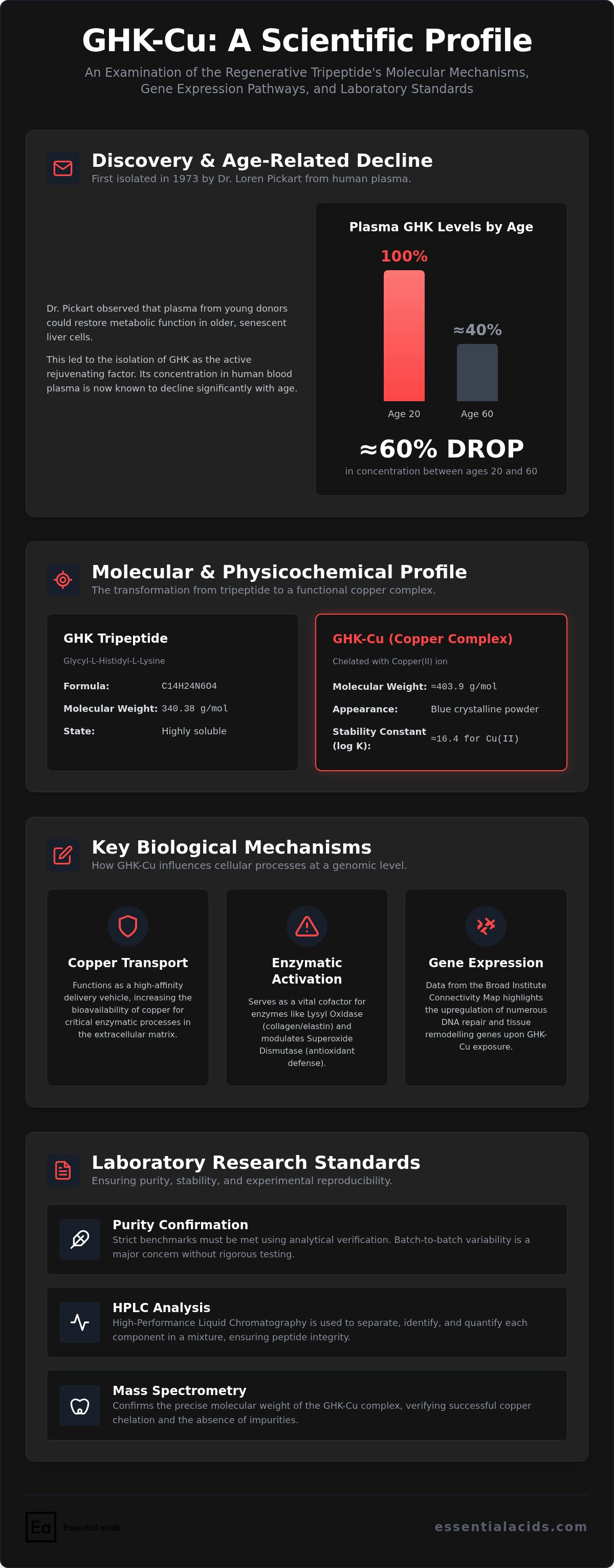
GHK-Cu research began with the identification of a specific tripeptide sequence: glycyl-L-histidyl-L-lysine. This small molecule, consisting of three amino acids, was first isolated in 1973 by Dr. Loren Pickart. His work focused on the age-dependent decline of systemic regenerative capacity in human plasma. Pickart observed that plasma from young donors could restore the metabolic function of older, senescent liver cells, leading to the isolation of GHK as the active factor. It's now understood that the concentration of this peptide in human blood drops by roughly 60% between the ages of 20 and 60.
In its isolated state, GHK is a highly soluble tripeptide. However, its biological utility is fundamentally tied to its affinity for copper(II) ions. When chelated, it forms the Copper peptide GHK-Cu complex. This complex is physically characterized as a blue crystalline powder with exceptional stability in aqueous solutions. The transition from the basic tripeptide to the copper-chelated form is essential; without the metal ion, the peptide doesn't possess the coordination necessary for many of its documented cellular interactions. The chelation process transforms the molecule into a functional signal-modulating agent.
Isolation and Early Plasma Research
The methodology for isolating GHK involved complex fractionation of human albumin. Researchers identified that GHK concentrations in the blood don't remain static throughout a lifespan. In the early 1970s, laboratory models using senescent liver cells demonstrated that GHK exposure could shift the metabolic profile of these cells toward a more youthful state. These findings established a direct correlation between circulating GHK levels and the body's innate ability to maintain tissue integrity. The peptide acts as a crucial link in the systemic communication of regenerative signals.
Physicochemical Profile of the Tripeptide
The empirical formula for GHK is C14H24N6O4, with a molecular weight of approximately 340.38 g/mol. Once the copper(II) ion is chelated, the complex gains a distinct thermodynamic stability. This stability is largely attributed to the histidine residue. Histidine provides a specific nitrogen-binding site that facilitates high-affinity coordination with the copper ion. Maintaining these specific molecular standards is critical for GHK-Cu research to ensure experimental reproducibility.
Key physical and chemical attributes include:
- High solubility in water and acetic acid.
- Thermodynamic stability constant (log K) of approximately 16.4 for copper(II) binding.
- Molecular weight of the complex is roughly 403.9 g/mol.
- Distinctive blue coloration upon successful chelation.
Essential Acids ensures that all GHK-Cu research compounds meet these precise chemical specifications through rigorous analytical verification. Every batch undergoes testing to confirm the integrity of the copper-peptide bond and the purity of the resulting crystalline powder.
Mechanisms of Copper(II) Chelation and Cellular Transport
The biological efficacy of GHK is fundamentally dependent on its capacity to form a stable complex with copper(II) ions. While many peptides exhibit generalized metal-binding properties, GHK demonstrates a high degree of specificity for copper over other transition metals like zinc or iron. This selectivity is a cornerstone of Regenerative and Protective Actions of GHK-Cu, as it allows the peptide to modulate copper levels within the extracellular matrix without interfering with other metal-dependent pathways. Once chelated, the complex acts as a delivery vehicle, increasing the bioavailability of copper for critical enzymatic processes.
Enzymatic activation is a significant outcome of this transport mechanism. GHK-Cu serves as a cofactor for lysyl oxidase (LOX), an enzyme essential for the cross-linking of collagen and elastin. It also modulates the activity of superoxide dismutase (SOD1), which provides a primary defense against oxidative stress by neutralizing superoxide radicals. Researchers seeking to maintain these specific enzymatic standards often rely on verified GHK-Cu compounds to ensure experimental consistency within their laboratory protocols.
The Binding Constant and Coordination Geometry
Quantitative analysis of the binding affinity reveals a stability constant (log K) of approximately 16.4. This high affinity ensures that the copper remains sequestered until it reaches specific cellular targets. The GHK-Cu(II) complex adopts a square-planar coordination geometry. In this configuration, the copper ion is coordinated by the nitrogen atoms of the glycyl amino group, the first two peptide bonds, and the imidazole side chain of the histidine residue. This specific molecular arrangement is significantly more stable than those found in many other copper-binding peptides used in dermatological research.
Copper Delivery to High-Affinity Transporters
The transport of copper into the intracellular environment is primarily mediated through interactions with the CTR1 transporter. GHK-Cu facilitates a redox-neutral transport process, delivering copper to the cell membrane without inducing the production of free radicals. Once inside the cell, the copper is released and chaperoned to various organelles, including the mitochondria. This mechanism is vital for mitochondrial function and cellular respiration, making GHK-Cu research a focal point for studies on cellular ageing and metabolic integrity. By regulating the intracellular copper pool, the tripeptide helps maintain the delicate balance required for optimal cellular homeostasis.
Gene Expression Profiling and Tissue Remodelling Data
Modern GHK-Cu research has moved beyond simple biochemical assays to embrace large-scale genomic profiling. The most significant data in this field originates from the Broad Institute Connectivity Map (CMap), which tracks the effects of thousands of compounds on the human genome. GHK-Cu stands out for its ability to reset the "Ageing Signature" of human fibroblasts, shifting their gene expression profile toward a younger, more regenerative state. This isn't a localized effect but a systemic modulation of the human genome, involving the upregulation of DNA repair genes and the suppression of pro-inflammatory cytokine signalling.
The Connectivity Map (CMap) Study
The CMap study provides a quantitative framework for understanding peptide-mediated gene modulation. GHK-Cu ranks among the highest-scoring compounds for its ability to influence specific biological pathways, particularly those related to proteasomal activity and cellular detoxification. High Z-scores in genomic research indicate a significant correlation between GHK-Cu exposure and the expression of genes responsible for repairing damaged DNA and neutralizing oxidative stress. By downregulating pathways associated with chronic inflammation, the tripeptide helps maintain cellular homeostasis in senescent models.
Extracellular Matrix (ECM) Remodelling
Laboratory data consistently demonstrates that GHK-Cu acts as a primary signal for tissue remodelling. It stimulates the synthesis of collagen type I and type III, which are the foundational proteins of the dermal matrix. Beyond simple protein synthesis, the tripeptide regulates the balance between Matrix Metalloproteinases (MMPs) and Tissue Inhibitors of Metalloproteinases (TIMPs). This regulation ensures that tissue breakdown and reconstruction occur in a controlled, non-pathological manner. Detailed studies on GHK-Cu's role in skin regeneration also highlight a marked increase in glycosaminoglycan (GAG) production, specifically hyaluronic acid and chondroitin sulfate. These molecules are essential for maintaining tissue hydration and structural integrity in dermal research models.
Essential Acids provides research-grade GHK-Cu to facilitate these complex genomic and histological studies. Our commitment to scientific integrity ensures that every batch meets the molecular standards required for reproducible gene expression profiling. We prioritize analytical transparency so that researchers can focus on the gravity of their data without concerns regarding compound purity.
Laboratory Research Standards: Stability and Analytical Verification
GHK-Cu research requires precise analytical data to ensure that experimental outcomes are not skewed by impurities or degradation products. High-Performance Liquid Chromatography (HPLC) is employed to quantify the purity of the peptide, while Mass Spectrometry (MS) serves as the primary tool for verifying the molecular weight and chemical identity of the compound. Without these verification steps, the integrity of the research is compromised. Every batch must be scrutinized to confirm that the observed biological effects are attributable solely to the GHK-Cu complex and not to residual reagents or truncated peptide sequences. High-purity standards are the baseline for any credible laboratory investigation.
Verifying Peptide Purity and Integrity
Analyzing a Certificate of Analysis (CoA) is a fundamental skill for laboratory researchers. A valid CoA for GHK-Cu must display a purity level of at least 98% to be considered research-grade. Identifying impurities in HPLC reports involves examining the chromatogram for secondary peaks, which may indicate synthesis by-products or degradation. It's established that HPLC remains the gold standard for those who buy research peptides australia. This methodology ensures that the tripeptide sequence and the copper chelation remain consistent across different batches, preventing the introduction of variables that could invalidate a study's findings.
Stability and Handling in Research Settings
The stability of GHK-Cu is highly sensitive to environmental factors. Lyophilized powder should be stored at -20°C for long-term preservation to prevent moisture absorption and peptide breakdown. Once reconstituted in bacteriostatic water or saline buffers, the solution's shelf life significantly decreases, often requiring use within a narrow window if stored at 4°C. The integrity of the copper-peptide bond is also pH-dependent; acidic environments with a pH below 5.0 can cause the copper ion to dissociate from the GHK tripeptide, rendering the complex inactive. Additionally, researchers must account for light sensitivity and oxidation risks during laboratory analysis. Exposure to ultraviolet light or prolonged contact with oxygen can alter the molecule's chemical profile, leading to the formation of reactive species that interfere with cellular assays.
Maintaining these rigorous standards is essential for producing reproducible data in a laboratory setting. Essential Acids provides batch-specific analytical documentation for every compound, ensuring that your laboratory work is built on a foundation of scientific integrity. You can access high-purity GHK-Cu that meets these exacting analytical benchmarks for your next research project.
Procuring High-Purity GHK-Cu for Australian Research
Scientific integrity serves as the foundation for every laboratory breakthrough. In the context of GHK-Cu research, the transition from theoretical molecular profiles to empirical data depends entirely on the quality of the starting material. Essential Acids operates as a rigorous gatekeeper for the scientific community, ensuring that high-purity compounds remain available to those conducting critical investigations into cellular ageing and tissue remodelling. We recognize that inconsistent purity in research compounds often leads to conflicting data, which is why we prioritize transparency and analytical verification above all else. High-purity standards aren't just a preference; they're a requirement for achieving reproducible results in any serious laboratory environment.
Essential Acids: Analytical Transparency
Our overarching philosophy, "Making better, normal," drives our commitment to providing compounds that meet the highest possible laboratory standards. This approach is rooted in the belief that human potential is best explored through precise, reproducible science. Every vial of GHK-Cu is accompanied by batch-specific analytical documentation, including HPLC and Mass Spectrometry reports. This documentation is not a secondary feature but a core component of our service, allowing researchers to verify the molecular identity and purity of their materials before beginning an assay. We maintain a strict research-use only policy, which acts as a linguistic and regulatory filter to ensure our products are utilized solely within professional laboratory environments. This discipline is particularly relevant for those conducting studies on peptides for skin research, where the concentration and stability of the tripeptide are paramount for accurate data collection.
National Research Distribution
Supporting the Australian scientific community requires a stable and well-regulated distribution framework. Essential Acids provides streamlined procurement for Australian universities and private research institutions, ensuring that high-purity GHK-Cu is accessible without the delays often associated with international logistics. We employ secure handling and temperature-controlled shipping protocols to maintain the stability of the lyophilized powder during transit. This protective approach prevents degradation caused by thermal fluctuations, ensuring the compound arrives in its optimal state for reconstitution. For investigators requiring specific analytical data or custom documentation beyond the standard Certificate of Analysis, our technical team is available to address detailed inquiries. This collaborative relationship between supplier and researcher is vital for maintaining the stability and reliability of GHK-Cu research across the country. Our focus remains on the precision of the laboratory rather than the trends of the marketplace, projecting an image of a trustworthy, high-level partner for all regenerative research needs.
Advancing Regenerative Science through Molecular Precision
The transition from early plasma research to modern genomic profiling has established GHK-Cu as a sophisticated regulator of cellular homeostasis. This review has detailed the tripeptide's high-affinity coordination with copper(II) and its capacity to reset the genetic "Ageing Signature" through the upregulation of DNA repair pathways. Achieving reproducible results in GHK-Cu research depends on maintaining strict analytical benchmarks, specifically through the use of HPLC and Mass Spectrometry to verify batch-specific purity and molecular integrity.
Essential Acids remains a reliable partner for Australian research institutions, providing high-purity compounds backed by comprehensive documentation. Our commitment to scientific integrity ensures that every compound is strictly for research-use only, maintaining the professional distance required for objective laboratory work. By prioritizing analytical transparency and national distribution, we facilitate the rigorous investigation of biological potential within a secure, well-regulated framework. We invite you to View High-Purity GHK-Cu for Research and integrate verified molecular standards into your next experimental protocol. Your dedication to precision is the key to uncovering the next frontier of metabolic science.
Frequently Asked Questions
What is the recommended storage temperature for GHK-Cu research powder?
The recommended storage temperature for lyophilized GHK-Cu research powder is -20°C for long-term stability. Maintaining this sub-zero environment prevents moisture absorption and reduces the risk of peptide hydrolysis. For short-term laboratory use, the powder can be held at 4°C for limited periods. Once the compound is reconstituted, it becomes significantly more labile and should be used promptly or stored in small aliquots to avoid repeated freeze-thaw cycles that compromise molecular integrity.
How does GHK-Cu differ from GHK-Na in laboratory research?
GHK-Cu is the copper-chelated form of the tripeptide, whereas GHK-Na is the sodium salt version. In GHK-Cu research, the presence of the copper(II) ion is critical because it's the specific metal-peptide coordination that facilitates cellular transport and gene expression modulation. GHK-Na doesn't possess these copper-dependent signaling properties, making it unsuitable for studies investigating copper-mediated enzyme activation or extracellular matrix remodeling. The chelated form remains the standard for most regenerative biochemistry protocols.
Can GHK-Cu be reconstituted in bacteriostatic water for stability studies?
GHK-Cu can be reconstituted in bacteriostatic water for stability studies, as the 0.9% benzyl alcohol acts as a preservative to inhibit microbial growth. This is a common practice in laboratory settings where a solution must remain sterile over several days of observation. However, researchers should account for the slightly acidic pH of bacteriostatic water, which can potentially influence the stability of the copper-peptide bond if the pH drops below 5.0.
What is the typical purity level required for GHK-Cu analytical research?
A purity level of 98% or higher is the standard requirement for GHK-Cu research. This benchmark ensures that experimental data is not influenced by residual solvents, trifluoroacetic acid (TFA), or truncated peptide sequences. Verification of this purity must be conducted via High-Performance Liquid Chromatography (HPLC). Essential Acids provides batch-specific analytical reports to confirm that every compound meets these exacting purity standards, maintaining the scientific integrity of your laboratory investigations.
Does GHK-Cu maintain stability when exposed to UV light in a lab setting?
GHK-Cu doesn't maintain long-term stability when exposed to intense UV light in a laboratory setting. The tripeptide complex is sensitive to photo-oxidation, which can lead to the dissociation of the copper ion or the degradation of the histidine residue. It's standard procedure to store both the powder and reconstituted solutions in amber vials or light-protected environments. Researchers should minimize exposure during analytical procedures to prevent the formation of reactive degradation products.
How is the copper-to-peptide ratio verified in GHK-Cu complexes?
The copper-to-peptide ratio in GHK-Cu complexes is typically verified using a combination of Mass Spectrometry (MS) and Inductively Coupled Plasma Mass Spectrometry (ICP-MS). These analytical tools confirm that the complex maintains the required 1:1 stoichiometric ratio between the glycyl-L-histidyl-L-lysine tripeptide and the copper(II) ion. Verification of this ratio is essential because an excess of free copper or unchelated peptide can introduce confounding variables into cellular assays and metabolic studies.
What are the solubility limits of GHK-Cu in common laboratory buffers?
GHK-Cu demonstrates high solubility in common laboratory buffers, including phosphate-buffered saline (PBS) and normal saline. It typically achieves solubility limits exceeding 20 mg/mL in aqueous solutions at room temperature. While it dissolves readily, researchers should ensure the buffer pH remains near physiological levels (pH 7.4) to preserve the integrity of the chelated complex. Excessive agitation or high-heat dissolution methods aren't recommended, as they may lead to peptide denaturation or bond instability.
Is GHK-Cu compatible with other peptides like BPC-157 in co-culture research?
GHK-Cu is generally compatible with other peptides like BPC-157 in co-culture research and multi-peptide experimental models. These compounds are often studied together in regenerative biochemistry to observe synergistic effects on tissue remodeling and DNA repair. However, researchers should verify that the final solution pH remains stable when mixing different compounds. It's often preferable to reconstitute each peptide separately before introducing them to the research medium to maintain precise control over concentration and stability.
Legal Disclaimer
All products sold on this website are intended exclusively for laboratory research purposes and not for human or veterinary use, diagnosis, cure, treatment, or prevention of any disease or condition. None of the statements on this site have been reviewed or evaluated by the U.S. Food and Drug Administration (FDA) or comparable regulatory authorities. Purchasing or using these products for any unintended purpose, including human consumption, may violate federal or local laws and poses safety risks.