

The traditional reliance on broad protein analysis in dermatology is being replaced by the study of precision peptide ligands that function as targeted molecular switches. As of June 2026, with the FDA currently reviewing the classification of 12 essential compounds, the demand for high-integrity peptides for skin research has reached a critical inflection point. You likely recognize that the validity of your data depends entirely on the purity of your analytical materials. Inconsistent documentation or unstable storage mediums don't just delay progress; they compromise the scientific integrity of the entire protocol.
This technical overview provides a disciplined analysis of molecular signaling pathways, specifically focusing on how ligands like GHK-Cu and KVP modulate fibroblast activity. We'll examine the biochemical mechanisms of telomerase activators and define the laboratory standards required for batch-specific verification of these research-use only compounds. By the end of this analysis, you'll have a clear framework for identifying high-purity materials and understanding their specific roles in cellular ageing research. Our focus remains on scientific integrity, supporting the objective of making better, normal, through rigorous laboratory transparency.
Key Takeaways
- Understand the classification of peptide ligands, differentiating between signal, carrier, and neurotransmitter-inhibiting sequences for precise experimental design.
- Analyze the molecular signaling of GHK-Cu, specifically its high affinity for copper ions and its role in modulating inflammatory cytokines like TNF-alpha and IL-6.
- Compare the structural anti-inflammatory mechanisms of KVP with the telomerase-activation focus of Epithalon in cellular ageing research models.
- Establish rigorous laboratory protocols by prioritizing batch-specific HPLC and Mass Spectrometry documentation when sourcing peptides for skin research.
- Identify how lyophilization maintains the structural integrity and long-term stability of research-grade compounds across various storage mediums.
Molecular Mechanisms of Peptides in Dermatological Research
Peptides are defined as short-chain amino acid sequences, typically comprising 2 to 50 residues, that function as primary signaling molecules within biological systems. Unlike larger proteins, these ligands possess the structural specificity to target unique cell-surface receptors. This targeted approach is fundamental to peptides for skin research, where researchers aim to modulate cellular behavior with high precision. By focusing on the maintenance of baseline cellular integrity, this research aligns with the objective of making better, normal, ensuring that laboratory models reflect stable biological processes. These molecules are not merely structural components; they are active biochemical messengers that dictate the repair and maintenance of the extracellular matrix (ECM).
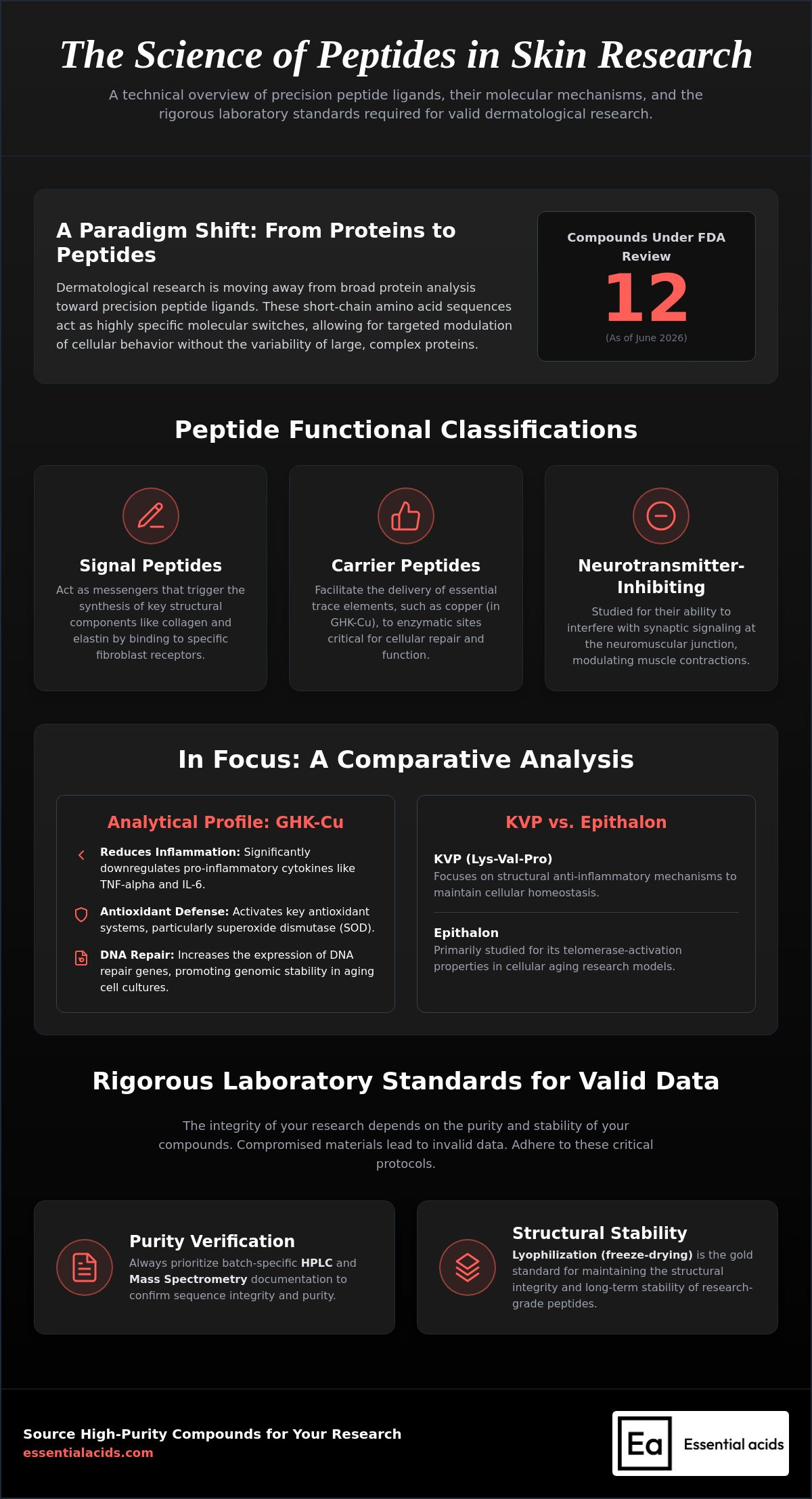
In dermatological research, peptides are categorized by their primary functional mechanism. Signal peptides act as messengers that trigger the synthesis of structural components. Carrier peptides, such as the Copper peptide GHK-Cu, facilitate the delivery of essential trace elements to enzymatic sites. Neurotransmitter-inhibiting peptides are studied for their ability to interfere with synaptic signaling at the neuromuscular junction. Each of these classes serves a specific role in modulating the ECM, which is the structural scaffold of the skin. This modulation is vital for understanding how cellular integrity is preserved against environmental and metabolic stressors.
Peptides vs. Proteins in Analytical Assays
The use of shorter peptide chains offers distinct advantages in terms of molecular weight and bioavailability. Smaller sequences are more easily synthesized and characterized than complex, high-molecular-weight proteins. Precision is a hallmark of synthetic peptides. They allow for exact sequence control, which reduces the variability often found in isolated natural proteins. Laboratory standards require the use of high-purity compounds to ensure that results are not skewed by contaminants or structural degradation. When researchers buy research peptides australia, the focus must remain on analytical documentation such as HPLC and Mass Spectrometry to confirm the sequence integrity of these short-chain molecules. This level of verification is essential for reproducible results in high-stakes laboratory models.
Targeting Fibroblast Activity and Collagen Synthesis
The molecular signaling pathways of peptides for skin research often involve the upregulation of mRNA expression for Type I and Type III collagen. This process is initiated when peptide ligands bind to specific receptor sites on fibroblasts, the primary cells responsible for ECM synthesis. Synthetic peptides can stimulate fibroblast proliferation through pathways like TGF-beta signaling, leading to increased structural protein density. Beyond collagen, these molecules are critical for inducing elastin production, a key metric in cellular aging studies. The ability to precisely trigger these biochemical pathways allows for the detailed study of tissue regeneration and the maintenance of structural integrity at the cellular level.
Analytical Profile: GHK-Cu and Copper-Peptide Complexes
GHK-Cu is a naturally occurring tripeptide, specifically Glycyl-L-Histidyl-L-Lysine, characterized by its high affinity for divalent copper ions. This tripeptide-copper complex is a cornerstone in peptides for skin research because it functions as a potent signaling molecule within the extracellular matrix. Its primary molecular mechanism involves the significant downregulation of pro-inflammatory cytokines, notably TNF-alpha and IL-6. By suppressing these inflammatory markers, GHK-Cu helps maintain cellular homeostasis in laboratory models. It also activates antioxidant defense systems, particularly superoxide dismutase (SOD), which neutralizes reactive oxygen species that typically degrade structural proteins.
The biological utility of GHK-Cu extends to DNA repair mechanisms. It has been observed to increase the expression of DNA repair genes, which is critical for maintaining genomic stability in aging cell cultures. A clinical review of peptides for skin aging highlights the systemic impact of these ligands on tissue regeneration across various administration routes. For investigators focused on high-integrity data, a technical assessment of procurement standards is available in our guide on where to buy ghk-cu.
GHK-Cu and Gene Expression Regulation
Data from comparative genomic studies suggest that GHK-Cu can reset the expression of over 4,000 human genes to a more youthful state. This genomic reset is partly achieved through its interaction with the ubiquitin-proteasome system, which is responsible for the degradation of misfolded or damaged proteins. In in vitro wound healing models, this regulation leads to enhanced keratinocyte proliferation and more efficient fibroblast recruitment. This ensures that the structural integrity of the tissue model is preserved during experimental stress, reflecting the brand's focus on making better, normal, through scientific integrity.
Carrier Peptide Mechanisms in Metal Ion Transport
GHK-Cu serves as a specialized carrier peptide, stabilizing copper ions and facilitating their transport into the intracellular environment. This delivery mechanism is essential for the activation of lysyl oxidase, a copper-dependent enzyme that catalyzes the cross-linking of collagen and elastin. Without sufficient copper delivery, the mechanical strength of the extracellular matrix is compromised. The chemical stability of these copper-peptide complexes in aqueous solutions is vital for consistent experimental outcomes in peptides for skin research. Researchers requiring reliable data should utilize batch-verified materials to ensure enzymatic pathways are correctly stimulated.
Comparative Analysis: KVP vs. Epithalon in Aging Research
While the previous sections analyzed the role of carrier peptides like GHK-Cu, specialized research protocols often require ligands with more targeted molecular signatures. KVP (Lysine-Proline-Valine) and Epithalon represent two distinct avenues within peptides for skin research. KVP is a tripeptide that primarily addresses the inflammatory microenvironment, while Epithalon is a tetrapeptide focused on the genomic regulation of cellular longevity. Understanding the contrast between these two molecules is essential for researchers designing multi-phasic aging models. One targets the structural degradation caused by chronic inflammation; the other targets the biological clock of the cell itself.
The synergistic potential of utilizing these distinct peptide ligands shouldn't be overlooked. In complex dermatological research, combining anti-inflammatory signaling with telomerase induction allows for a more comprehensive observation of cellular behavior. This dual-action approach provides data on how reducing immediate biochemical stress impacts long-term genomic stability. Such protocols are vital for maintaining scientific integrity when modeling the transition from pathological states to baseline cellular health. For investigators specifically interested in the telomerase-activation pathway, our epithalon research profile provides a detailed technical guide on molecular aging studies.
KVP: Modulating the Inflammatory Response
KVP functions as a potent anti-inflammatory tripeptide by inhibiting alpha-melanocyte-stimulating hormone (alpha-MSH) signaling. This pathway is a primary driver of the inflammatory response in dermal tissues. By antagonizing these signals, KVP effectively reduces the production of pro-inflammatory mediators in skin cell cultures. This capacity makes KVP an ideal candidate for research targeting chronic dermatological inflammation. Unlike broader immunosuppressants, KVP offers a localized, peptide-based mechanism to study how inflammatory suppression preserves the integrity of the extracellular matrix in laboratory models.
Epithalon: Telomerase Activation and Cellular Longevity
Epithalon operates through a fundamentally different mechanism by inducing the expression of telomerase. This enzyme is responsible for maintaining telomere length, which naturally shortens during each cell division cycle. Research has shown that Epithalon can facilitate telomere lengthening, effectively extending the Hayflick limit in human fibroblasts. This extension delays the onset of cellular senescence, the state where cells stop dividing but remain metabolically active and pro-inflammatory. By modulating the pathways involved in programmed cell death and senescence, Epithalon provides a unique tool for investigating the fundamental limits of cellular life cycles in peptides for skin research.
Laboratory Standards for Skin Peptide Stability and Handling
Establishing strict laboratory standards is mandatory for any investigator utilizing peptides for skin research. The validity of experimental data relies on the assumption that the peptide sequence remains intact and active throughout the study. High-purity compounds must be accompanied by batch-specific HPLC and Mass Spectrometry documentation to verify this integrity. Lyophilization, or freeze-drying, is the preferred stabilization method. This process removes water through sublimation, which prevents the hydrolysis and oxidation that typically degrade peptide bonds in aqueous environments. Maintaining the solid state until the point of use is the most effective way to preserve the structural integrity of complex ligands.
Temperature and pH levels are critical variables in the stability of dermatological peptides. For example, GHK-Cu requires a controlled environment; improper pH can lead to the dissociation of the copper ion from the tripeptide carrier, rendering the complex biologically inert in cellular models. Adhering to "research-use only" protocols ensures that laboratory procedures remain compliant with established safety and transparency standards. These rigorous steps are fundamental to maintaining scientific integrity and achieving reproducible results in cellular ageing models. For researchers seeking verified materials, you can procure analytical-grade compounds that meet these specific documentation requirements.
Reconstitution and Aliquoting Protocols
Reconstitution must be performed with precision to avoid mechanical stress on the molecular chains. Lyophilized peptides should be dissolved in bacteriostatic water or sterile saline, depending on the requirements of the specific research model. Once reconstituted, the solution is highly susceptible to degradation. Aliquoting the solution into single-use vials is necessary to avoid the freeze-thaw cycles that break peptide bonds and lead to sample heterogeneity. Peptide stability is the maintenance of the primary amino acid sequence under storage conditions. Solutions should be stored at temperatures between -20°C and -80°C to minimize kinetic energy and enzymatic activity.
Verifying Analytical Purity
Interpreting an HPLC chromatogram is a core competency for research validation. The primary peak represents the target peptide, and its area relative to any secondary peaks determines the purity percentage, which should ideally exceed 98% for peptides for skin research. Mass spectrometry complements this by confirming the molecular weight of the compound, ensuring the sequence hasn't been substituted or altered during synthesis. Certificates of analysis provide the necessary transparency for high-integrity research. These documents act as the final gatekeeper for quality assurance, reflecting the brand's commitment to making better, normal, through disciplined laboratory oversight and the rejection of ambiguous research materials.
Procuring High-Purity Compounds for Skin-Related Research
Modern dermatological research has transitioned from observational study to the manipulation of specific molecular pathways. The use of precision peptides for skin research allows for the targeted modulation of the extracellular matrix and cellular senescence. As established in the preceding sections, the success of these protocols depends on the chemical stability and analytical purity of the ligands used. Researchers must prioritize suppliers that provide comprehensive, batch-specific documentation to ensure that the primary amino acid sequence is verified and free from contaminants. It's a fundamental requirement for maintaining the reproducibility of your data.
A strict adherence to "research-use only" protocols is necessary to ensure compliance with laboratory standards. These analytical compounds are intended for in vitro and in vivo research models and are not for human consumption. By maintaining a professional distance from consumer trends, the focus remains on the gravity of laboratory investigation. This disciplined approach ensures that the quality of the compounds speaks for itself, reflecting a commitment to scientific integrity and the objective of making better, normal.
Essential Acids: A Partner in Scientific Integrity
Essential Acids operates with a commitment to providing materials that meet rigorous laboratory standards. Every compound in the inventory is subject to batch-specific verification to ensure it meets the required analytical profile. Beyond dermatological applications, the catalog includes ligands like pt 141 for broader physiological research. Providing high-purity materials is our primary contribution to the scientific community. Researchers can access a full catalog of verified peptides, each accompanied by the documentation necessary for high-integrity research protocols.
Future Directions in Peptide Research
The landscape of peptides for skin research is evolving with the integration of computational biology. As of 2026, AI's role in predicting peptide-receptor binding affinities has become a standard component of pre-analytical modeling. This technology allows researchers to simulate molecular interactions before commencing in vitro studies, which significantly increases the efficiency of experimental design. There is also a noticeable shift toward the study of multi-functional peptide hybrids. These hybrids are designed to target several metabolic pathways simultaneously, providing a more holistic view of cellular behaviour. This evolution suggests that the next generation of research will focus on the complex interplay between multiple signaling molecules.
Establishing a reliable source for analytical materials is the final step in any rigorous research protocol. Precision and transparency remain the core values of our operation. Explore our high-purity research catalog at Essential Acids to secure verified compounds for your 2026 laboratory protocols.
Advancing Analytical Integrity in Dermatological Research
The transition toward precision molecular signaling marks a fundamental advancement in dermatological investigation. Successful peptides for skin research require more than just the correct amino acid sequence; they demand a rigorous commitment to structural stability and verified chemical purity. As established throughout this overview, the differentiation between specialized ligands like KVP and telomerase activators is only as reliable as the analytical documentation supporting the compound. Batch-specific verification via HPLC and Mass Spectrometry remains the mandatory standard for ensuring that experimental outcomes aren't compromised by chemical degradation or sequence heterogeneity.
Achieving reproducible results in high-stakes cellular ageing models depends on a secure, professional laboratory procurement process. We provide analytical materials that meet 99%+ purity standards, accompanied by comprehensive batch-specific HPLC and MS reports to maintain your scientific integrity. Access Batch-Verified Research Peptides at Essential Acids to ensure your 2026 protocols are built on a foundation of analytical transparency. We remain a dedicated partner in the pursuit of making better, normal, through disciplined laboratory oversight and a firm adherence to research standards.
Frequently Asked Questions
What are the most common peptides used in skin research today?
Commonly utilized ligands include GHK-Cu, KVP, and Epithalon, alongside structural modulators like BPC-157. These compounds are selected for their specific molecular signaling pathways within the extracellular matrix. Research focuses on their ability to regulate fibroblast activity and structural protein synthesis. All such materials are strictly for research-use only to maintain analytical integrity in laboratory settings.
How do signal peptides differ from carrier peptides in laboratory models?
Signal peptides function as biochemical messengers that trigger specific cellular responses, whereas carrier peptides facilitate the transport of metal ions or micronutrients. Signal peptides often target receptors to upregulate collagen mRNA expression. Carrier peptides, like GHK-Cu, stabilize ions such as copper to activate enzymatic pathways. Differentiating these mechanisms is essential for accurate experimental design in peptides for skin research.
Is GHK-Cu stable for long-term storage in liquid form?
GHK-Cu is not stable for long-term storage once it is reconstituted in liquid form. Aqueous environments promote hydrolysis and oxidation, which degrade the tripeptide-copper complex over time. Stability is best maintained in a lyophilized state until the point of reconstitution. For long-term preservation, the solid-state compound should be kept at temperatures between -20°C and -80°C.
Why is HPLC testing critical for peptides used in skin research?
High-Performance Liquid Chromatography (HPLC) is critical for verifying the purity and sequence identity of synthetic peptides. It ensures that the compound matches the intended primary amino acid sequence and is free from synthesis byproducts. Without batch-specific HPLC reports, the risk of sample heterogeneity increases, which can compromise the reproducibility of laboratory data. Scientific integrity relies on these verified analytical standards.
Can these peptides be used in human clinical trials?
No, these compounds are not intended for human clinical trials or any form of human consumption. Essential Acids provides high-purity materials strictly for laboratory research and analytical use. Use in clinical settings is prohibited by our research-only policy. This boundary is maintained to ensure regulatory compliance and prioritize the precision of laboratory investigations over commercial applications.
What is the role of telomerase activation in dermatological research?
Telomerase activation is studied to understand the mechanisms of cellular longevity and the delay of the Hayflick limit in dermal cells. By inducing telomerase expression, researchers can observe the lengthening of telomeres in fibroblasts, which prevents the onset of cellular senescence. This research provides insights into how genomic stability is maintained over multiple cell division cycles in vitro.
How should lyophilized peptides be stored for maximum stability?
Lyophilized peptides should be stored in a climate-controlled environment at -20°C or lower to ensure maximum stability. Protection from light and moisture is also required to prevent structural degradation. Once a vial is reconstituted, aliquoting the solution into single-use containers is necessary to avoid freeze-thaw cycles. These procedures are fundamental to preserving the integrity of peptides for skin research.
What are the molecular targets of KVP in anti-inflammatory studies?
KVP targets the alpha-melanocyte-stimulating hormone (alpha-MSH) signaling pathway to modulate the inflammatory microenvironment. By inhibiting these specific signals, the tripeptide reduces the production of pro-inflammatory cytokines such as TNF-alpha. This targeting is used in studies focused on chronic inflammation and the preservation of the extracellular matrix scaffold under biochemical stress.
Legal Disclaimer
All products sold on this website are intended exclusively for laboratory research purposes and not for human or veterinary use, diagnosis, cure, treatment, or prevention of any disease or condition. None of the statements on this site have been reviewed or evaluated by the U.S. Food and Drug Administration (FDA) or comparable regulatory authorities. Purchasing or using these products for any unintended purpose, including human consumption, may violate federal or local laws and poses safety risks.