

The common conflation of exogenous somatotropin with growth hormone secretagogues represents a fundamental misunderstanding of endocrine signaling pathways in modern biochemistry. While the broader scientific community recognizes the physiological potential of these compounds, researchers often struggle with the ambiguity between direct hormone replacement and the nuanced stimulation of endogenous pathways. It's a persistent challenge to find reliable, comparative data that distinguishes between the various classes of hgh peptides without encountering the hyperbole of the consumer market.
This technical overview provides a disciplined analysis of growth hormone secretagogues, focusing on their specific molecular mechanisms and applications in contemporary biochemical research. You'll gain a clear understanding of the functional differences between GHRH and GHRP analogs, such as Ipamorelin and CJC-1295. We provide a technical roundup of available research compounds and address the strict regulatory requirements for laboratory procurement. Our focus remains on scientific integrity, ensuring that the transition from broad biological categories to specific product data supports the rigorous demands of your laboratory environment as we work toward making better, normal.
Key Takeaways
- Distinguish between exogenous Human Growth Hormone and synthetic secretagogues to establish a precise foundation for endocrine research.
- Analyze the unique signaling mechanisms of GHRH and GHRP analogs to predict their specific impact on somatotropic pathways.
- Review the molecular characteristics of prominent hgh peptides, including Ipamorelin and CJC-1295, within contemporary biochemical models.
- Optimize experimental design by comparing receptor specificity and half-life durations for pulsatile versus sustained release simulations.
- Verify the authenticity of laboratory reagents through rigorous batch-specific HPLC/MS analytical documentation to ensure scientific integrity.
Defining HGH Peptides in a Research Context
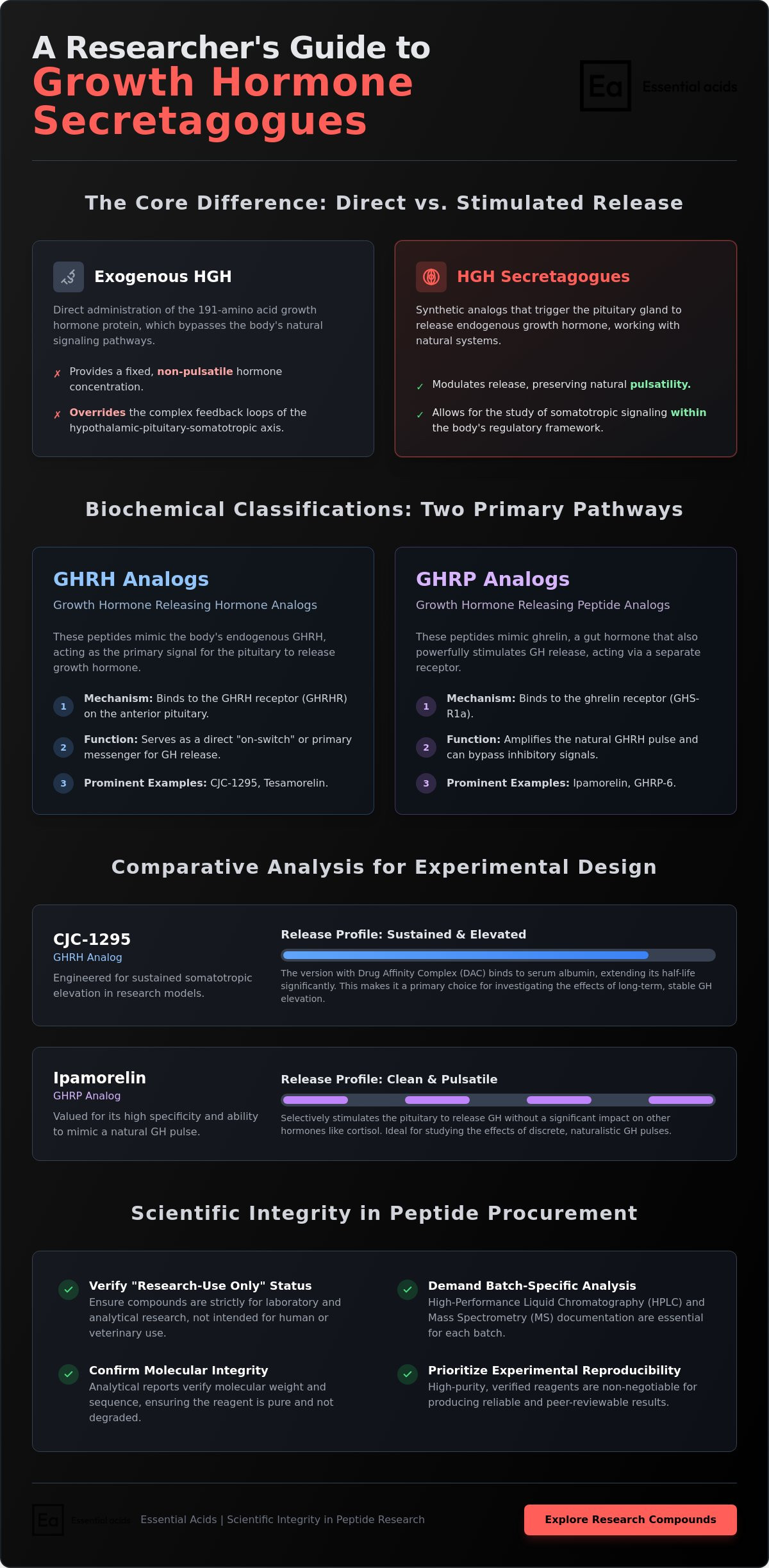
HGH peptides are synthetic analogs designed to trigger the release of growth hormone from the anterior pituitary gland. Unlike exogenous Human Growth Hormone (HGH), which involves the direct administration of the 191-amino acid protein, these Growth hormone secretagogues (GHSs) act as ligands for specific receptors within the endocrine system. This distinction is critical for experimental design. While exogenous HGH provides a fixed, non-pulsatile concentration of the hormone, hgh peptides utilize the body's natural regulatory mechanisms to modulate endogenous release. This allows researchers to study somatotropic signaling without overriding the complex feedback loops of the hypothalamic-pituitary-somatotropic axis.
The use of these compounds is strictly limited to laboratory and analytical research. They aren't intended for human or veterinary diagnostic or therapeutic use. Scientific integrity requires a rigorous separation between medical applications and the controlled environment of biochemical investigation. Researchers utilize these peptides to observe cellular signaling, metabolic shifts, and the downstream activation of insulin-like growth factor 1 (IGF-1) in various research models. By focusing on the stimulation of the pituitary, scientists can investigate the nuances of growth hormone production in a way that direct hormone replacement cannot replicate.
The Mechanism of Somatotropic Signalling
In metabolic research, the GHRH-GH-IGF-1 axis serves as the primary pathway for examining growth and cellular repair. GHS compounds function by either mimicking endogenous Growth Hormone-Releasing Hormone (GHRH) or by activating the ghrelin receptor, often referred to as the Growth Hormone Secretagogue Receptor (GHS-R). This activation bypasses traditional inhibitory signals like somatostatin, allowing researchers to investigate cellular responses without the confounding variables of direct hormone application. The focus remains on how these ligands influence metabolic pathways and cellular ageing at a molecular level within specialized research environments.
Research vs. Medical Applications
The regulatory landscape for peptides underwent significant shifts in early 2026. While certain compounds were reclassified for compounding use under physician supervision, the "research-use only" classification remains a vital category for scientific discovery. For laboratory validation, high-purity compounds are non-negotiable. Peer-reviewed research demands batch-specific analytical documentation, such as High-Performance Liquid Chromatography (HPLC) and Mass Spectrometry (MS). These reports verify the molecular weight and sequence integrity, ensuring that experimental results are reproducible and free from the interference of contaminants or degraded amino acid chains. It's the precision of these reagents that defines the quality of modern endocrine research.
Biochemical Classifications: GHRH vs. GHRP Analogs
Within the categorization of hgh peptides, two primary molecular classes emerge: Growth Hormone Releasing Hormone (GHRH) analogs and Growth Hormone Releasing Peptides (GHRP). These classes operate through distinct biochemical pathways to facilitate somatotropic signaling. GHRH analogs function as primary messengers that bind to the GHRH receptor (GHRHR) on the anterior pituitary. In contrast, GHRPs utilize the ghrelin receptor pathway, specifically targeting the Growth Hormone Secretagogue Receptor (GHS-R1a). For researchers, selecting between these classes requires a precise understanding of receptor affinity and metabolic half-life to ensure the integrity of the experimental model. The choice between a GHRH or a GHRP often depends on whether the study aims to mimic natural pulsatile release or achieve a steady state of hormone elevation.
GHRH Analogs: CJC-1295 and Tesamorelin
CJC-1295 is a synthetic 29-amino acid peptide that mimics endogenous GHRH. Its research utility is often defined by the presence or absence of the Drug Affinity Complex (DAC). While CJC-1295 No DAC provides a transient, pulsatile stimulation, the version with DAC binds to serum albumin to significantly extend the half-life. This makes it a primary choice for investigating sustained somatotropic elevation. Tesamorelin, another modified GHRH analog, is frequently utilized in research focused on lipodystrophy and metabolic regulation. These FDA-Approved Peptide Analogues provide a template for understanding how subtle molecular modifications can alter the pharmacokinetic profile of a compound in a laboratory setting.
GHRP Analogs: Ipamorelin and MK-677
GHRP analogs, as a subclass of hgh peptides, represent a more diverse group of secretagogues. Ipamorelin is recognized for its high selectivity in laboratory research. Unlike earlier generations of GHRPs, Ipamorelin doesn't significantly stimulate the release of cortisol or prolactin, allowing for a more isolated study of the growth hormone pathway. Conversely, MK-677 (Ibutamoren) is a non-peptide, orally active agonist of the ghrelin receptor. While it shares the same target receptor as Ipamorelin, its non-peptide structure and metabolic stability offer a different research perspective on long-term GH stimulation. Researchers must weigh the selective affinity of Ipamorelin against the potency and duration of non-peptide agonists when designing metabolic studies.
When sourcing these compounds, ensuring the highest analytical standards is paramount for reproducible data. You can find batch-verified reagents at Essential Acids to support your project's technical requirements.
A 2026 Roundup of Leading HGH Peptides in Molecular Research
The selection of hgh peptides for laboratory use has expanded to include specialized fragments and highly selective agonists that offer distinct pharmacokinetic profiles. Researchers in 2026 prioritize compounds that allow for the isolation of specific metabolic variables. Sermorelin Acetate remains a foundational tool; as the 1-29 amino acid fragment of endogenous GHRH, it's frequently utilized to assess pituitary response without the extended half-life of modified analogs. In contrast, Tesamorelin is characterized by an added hexenoyl group that enhances its resistance to enzymatic degradation, making it a primary candidate for studies focused on visceral adipose tissue and metabolic regulation in complex models.
AOD-9604 represents a divergence from traditional secretagogues. Instead of stimulating the pituitary, this C-terminal fragment (Tyr-hGH 177-191) mimics the lipolytic action of the full growth hormone molecule without inducing the systemic growth effects or IGF-1 elevations associated with the parent protein. This isolation of function is critical for lipid metabolism research where the anabolic properties of HGH would act as a confounding variable. Each of these tools requires rigorous analytical verification to ensure that the molecular sequence matches the research objective.
Ipamorelin and CJC-1295 Synergy Models
Experimental designs often investigate the "dual-signal" approach by combining CJC-1295 and Ipamorelin. This synergy model is based on the physiological reality that GHRH and ghrelin-receptor agonists act through different intracellular pathways to stimulate the pituitary. While CJC-1295 provides a steady GHRH signal, Ipamorelin triggers a selective, pulsatile release of growth hormone. This combined application allows researchers to study the maximal secretory capacity of the somatotropic axis while maintaining a high degree of selectivity, as Ipamorelin doesn't significantly impact prolactin or ACTH levels.
Specialised Fragments and Non-Peptide Agonists
The roundup of hgh peptides isn't complete without considering non-peptide options like MK-677 (Ibutamoren). As a potent, long-acting agonist of the ghrelin receptor, MK-677 offers a non-invasive route for investigating sustained GH elevation in longitudinal research. Additionally, compounds like Thymalin are being examined for their secondary roles in endocrine models. While primarily a bioregulator of the thymus, Thymalin's interaction with the hypothalamic-pituitary axis provides a broader context for research into cellular ageing and systemic homeostasis. Maintaining scientific integrity in these studies depends entirely on the use of research-use only materials that meet strict high-purity standards.
Comparative Analysis for Experimental Design
Selecting the appropriate hgh peptides for a laboratory model requires a rigorous assessment of the desired secretory pattern. For studies simulating natural physiological rhythms, short-acting secretagogues like Sermorelin or Ipamorelin are utilized to produce discrete, pulsatile bursts of growth hormone. Conversely, researchers investigating the effects of chronic somatotropic elevation often select analogs with extended half-lives, such as CJC-1295 With DAC. This decision-making process is foundational to experimental design, as the pharmacokinetic profile directly influences downstream IGF-1 levels and metabolic outcomes. The duration of the GH pulse must be aligned with the specific cellular response being measured.
Receptor Specificity and Side-Effect Profiles
Receptor specificity remains a primary differentiator among hgh peptides. Ipamorelin is frequently preferred in endocrine research due to its unique selectivity for the GHS-R1a receptor. Unlike non-selective agonists like GHRP-2 and GHRP-6, Ipamorelin doesn't elicit significant increases in cortisol or prolactin secretion. This allows for a cleaner, isolated study of the GH axis without the confounding variables of secondary hormonal shifts. In multi-pathway research, scientists often examine these secretagogues alongside compounds like BPC 157 5mg to investigate the interplay between systemic growth hormone signaling and localized tissue repair mechanisms. The choice between selective and non-selective agonists depends on whether the research model requires a pure GH stimulus or a broader metabolic response that includes ghrelin-mediated effects on appetite and pituitary signaling.
Stability and Analytical Integrity
The integrity of laboratory results depends entirely on the stability of the lyophilised peptide. Peptides are highly susceptible to enzymatic degradation and thermal instability. Therefore, maintaining a cold chain at -20°C for long-term storage is standard protocol to preserve the peptide's structural integrity. Once reconstituted, the compounds become significantly more fragile and are prone to degradation if agitated or exposed to light. Reconstitution protocols dictate the use of Bacteriostatic Water to inhibit bacterial growth and maintain a stable pH environment for the duration of the experiment. This is particularly important for multi-dose research vials where sterility must be maintained over several days.
Researchers must interpret batch-specific HPLC reports to confirm purity levels, typically requiring a threshold of 98% or higher for peer-reviewed validation. Analytical documentation serves as the final gatekeeper of scientific integrity. A mass spectrometry report should verify the exact molecular weight, ensuring that the synthesized sequence matches the theoretical structure of the peptide. Without this verification, the risk of cross-contamination or amino acid substitutions remains high, potentially compromising the data. To ensure your laboratory documentation meets these rigorous analytical standards, you can source verified hgh peptides from Essential Acids.
Scientific Integrity in Peptide Procurement
The procurement of hgh peptides for laboratory use isn't a mere logistical transaction; it's a critical phase of experimental validation. Scientific integrity requires that every compound introduced into a controlled environment be accompanied by batch-specific analytical documentation. High-Performance Liquid Chromatography (HPLC) and Mass Spectrometry (MS) serve as the primary tools for verifying that the molecular sequence and purity levels align with the theoretical structure. Without these reports, researchers risk introducing unknown contaminants that can skew metabolic data or compromise cellular models. Differentiating between high-purity laboratory reagents and lower-grade consumer products is essential for maintaining the rigor of peer-reviewed research.
In the Australian regulatory landscape of 2026, institutions must adhere to strict compliance frameworks for the acquisition of synthetic secretagogues. These regulations ensure that research materials are handled with the necessary oversight, preventing the diversion of analytical compounds into unregulated channels. Procurement must be handled through established entities that prioritize transparency and regulatory adherence. This disciplined approach to sourcing ensures that the transition from broad biological hypotheses to specific experimental data remains untainted by material inconsistency.
Quality Assurance Standards for 2026
By 2026, the industry has transitioned toward mandatory mass spectrometry for all research-grade batches. This shift ensures that the molecular identity of every peptide is verified beyond simple purity percentages. While a purity level of 98% or higher is the standard for data reproducibility, the identification of the remaining 2% is equally important for metabolic studies. Transparency in reporting these findings builds a foundation of trust within the scientific community. It's the precision of these analytical standards that allows for the successful replication of complex endocrine signaling models across different laboratory environments.
Procuring Research Materials Nationally
For Australian laboratories, the streamlined acquisition of high-purity peptides is vital for staying at the forefront of neuroscientific and metabolic research. Essential Acids acts as a dedicated partner in this process, providing the scientific community with reagents that meet rigorous analytical criteria. Our commitment to "Making better, normal" is reflected in our disciplined focus on quality assurance and regulatory transparency. Every compound, from Ipamorelin to CJC-1295, is provided under a strict research-use only policy. This boundary-setting is fundamental to our operation, ensuring that our materials support the visionary potential of laboratory discovery while maintaining a formal, detached perspective on human application. We prioritize the precision of the laboratory over the trends of the marketplace, serving as a reliable gatekeeper for high-integrity research reagents.
Advancing Endocrine Research with Molecular Precision
The progression of somatotropic research in 2026 requires a disciplined approach to molecular selection. Understanding the functional distinctions between GHRH and GHRP pathways is essential for developing accurate endocrine models. Whether a study necessitates the selective, pulsatile release of Ipamorelin or the sustained signaling of CJC-1295, the validity of the results rests on the precision of the underlying reagents. The careful selection of hgh peptides enables researchers to isolate metabolic variables with a level of control that direct hormone application cannot provide.
Essential Acids serves as a reliable partner for Australian laboratories, offering national distribution of high-purity reagents for analytical research. Every compound is verified through batch-specific HPLC and Mass Spectrometry documentation to ensure sequence integrity and data reproducibility. We remain committed to the rigorous standards of the scientific community, providing materials that are strictly for research-use only. View our catalog of high-purity research peptides for laboratory use to support your next phase of discovery as we work toward making better, normal.
Frequently Asked Questions
What is the primary difference between HGH and HGH peptides in research?
The primary difference lies in the mechanism of action. Human Growth Hormone is the exogenous administration of the 191-amino acid protein; hgh peptides are secretagogues that stimulate the anterior pituitary to release endogenous growth hormone. This allows researchers to investigate physiological pathways without overriding the hypothalamic-pituitary-somatotropic axis. This distinction is critical for studies that require the preservation of natural feedback loops.
Can HGH peptides be used for human or veterinary diagnosis?
No; these compounds are strictly for laboratory and analytical research only. They are not intended for human or veterinary diagnosis, treatment, or therapy. Essential Acids maintains a professional distance from clinical applications, ensuring that all materials are handled within the rigorous, protective language of our research-only policy. Adherence to these boundaries is a core component of scientific integrity and regulatory compliance.
Which HGH peptide has the highest selectivity for the pituitary gland?
Ipamorelin is recognized as the most selective secretagogue for pituitary stimulation in contemporary research. It targets the growth hormone secretagogue receptor (GHS-R1a) without eliciting significant elevations in secondary hormones such as cortisol or prolactin. This isolation of the growth hormone pathway is critical for clean data collection, as it prevents confounding variables from affecting metabolic or endocrine research outcomes.
How should research peptides be stored to maintain molecular stability?
Lyophilized peptide powders should be stored at -20°C for long-term molecular stability. Once reconstituted with Bacteriostatic Water, the solution must be kept refrigerated at 2-8°C and protected from light. Physical agitation must be minimized to prevent the degradation of delicate peptide bonds. Maintaining a stable cold chain is non-negotiable for ensuring the analytical integrity of the compound during the experimental period.
What is the significance of the DAC (Drug Affinity Complex) in CJC-1295?
The Drug Affinity Complex (DAC) is a chemical modification that allows the peptide to bind to serum albumin. This significantly extends the half-life of CJC-1295, shifting the pharmacokinetic profile from a short-acting pulsatile stimulus to a sustained elevation of growth hormone levels. Researchers select the DAC version when the study objectives require a long-acting formulation rather than the transient release provided by the No DAC variant.
Are HGH peptides legal for laboratory research in Australia?
Yes, hgh peptides are legal for procurement and use within Australian laboratory and research environments. Researchers must ensure that their acquisition and handling of these materials comply with institutional ethics committees and national regulatory standards. These compounds are strictly classified for research-use only and are not for human consumption. Essential Acids provides national distribution to support high-integrity scientific discovery across the country.
What analytical reports should accompany a research peptide purchase?
Every research peptide purchase must be accompanied by batch-specific HPLC (High-Performance Liquid Chromatography) and Mass Spectrometry (MS) reports. These documents verify the purity percentage and molecular weight of the compound, ensuring the sequence matches the theoretical structure. High-integrity research requires a purity threshold of at least 98% for reproducible analytical results. This documentation is the final gatekeeper of quality assurance in the laboratory.
How does Ipamorelin differ from other GHRPs like GHRP-6?
Ipamorelin differs from GHRP-6 through its enhanced receptor selectivity. While GHRP-6 is known to stimulate the hunger-regulating ghrelin pathway and can lead to increased cortisol and prolactin levels, Ipamorelin provides a more isolated growth hormone stimulus. This makes Ipamorelin the preferred tool for studies requiring high specificity. It allows for the investigation of somatotropic signaling without the interference of secondary endocrine responses seen with earlier-generation GHRPs.
Legal Disclaimer
All products sold on this website are intended exclusively for laboratory research purposes and not for human or veterinary use, diagnosis, cure, treatment, or prevention of any disease or condition. None of the statements on this site have been reviewed or evaluated by the U.S. Food and Drug Administration (FDA) or comparable regulatory authorities. Purchasing or using these products for any unintended purpose, including human consumption, may violate federal or local laws and poses safety risks.